


The ceaseless thrum of the digital world, marked by vibrating pockets and illuminated screens, has cultivated a peculiar form of indifference. We scroll past stark inequalities and viral cat videos with equal emotional investment, often registering neither as truly salient. This generalized desensitization, initially observed in the burgeoning urban centers of the early 20th century, has found its modern apotheosis in the perpetual online experience.

The Psychic Economy of Overload: Simmel’s Blasé Reemerges
Georg Simmel, observing the nascent industrial metropolis of Berlin, identified a crucial psychological adaptation: the “blasé attitude.” In his seminal 1903 essay “The Metropolis and Mental Life,” Simmel argued that the sheer quantity and intensity of urban stimuli — the rapid succession of impressions, the clatter of commerce, the anonymity of crowds — forced the metropolitan individual to develop a protective psychological shell. He wrote: “The metropolitan type of man develops an organ for protecting himself against the threatening currents and discrepancies of his external environment which would uproot him.” This organ, the blasé attitude, manifested as a blunting of emotional responses and a pervasive sense of indifference to the distinctiveness of things. Value and meaning, under such conditions, were increasingly reduced to quantitative differences, epitomized by the universal solvent of money. Today, the digital metropolis subjects its inhabitants to an even more unrelenting torrent of information. Notifications, alerts, news feeds, and endless content streams replicate the urban sensory bombardment, compelling a similar, perhaps even more profound, psychic defense mechanism.
The Digital Deluge: Quantifying Perpetual Stimuli
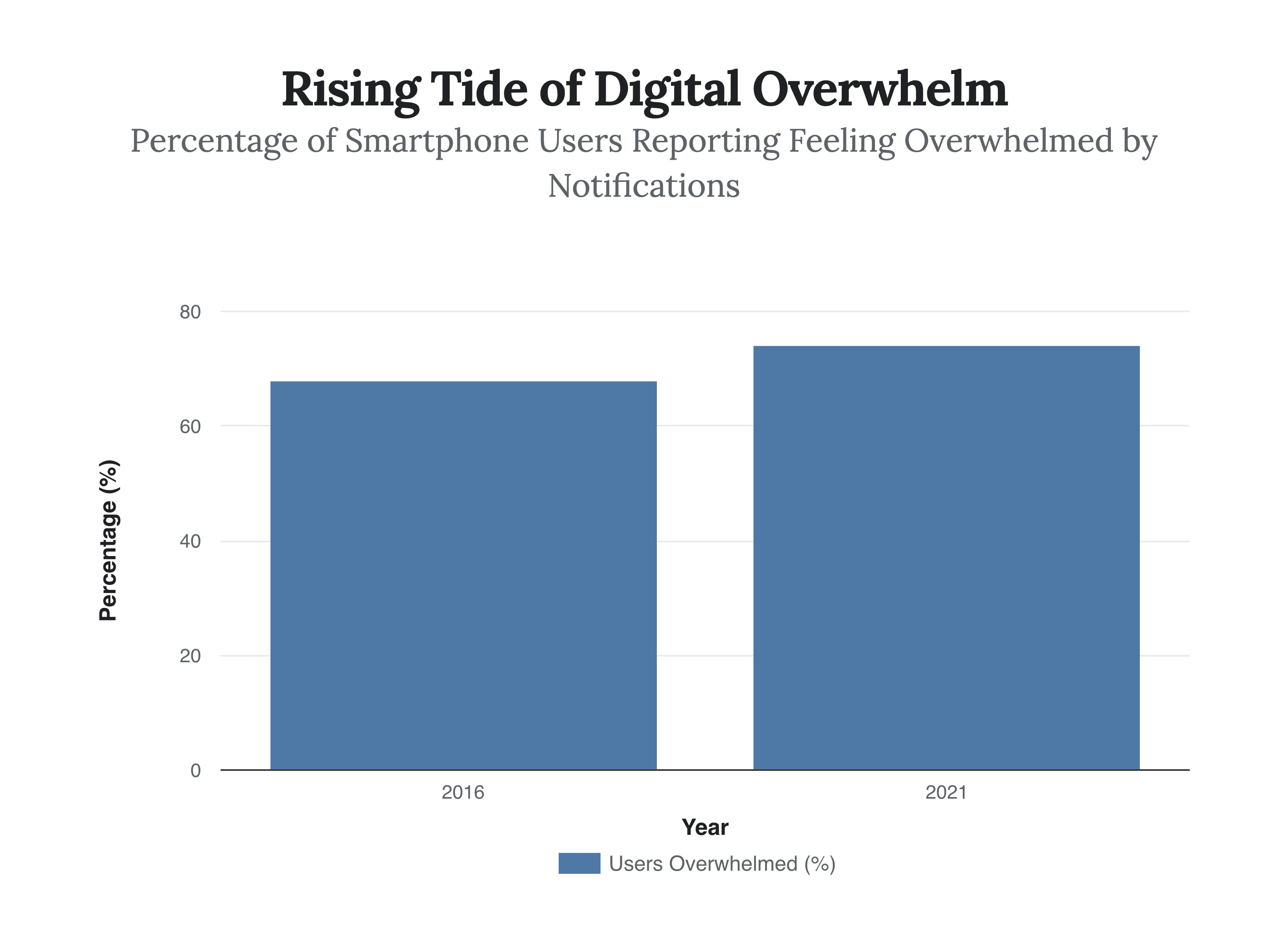
The contemporary digital experience is defined by an unprecedented volume of stimuli, far surpassing Simmel’s early 20th-century metropolis. Smartphone users, for example, are subjected to a constant barrage of alerts, ranging from essential communications to trivial updates. This relentless demand on cognitive resources inevitably triggers a coping mechanism. A 2021 study by Statista revealed that 74% of smartphone users in the United States report feeling overwhelmed by the sheer number of notifications they receive daily. This represents a notable increase from a similar Statista survey in 2016, which found 68% of users expressed such sentiments. The data suggests an escalating challenge to cognitive filtering, where the brain, perpetually exposed to novel but largely unimportant information, struggles to differentiate the signal from the noise, resulting in a widespread emotional flattening.
The Cost of Indifference: Erosion of Discrimination
The cultivation of a blasé attitude in the digital sphere carries profound consequences for individual and collective cognition. When all stimuli — a global crisis alert, a friend’s vacation photo, a targeted advertisement — are processed with a similar low-grade intensity, the capacity for nuanced discrimination diminishes. Simmel posited that the blasé attitude leads to a devaluation of the unique, reducing qualitative distinctions to mere quantitative gradations. In the digital realm, this manifests as “content shock,” where the abundance of information renders any single piece less impactful. The cognitive cost is not merely emotional distance; it is also a measurable drain on mental resources. A 2023 Statista survey revealed that 49% of U.S. workers admit to being distracted by their mobile devices during work hours, directly impacting productivity and focus. This constant task-switching and exposure to peripheral information fragment attention, preventing deep engagement and meaningful reflection. The cumulative effect is a society that, by design, becomes less capable of deep engagement and more prone to superficial processing, mirroring Simmel’s urbanite perpetually on guard against cognitive overload.If the digital metropolis inherently demands a blasé attitude for psychological survival, what then becomes of our capacity for genuine discernment, for profound connection, and for distinguishing what truly matters amidst the noise? How do we calibrate our inner filters when the world itself is engineered to overwhelm them?