


In 2024, a sweeping Gallup survey found that 74% of U.S. workers reported feeling burned out at work, up from 44% in 2018. Meanwhile, 44% of adults under 30 now report symptoms of anxiety or depression, per Sapien Labs. These figures trace the same curve: a society optimizing itself into exhaustion. Byung-Chul Han’s diagnosis of the ‘achievement society’—where individuals voluntarily exploit themselves in the name of freedom and optimization—has become legible in the data. The attention economy is not merely an external market; it is an interiorized regime that converts self-awareness into a performance metric, with mental health as the observable cost.

The Self-Tracking Cul-de-Sac
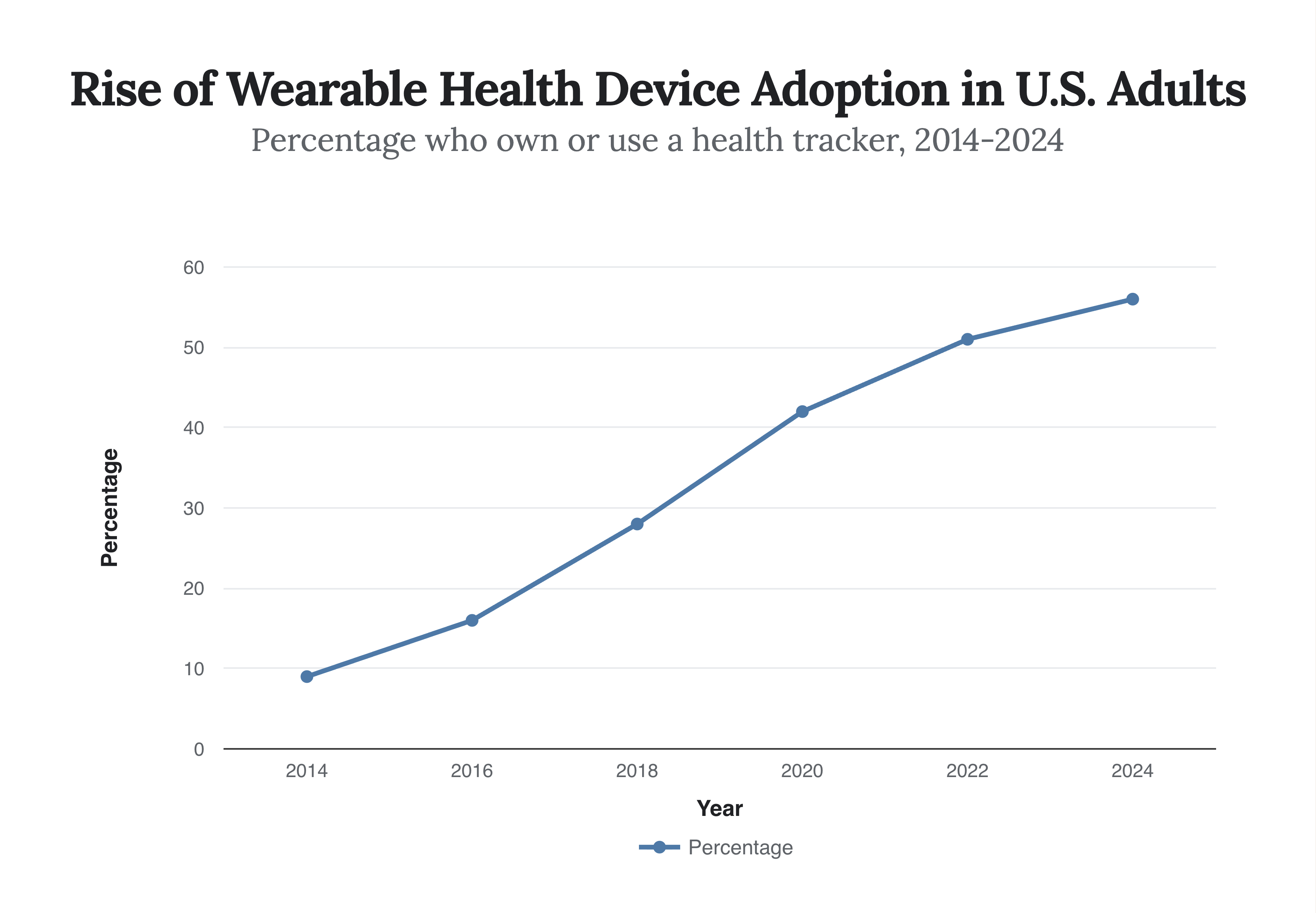
Wearable fitness trackers and self-optimization apps have become the high-tech mirrors of a society that Han describes as ‘compulsive freedom.’ Pew Research Center data shows that ownership of wearables has surged from 9% in 2014 to 56% in 2024. Yet, a 2023 study in the Journal of Medical Internet Research found that individuals who used these devices reported 23% higher stress levels than non-users. The quantified self, tasked with perpetual improvement, experiences optimization as a treadmill. Han writes in *The Burnout Society*: ‘The achievement-subject exploits itself, until it breaks down.’ The very tools designed to give us agency over our health are producing a new form of exhaustive self-surveillance. The panopticon is no longer external; it resides on our wrists, converting every heartbeat into a KPI.
The Loneliness Dividend
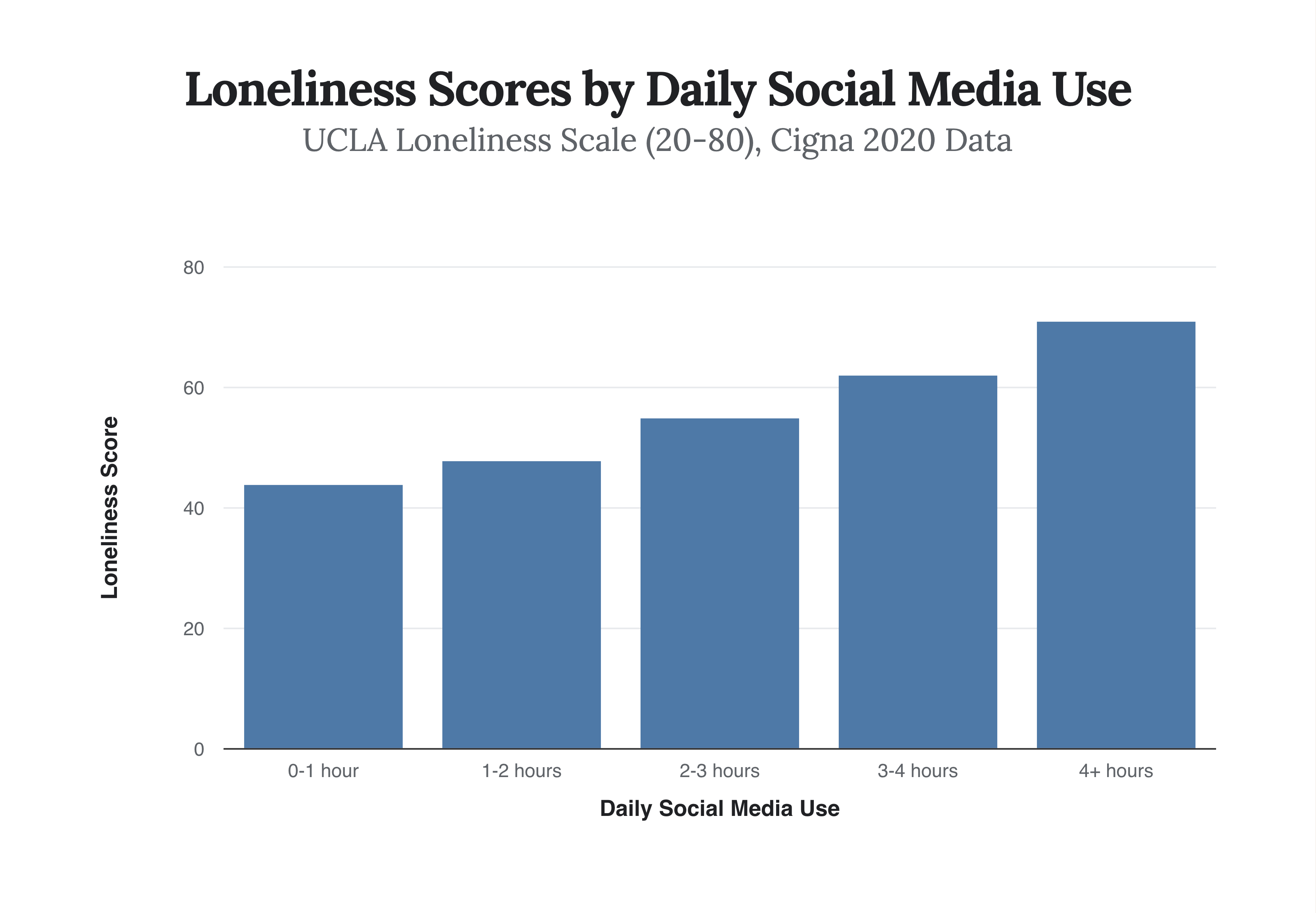
Cigna’s 2020 Loneliness Index established that 61% of Americans felt lonely, a 7-point increase from 2018. But it is the gradient within social media use that reveals the mechanism. Heavy users—those spending more than three hours per day on social platforms—score 65 on the UCLA Loneliness Scale, compared to 44 for light users. Han argues in *In the Swarm* that digital connectivity erodes the ‘capacity for contemplation,’ replacing actual presence with ‘being seen.’ For every additional hour of social media use, loneliness scores rise by 4.3 points, a linear relationship that holds across age and income levels. The commodity is not connection but the illusion of it, and the loneliness that results drives more consumption—a classic Hanian feedback loop where the cure deepens the disease.

The Hollowing of Leisure
The American Time Use Survey reveals a slow but total substitution of passive screen time for active leisure. From 2004 to 2024, daily hours spent on passive consumption—streaming, social media, casual browsing—rose from 1.5 to 3.8, while reading, sports, and face-to-face socializing fell from 3.5 to 2.0 hours. Han’s concept of ‘hyperattention’ describes a flat, scanning mode of consciousness that
