


The American consumer, the bedrock of the U.S. economy, is sounding a clear and urgent alarm. The preliminary November 2025 data from the University of Michigan’s Survey of Consumers reveals a sharp 6% month-over-month decline in overall sentiment, with the headline index falling to 50.3, perilously close to the all-time low of 50.0 recorded in June 2022. But the headline number, grim as it is, masks a more startling reality.
The index measuring consumers’ assessment of their *current* economic conditions plummeted by nearly 11% to a reading of 52.3—the lowest level in the survey’s 73-year history. This historic pessimism about the present, driven by a prolonged government shutdown and persistent economic anxieties, creates a complex and hazardous environment for businesses and investors. This briefing deconstructs the multifaceted drivers of this sentiment collapse, analyzes the growing divergence in economic realities among different consumer segments, and provides a forward-looking assessment of the strategic risks and opportunities that lie ahead.
The Shutdown Shock: Unpacking the Primary Catalyst
The immediate trigger for this precipitous drop in confidence is clear: the federal government shutdown, now dragging on for over a month. Unlike previous political standoffs that consumers largely brushed off, this extended disruption is now fueling widespread worry about tangible negative consequences for the national economy. The decline in sentiment is remarkably broad, cutting across age, income, and, notably, political affiliation, indicating a national loss of faith rather than a partisan grievance. According to Joanne Hsu, the director of the Surveys of Consumers, the ongoing stalemate has moved from a background political drama to a primary economic concern.
Deconstructing the November Nosedive
The anatomy of the November sentiment drop reveals specific areas of acute consumer distress. The overall index’s fall was led by a staggering 17% drop in how consumers view their current personal finances. This is a direct reflection of households feeling the squeeze. Simultaneously, expectations for business conditions over the coming year tumbled by 11%. This dual collapse in present security and future optimism paints a troubling picture of an increasingly defensive consumer mindset.
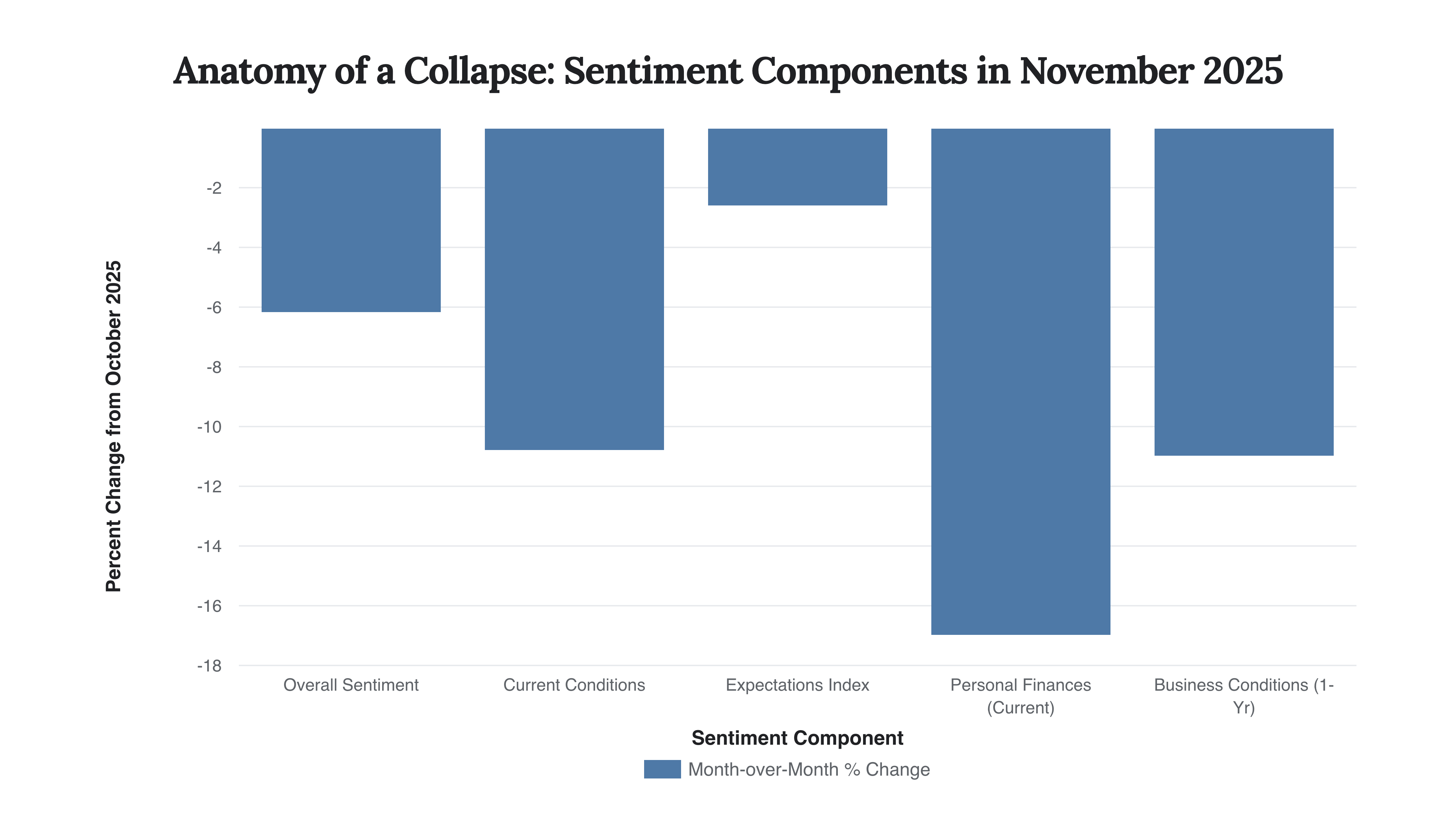
This chart illustrates the dramatic month-over-month percentage decline in the key components of the University of Michigan Consumer Sentiment Index for November 2025, highlighting the disproportionate collapse in assessments of current personal finances and economic conditions.
“With the federal government shutdown dragging on for over a month, consumers are now expressing worries about potential negative consequences for the economy.” - Joanne Hsu, Director, Surveys of Consumers
The shutdown’s impact is not just psychological. Hundreds of thousands of federal workers are either furloughed or working without pay, and cuts to benefits like food stamps are directly impacting lower-income households, creating real economic hardship that ripples through the broader economy.
A Tale of Two Consumers: The Great Disconnect
While the vast majority of the population is bracing for impact, a crucial exception emerges from the data, revealing a starkly bifurcated economic experience. Consumers with the largest tercile of stock holdings reported an 11% *increase* in sentiment. This segment, buoyed by the continued strength and record highs in the stock market, appears insulated from the anxieties gripping the rest of the country. This divergence is not just a footnote; it is a central feature of the current economic landscape.
The Wealth Effect vs. Main Street Reality
This growing chasm in economic perception poses a significant challenge for businesses that serve a broad consumer base. While high-income households, who account for an outsized portion of consumer spending, may continue to spend due to the ‘wealth effect’ from their investment portfolios, the vast majority of consumers are signaling retrenchment. This creates a treacherous market where premium and luxury brands might outperform, while businesses catering to middle and lower-income households face significant headwinds.
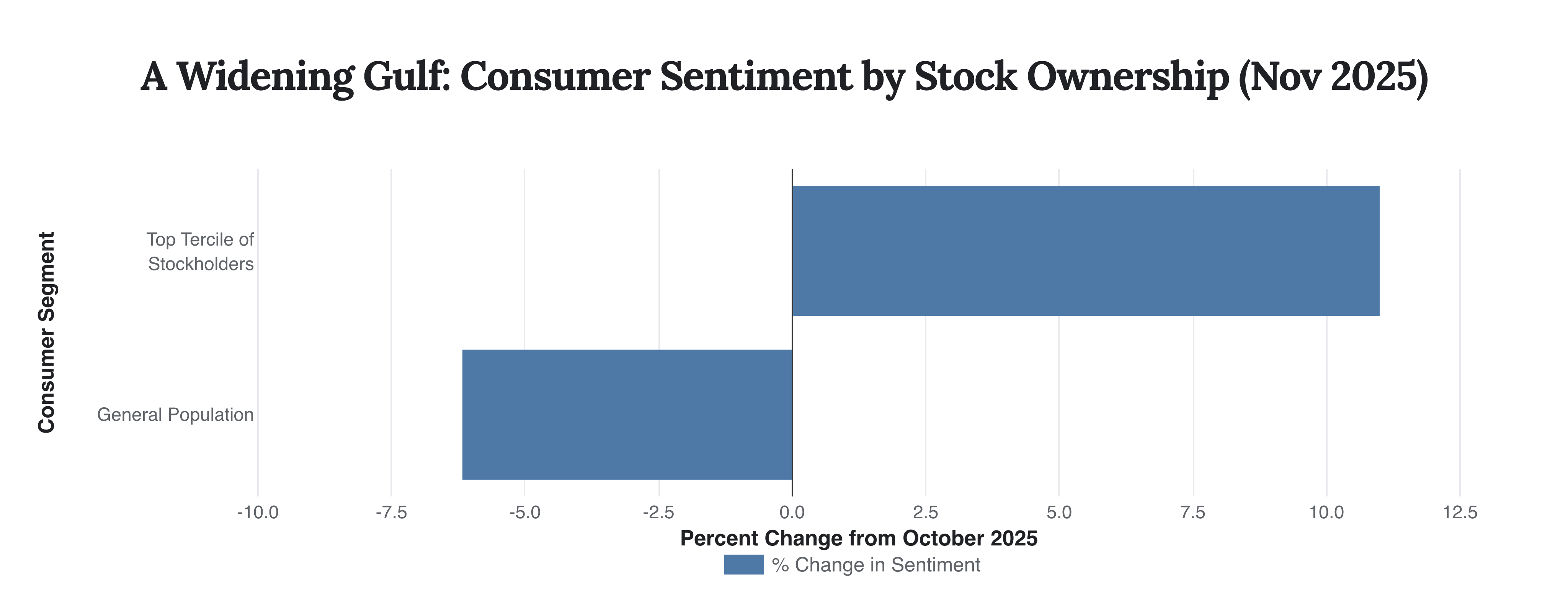
This chart starkly contrasts the 11% increase in sentiment among the top third of stockholders with the 6.2% decrease experienced by the general population in November 2025, showcasing a deep divide in economic outlooks.
This bifurcation is also reflected in the labor market data. While private payroll provider ADP reported the addition of 42,000 jobs in October, this represents a dramatic slowdown. More ominously, outplacement firm Challenger, Gray & Christmas reported that announced job cuts surged by 175% in October compared to the previous year, reaching the highest level for any October since 2003. Consumers are taking note, with fears of future unemployment rising significantly.
Inflation and Expectations: A Tangled Web
Underpinning the headline anxieties is a persistent concern about inflation. While the panic of 2022 has subsided, price pressures remain a primary source of frustration for households. The November survey shows a complex and somewhat contradictory view on inflation’s future path.
Short-Term Pain, Long-Term Questions
Year-ahead inflation expectations ticked up slightly, from 4.6% in October to 4.7% in November. This suggests that consumers expect no immediate relief from the high cost of living. However, long-run inflation expectations (for the next five years) actually eased, falling from 3.9% to 3.6%. This divergence indicates that while consumers are bracing for continued price pressures in the near term, they may believe the Federal Reserve will eventually bring inflation under control. Yet, this long-term optimism is fragile and could be easily shaken by further economic shocks or policy missteps.
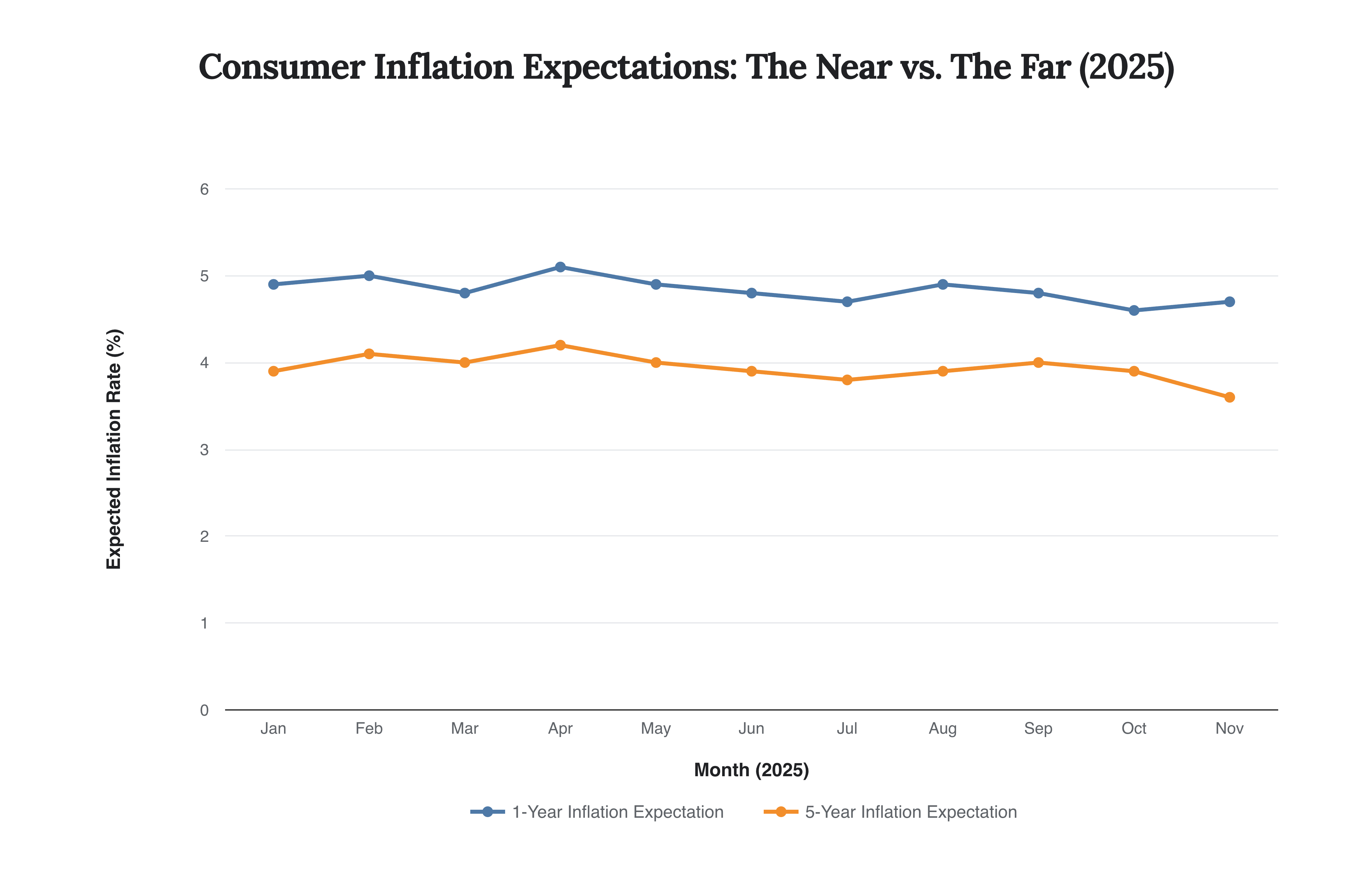
This line chart tracks the divergence between short-term (1-Year) and long-term (5-Year) consumer inflation expectations throughout 2025, showing persistent near-term anxiety even as long-term fears began to ease late in the year.
Strategic Foresight: Navigating the Peril
The collapse in consumer sentiment, particularly the record low in perceptions of current conditions, is a leading indicator that demands strategic adjustment. While some economists argue the link between sentiment and actual spending has weakened, ignoring a signal this strong would be a grave error.
Winners and Losers in a Bifurcated Market
Losers: Mid-Market Retail & Durables. Companies reliant on middle-income discretionary spending face the most significant risk. With consumer views on their personal finances cratering, big-ticket purchases like furniture, electronics, and vehicles will likely be deferred. Businesses in this space must focus on value messaging, flexible payment options, and aggressive inventory management.
Winners: Discount Retail & Essentials. As in previous downturns, consumers will trade down. Discount grocers, private-label brands, and essential goods providers are positioned to capture a greater share of household budgets.
Wildcard: Luxury & High-End Services. Buoyed by the confident, stock-owning consumer, the luxury market may show surprising resilience. However, these firms must watch for any contagion from the broader economy that could shake equity market confidence.
“The link between sentiment data and consumer spending has been weak.” - Federal Reserve Chair Jerome Powell (in a May 2025 press conference)
Signposts to Watch
For leaders and investors, several key indicators will determine the trajectory of the economy in the coming months:
Resolution of the Shutdown: The speed at which the political impasse in Washington is resolved is the most critical near-term variable. A swift resolution could lead to a modest rebound in confidence, while a continued stalemate will undoubtedly deepen the economic damage.
Holiday Retail Sales Data: Forecasts for the holiday season were already cautious. The actual sales figures will be the first hard data to confirm whether plunging sentiment is translating into pulled-back spending.
Weekly Jobless Claims: With layoff announcements surging, weekly jobless claims will be a high-frequency indicator of labor market deterioration. A sustained move above the 250,000 mark would be a major red flag.
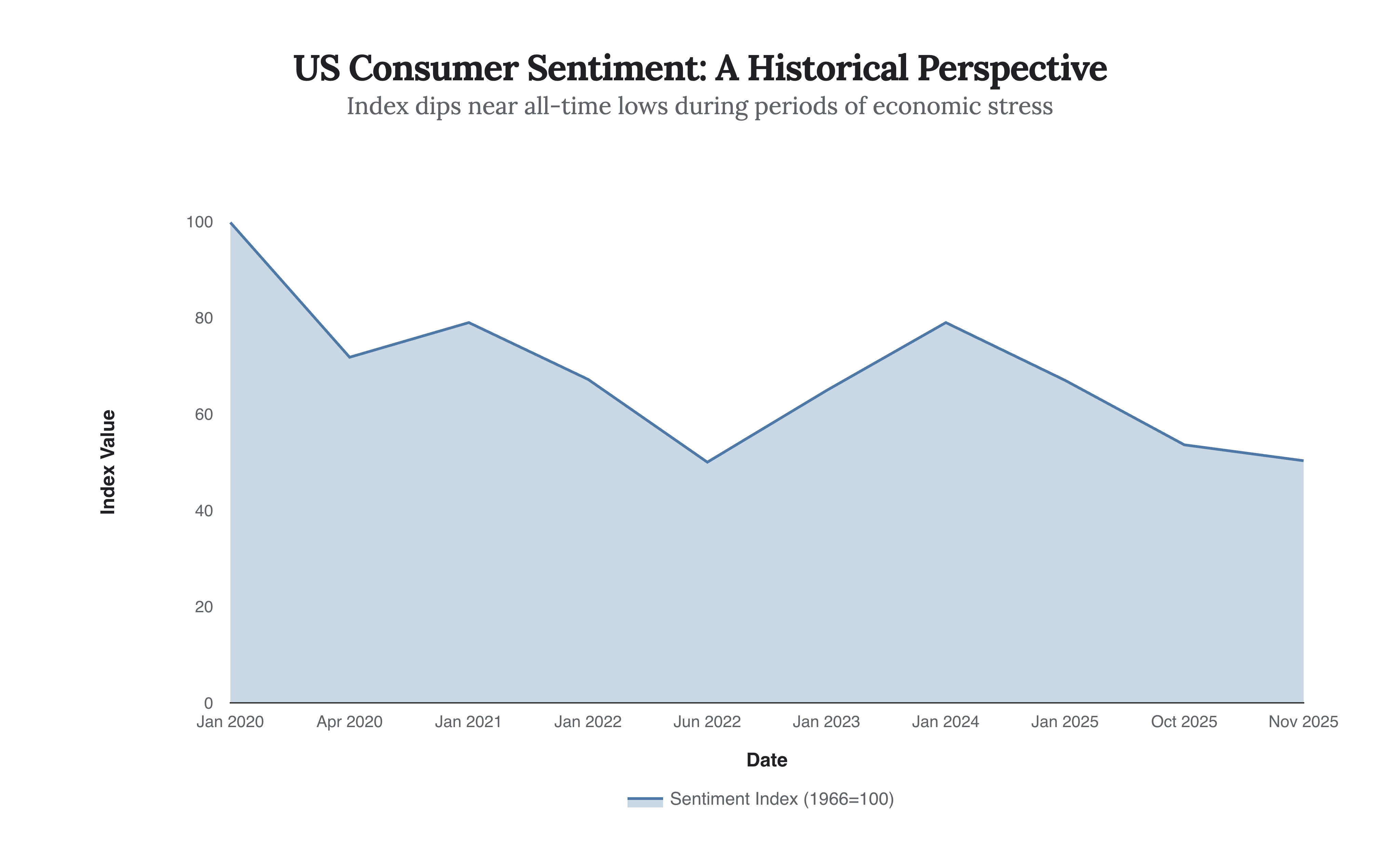
This chart places the current sentiment level in historical context, showing the sharp declines associated with the COVID-19 pandemic, the 2022 inflation peak, and the current drop in late 2025.
The current economic environment is fraught with contradiction: record stock prices coexist with record pessimism about personal finances. A political crisis has become a potent economic depressant, threatening to derail an economy already navigating the crosscurrents of inflation and a cooling labor market. The message from the American consumer is not one of subtle concern, but of profound anxiety about their present condition. Businesses and policymakers must recognize that this is not a drill; it is a clear signal of heightened economic fragility.
The single most important strategic insight is that the unprecedented collapse in consumers’ assessment of their *current* financial situation signals a fundamental break from past downturns, demanding an immediate pivot to defensive, value-centric business strategies.