


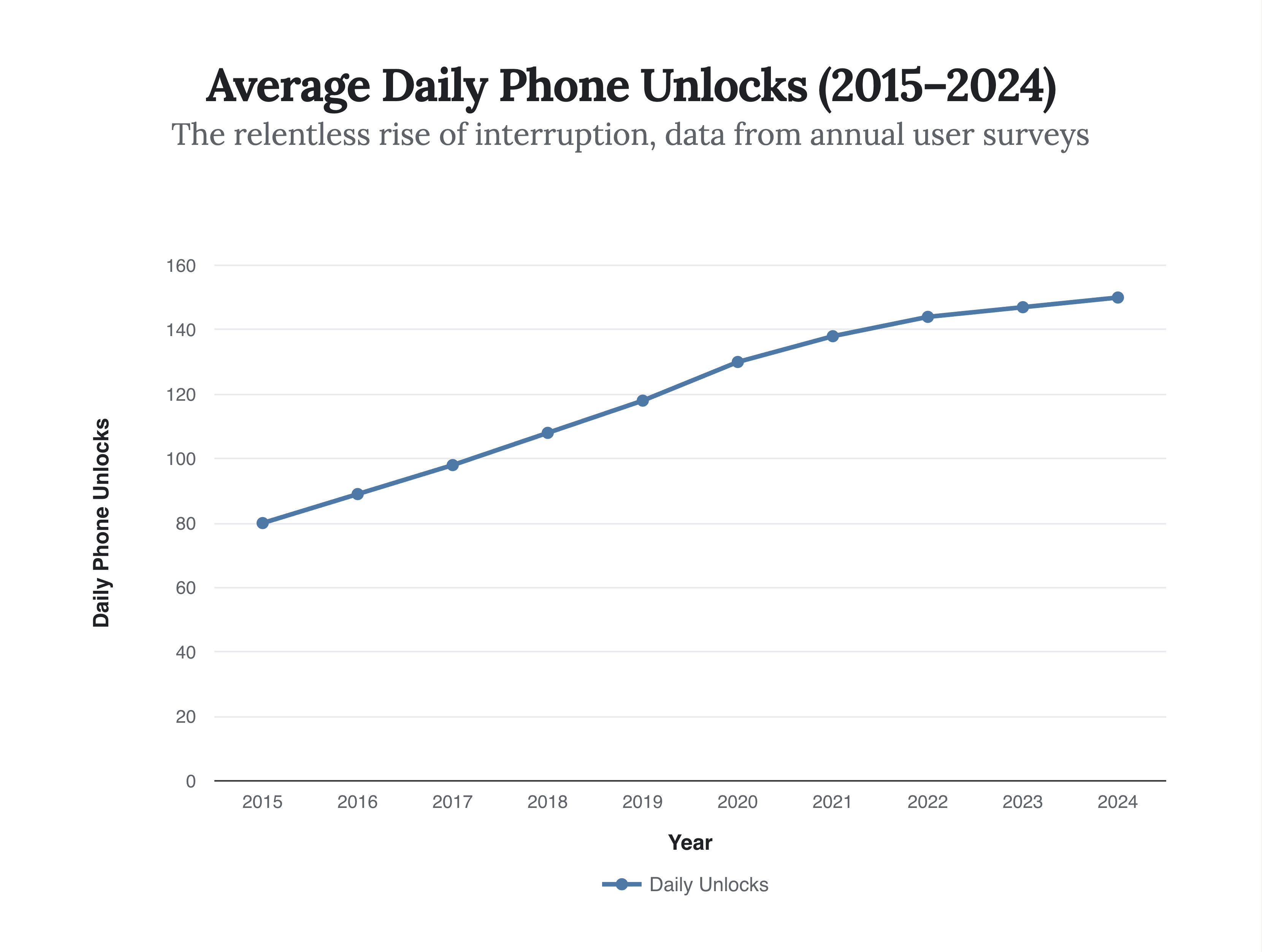
Most people unlock their phone 150 times a day. Not to call, not to message — but to check if something has arrived that demands less than they do. The screen becomes a mirror of the self, but a mirror that fragments the gaze. Iris Murdoch, the philosopher and novelist, argued that how we pay attention determines the moral quality of our lives. In 1970, she wrote: ‘Man is a creature who makes pictures of himself, and then comes to resemble the picture.’ Today, the picture is the infinite scroll, and resemblance is the cost. For Murdoch, ethics is not primarily about choice or duty but about the quality of consciousness we bring to the world. In *The Sovereignty of Good*, she insists: ‘The task of attention is to go on reducing false pictures of the self.’ She called this ‘unselfing’ — the disciplined, loving regard for what is real beyond the ego. Moral progress, on her account, is not a series of heroic decisions but the slow, daily work of seeing clearly. That work requires a form of attention that is increasingly impossible to sustain in an environment engineered to capture and monetize every glance.

Notifications Interrupt the Moral Act
The average US adult now spends 7 hours and 16 minutes per day on screen-based media, according to Q1 2024 data from DataReportal. This is not passive downtime; it is active engagement with apps designed to hijack the brain’s reward pathways. The median length of an uninterrupted work interval, as measured by researchers at the University of California, Irvine, has collapsed to 40 seconds — down from 3 minutes in 2004. Murdoch’s concept of attention as a just and loving gaze directed upon reality is impossible when reality is replaced by 15-second videos. She writes: ‘The moral life is not intermittent or specialised; it is not a peculiar matter of dealing with ‘ethical situations’ as they arise; it is a life lived in each moment, and the moments are ‘pregnant’ with good or evil.’ When each moment is interrupted by a notification, the pregnancy is aborted. The phone has become the most successful moral distraction device in history. It does not merely steal time; it trains the mind to flinch away from the sustained, unselfish attention that Murdoch identified as the foundation of moral perception. The constant interruption atomizes experience into discrete, consumable units, each one reinforcing the self as the centre of all value — precisely the ‘false picture’ she urged us to dismantle.
The Atrophied Moral Imagination
Murdoch’s debt to Simone Weil is explicit here. Weil described attention as a ‘negative effort,’ one that requires us to suspend our own thoughts and wait for the other to fill our consciousness. In digital culture, we are trained in the opposite: we do not wait; we swipe. The algorithm does not suspend the self; it hypertrophies it, feeding back an ever-narrower image of our preferences. The result is what the psychologist Jean Twenge calls ‘iGen’: a generation with record levels of loneliness and anxiety, but also a diminished capacity for the kind of imaginative leap that moral life demands. Without sustained attention, we cannot grasp the particularity of others, reducing them to types, avatars, political categories. Murdoch’s warning was precise: ‘Love is the extremely difficult realisation that something other than oneself is real.’ In a culture of perpetual distraction, that realisation is systematically foreclosed.

The 73% of adults who cannot focus on a single task for more than eight minutes without checking a screen are living evidence of a moral faculty in retreat. A study from the American Psychological Association in 2023 found that high phone-checking frequency correlates with lower scores on empathic concern — the very form of moral perception Murdoch located at the heart of ethics. The attention economy is an unselfing machine in reverse, continuously reinforcing the false picture of the self as the only thing that matters.If moral vision depends on attention, and if attention is now a commodity priced by algorithms, can we still claim to be morally free? Murdoch would ask: what are you actually looking at, and what is it making of you? Her question is not rhetorical — it is the starting point for a resistance that begins with putting the phone down, not as a wellness hack, but as a moral act.