


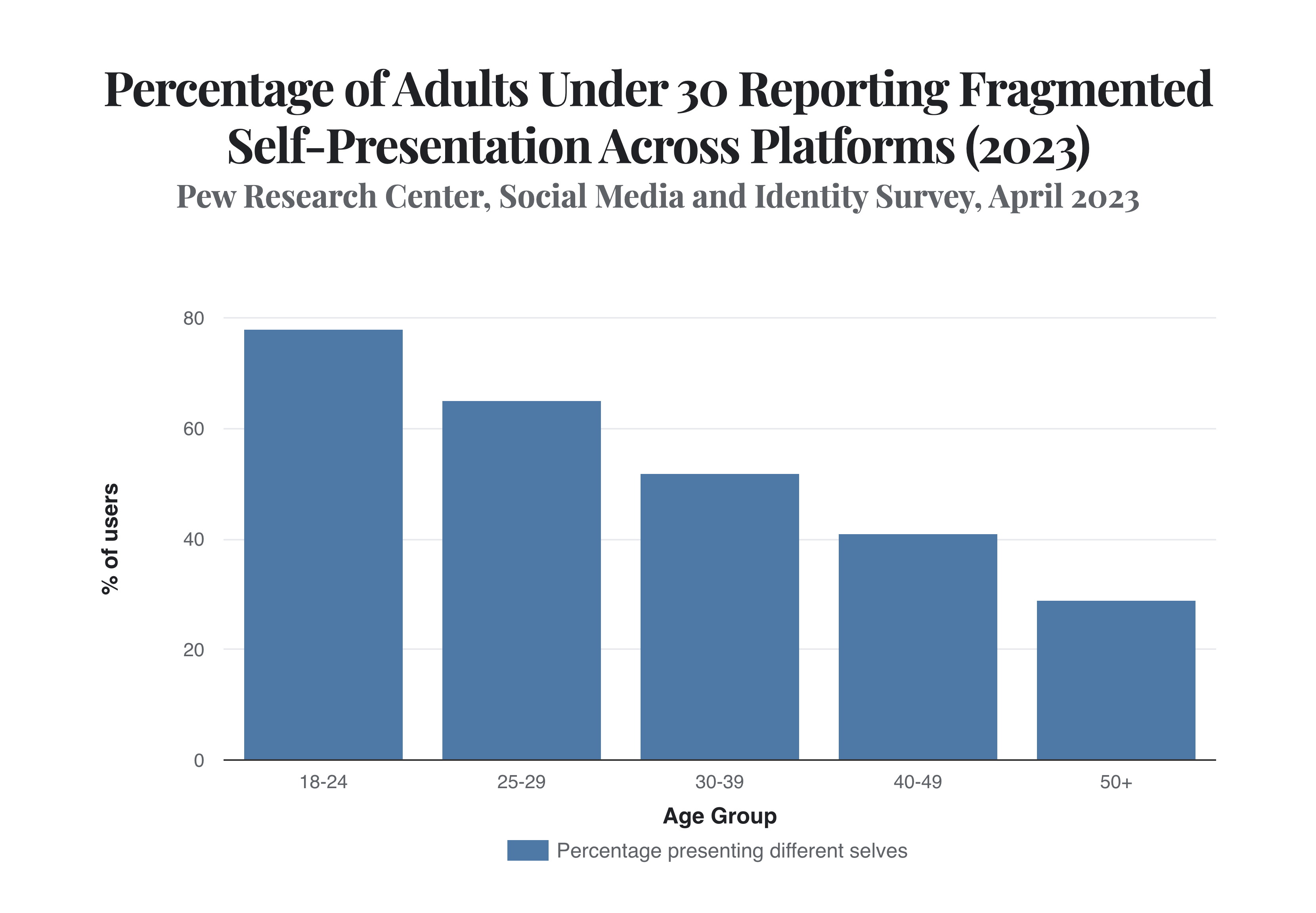
The personalized feed is not a mirror — it is a prism. Every like, scroll, and pause trains a recommendation engine to deliver a narrower slice of reality, one that optimises not for truth but for engagement. The consequence is a self that cannot hold together. A 2023 Pew Research Center study found that 71% of adults under 30 say they present different versions of themselves across different social media platforms.

This is not a harmless performance of multiplicity. It is a structural assault on narrative identity — the ability to tell a coherent story of who you are across time. When the algorithm serves you a version of the world calibrated to your last click, the internal thread that connects past, present and future snaps. The result is a fragmented self that no longer recognises its own authorship.
The Sickness Unto the Feed: Kierkegaard and Algorithmic Despair
Søren Kierkegaard diagnosed the modern condition 180 years before the first timeline. In The Sickness Unto Death (1849), he defined despair as the unwillingness to be oneself: ‘The self is a relation that relates itself to itself and in relating itself relates itself to something else.’ For Kierkegaard, the self must commit to a definite shape; flight into possibility is the essence of despair. The algorithm transforms this metaphysical trap into a daily routine. Every feed presents infinite alternative selves: the fitness enthusiast, the political analyst, the meme curator, the activist. But none is allowed to settle. The user scrolls through identities the way Kierkegaard’s aesthete flits from pleasure to pleasure. The algorithm’s implicit promise — ‘you can be anyone’ — is actually the engine of a quiet despair that the user feels as restlessness, not sadness. The 71% who perform multiple selves are not empowered; they are in what Kierkegaard called ‘the despair of possibility’ — a state where no single self feels true enough to live in, so all selves become optional and therefore meaningless.
The Panopticon 2.0: Foucault, Visibility and the Performed Self
Michel Foucault’s panopticon — a prison design where inmates never know when they are watched — has been upgraded. The algorithm does not merely observe; it scores, ranks and profiles. In Discipline and Punish (1975), Foucault argued that constant visibility disciplines the subject into internalising the gaze. The modern equivalent is the engagement loop: every post is a performance for an invisible audience of metrics. The user learns to anticipate what will be rewarded — a sharper photo, a wittier caption, a slightly more outrageous opinion. The self becomes a product optimised for algorithmic approval, and the fragmentation is not accidental but engineered: the feed rewards inconsistency because novelty drives clicks. Foucault wrote that the major effect of the panopticon is ‘to induce in the inmate a state of conscious and permanent visibility that assures the automatic functioning of power.’ Now the inmate stares at the feed. The power is engagement maximisation. The self is splintered into pieces that perform well, while the coherent narrator — the one who would say ‘I believe this, consistently’ — is starved of reinforcement. A 2024 Common Sense Media report found that 62% of teens feel their online persona is ‘different or very different’ from who they are offline. The panopticon has turned into a theatre, and the only roles that survive are the ones that get applause.

Psychopolitics and the Digital Swarm: Byung-Chul Han on Identity Dissolution
Byung-Chul Han, in Psychopolitics: Neoliberalism and New Technologies of Power (2014), argues that contemporary power no longer disciplines bodies but exploits emotions. The algorithm harvests not labour but attention and mood. Han describes the ‘digital swarm’ — a mass of unconnected individuals who are linked by transient emotional responses, not shared history or narrative.
