


The most dangerous naval blockade of the 21st century involves no battleships, no declared exclusion zones, and no kinetic firing solutions. Instead, it is being fought with dragged anchors, disabling transponders, and a single, devastating variable: Mean Time to Repair (MTTR).
While the world’s attention remains fixed on surface tensions in the Taiwan Strait and missile exchanges in the Levant, a silent, synchronized attrition of the Digital Commons is underway. The strategic fracture points are no longer just the cables themselves—which have always been vulnerable—but the mechanisms of their recovery.
New intelligence from the Baltic and Red Seas confirms a shift in adversarial doctrine. State-sponsored actors are moving beyond simple sabotage to a strategy of Resilience Denial. By targeting the legal, logistical, and financial machinery required to fix undersea infrastructure, they have successfully converted minor incidents into months-long strategic outages. This is the Invisible Blockade.
The Geometry of Denial: From Kinetic to Kinetic-Administrative
The traditional view of cable security focuses on the act of cutting: a submarine or trawler severs a line, and traffic is rerouted. This model is obsolete. The events of late 2024 and 2025 demonstrate that the cut is merely the opening move; the checkmate is the delay.
In November 2024, the severance of the C-Lion1 (Finland-Germany) and BCS East-West (Sweden-Lithuania) cables by the Chinese vessel Yi Peng 3 revealed the new geometry of denial. The vessel operated in the “gray zone”—using a dragged anchor to claim plausible deniability while severing critical links in rapid succession. But the true weapon was the ensuing ambiguity.
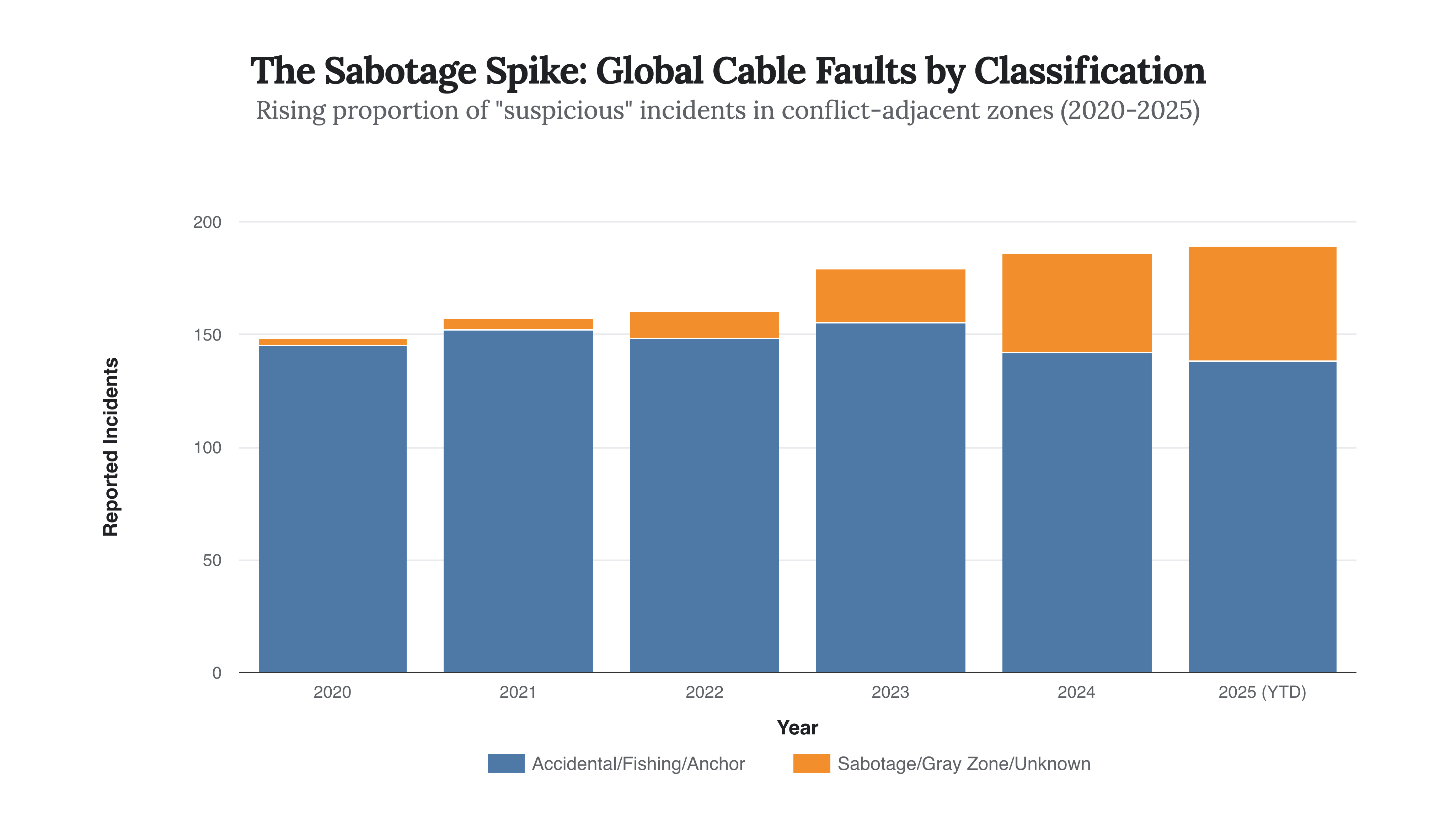
As the chart above illustrates, while the baseline of accidental faults (fishing, geological) remains steady, “suspicious” or gray-zone incidents have surged by over 1,000% since 2020. This is not statistical noise; it is a signal of operational testing. Adversaries are probing the threshold of Article 5, determining exactly how much infrastructure can be degraded before triggering a collective military response.
The Logistics of Attrition: The Repair Gap
The core of the Invisible Blockade is the Repair Gap. In peace time, a cable fault is a logistical nuisance, typically resolved in 2-4 weeks. In the current contested environment, that timeline has ballooned into a strategic liability.
