


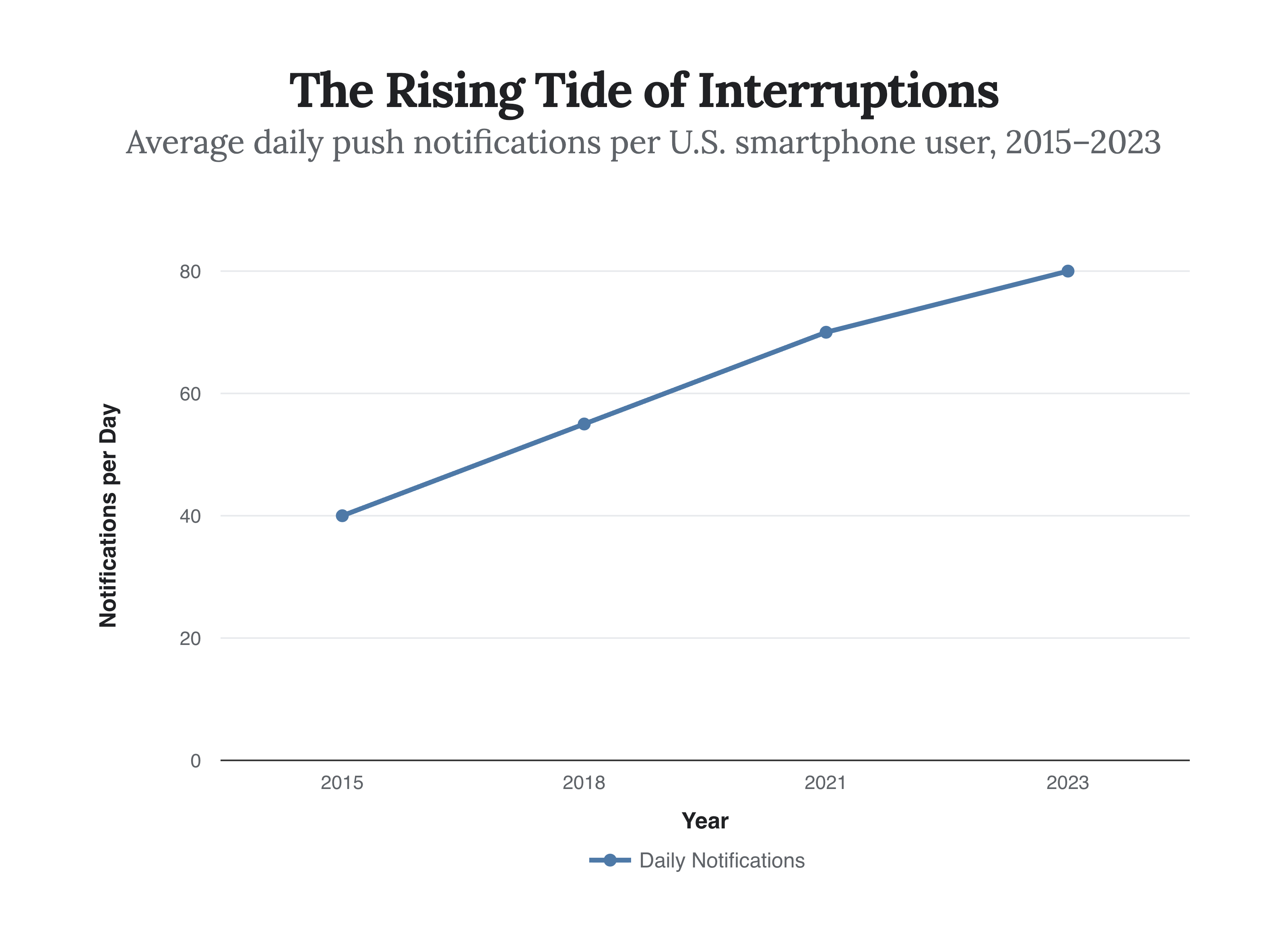
Your phone pings. You glance down. In the 23 minutes it takes to refocus, you’ve lost the thread of a thought that might have been important. The interruption itself lasted only three seconds, but the cognitive reset consumes nearly a half-hour. Gloria Mark, a researcher at UC Irvine, found that the average office worker is interrupted every three minutes and takes over 23 minutes to return to the original task. Multiply that across a day of 80 notifications—the current U.S. smartphone average—and the arithmetic of attention becomes ruinous. The rise from 40 daily pings in 2015 to 80 in 2023 is not a natural phenomenon; it is an engineered escalation, each buzz a calculated intrusion.
Every ping is a small, deliberate theft of your most finite resource. The global economy hemorrhages an estimated $650 billion annually to workplace distractions, according to a Basex study—a figure larger than the GDP of most nations. When the cost of lost cognitive capacity is tallied, the notification economy reveals itself as an extraction industry, strip-mining mental focus for profit.
Epictetus and the Dichotomy of Control
In the opening lines of the Enchiridion, Epictetus draws the line that matters: “Some things are up to us, others are not.” Our judgments, impulses, desires, and aversions are ours; our body, property, reputation, and office are not. For Epictetus, the inner fortress is built on the ability to recognize that external events have no power over the mind unless we grant it. A notification is an external event. Its sound and vibration are indifferent; it is our judgment—the craving to check, the fear of missing something—that disturbs our tranquility. The Stoic project is to train that judgment until the ping becomes no more disruptive than a birdcall outside the window. The notification is a test of the will, and most are failing it. Epictetus taught a rigorous daily practice of attention: constantly asking, “Is this up to me?” If not, let it go. Applied today, this means turning off all but essential notifications, and treating the remaining ones as opportunities to practice indifference. The fortress is not built by blocking the world but by reclassifying what counts as a threat. When you no longer consider the ping an enemy, it ceases to be one.

The Modern Siege Engine
Notifications are not incidental annoyances; they are behavioral design at scale. Platforms leverage variable reward schedules—the same mechanism that hooks gamblers to slot machines—to train compulsive checking. Tristan Harris, a former Google design ethicist, calls this “brain hacking.” Each ping triggers a micro-dose of dopamine, reinforcing the loop. The architecture is adversarial: your attention is the product, and the tools are optimized for maximum engagement, not your well-being. Notifications are the pickaxes of the attention
economy, chipping away at your agency one buzz at a time. The result is not merely scattered focus but a fractured self. When the mind is perpetually tugged outward, the capacity for sustained, self-directed thought atrophies. Consider the 2017 study showing that the mere presence of a smartphone—even turned off and face down—reduces available cognitive capacity. The device itself has become an appendage of distraction. Epictetus’s inner fortress is not a luxury; it is a survival mechanism for those who wish to think clearly in an age that profits from confusion.
The Unanswered Question
Can you build an inner fortress strong enough to withstand a system engineered to exploit your psychological vulnerabilities? Or has the machinery already conditioned your mind to crave the ping, mistaking the notification for connection and the dopamine hit for meaning?