



The Attention Liquidity Crisis
The global economy is currently hemorrhaging value through a mechanism that does not show up on a standard P&L statement. While C-suite executives focus on supply chain resilience and AI integration, a more corrosive solvent is dissolving the foundation of operational efficiency: Cognitive Fragmentation.
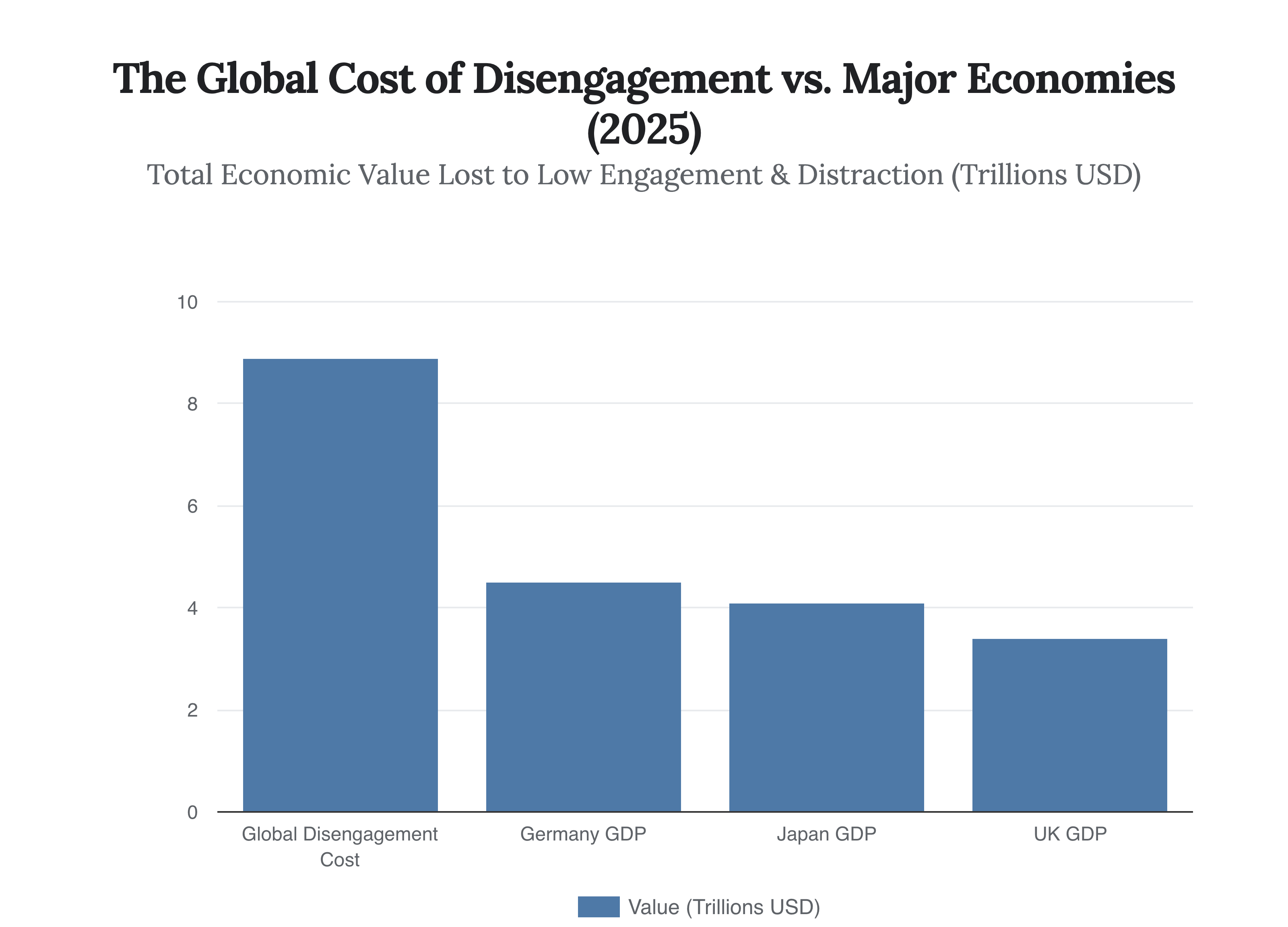
Intelligence gathered from the Q4 2025 and early 2026 landscape indicates that the cost of workplace distraction has metastasized from a human resources concern into a tier-one strategic risk. The headline figure—$650 billion in annual losses for U.S. businesses alone—is a conservative floor, not a ceiling. When extrapolated globally to include the cost of low engagement and “Digital Debt,” the figure swells to an agonizing $8.9 trillion, roughly 9% of Global GDP.
This is not a discipline problem. It is a physics problem. The modern workflow infrastructure, designed for hyper-connectivity, has exceeded the biological bandwidth of the human cortex.
We are not suffering from a lack of effort; we are suffering from a structural inability to sustain the cognitive continuity required for high-value strategic execution.
The Physics of “Switching Costs”
The lethality of distraction lies in the “Recovery Lag.” Data from 2025 behavioral studies reinforces the “23-Minute Rule” originally identified by Gloria Mark. When a knowledge worker is interrupted—whether by a Slack notification, an open-plan office intrusion, or a “quick sync”—the cognitive penalty is not merely the duration of the interruption.
The brain requires an average of 23 minutes and 15 seconds to reconstruct the mental mental model required for deep work. In a 2026 operational environment where the average executive faces approximately 275 interruptions per day (roughly one every two minutes during core hours), the mathematical probability of achieving “Deep Work” approaches zero.
The result is a phenomenon known as “Context Switching Fatigue.” The brain burns glucose not on solving complex problems, but on the metabolic tax of orienting and re-orienting to new tasks. This is the biological equivalent of driving a Formula 1 car in first gear: high RPM, massive fuel consumption, and minimal forward velocity.
The 60/40 Split: Why Innovation Stalls
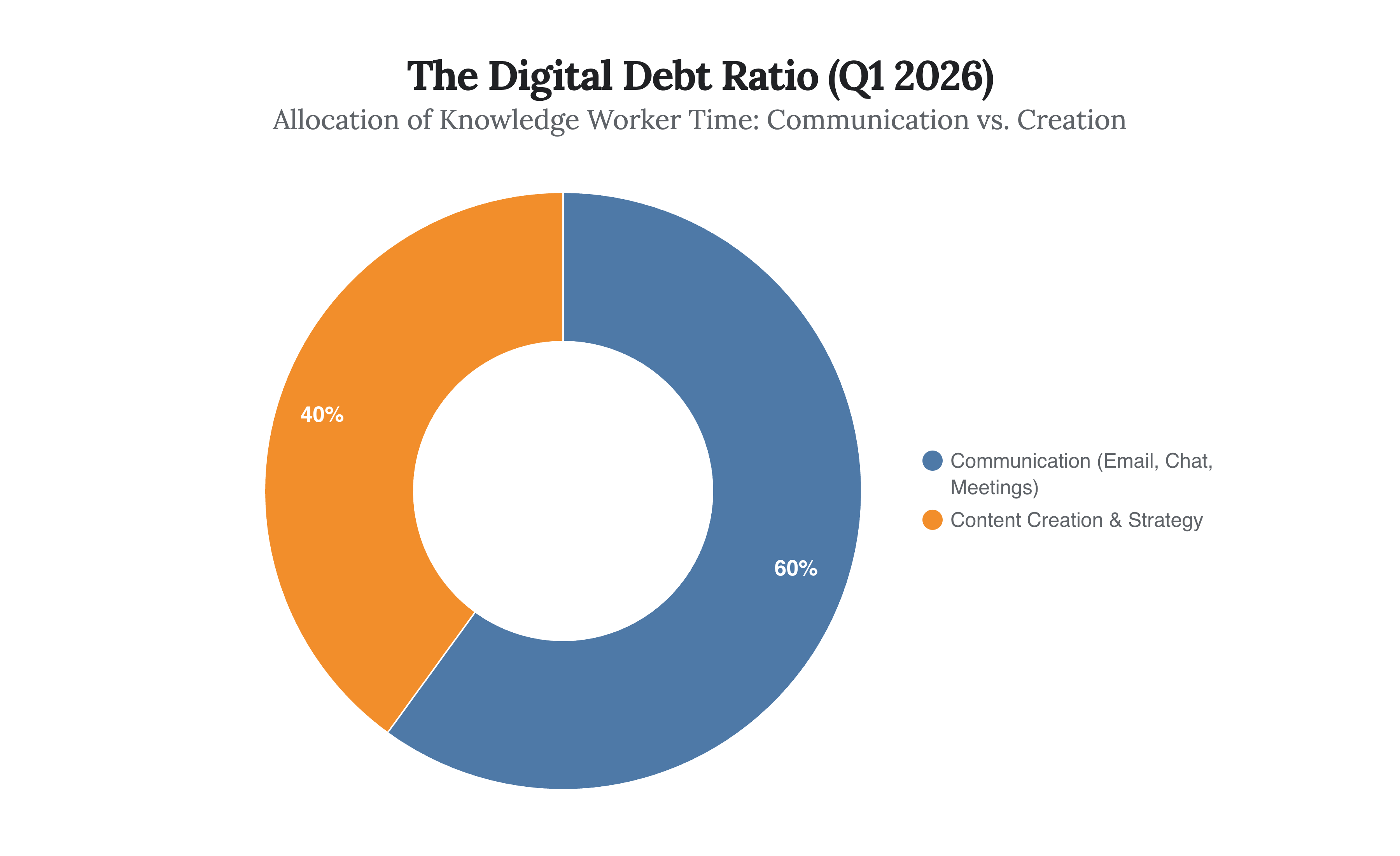
Microsoft’s 2025 Work Trend Index illuminated a critical fissure in the modern enterprise: the imbalance between communication and creation. The data reveals that 60% of the average knowledge worker’s time is now consumed by managing the digital signal (email, chat, video calls), leaving only 40% for the actual generation of value (coding, writing, designing, strategizing).
This creates a feedback loop of “Performative Productivity.” Teams are visibly busy—green dots on status bars, rapid response times, full calendars—yet output remains stagnant. They are servicing the machinery of work rather than doing the work itself.
Unlock deeper strategic alpha with a 10% discount on the annual plan.
Support the data-driven foresight required to navigate an era of radical uncertainty and join a community of institutional-grade analysts committed to the truth.
The Frontier Firm Divergence
The data from early 2026 suggests a bifurcation in the market. Microsoft and LinkedIn labor trends identify a new class of organization: the “Frontier Firm.” These entities have integrated AI not just as a content generator, but as a “noise filter.”
In Frontier Firms, AI agents handle the asynchronous layer of communication—summarizing threads, scheduling, and retrieving information. The result is statistically significant: 71% of employees in these AI-integrated environments report they are “thriving” and able to manage their workload, compared to just 37% globally.
The companies that fail to automate the “drudgery of coordination” will continue to pay the Distraction Tax. Their talent will burn out, not from the difficulty of the work, but from the sheer volume of context switching required to perform it.
Strategic Implications for 2026
For the high-agency leader, the data mandates a shift in protocol. The open-door policy and the “always-on” culture are no longer badges of honor; they are liabilities. To recapture the $650 billion currently being incinerated, organizations must engineer “Cognitive Fortresses”—blocks of time protected by policy and technology.
The modern executive is effectively paying a 60% tax on their cognitive output to manage the very tools intended to accelerate it. Unless this debt is serviced through radical prioritization and AI-assisted filtering, the cost of doing business will continue to rise, even as the tools of business become cheaper.
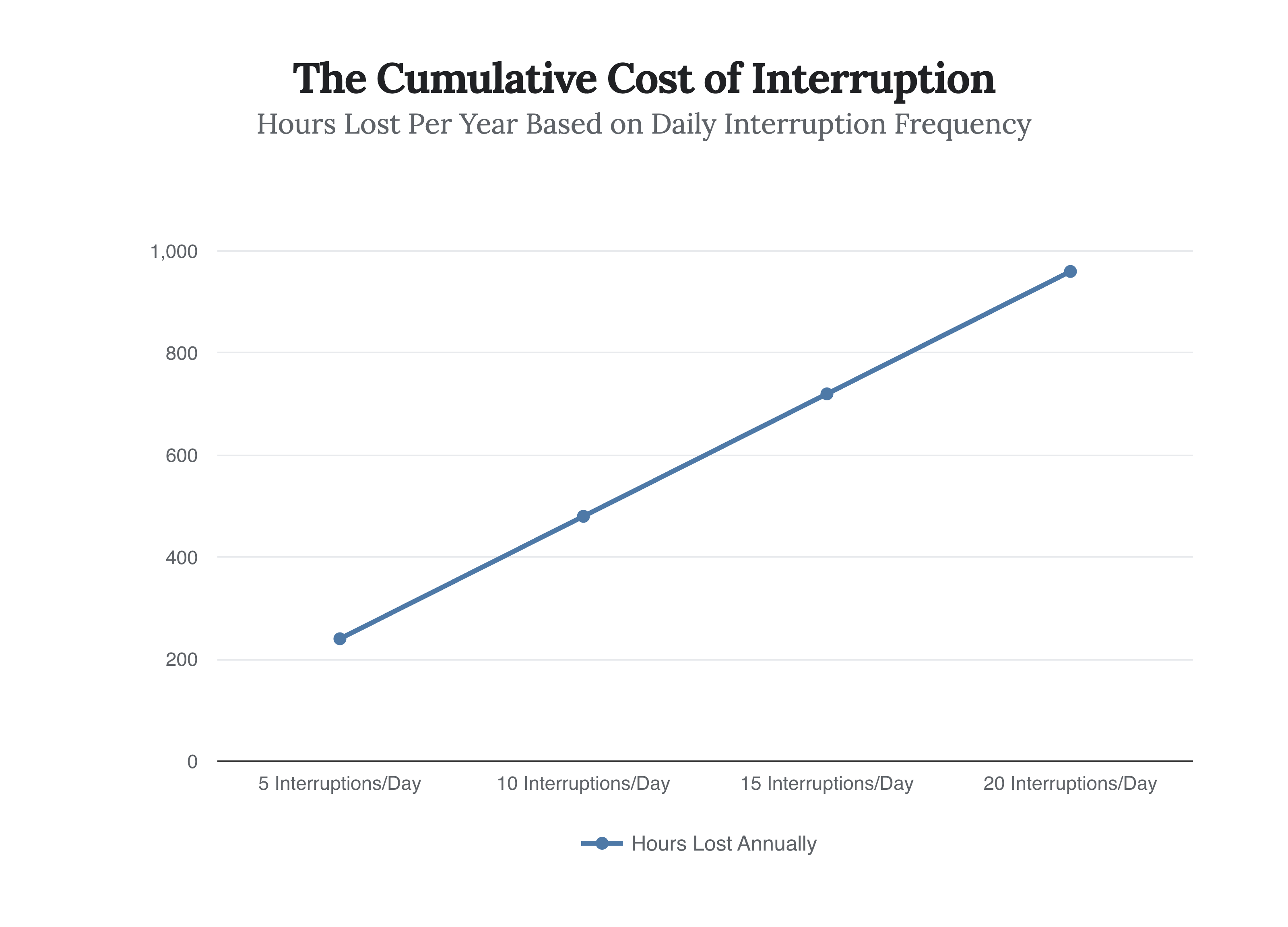
The chart above visualizes the cumulative impact. At a modest 15 significant interruptions per day (where recovery time is required), an employee loses approximately 720 hours a year—roughly 30% of a standard work year—to the “Refocus Lag.” This is the invisible leak in the hull of the global economy.