


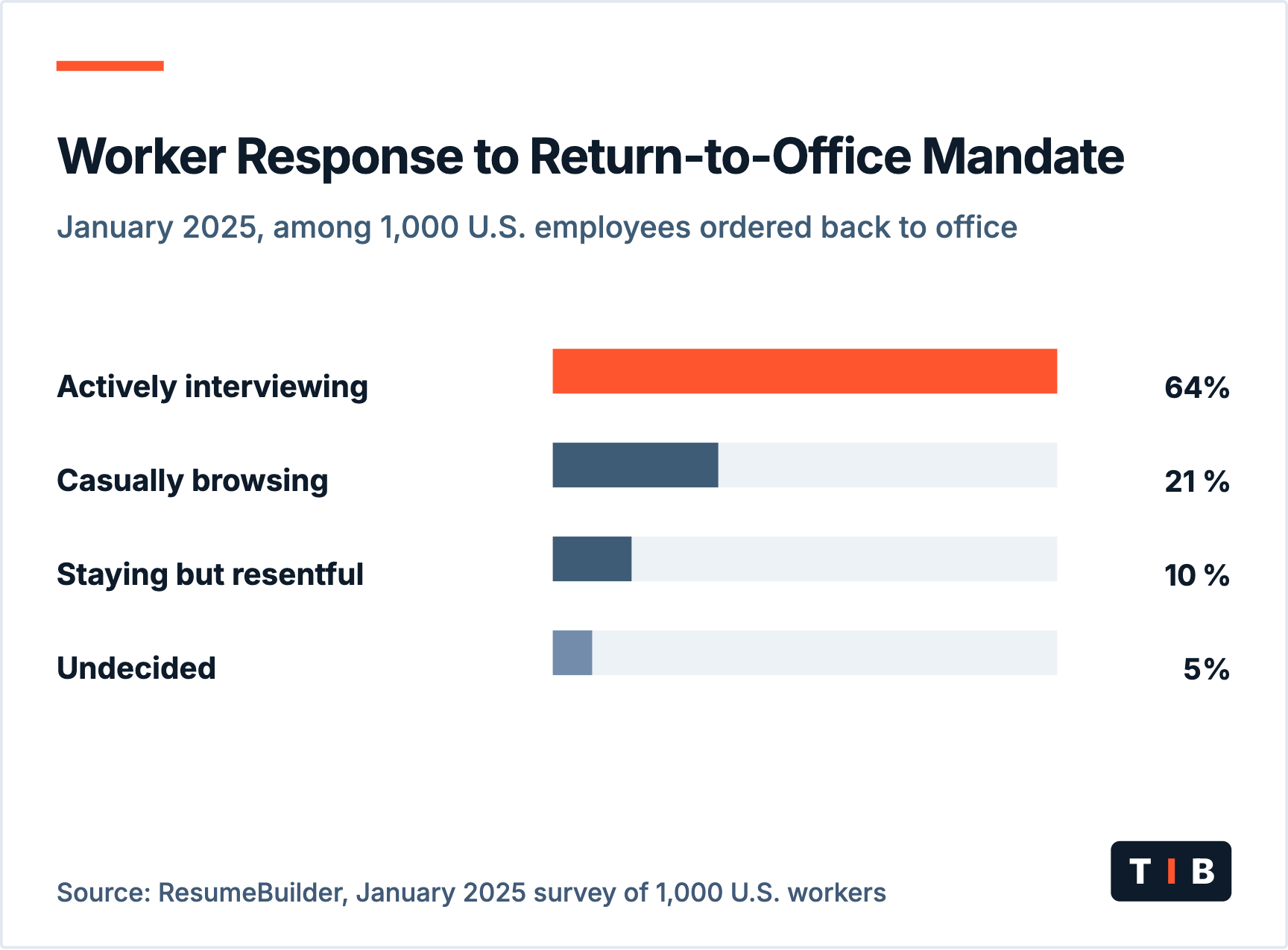
Return-to-office mandates are now reliably predicting attrition. ResumeBuilder’s January 2025 survey of 1,000 U.S. employees found that 64% of workers ordered back to the office are actively interviewing elsewhere, a 12-point increase from its June 2024 measure. Return-to-office mandates now function less as management tools than as attrition accelerators. That number is not a sentiment index; it is a forward indicator of resignations.
The mandate is a disciplinary technology, not a collaboration tool. Michel Foucault described the mechanism precisely in Discipline and Punish (trans. Alan Sheridan, Vintage, 1977, p. 141): “Discipline sometimes requires enclosure, the specification of a place heterogeneous to all others and closed in upon itself.” The office, as enforced by badge swipes, occupancy sensors, and manager walk-bys, is that enclosure. ResumeBuilder found that 37% of mandated workers report increased workplace surveillance since the mandate, up from 22% in 2024. This is not nostalgia for presenteeism; it is an exercise in what Foucault called “the means of correct training.”
The data are unambiguous. Owl Labs’ 2024 State of Hybrid Work report found that 62% of U.S. workers would accept a pay cut to preserve remote work, and the American Psychological Association’s 2024 Work in America survey recorded a 41% increase in reported workplace stress among mandated returners. Kastle Systems’ back-to-work barometer shows average office occupancy in 10 major U.S. metros stabilized at 50% in 2024, down from 2019 baseline. The enclosure does not produce loyalty; it produces résumés.
For subscribers, we move past the headline to the synthesis: what a 64% flight risk among mandated returnees means for leverage, labor liquidity, and the next shift in the principal-agent problem.
Join the readers who see the 64% and know it’s not about the office—it’s about the power.
The Labor Market’s Countermove
The 64% actively interviewing are not merely browsing; they are in active negotiation. ResumeBuilder found that 68% of mandated workers began their job search within one month of the mandate announcement, and 42% have already advanced to final-round interviews with remote-friendly employers. A 2024 FlexJobs survey reported that 57% of remote-capable workers would look for a new job if forced back full-time. The countermove is not hypothetical: quit rates for professional and business services remain at 3.4%, well above the national average, signaling that high-skill workers are exercising their exit option.
The Managerial Class’s Blind Spot
Executives ignore this data because they optimize for visibility, not output. A 2024 Harvard Business School study that analyzed 3 million meeting invitations across 20 firms found RTO increased digital messaging by 14% but in-person collaboration by only 2%. The presenteeism bias is persistent: a 2023 Slack State of Work report found that 60% of executives still equate physical presence with productivity, despite no correlation in output data. Microsoft’s 2024 Work Trend Index found 43% of leaders cite relationship-building as the main reason for RTO, yet the same report shows 74% of employees say ties have not improved. What Foucault called “disciplinary society” has been outrun by a labor market that no longer needs the factory floor.
What follows is predictable. By Q3 2025, the 64% active interviewing rate will convert into resignation rates above historical norms, and companies that enforce RTO will find themselves paying a retention premium for a workforce that is already looking. SHRM estimates replacement costs average 50% of annual salary per lost worker. The remote and hybrid competitors will capture the most productive defectors. The mandate is not a strategy; it is a slow-motion liquidation of talent.