


On March 10, 2026, Elon Musk hit “post” on a sentence that the traditional financial sector had spent three years hoping he would never write: “X Money early public access will launch next month” . As of April 2026, the transition of X from a digital town square into a WeChat-style “everything app” is no longer a theoretical whitepaper. It is a fully licensed, heavily capitalized reality.
To understand the sheer kinetic force of this rollout, we must look past the social media noise and examine the underlying structural game. This is not merely a feature update. It is a direct, calculated siege on a multi-trillion-dollar payments oligopoly, orchestrated by leveraging the attention of over 600 million monthly active users .
The Anatomy of a Financial Siege
For a decade, the peer-to-peer (P2P) payments space has been a fortified duopoly. In 2025, PayPal processed a staggering $1.79 trillion in Total Payment Volume (TPV) , while its subsidiary Venmo handled $325 billion . Block’s Cash App cleared $248 billion . These incumbents built massive, seemingly unassailable moats based on network effects—you use Venmo because your friends use Venmo, and you use Cash App because your local merchants accept it.
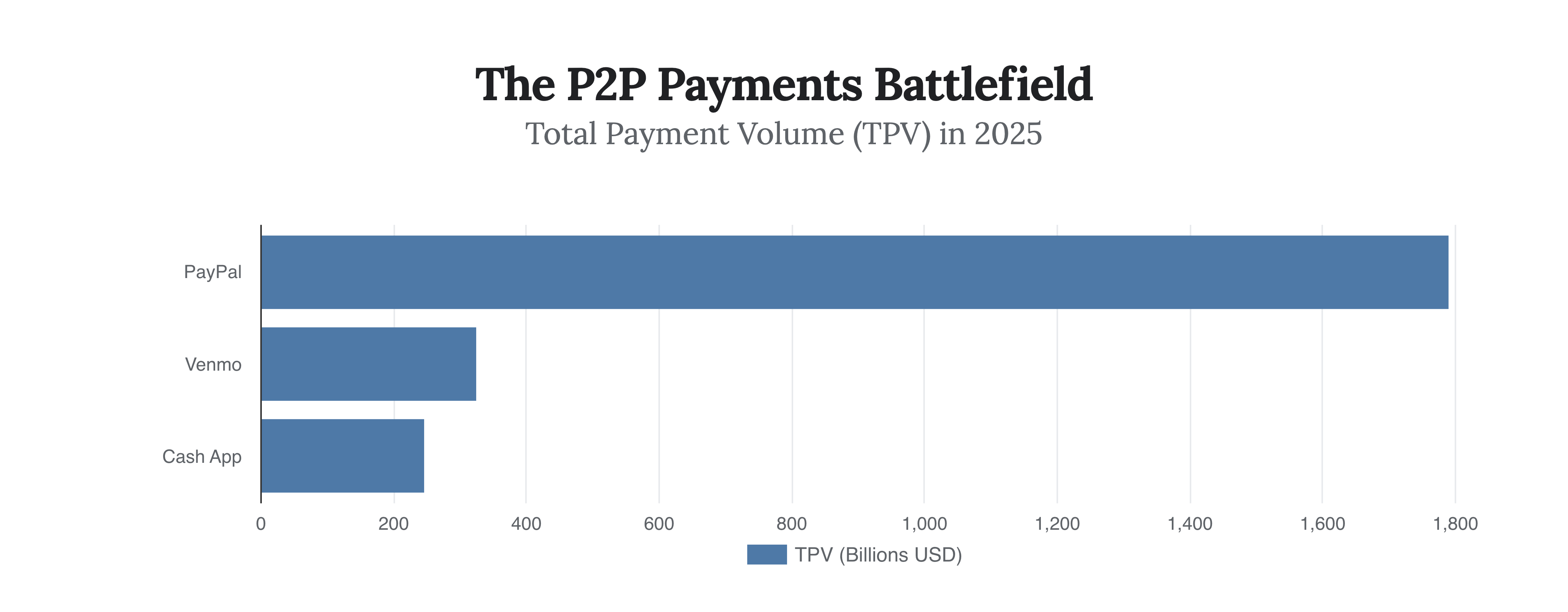
But X possesses a distinct, perhaps insurmountable, strategic advantage. By merging the global social graph with a financial ledger, X Money creates an information asymmetry that traditional banks and standalone payment apps simply cannot replicate.
When you open Venmo, you only see a sterile feed of pizza emojis and rent splits. When you open X, you are immersed in the exact context that drives commerce: breaking news, creator content, product launches, and high-velocity financial discourse. X Money collapses the friction between discovering a product or creator and funding them. The network effect is already built; the payment rail is simply the final bridge to close the loop.
The Weaponization of Yield
Acquiring new financial customers is notoriously expensive. Traditional banks spend hundreds of dollars in marketing and sign-up bonuses to acquire a single retail depositor. X Money, however, is using a strategy borrowed from the blitzscaling playbooks of early Silicon Valley: overwhelming financial incentives funded by deep capital and systemic leverage.
In its limited external beta launched in March 2026, X Money didn’t just offer standard checking features. It debuted with a devastatingly attractive value proposition: a 6.0% Annual Percentage Yield (APY) on deposits, zero foreign transaction fees, 3% cashback on purchases, and a metal Visa debit card personalized with the user’s handle . The deposits are FDIC-insured up to $250,000 via a partnership with Cross River Bank .
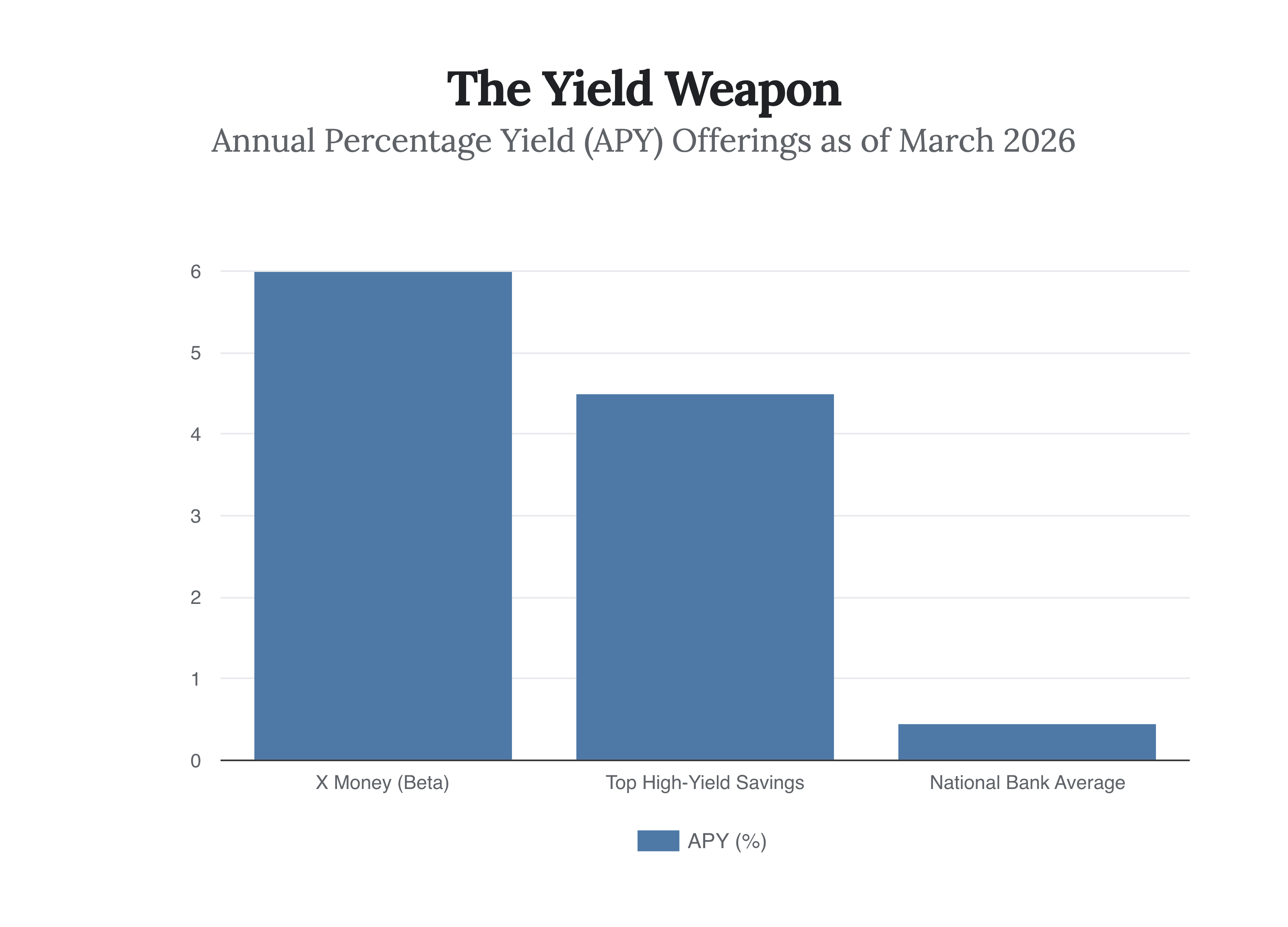
The 6% yield isn’t a long-term business model; it is a weaponized loss leader designed to break the inertia of consumer banking habits.
By offering an APY that significantly outperforms both the national banking average and top high-yield savings accounts, X is presenting a highly credible threat to legacy retail banks. It creates a rational financial incentive for users to park their idle liquidity directly inside their social media app. The average Venmo user keeps a balance of roughly $211, treating it as a temporary holding zone rather than a wealth vehicle . X Money wants to turn that holding zone into a primary treasury. Once the liquidity is anchored in X, the friction to spend, tip, or transfer within the ecosystem drops to absolute zero.
Unlock deeper strategic alpha with a 10% discount on the annual plan.
Support the data-driven foresight required to navigate an era of radical uncertainty and join a community of institutional-grade analysts committed to the truth.
The Invisible Regulatory Moat
While the public was debating algorithm changes and content moderation policies, X Corp. was quietly executing one of the most aggressive regulatory ground games in recent fintech history.
In the United States, there is no single federal money transmitter license. To operate a payments network, a company must engage in grueling administrative trench warfare, fighting state-by-state for regulatory approval. As of early 2026, X Payments LLC holds money transmitter licenses in 47 U.S. states . The operation is officially registered with the Financial Crimes Enforcement Network (FinCEN) and deeply backed by a global partnership with Visa, utilizing Visa Direct for real-time fund transfers .
This regulatory moat is virtually impassable for a new startup today. X has effectively secured the legal infrastructure required to hold user balances, facilitate merchant checkouts, and process immediate transfers. While the notoriously strict state of New York remains a holdout—a friction point X will ultimately need to resolve before declaring total national victory—the foundation is laid . They have bypassed the traditional banking layer to interact directly with the rails of global commerce.
Solving the Two-Sided Market Paradox
To understand the ultimate endgame of X Money, we have to look at the merchants. Launching a new payment network requires solving a classic two-sided market paradox: users won’t adopt the network if merchants don’t accept it, and merchants won’t accept it if users aren’t utilizing it.
In 2025 and 2026, small and medium-sized businesses have been quietly suffocating under the weight of credit card processing fees. The standard toll for accepting an online payment sits at roughly 2.9% plus $0.30 per transaction . Premium rewards cards can push that effective rate closer to 3.5% . For a business operating on razor-thin margins, this “interchange tax” is crippling.
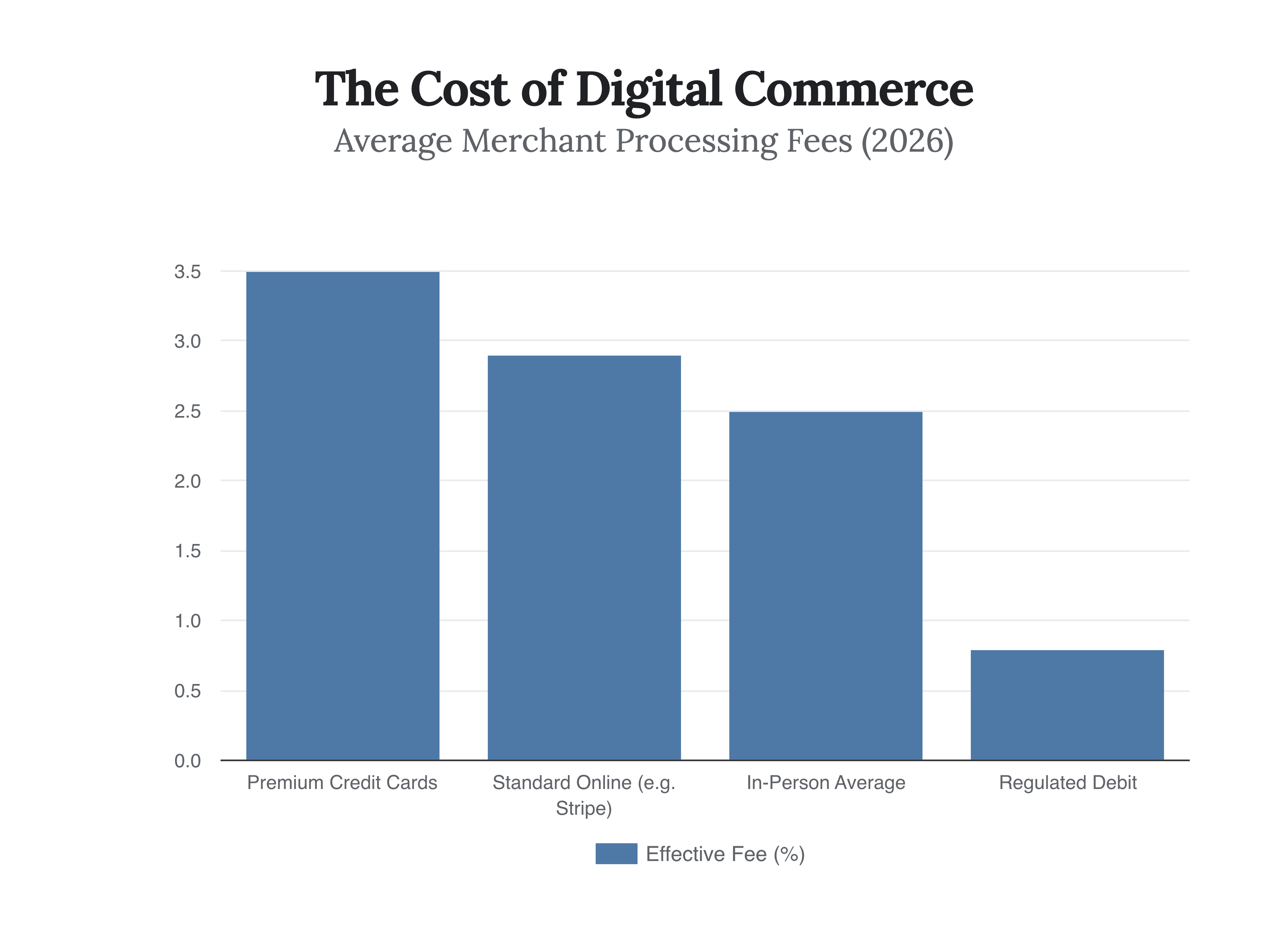
X Money presents a structural alternative that could shatter this dynamic. Because X already commands the attention of the consumer (the 600 million nodes of the network), it can use high APYs to convince them to load funds into the platform. Once the consumer is holding a balance in X Money, and the merchant accepts payments directly via X Money, the transaction never touches the traditional credit card interchange rails. It becomes a closed-loop internal ledger update.
Merchants aren’t going to adopt X Money because they admire the platform’s leadership; they will adopt it to escape the suffocating 2.9% tax that legacy processors impose on digital commerce. If X offers merchants a 1% processing fee for direct X Money transfers, it will trigger a mass migration of online checkouts. The resulting margin expansion for businesses would be too substantial to ignore.
The Crypto Whisper and the Human Impact
And then there is the persistent crypto whisper. While the April 2026 rollout relies firmly on traditional fiat rails—a necessity to ensure regulatory compliance and consumer protection—the architecture for Web3 is already being installed. The deployment of “Smart Cashtags” in early 2026 allows users to click a ticker like $BTC or $SOL to see real-time charts and execute trades via API integrations with partner exchanges . This proves that high-velocity financialization is baked into the platform’s DNA.
We are witnessing the collision of two worlds that, until now, operated in deliberate silos: human communication and capital transfer. If X Money succeeds in its “everything app” ambitions, it will fundamentally alter the unit economics of the internet. For creators, it signals the end of leaking traffic to external monetization platforms like Patreon or Substack; monetization will happen natively and instantly within the feed. For the average consumer, it means your financial dashboard, your newsfeed, and your digital identity are inextricably linked into a single application.
The inherent risk, of course, is centralization. The WeChat model in China is a marvel of technological efficiency, generating tens of billions in revenue by keeping users within a seamless walled garden . But it also places immense, unchecked power in the hands of a single platform. When communication and commerce are unified, a suspension from the network no longer just silences your voice—it freezes your wallet and severs your access to the digital economy.
As X Money opens its gates to the public this month, the legacy institutions that dismissed the “everything app” as a billionaire’s fever dream are now scrambling to draft a response. The boardrooms of Visa’s competitors, major retail banks, and standalone digital wallet providers are suddenly facing an adversary who possesses the one asset they cannot buy: our daily, undivided attention. X already owns the conversation. Starting in April 2026, it is coming for the treasury.