


As of April 20, 2026, the United States is exactly fifty-two days into an unauthorized, multi-front military conflict with the Islamic Republic of Iran. The strikes, initiated on February 28, 2026, alongside Israeli defense forces, bypassed explicit congressional authorization, triggering a constitutional countdown that is now sending shockwaves through both the legislative branch and global energy markets. Last week, the geopolitical theater collided violently with domestic political reality. In a pair of razor-thin votes, the U.S. Congress effectively sanctioned the continuation of the war—for now—while setting the stage for a massive institutional crisis looming in the first week of May.
On Wednesday, April 15, 2026, the Senate rejected a Democratic-led War Powers Resolution introduced by Senator Tammy Duckworth, voting 52-47 to block a mandate that would have forced President Donald Trump to withdraw U.S. armed forces from hostilities against Iran. The very next day, the House of Representatives narrowly defeated a mirrored effort spearheaded by Representative Gregory Meeks, with the resolution failing by a microscopic margin of 214-213.
The Anatomy of Institutional Paralysis
To the untrained eye, these failed votes look like a standard partisan rubber stamp. But viewed through the lens of strategic intelligence and game theory, this is a calculated game of legislative chicken. Congress is not merely stepping aside; it is utilizing deliberate inaction as a mechanism of foreign policy.
By deliberately overriding the War Powers Resolution of 1973 for the fourth consecutive time this year, Congress has weaponized its own paralysis to maintain a maximum-pressure threat architecture against Tehran.
If the Senate had advanced the resolution, it would have signaled a fractured domestic front, presenting Tehran with a profound information asymmetry to exploit. In game theoretic terms, the executive branch relies on “credible threats” to deter adversaries. When President Trump recently warned that a “whole civilization will die” if Iran escalates—a rhetorical flourish that preceded the fragile two-week ceasefire currently holding as of late April 2026—that threat only carries weight if the adversary believes the U.S. military is fundamentally unshackled. A successful War Powers vote would have instantly eroded that credibility, signaling to the Iranian regime that they simply need to absorb the initial kinetic strikes and wait for American domestic politics to force a retreat.
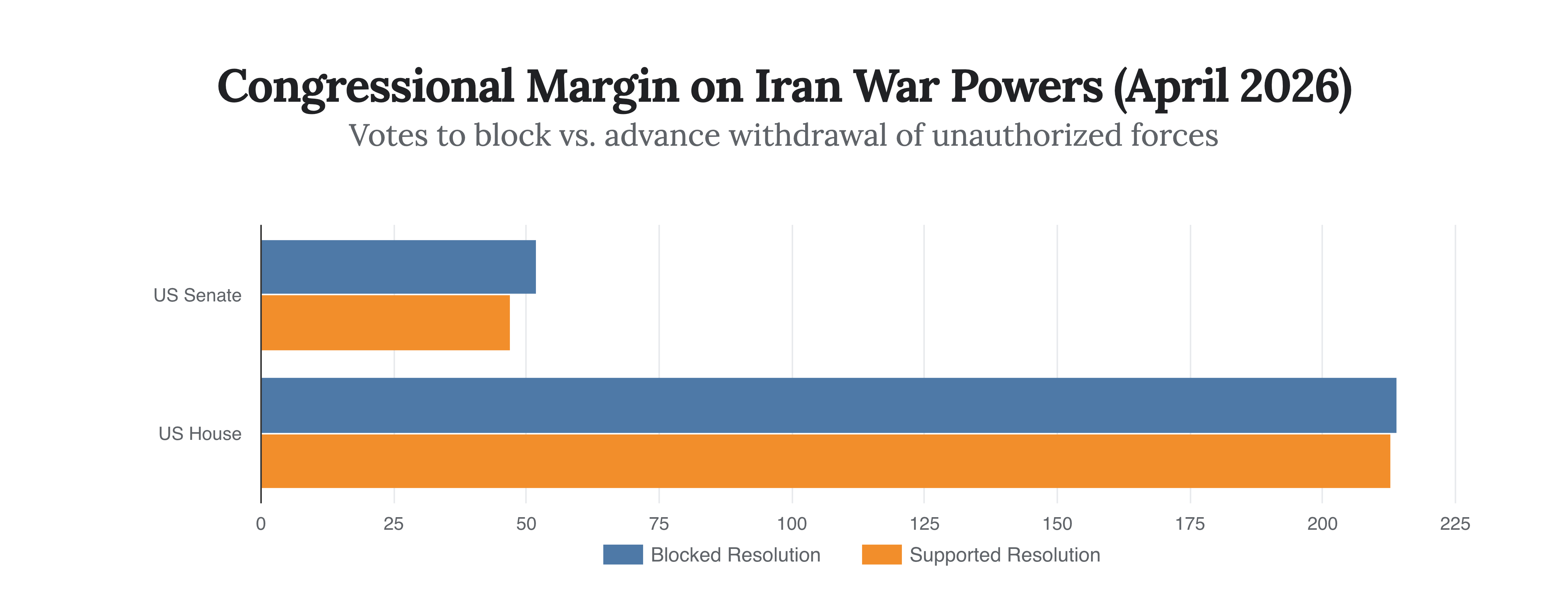
However, the geometry of the vote reveals a foundation that is cracking under the weight of an approaching statutory deadline. The defections tell the real story. In the Senate, Republican Rand Paul crossed the aisle to vote against the administration, while Democrat John Fetterman defected to support the continuation of hostilities. In the House, the sole Democratic defector against the resolution was Representative Jared Golden of Maine, while Republican Thomas Massie voted to rein in the president. This is not purely ideological alignment; it is a manifestation of shifting incentive structures as lawmakers weigh the costs of a protracted Middle Eastern war against the political risks of abandoning the Commander in Chief during an active deployment.
The May 1st Ultimatum and The Ticking Clock
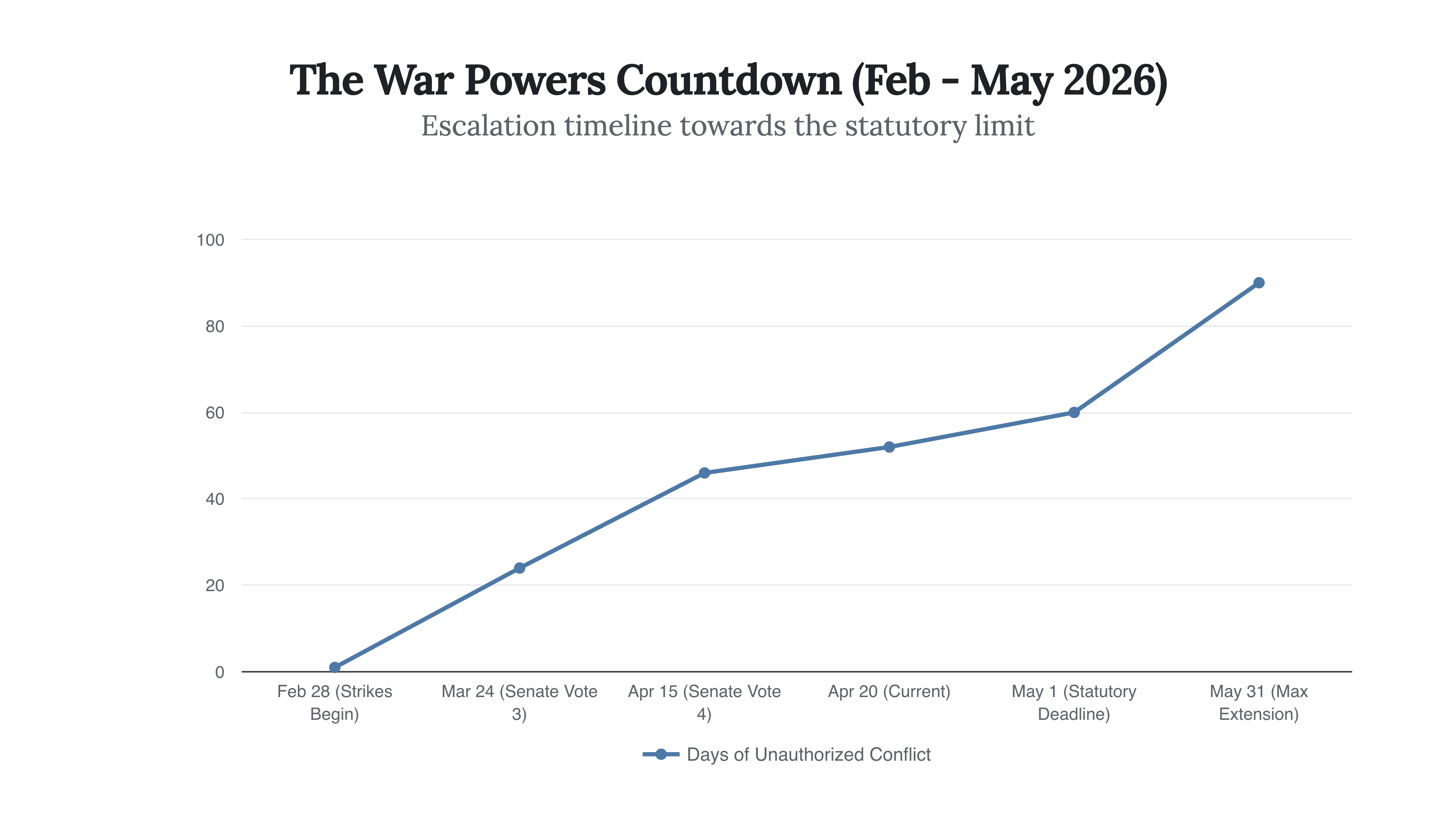
The War Powers Resolution of 1973 was designed in the shadow of Vietnam to prevent precisely the scenario unfolding today: an open-ended, executive-driven war of attrition. The law operates as a strict chronological constraint. Once a president introduces U.S. forces into imminent hostilities, a 60-day countdown begins. If Congress does not explicitly declare war or pass an Authorization for Use of Military Force (AUMF) by the end of that window, the military must stand down and withdraw.
That 60-day mark arrives on May 1, 2026.
Think of the War Powers Act like a corporate board granting a CEO an emergency credit card. The CEO can swipe the card unilaterally to handle a sudden crisis—in this case, the February 28 strikes intended to preemptively degrade Iranian nuclear ambitions and terror network financing. But after 60 days, the board must vote to either pay the bill or freeze the account. By voting down the resolutions in mid-April, the Senate and House essentially refused to freeze the account on Day 47. But the May 1 billing cycle is an inescapable legal reality.
Moderate Republicans, including Senators Susan Collins, Thom Tillis, and Lisa Murkowski, have made their strategic positioning explicitly clear. They held the line in April to preserve operational security and executive leverage, but they are publicly signaling that their compliance expires on Day 60. They expect the administration to either formally request an AUMF or present a verifiable diplomatic off-ramp.
Unlock deeper strategic alpha with a 10% discount on the annual plan.
Support the data-driven foresight required to navigate an era of radical uncertainty and join a community of institutional-grade analysts committed to the truth.
The impending May 1st deadline is no longer just a legal technicality; it is a forced commitment device that will definitively unmask whether the administration possesses a cohesive exit strategy or is engaged in an open-ended regime change operation.
Geopolitical Friction and The Costs of Asymmetry
While Washington debates constitutional law, the tactical reality on the ground is rapidly degrading. The U.S. military has initiated a blockade of Iranian ports, fundamentally restructuring maritime traffic and energy logistics in the Persian Gulf. Meanwhile, the administration recently designated new targets on the Specially Designated Nationals (SDN) list through the Treasury’s Office of Foreign Assets Control (OFAC), attempting to squeeze Hezbollah financing and Iranian proxy networks via individuals tied to figures like Mohammad Hossein Shamkhani.
But these aggressive maneuvers carry steep negative externalities. As of Q2 2026, the conflict has already claimed the lives of at least 13 U.S. service members. The financial burn rate is accelerating, with defense analysts projecting that the White House will soon be forced to submit supplemental funding requests totaling hundreds of billions of dollars. And for the domestic consumer, the macroeconomic blowback is impossible to ignore: gasoline prices are soaring as markets price in the persistent threat of Iranian retaliation against energy infrastructure or a sustained closure of the Strait of Hormuz.
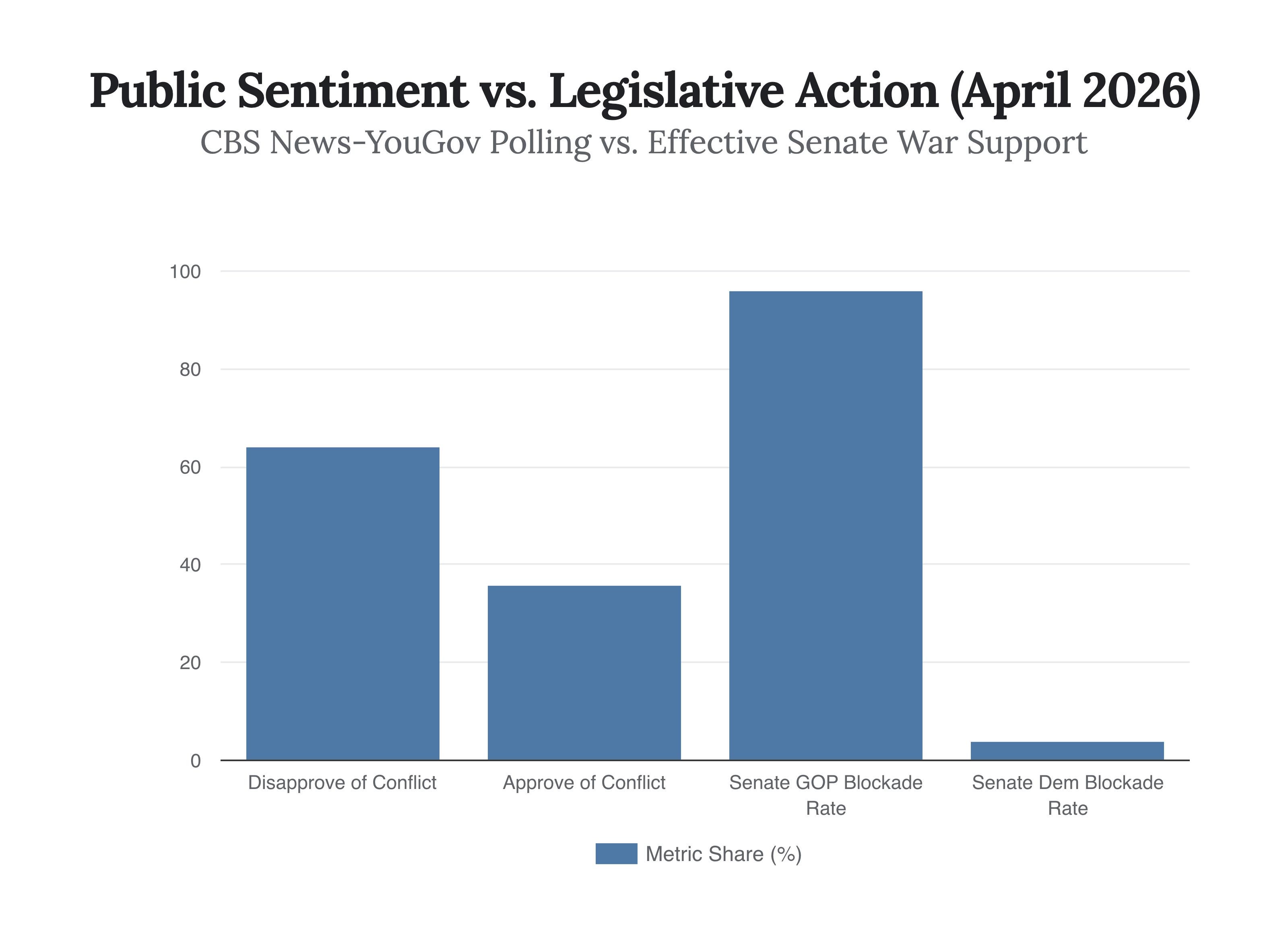
This creates a massive divergence between institutional backing and public sentiment. According to recent CBS News-YouGov polling data finalized in early April 2026, 64 percent of Americans disapprove of the administration’s handling of the conflict, compared to just 36 percent who approve. Lawmakers are highly sensitive to this asymmetry as they head toward the midterm campaign cycle. Representative Brian Mast (R-FL), chair of the House Foreign Affairs Committee, highlighted the hypocrisy of Democratic complaints, noting that the Biden administration operated against Houthi targets in Yemen in 2024 without explicit War Powers authorization. But historical equivalencies do little to soothe a public alarmed by apocalyptic rhetoric and climbing prices at the pump.
The Market Blindspot: A May Confrontation
If you couldn’t explain the core insight to a smart friend over dinner, you are overcomplicating it. Here is the dinner table reality: The U.S. government is legally required to stop fighting a war in two weeks unless Congress votes to officially start it. But Congress is deeply fractured, the public hates the war, and the President has shown no inclination to ask for a permission slip.
What happens if the executive branch simply ignores the May 1 deadline? The law permits a single 30-day extension if the president formally certifies that the time is an “unavoidable military necessity” required to safely withdraw troops. However, using a withdrawal extension to actively expand a blockade or launch new strikes would trigger an unprecedented constitutional showdown.
Markets are currently pricing in a localized kinetic conflict, but they are entirely blind to the constitutional collision course set for the first week of May, which threatens to freeze defense appropriations and trigger unprecedented domestic volatility.
If the administration defies the War Powers Act entirely, Congress’s ultimate recourse is the power of the purse. But cutting off funding for troops engaged in active combat operations is the nuclear option of legislative politics—one that neither party wants to trigger. We are likely to see a frantic, last-minute push for a tailored, geographically constrained AUMF before May 1, designed to give the administration the legal cover to maintain the port blockades while forbidding a widespread ground invasion of Iranian territory.
Strategic Foresight for Q2 2026
Looking ahead to the final weeks of April 2026, institutional analysts should monitor three critical leading indicators. First, watch the rhetoric from Senate Majority Leader John Thune; his recent demands that the administration articulate a plan to “wind this down” signals that leadership patience is finite. Second, track the supplemental defense appropriations requests. A massive funding ask prior to May 1 will force Congress into a proxy vote on the war’s existence. Finally, monitor the fragility of the current two-week ceasefire. If Iran breaks the ceasefire before May 1, they will inadvertently hand the administration the exact “imminent threat” justification required to push an AUMF through a reluctant Congress.
The Senate’s 52-47 vote was not an endorsement of endless war. It was a stay of execution for the administration’s strategic ambiguity. But in geopolitics, as in constitutional law, the clock always runs out. May 1st is approaching, and the bill is finally coming due.