


The Silicon Rubicon
The architecture of planetary intelligence was not ordained by the inevitable march of scientific progress; it was violently forged by the unforgiving laws of economics. Looking back from our vantage point in 2031, the invisible, ubiquitous utility grid that powers personal superintelligence appears as a natural evolution of the internet infrastructure. But the foundation of this reality was deliberately engineered during a critical inflection point in the first quarter of 2026. Specifically, February 24, 2026, marks the temporal boundary where the monopolistic equilibrium of the artificial intelligence hardware market was irrevocably shattered. On that Tuesday, Meta Platforms and Advanced Micro Devices (AMD) executed a multi-year, multi-generation supply agreement that fundamentally rewired the geopolitical, financial, and infrastructural topology of global compute. This was not a standard vendor procurement order. It was a sovereign declaration of independence by a hyperscaler, a strategic maneuver designed to permanently sever the single-vendor dependency that had trapped the entire technology sector.
Meta committed to deploying an unprecedented 6 gigawatts of AMD Instinct GPUs—specifically customized variants based on the MI450 architecture—beginning in the second half of 2026. To truly grasp the physical scale of this commitment, one must recognize that 6 gigawatts is equivalent to the continuous energy output of six large-scale nuclear power reactors, dedicated entirely to the matrix multiplications that sustain artificial neural networks. But the brilliance of the maneuver was not embedded in the silicon itself; it was woven into the financial architecture of the alliance. The deal carried a nominal value of up to $60 billion, establishing it as the largest single hardware procurement in the history of the Magnificent Seven technology cohort. More critically, it was structurally bound by a performance-based warrant mechanism granting Meta the right to acquire up to 160 million shares of AMD common stock—an effective 10% equity stake—contingent on rigorous shipment milestones and an ambitious stock price target of $600 per share.
In the clinical lexicon of Game Theory, Meta executed a flawlessly timed defection from a punishing Nash Equilibrium. By directly subsidizing the only viable alternative to the reigning monopoly, Meta absorbed immense short-term friction to engineer a structural collapse in the cost of planetary compute. Before this moment, the global AI compute market was a strict oligopoly bordering on a pure monopoly. A single entity dictated the pace of innovation, the geographic allocation of supply, and the extraction of capital from the entire software ecosystem. Meta’s defection broadcasted a mathematically undeniable signal to the broader market: the era of single-vendor rent extraction had concluded. This intervention catalyzed a cascade of second-order effects across the global supply chain, forcing a brutal transition from closed, proprietary ecosystems to the heterogeneous, multi-vendor reality that defines the 2031 baseline.
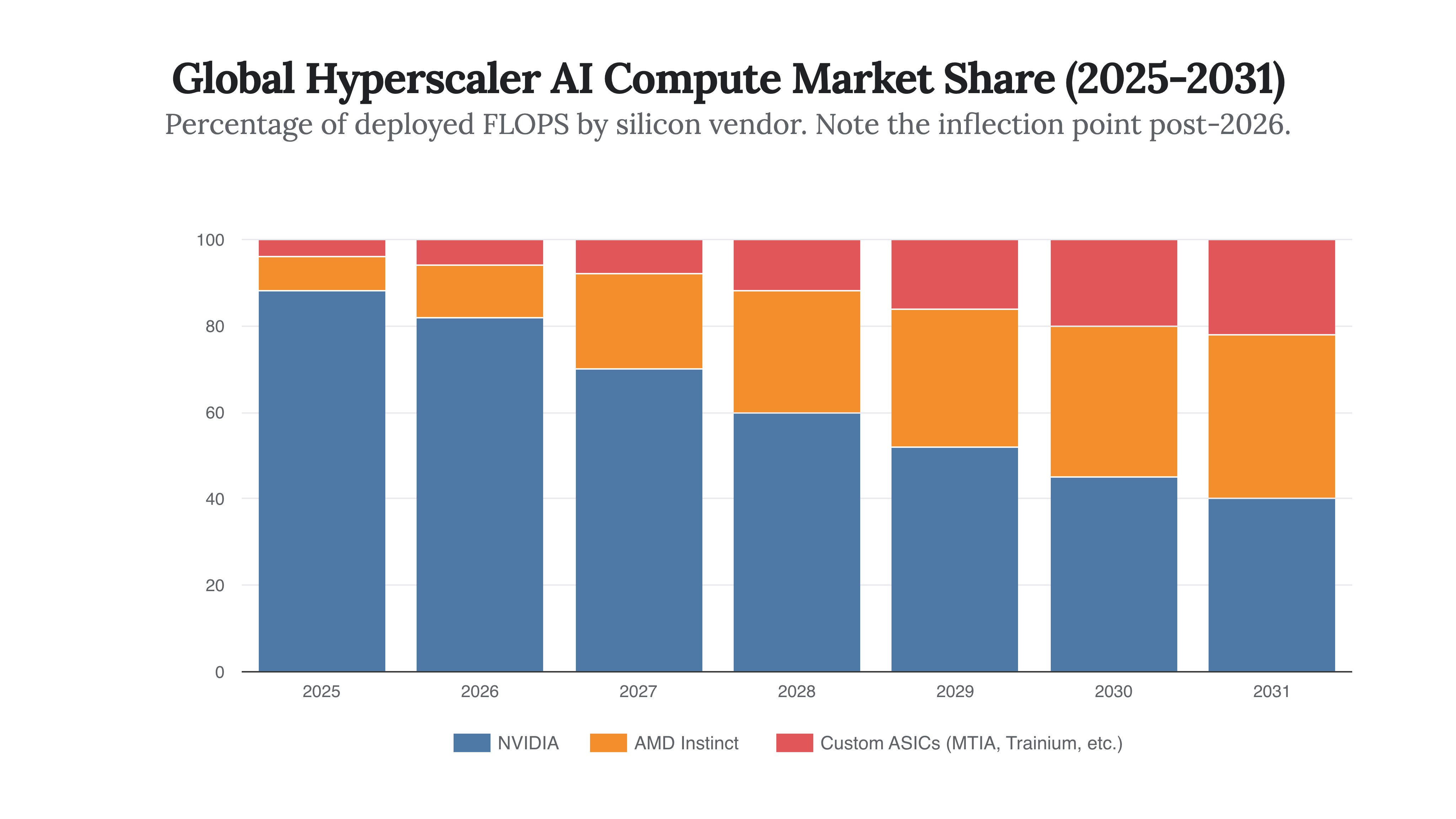
The immediate fallout was a repricing of risk across the semiconductor index. Analysts accustomed to linear projections of monopoly power were forced to frantically recalibrate their discounted cash flow models. What the market initially perceived as a desperate attempt by Meta to secure secondary supply was, in reality, a meticulously calculated restructuring of the industry’s unit economics. By weaponizing its colossal capital expenditure budget, Meta did not just buy hardware; it bought the very concept of market competition, ensuring that the future iterations of Llama would be trained and deployed in an environment where compute was a aggressively commoditized utility, rather than a luxury good hoarded by a single gatekeeper.
The Payoff Matrix and the Prisoner’s Dilemma
To understand the sheer necessity of the $60 billion AMD alliance, one must dissect the Payoff Matrix that governed the hyperscaler ecosystem between 2023 and early 2026. The technology titans—Meta, Microsoft, Google, and Amazon—were locked in a classic, multi-player Prisoner’s Dilemma. The “warden” in this scenario was the dominant silicon provider, Nvidia. The dominant strategy for any individual hyperscaler was to purchase the absolute highest-performance GPUs available (the H100s and subsequent Blackwell architectures) regardless of the extortionate pricing. To defect from this strategy—to buy cheaper, unproven silicon—was to risk falling behind in the frontier model arms race. If Meta paused its procurement to wait for a viable alternative, but Microsoft continued buying, Microsoft would capture the market for artificial general intelligence. Because every player feared the defection of the others, the Nash Equilibrium dictated that all players aggressively overpaid for identical hardware.
This dynamic created a pathological wealth transfer. Hyperscalers were expanding their capital expenditure (CapEx) budgets at an unsustainable velocity, with Meta alone projecting between $115 billion and $135 billion in infrastructure spend for the 2026 fiscal year. In a deeply asymmetric Zero-Sum Game, all the surplus value generated by the promise of AI was being captured not by the entities building the applications, but by the supplier of the foundational compute. The supplier was reporting gross margins exceeding 75%, an economic anomaly that screamed of unchecked monopoly power. The hyperscalers were cannibalizing their own balance sheets to subsidize the historic market capitalization of their vendor.
Mark Zuckerberg and the Meta infrastructure leadership realized that the only mechanism to escape this sub-optimal equilibrium was to unilaterally alter the rules of the game. They recognized that a monopoly cannot be negotiated with; it must be structurally dismantled through the creation of a heavily armed competitor. The $60 billion allocation to AMD was not a procurement expense, but a calculated defection tax paid to fundamentally destroy the pricing power of their primary supplier. By injecting guaranteed, decade-defining capital into AMD’s research and development pipeline, Meta converted a Zero-Sum supplier dynamic into a Non-Zero-Sum strategic alliance.
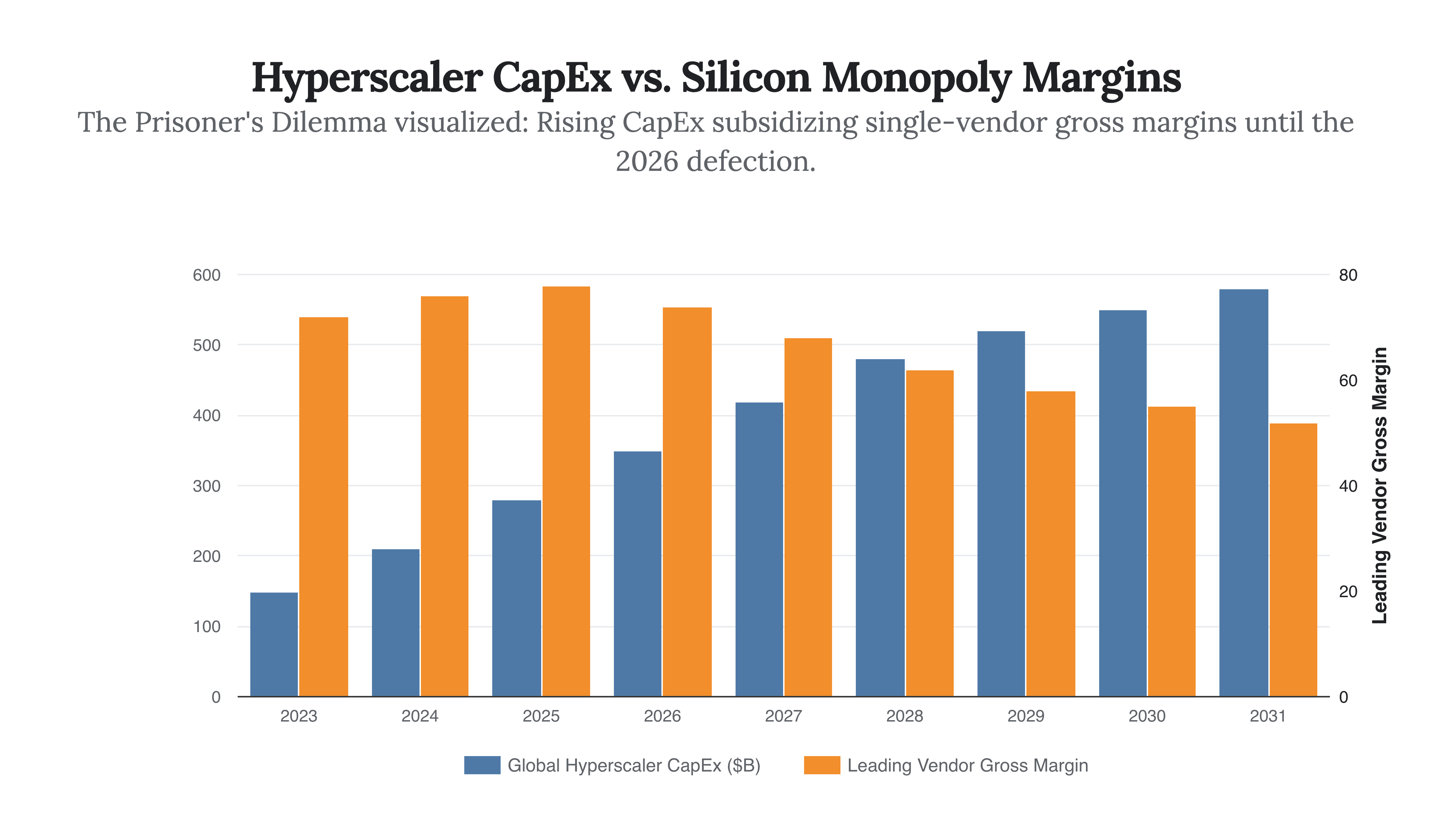
This intervention required absorbing massive short-term switching costs. Porting the vast, intricate web of Meta’s recommendation engines and Llama training runs away from the highly optimized, proprietary CUDA software stack and onto AMD’s ROCm architecture was a monumental engineering risk. But in the calculus of long-term survival, the friction of software refactoring was vastly cheaper than paying a permanent 75% margin tax on every floating-point operation. Meta effectively calculated that the Present Value of the tens of billions of dollars they would save through competitive pricing over the 2026-2031 horizon far outweighed the $60 billion they committed to AMD upfront. It was a masterstroke of corporate game theory that forced the rest of the industry to follow suit, permanently flattening the silicon yield curve.
The Hardware Reality: MI450 and the Helios Architecture
To execute a geopolitical-scale disruption of a market, the underlying physical technology must be unassailable. The $60 billion agreement was anchored precisely on the custom AMD Instinct GPU based on the MI450 architecture, co-engineered tightly with Meta’s internal silicon teams. While the media obsessed over the sheer dollar amount, the true intelligence value lay in the technical specifications and the strategic pivot they represented. The MI450 was not merely a faster processor; it was an architecture ruthlessly optimized for the specific endgame of the AI revolution: planetary-scale inference.
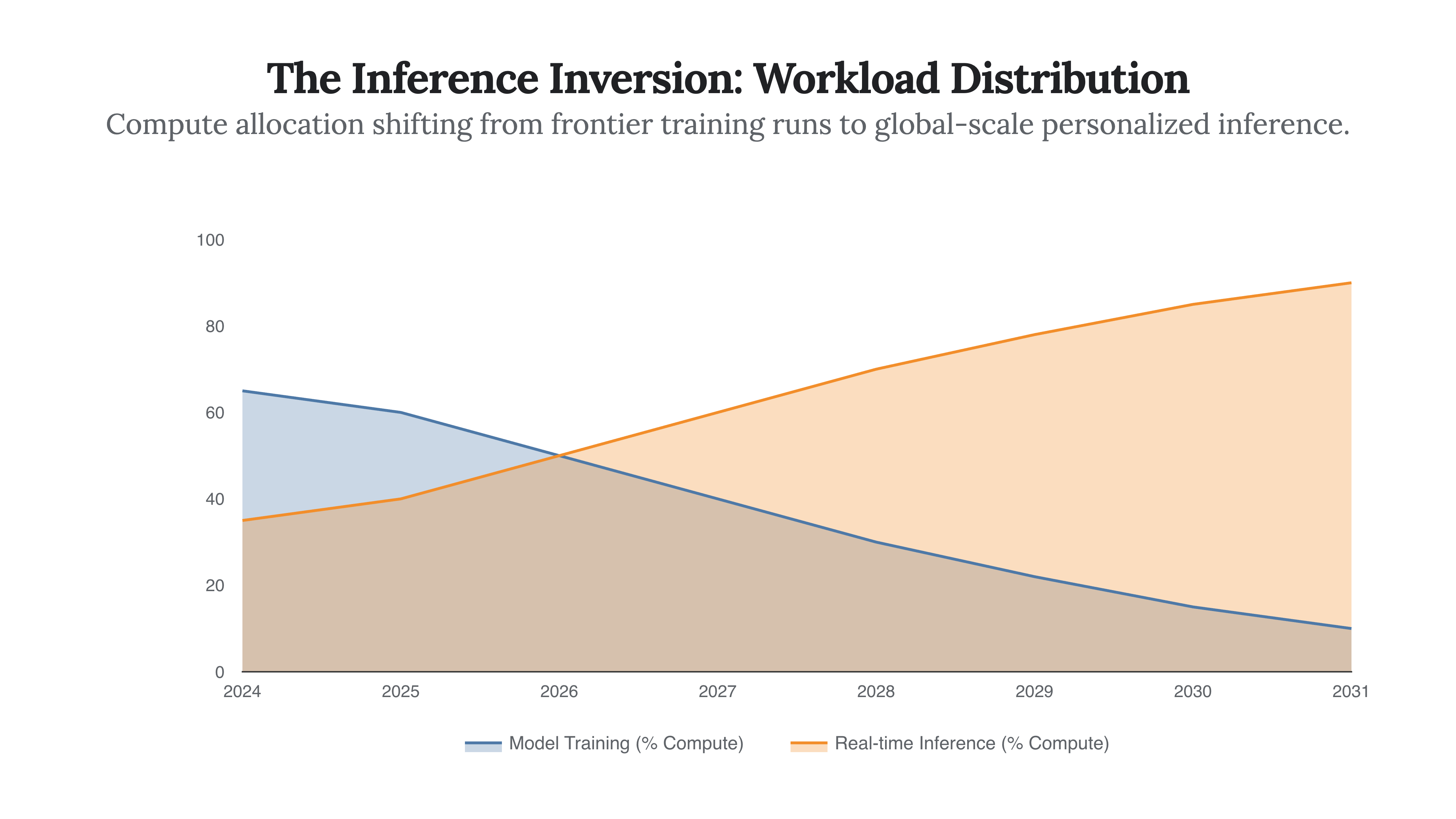
Prior to 2026, the hardware narrative was entirely dominated by “training”—the computationally brutal, months-long process of forcing a neural network to compress the internet into functional weights. Training required vast, tightly coupled supercomputers with proprietary, high-speed interconnects. However, as the frontier models matured, the economic center of gravity violently shifted toward “inference”—the process of running the trained model to generate real-time responses for billions of users. Training is a capital expenditure arms race; inference is an operational expenditure war of attrition. Meta, aiming to integrate “personal superintelligence” into WhatsApp, Instagram, and Ray-Ban smart glasses, faced a terrifying reality: running a multi-modal Llama 4 model for three billion daily active users using incumbent hardware would bankrupt the company in power and cooling costs alone.
The MI450, fabricated on a bleeding-edge 2-nanometer CDNA 5 node, was custom-tailored to solve this exact bottleneck. By incorporating massive 432 GB pools of next-generation HBM4 (High Bandwidth Memory), the chip solved the fundamental physics problem of large language models: they are memory-bandwidth bound, not compute-bound. By prioritizing memory bandwidth over raw theoretical compute, the MI450 was precision-engineered to win the only war that mattered: the unit economics of real-time inference. This allowed Meta to dramatically increase the “batch size” of simultaneous user queries a single GPU could handle, collapsing the cost-per-token by an order of magnitude.
Furthermore, these customized MI450s were deployed within the AMD Helios rack-scale architecture, an open-standard framework announced at the Open Compute Project (OCP) Global Summit. Rather than relying on closed, proprietary networking topologies designed to lock customers into a single vendor’s ecosystem, Helios utilized open standard ethernet and interoperable fabrics. Each Helios rack densely packed 72 GPUs, powered by 6th Gen AMD EPYC “Venice” CPUs, creating a modular, violently efficient infrastructure block that could be copy-pasted across Meta’s global data center fleet. This modularity was the critical prerequisite for scaling to the mind-bending target of 6 gigawatts of deployed compute.
The Warrant Mechanism and Subgame Perfect Equilibrium
The most sophisticated, and perhaps the most aggressive, component of the 2026 AMD-Meta pact was its financial engineering. A $60 billion supply agreement carries massive counterparty risk. If AMD failed to deliver the silicon on time, or if the 2nm yields were disastrous, Meta’s entire multi-year product roadmap would disintegrate. Conversely, if AMD committed billions to standing up new TSMC fabrication lines and Meta suddenly backed out or pivoted to a different architecture, AMD would face catastrophic inventory write-downs. This Information Asymmetry required a mechanism that flawlessly aligned the long-term survival of both corporate entities.
The solution was a performance-based warrant structure. AMD issued Meta the right to acquire up to 160 million shares of AMD common stock—roughly 10% of the company—at an exercise price of a singular penny ($0.01) per share. However, these warrants were heavily tranched, vesting only as rigorous, gigawatt-scale shipment milestones were achieved, and critically, requiring AMD’s stock price to hit escalating targets up to an astonishing $600 per share. (This mirrored a similar “circular transaction” AMD pioneered with OpenAI in October 2025, revealing a conscious strategy by AMD’s leadership to utilize corporate equity as a weapon to secure absolute hyperscaler loyalty).
The genius of the warrant structure is that it transformed a vendor into a hostage, mutually binding Meta and AMD in a high-stakes suicide pact where failure meant mutually assured destruction. In Game Theory, this establishes a Subgame Perfect Equilibrium. At every stage of the multi-year deployment, the optimal move for both players is absolute cooperation and maximum execution speed. Meta is deeply incentivized to write the best possible ROCm software optimization to make the MI450 sing, because doing so directly inflates the value of their massive equity position. Every percentage point of market share they help AMD steal from Nvidia directly enriches Meta’s balance sheet. Simultaneously, AMD is forced to treat Meta not as a customer, but as a board-level sovereign, granting them unprecedented access to the silicon design process to ensure the $600 stock price target is achieved.
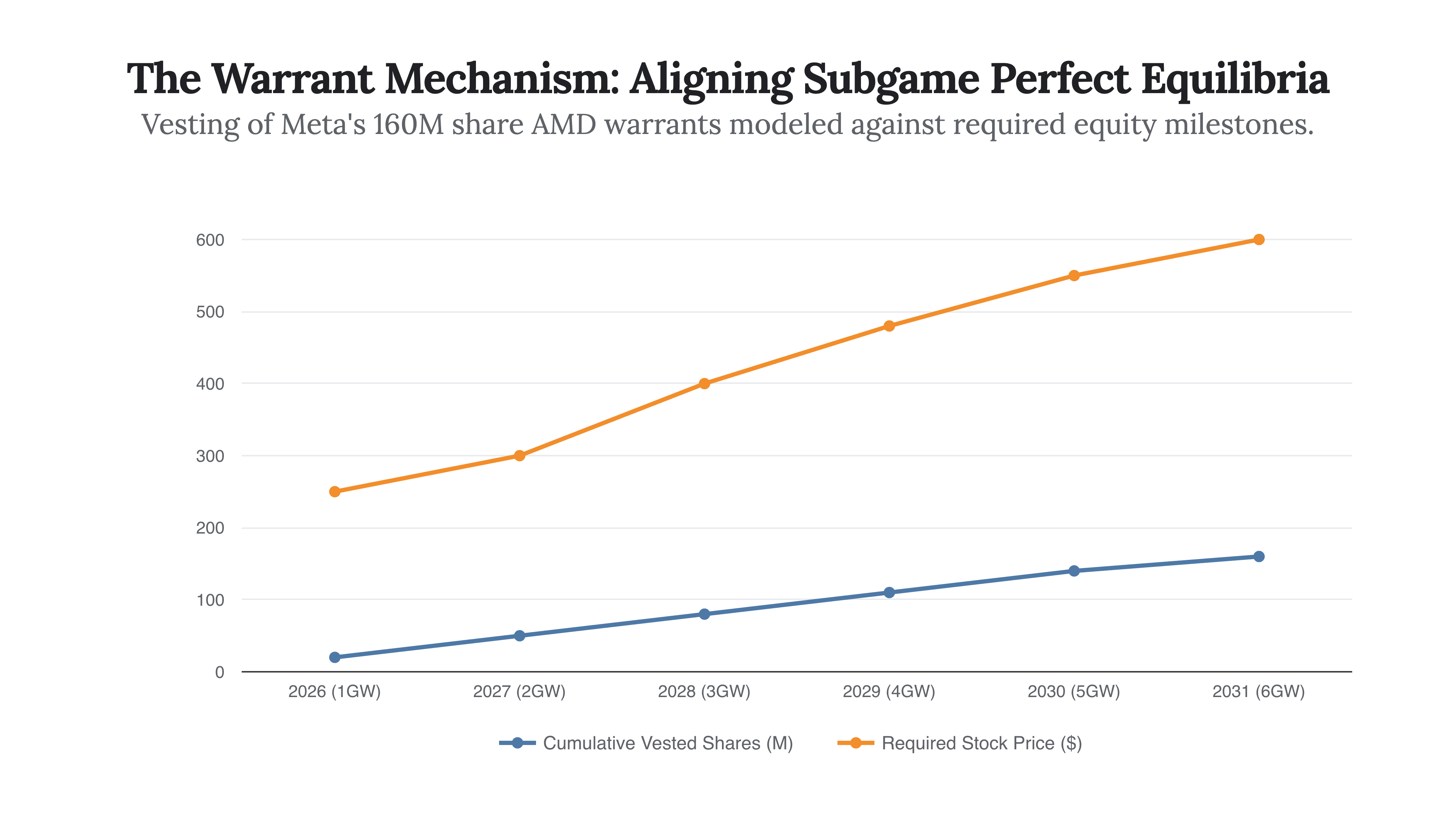
This circular economic model fundamentally altered the definition of capital expenditure. When Meta buys Nvidia chips, the cash leaves the company forever, captured as profit by a rival. When Meta buys AMD chips under this warrant structure, a significant portion of that capital expenditure is essentially recycled back onto Meta’s balance sheet as appreciating equity. It was a financial perpetual motion machine that allowed Meta to outspend its rivals in infrastructure while simultaneously hedging its own balance sheet against the crushing costs of the AI arms race.
Unlock deeper strategic alpha with a 10% discount on the annual plan.
Support the data-driven foresight required to navigate an era of radical uncertainty and join a community of institutional-grade analysts committed to the truth.
