


In a strategic pivot that has redefined the global energy landscape, the OPEC+ alliance, responsible for nearly half of the world’s oil production, has methodically begun to dismantle the colossal 5.86 million barrels per day (bpd) production cut that has propped up prices since late 2022. This is not a surrender, but a calculated recalibration.
The group, steered by Saudi Arabia and Russia, is walking a tightrope: attempting to claw back market share from rivals like the U.S. shale industry without triggering a catastrophic price collapse. The year 2025 marks the inflection point where the alliance’s focus shifts from price preservation to a more aggressive, forward-looking strategy aimed at reasserting its dominance. However, this high-stakes maneuver is fraught with internal and external risks, from wavering compliance within its own ranks to the specter of a global economic slowdown that could evaporate demand. This briefing deconstructs the intricate mechanics of OPEC+’s 2025 strategy, analyzes the deep-seated tensions shaping its decisions, and provides a forward-looking assessment of the winners, losers, and critical signposts for the turbulent year ahead.
The Great Unwinding: Deconstructing the 2025 Production Pivot
The core of the OPEC+ 2025 strategy is the gradual and flexible unwinding of a complex, three-tiered system of production cuts. These cuts, totaling a massive 5.86 million bpd—roughly 5.7% of global demand—were initially implemented to stabilize a volatile post-pandemic market. The process of reversing these cuts is not a simple flick of a switch but a meticulously phased rollback designed to test market elasticity at every step.
From Deep Cuts to Measured Increases
The unwinding began in earnest in April 2025, targeting the 2.2 million bpd of “voluntary” cuts shouldered by a core group of eight influential members: Saudi Arabia, Russia, Iraq, the UAE, Kuwait, Kazakhstan, Algeria, and Oman. The initial plan involved adding back supply in monthly increments, which have varied as the group assesses market reaction, starting with accelerated increases of 411,000 bpd for May, June, and July. Later in the year, adjustments became more cautious, with a 547,000 bpd increase in September followed by a smaller 137,000 bpd increment for November, signaling a responsive and data-driven approach. This gradual return of barrels is a clear signal that the alliance is shifting its priority from simply defending a high price floor to actively managing its market share. The entire rollback of the 2.2 million bpd cut is now slated to be phased out monthly until the end of September 2026, a timeline that remains flexible and subject to reversal if market conditions sour.
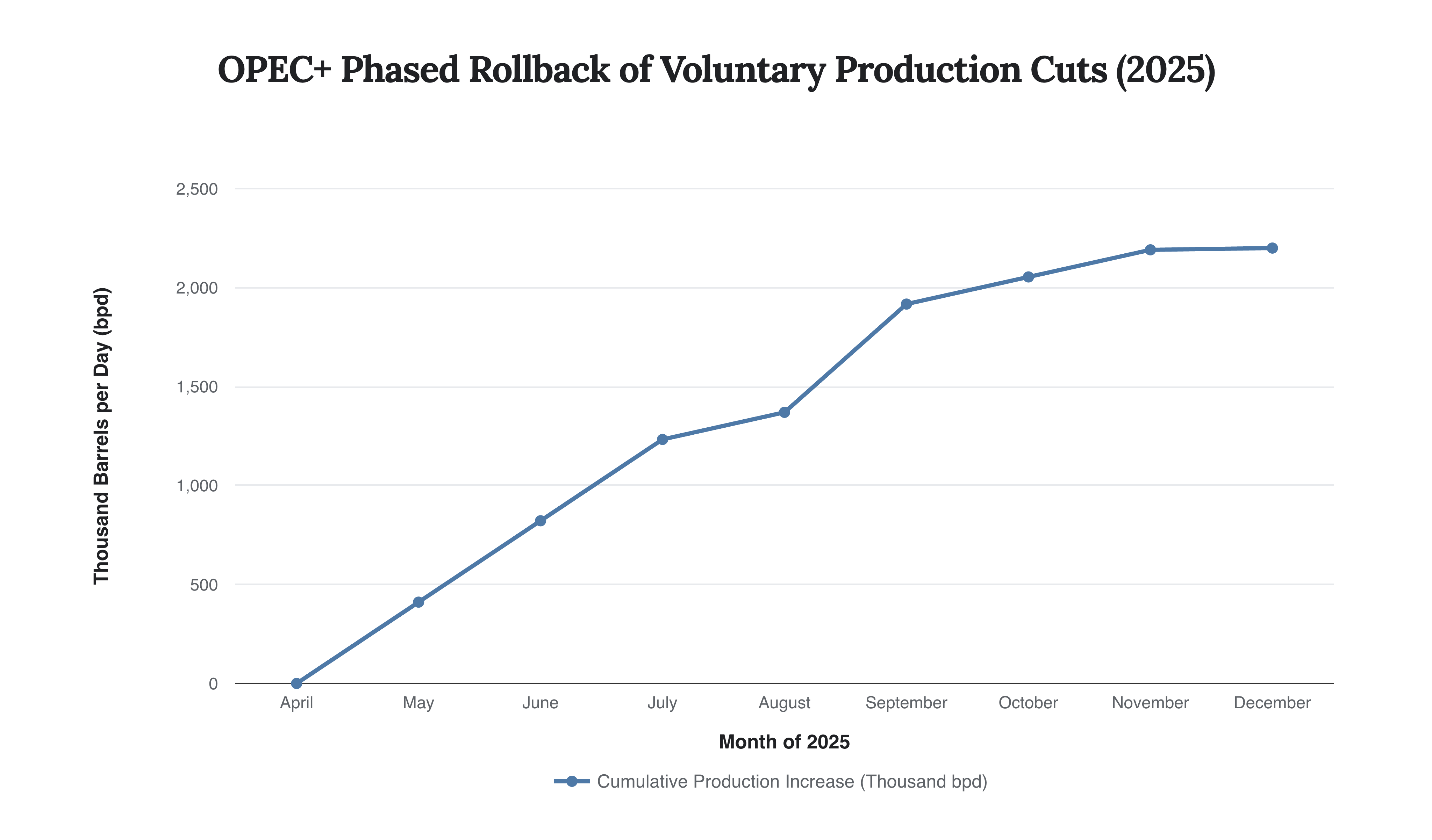
Caption: This chart illustrates the planned cumulative increase in oil production by the eight core OPEC+ members throughout 2025 as they begin to unwind their 2.2 million bpd voluntary cuts.
The Compliance Conundrum
A persistent thorn in the side of OPEC+ strategy is the issue of quota compliance. While the headline figures suggest a united front, several members have consistently produced above their allocated levels. Nations like Iraq and Kazakhstan, heavily reliant on oil revenues to meet domestic budget needs, have been notable overproducers. In March 2025, reports indicated that despite pledges to compensate, this overproduction has historically been a point of contention and weighs on the credibility of the group’s agreements. This internal friction is a critical vulnerability. The decision to gradually increase production can be seen, in part, as a “subtle disciplinary mechanism”—an acknowledgment of the reality of overproduction while trying to maintain a semblance of collective control. The group’s Joint Ministerial Monitoring Committee (JMMC) now holds monthly meetings to scrutinize conformity and compensation plans, reflecting the high priority placed on reining in rogue production.
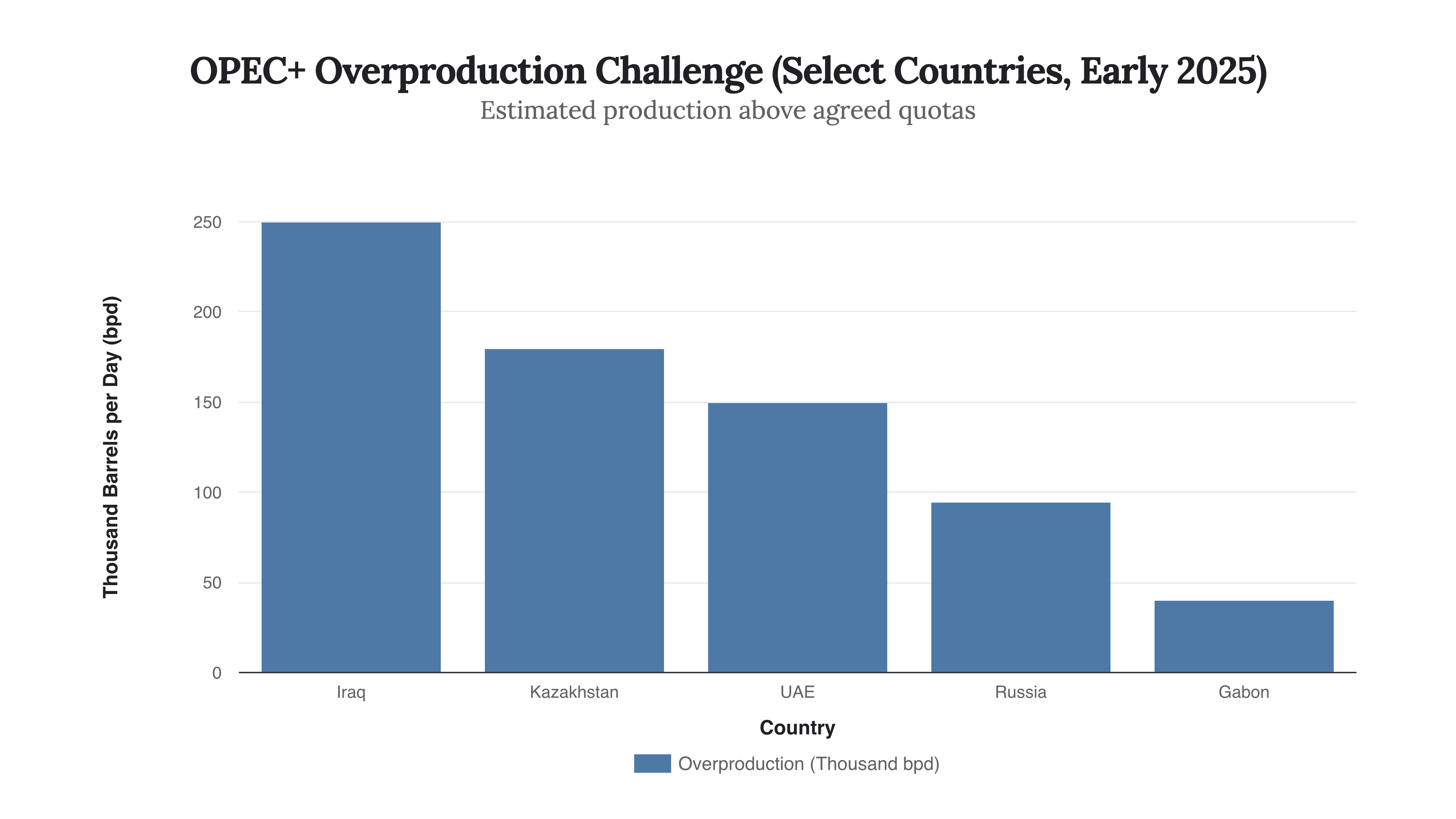
Caption: This chart highlights the persistent issue of overproduction within the alliance, showing estimated output above quotas for key members in early 2025, a challenge the group is actively trying to manage.
The Geopolitical Chessboard: Market Share vs. Price Stability
The 2025 strategy is fundamentally a response to shifting dynamics on the global supply stage. For years, OPEC+’s production cuts created a price umbrella that inadvertently benefited non-member producers, most notably the resilient U.S. shale industry. The unwinding of cuts is a direct challenge to these high-cost producers, aiming to squeeze their margins and reclaim lost market share.
Targeting U.S. Shale
The strategic calculus is clear: by carefully increasing supply and keeping a lid on prices—with Brent crude hovering around $65 per barrel and WTI in the low $60s—OPEC+ hopes to make new investments in U.S. shale less attractive. Many shale operations require prices in the $60-$70 per barrel range to be profitable. The alliance’s actions appear to be having an effect, with forecasts anticipating a rare 1.1% contraction in U.S. shale production in 2025. This demonstrates a sophisticated, long-term strategy to manage the competitive landscape by leveraging its lower production costs.
“This shift in policy after years of cuts is designed to regain market share from rivals such as US shale producers.”
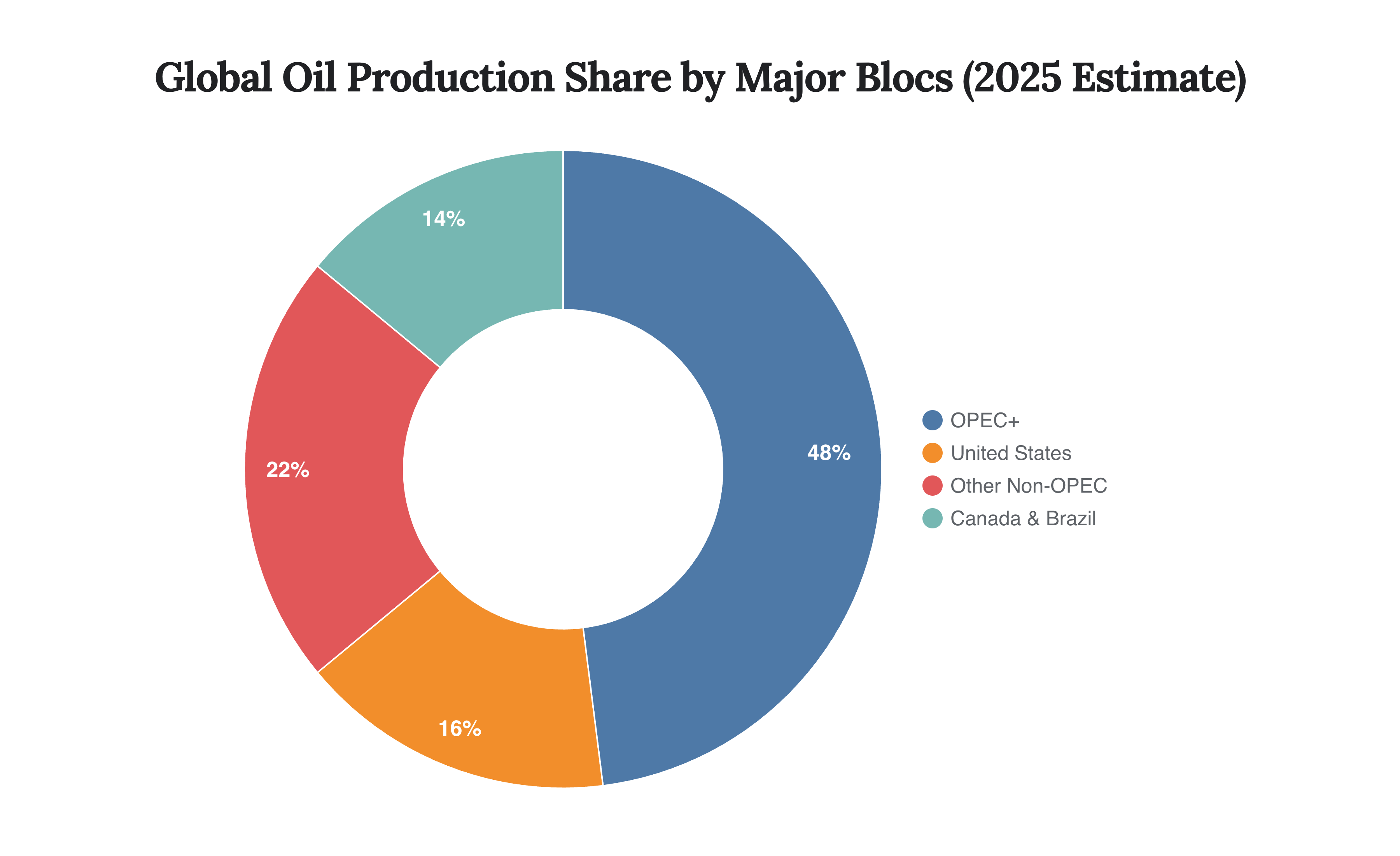
Caption: This chart shows the estimated breakdown of global oil production, underscoring the dominant 48% market share held by the OPEC+ alliance, which it seeks to defend and expand.
The Demand Dilemma and Dueling Forecasts
The entire strategy hinges on one critical variable: the strength of global oil demand. Here, the outlook is murky, with major forecasting agencies presenting divergent views. OPEC has consistently maintained a more bullish forecast for demand growth in 2025, projecting an increase of around 1.3 million bpd. In stark contrast, the International Energy Agency (IEA) offers a more sober outlook, forecasting growth of only 730,000 bpd, citing economic headwinds and trade disruptions. This analytical divide is at the heart of the risk OPEC+ is undertaking. If the IEA’s more pessimistic forecast proves correct, the alliance’s scheduled production increases could tip the market into a significant surplus, exerting severe downward pressure on prices. Recognizing this risk, the group has paused planned supply increases for the first quarter of 2026 and emphasized that the phase-out can be paused or reversed at any time.
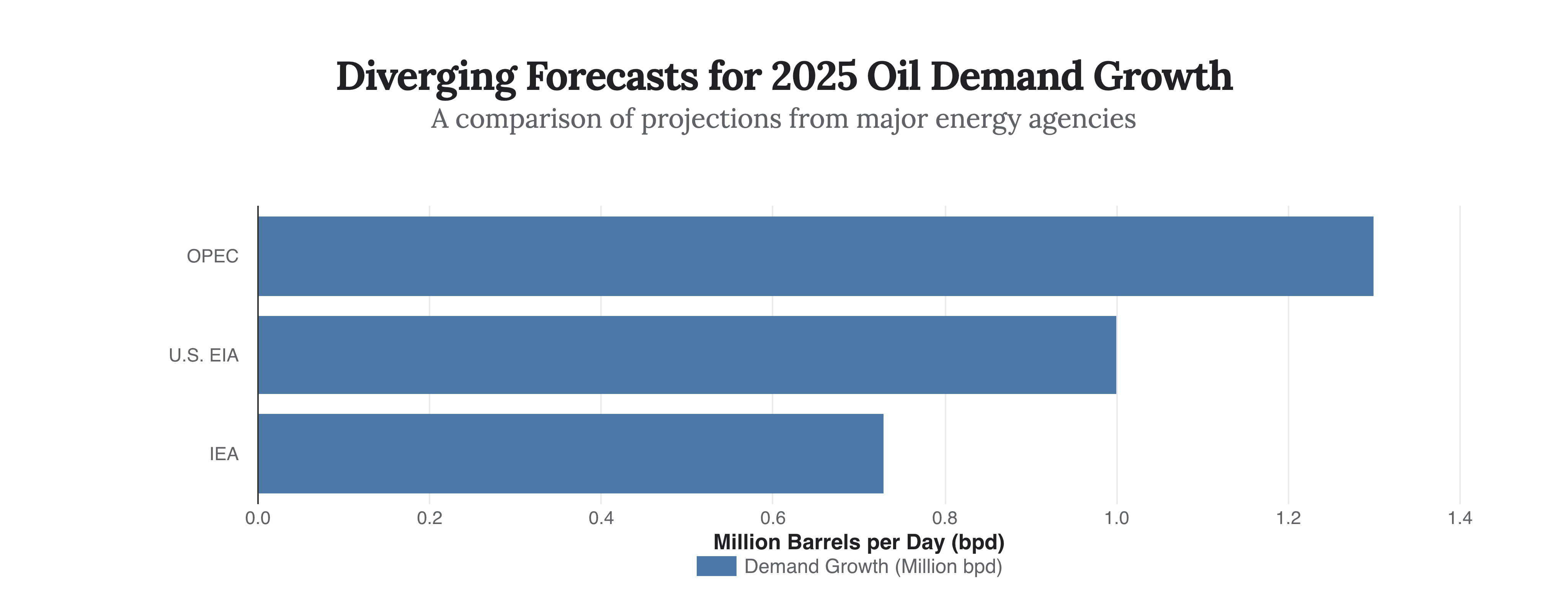
Caption: The significant gap in 2025 oil demand growth forecasts between OPEC and the IEA highlights the profound uncertainty facing the market, a key risk factor for the OPEC+ strategy.
Fiscal Fault Lines: The Breakeven Balancing Act
Beneath the unified policy announcements lie the diverse and often competing economic realities of the member states. The price of oil required to balance national budgets—the fiscal breakeven price—varies dramatically across the alliance, creating underlying tensions that complicate decision-making.
The High Cost of Stability
For a leader like Saudi Arabia, the stakes are enormous. The Kingdom requires an oil price of approximately $81 per barrel in 2025 to balance its budget, which funds ambitious economic diversification projects under its Vision 2030 plan. This high breakeven point means that any prolonged period of prices in the $60s, while strategically effective against competitors, will strain its national finances. Russia, facing Western sanctions, has a lower breakeven point of around $68 per barrel but faces its own unique challenges in monetizing its output. This disparity explains the sometimes-conflicting preferences within the group, with Riyadh often pushing for measures that support higher prices while Moscow may prioritize volume and market share.
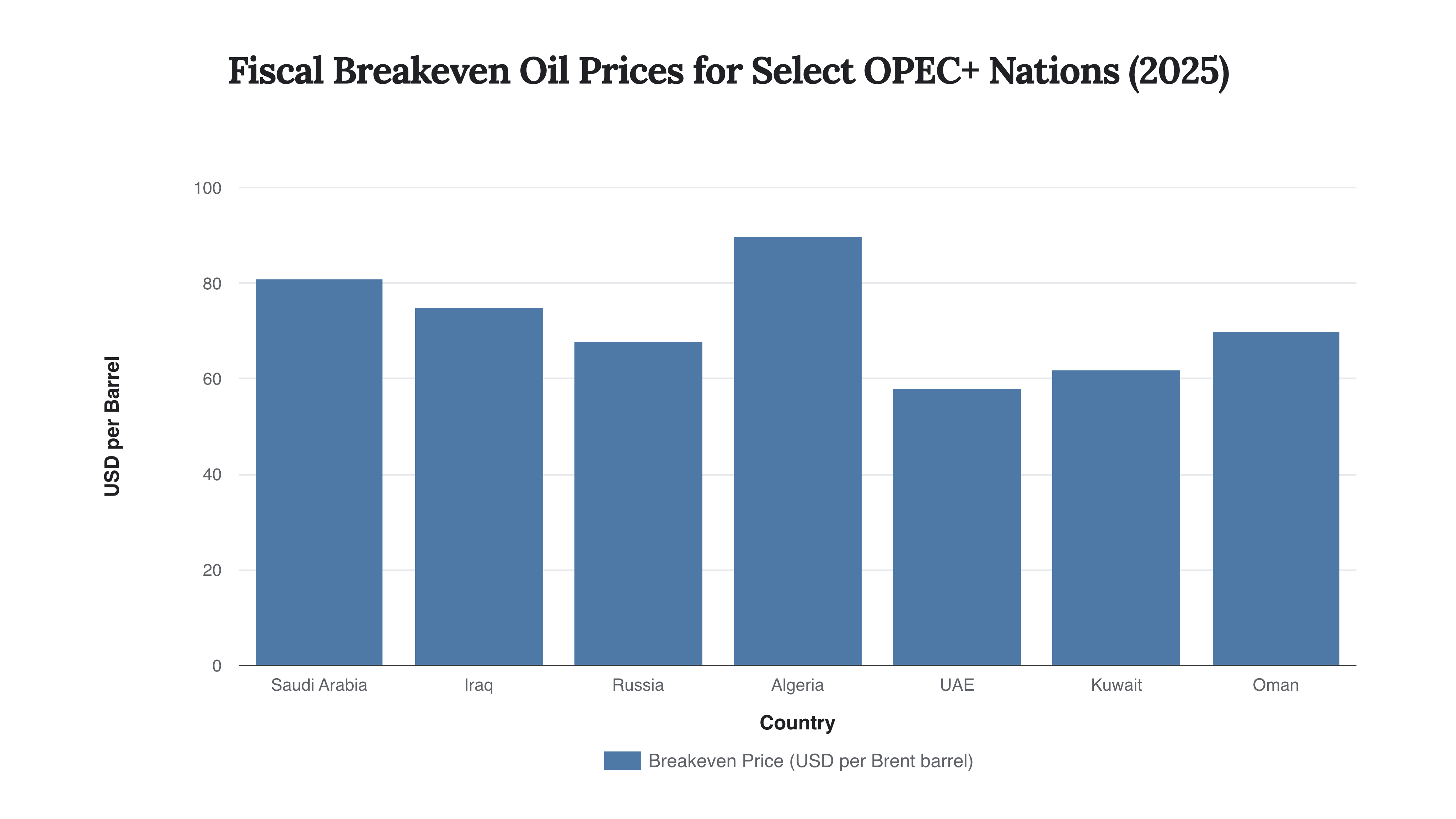
Caption: The wide range of fiscal breakeven oil prices among key OPEC+ members in 2025 illustrates the internal economic pressures that influence the group’s collective production decisions.
Spare Capacity: The Ultimate Leverage
A key instrument of power within the alliance is spare production capacity—the ability to quickly bring additional barrels to market. Only a few members hold this card. Saudi Arabia leads with an estimated 3.0-3.5 million bpd of spare capacity, followed by the UAE and Iraq. Most other members are already producing at or near their maximum sustainable levels. This concentration of spare capacity gives the Gulf states immense leverage in negotiations and reinforces their role as the true market swing producers, capable of steering policy and absorbing shocks.
Strategic Outlook: Navigating the Path to 2026
As OPEC+ navigates the second half of 2025 and looks toward 2026, its strategy will be defined by its reaction to three critical factors: the trajectory of global demand, the resilience of non-OPEC supply, and the discipline of its own members. The decision to pause production hikes in early 2026 already signals a recognition that a supply surplus is a credible threat.
Mike Wirth, CEO of Chevron, stated in an interview with the media: “A significant amount of oil supply from OPEC+ countries is returning to the market, and it appears we are entering a period where supply will exceed the ability of demand to absorb it.”
The alliance has built flexibility into its plan, with monthly meetings allowing for rapid course correction. If demand proves weaker than OPEC’s optimistic forecasts, expect a swift pause or even a reversal of the planned production increases. Conversely, if demand surprises to the upside or geopolitical disruptions tighten the market, the group has the capacity to accelerate the return of barrels. The key signpost for investors and policymakers will be the rhetoric coming out of the monthly JMMC meetings and the official statements from the energy ministers of Saudi Arabia and Russia, which will signal the alliance’s latest reading of market fundamentals.
The grand pivot of 2025 is a testament to OPEC+’s evolution into a dynamic and proactive market manager. It has moved beyond the simple defense of a price floor to a complex, multi-front campaign to secure its long-term relevance in a rapidly changing energy world. The success of this strategy is far from guaranteed, and the path is laden with economic and geopolitical risk.
The core challenge remains balancing the conflicting timelines of national budgets, which demand high prices now, against a long-term market share strategy that may require price discipline for the foreseeable future.