


Yesterday, the AI landscape shifted beneath our feet, not with a roar, but with a quiet, efficient update from Hangzhou. On December 1, 2025, DeepSeek released its V3.2 reasoning models, cementing a trend that has defined the last twelve months: the absolute commoditization of high-level machine intelligence. But the real story isn’t just the model; it is the interface of reasoning itself.
For most of the generative AI boom, “reasoning”—the ability of a model to pause, chain logical steps, and self-correct before answering—was a luxury feature. It was the “Pro” tier, the black box that justified subscription fees north of $200 a month for enterprise API access. DeepSeek has systematically dismantled this hierarchy. By offering a transparent “DeepThink” interface that visualizes the model’s hidden chain-of-thought process, they haven’t just lowered the price; they have demystified the product.
The numbers are startling. In an industry obsessed with margins, DeepSeek has introduced a pricing structure so aggressive it looks less like competition and more like a market correction. The chart below visualizes the staggering cost disparity between accessing OpenAI’s o1 reasoning tier and DeepSeek’s R1 equivalent.
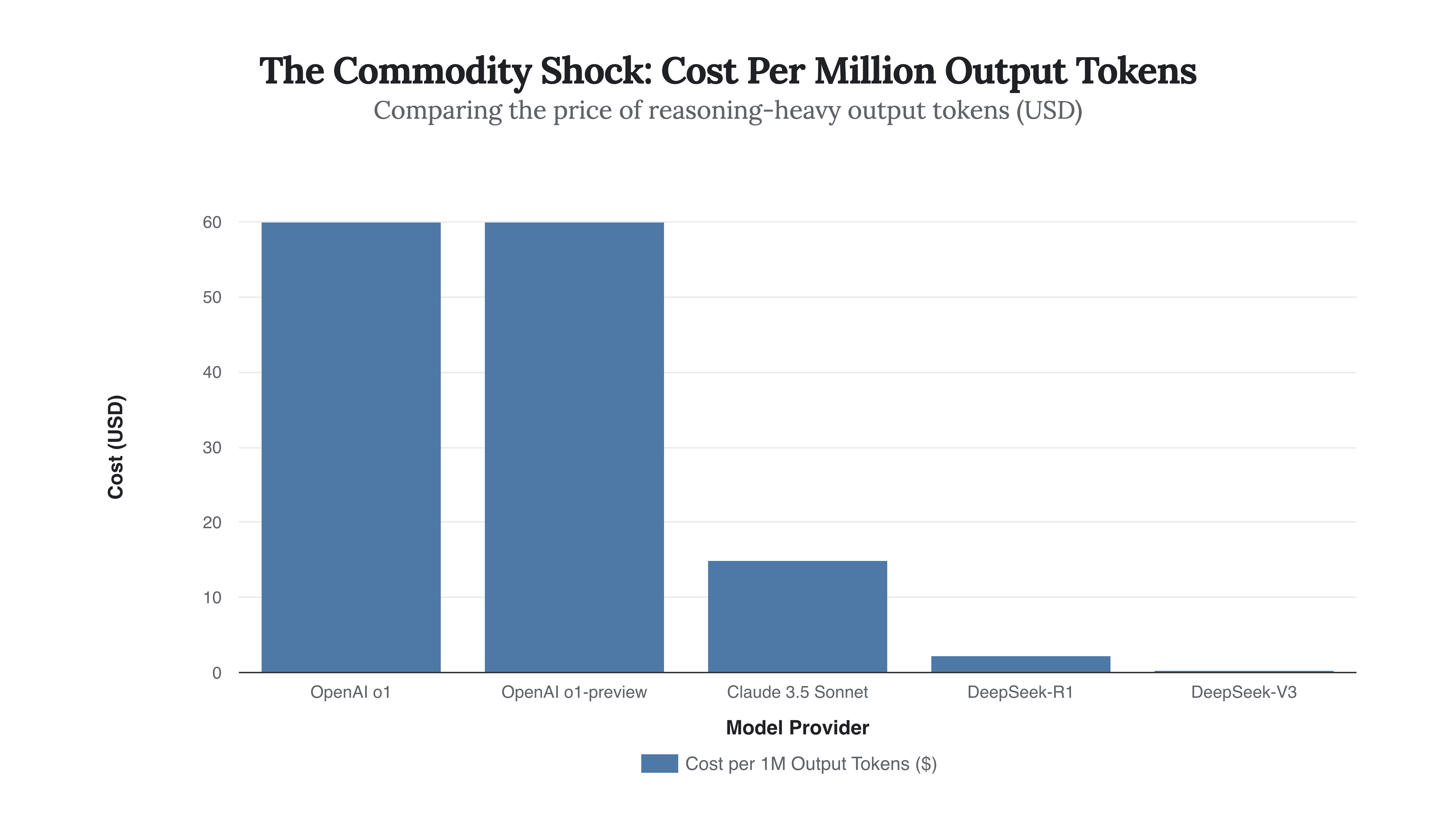
This is not a marginal discount; it is a 27-fold price reduction for the most expensive compute resource in the AI supply chain: the output token. For developers and researchers, this $57.81 price difference per million tokens changes the fundamental economics of building AI applications. It transforms reasoning from a scarce resource to be rationed into a utility that can be deployed at scale.
“DeepSeek-R1 focuses on transparency—giving developers and decision-makers a clear view of its logical steps, enabling better validation. What’s jaw-dropping is that DeepSeek-R1 not only talks the talk... it walks the walk.”
However, a race to the bottom in price usually implies a sacrifice in quality. The “cheap” option is historically the “dumb” option. This is where DeepSeek’s 2025 run becomes truly disruptive. The interface does not merely serve up cheap text; it serves up elite-level logic. The “DeepThink” toggle available in the app and API allows users to expand and inspect the model’s internal monologue, revealing a reasoning chain that rivals the world’s most closed and expensive systems.
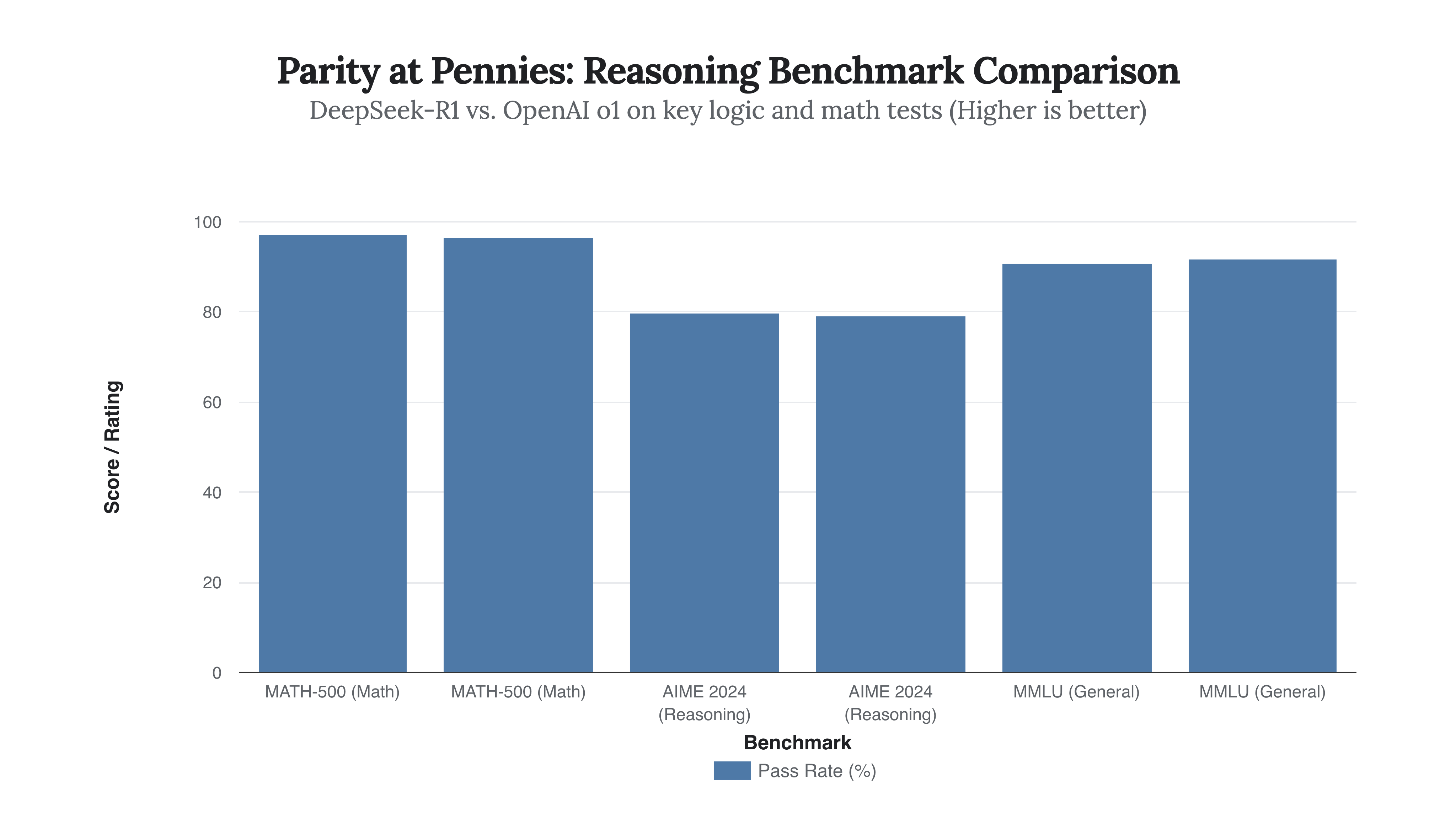
When we analyze the benchmark performance of the R1 reasoning model against its primary competitor, OpenAI’s o1, the data reveals a near-perfect parity. In the AIME 2024 (mathematical reasoning) and MATH-500 benchmarks, the “budget” model actually edges out the premium incumbent.
The interface itself has evolved to support this high-level cognition. The mobile app’s “DeepThink” mode doesn’t just spin a loading wheel; it streams the thought tokens in real-time. This transparency addresses a critical psychological barrier in AI adoption: trust. By seeing the model catch its own errors—literally outputting text like “Wait, that calculation is incorrect, let me re-verify”—users are less likely to be hallucinated into a false sense of security.
The December 2025 release of DeepSeek-V3.2 has further refined this, introducing “Thinking in Tool-Use,” where the model plans its interaction with external software APIs before executing them. This is the difference between a chatbot that blindly guesses a command and an agent that deliberates on the consequences.
“DeepSeek-R1 is particularly well-suited for tasks that require deep technical and scientific reasoning... making it a strong choice for research-oriented applications.”
We are witnessing the end of the “intelligence premium.” As we move into 2026, the value of an AI model will no longer be defined by its ability to reason—which is now effectively free—but by how seamlessly that reasoning is integrated into human workflows. DeepSeek’s interface, with its radical transparency and aggressive pricing, has set a new standard. Intelligence is no longer a luxury good; it is a commodity, and the price is dropping fast.