


The Architect and the Iconoclast: An Alliance Reshaping the West
The meeting between U.S. President Donald Trump and Hungarian Prime Minister Viktor Orbán in the White House transcends typical diplomatic engagement. It marks the convergence of two political movements that fundamentally challenge the post-Cold War liberal international order. This is not merely a meeting of allies, but a summit between an architect and an iconoclast—Orbán, the architect of a self-described “illiberal state” within the European Union, and Trump, the iconoclast intent on deconstructing long-standing norms of American foreign policy.
Orbán’s Hungary provides a tested, real-world model for the nationalist, anti-globalist, and sovereignty-focused policies a second Trump administration is poised to pursue. The core of their alignment is a shared belief that the nation-state, not international bureaucracy, is the ultimate arbiter of its own destiny. Their White House discussions signal a formalization of this transatlantic axis, with profound implications for security alliances, global trade, and the ideological struggle between liberal democracy and a rising tide of national conservatism.
A Shared Worldview: Sovereignty, Tradition, and the ‘Deep State’
At the heart of the Trump-Orbán relationship is a deep ideological sympathy. Both leaders have built their political brands on a rejection of what they term “globalism,” a critique of supranational institutions like the European Union and the United Nations, and a staunch defense of national sovereignty. They share a vocabulary of grievance against liberal elites, a so-called “deep state,” and progressive cultural shifts. Orbán’s vision, which he began articulating over a decade ago, involves re-centering Hungarian policy on Christian cultural foundations, strict immigration controls, and the protection of the traditional family. This platform has found a powerful echo in Trump’s “America First” movement. The Varieties of Democracy (V-Dem) Institute’s Liberal Democracy Index starkly illustrates Hungary’s trajectory under Orbán, showing a significant divergence from its Western European counterparts. This ideological convergence makes Orbán not just a foreign ally for Trump, but a proof of concept.
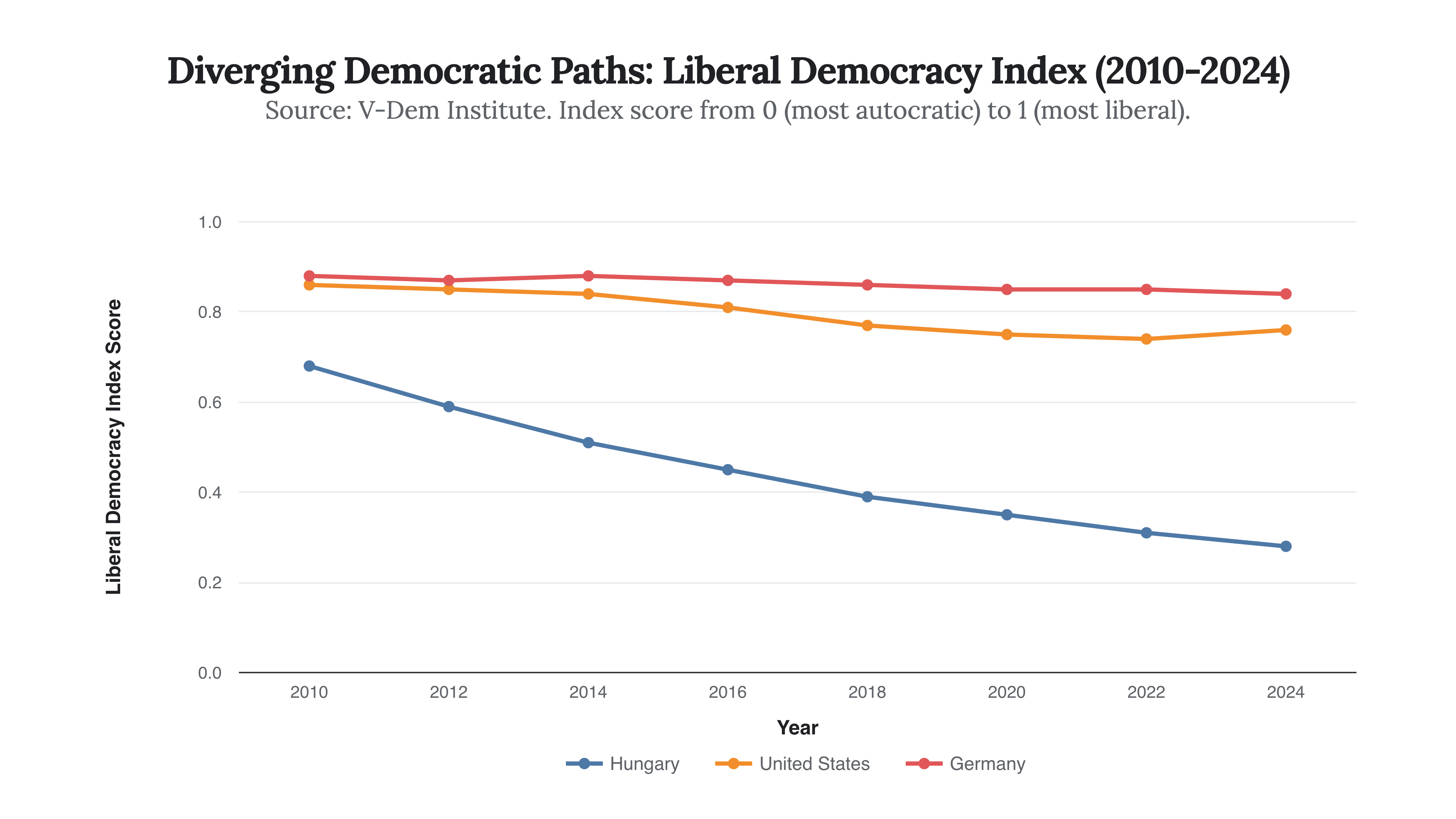
This chart traces the significant decline in Hungary’s liberal democracy score since 2010, contrasting it with the relative stability of Germany and the more moderate decline in the United States. It provides a quantitative basis for understanding the political transformation in Hungary that has made it a model for nationalist movements elsewhere.
Rewiring Alliances: The ‘Eastern Opening’ and the NATO Doctrine
A central pillar of the Trump-Orbán agenda is the radical rethinking of legacy alliances, particularly NATO. Trump has long criticized member states for failing to meet their defense spending commitments, viewing the alliance through a transactional lens. Orbán, while a NATO member, has pursued a foreign policy of strategic autonomy, famously dubbed the “Eastern Opening.” This policy seeks to reduce economic dependence on the West by cultivating deep relationships with Eastern powers, namely Russia and China. For Orbán, this is a pragmatic economic strategy; for his critics, it makes Hungary a “Trojan horse” within both the EU and NATO. The meeting at the White House serves to validate Orbán’s approach on the world stage and signal that a Trump-led America may view such strategic diversification not as a betrayal, but as a sensible exercise of national sovereignty.
“We are sailing under a Western flag, though an Eastern wind is blowing in the world economy.” - Prime Minister Viktor Orbán
The 2% Transatlantic Bargain
President Trump’s insistence that NATO members pay their “fair share” has been a consistent theme of his foreign policy. He argues that the United States disproportionately shoulders the burden of European security. The data on defense spending reveals the source of this friction. While there has been a significant increase in spending since 2014, many allies still fall short of the 2% of GDP target, a fact that both Trump and Orbán use to critique the alliance’s current structure. Hungary itself has increased spending to meet the target, positioning itself as a responsible partner in Trump’s eyes, even as it pursues policies that challenge the alliance’s unity on other fronts, such as relations with Russia.
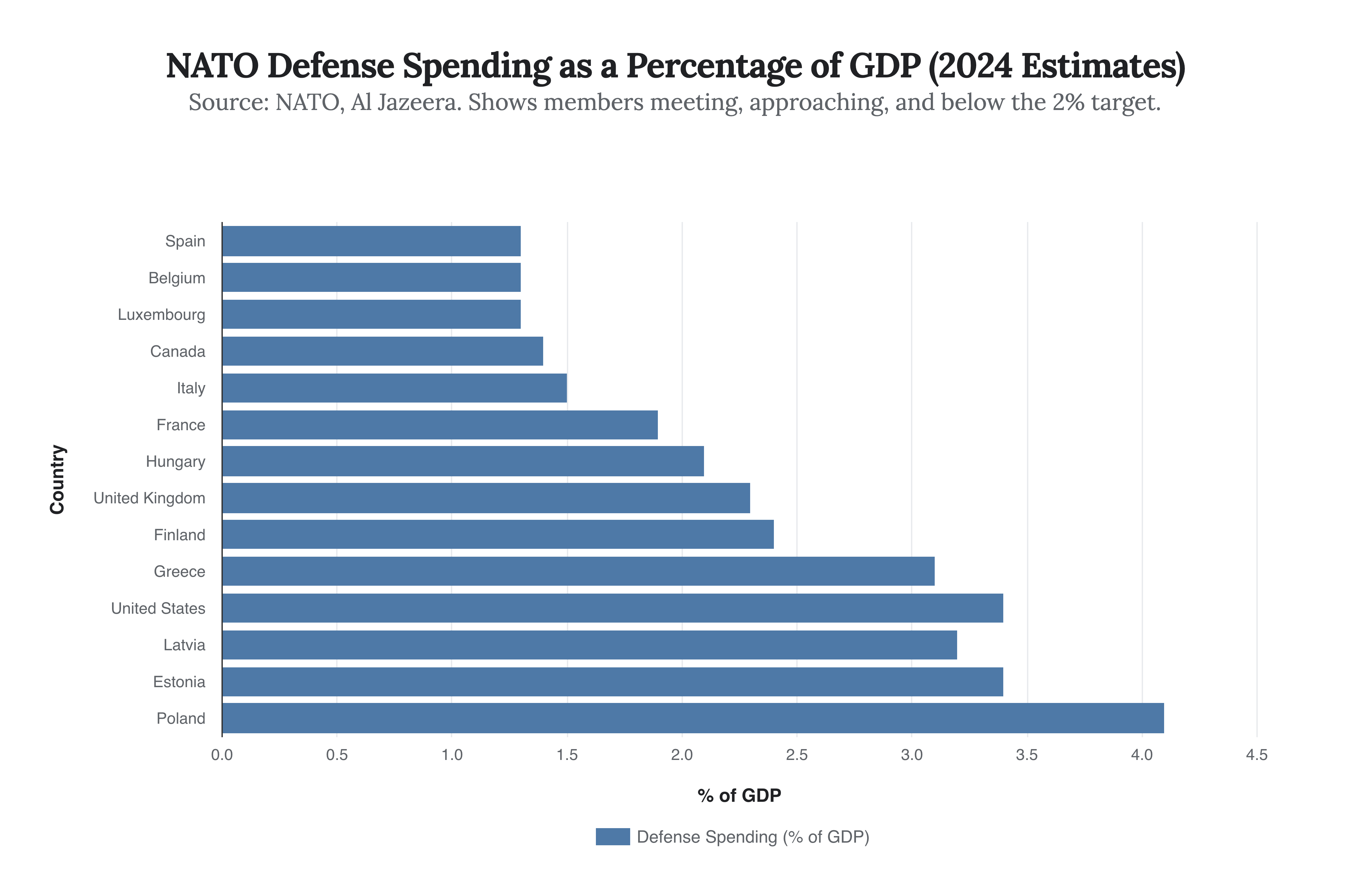
This chart demonstrates the wide disparity in defense spending across the alliance, highlighting the countries that meet the 2% threshold and those that do not. This data is central to understanding Trump’s long-standing critique of NATO and his affinity for partners like Hungary who have increased their contributions.
The China Pivot: Hungary as a Gateway to Europe
Perhaps the most significant element of Orbán’s “Eastern Opening” is his embrace of Chinese investment. While Brussels and Washington have grown warier of Beijing’s economic influence, Hungary has rolled out the red carpet. In a stunning strategic pivot, Hungary has become the primary destination for Chinese Foreign Direct Investment (FDI) in Europe, particularly in the critical electric vehicle (EV) and battery sectors. According to data from the Hungarian Investment Promotion Agency, Chinese investment in 2023 accounted for a staggering 58% of all FDI in the country, a figure that sends shockwaves through a European Union attempting to “de-risk” from China. This influx, including a €7.3 billion battery plant from CATL, showcases Hungary’s role as China’s strategic gateway into the EU single market. This economic model—prioritizing national economic benefit and job creation over bloc-level geopolitical concerns—is precisely the kind of bilateral, deal-oriented approach favored by Trump.
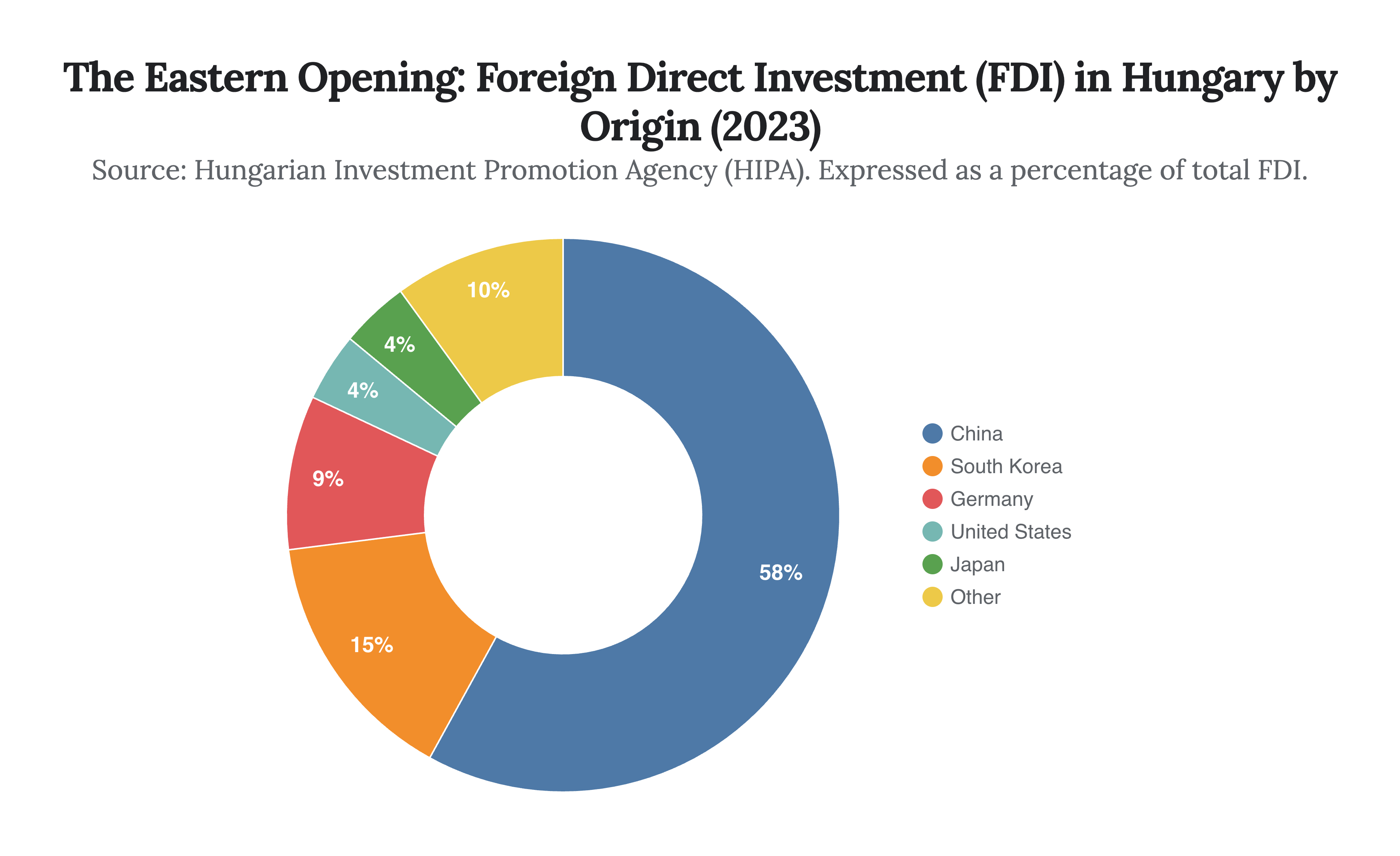
This chart reveals the dramatic success of Hungary’s ‘Eastern Opening’ policy. China’s 58% share of FDI in 2023 demonstrates a fundamental reorientation of the Hungarian economy and highlights its unique position within the EU as a prime destination for Chinese capital.
The Economic Blueprint: Transactional Trade and Energy Realism
The Trump-Orbán economic philosophy prioritizes bilateral deal-making and a pragmatic, if not cynical, view of national interest over multilateral trade frameworks. Both leaders are skeptical of free trade agreements that they believe disadvantage domestic workers and favor a more protectionist industrial policy. U.S.-Hungary bilateral trade, while modest in global terms, has been growing steadily. The discussions at the White House are expected to deepen this relationship, particularly in strategic sectors like energy and technology. A key outcome of the meeting was a U.S. agreement to grant Hungary an exemption from sanctions on Russian energy, a vital concession for the landlocked nation. In return, Hungary committed to purchasing U.S. liquefied natural gas (LNG) and collaborating on nuclear energy, including U.S. Westinghouse fuel for its Paks nuclear plant. This is the Trump doctrine in action: a direct, transactional exchange of strategic interests.
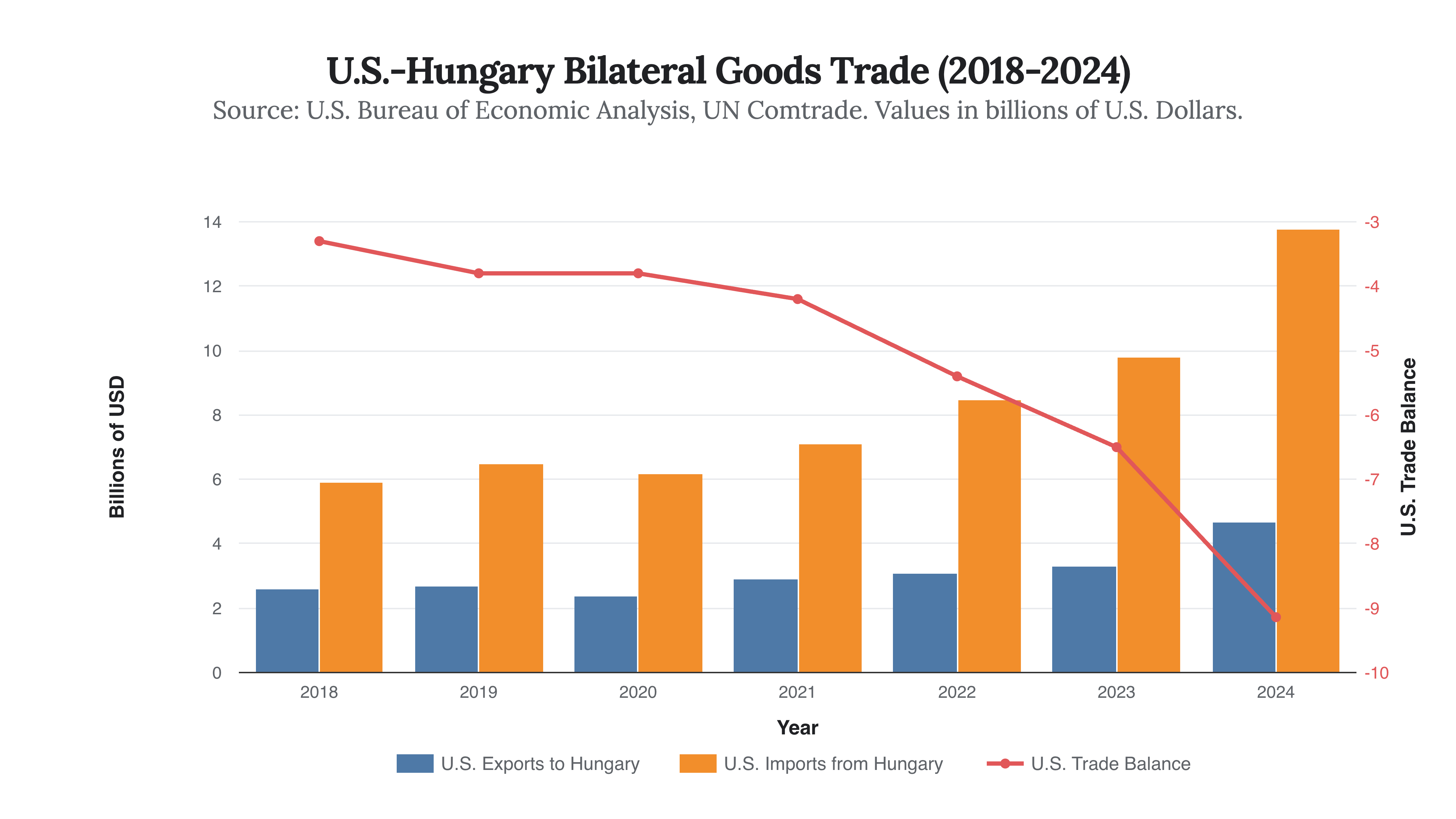
This chart illustrates the consistent growth in U.S.-Hungary trade, alongside a widening trade deficit for the United States. While the overall volume is not massive, the trend points toward an increasingly intertwined economic relationship that both leaders are keen to foster through direct, bilateral agreements.
Strategic Foresight: Ukraine, EU Cohesion, and the New Geopolitical Calculus
The Trump-Orbán alliance has its most immediate and volatile implications for the war in Ukraine. Both leaders have expressed deep skepticism about the current Western strategy of open-ended support for Kyiv and have called for a negotiated settlement. Orbán has consistently blocked or delayed EU aid packages and has maintained open channels with Moscow, arguing that a military victory for Ukraine is impossible. A recent poll shows that 77% of Hungarians believe Trump could end the war, reflecting a population weary of the conflict and its economic consequences. The alignment between Washington and Budapest on this issue could dramatically alter the trajectory of the war, increasing pressure on Ukraine to negotiate from a position of weakness and potentially fracturing the united front among NATO and EU allies.
“If [Trump] were still the president of the United States, there would be no war today.” - Prime Minister Viktor Orbán
A Tale of Two Publics: Divergent Views on the War
Public opinion data reveals a stark contrast between Hungarian and American views on the conflict, explaining the political space Orbán has to pursue his dovish stance. While a majority of Americans see Russia as a major threat, Hungarians are more ambivalent, with a recent poll even suggesting more Hungarians now see Ukraine as a greater threat than Russia. This divergence reflects years of government messaging in Hungary that has framed the conflict as a dispute between two Slavic nations in which Hungary has no interest, and has portrayed sanctions against Russia as more damaging to Europe than to Moscow.
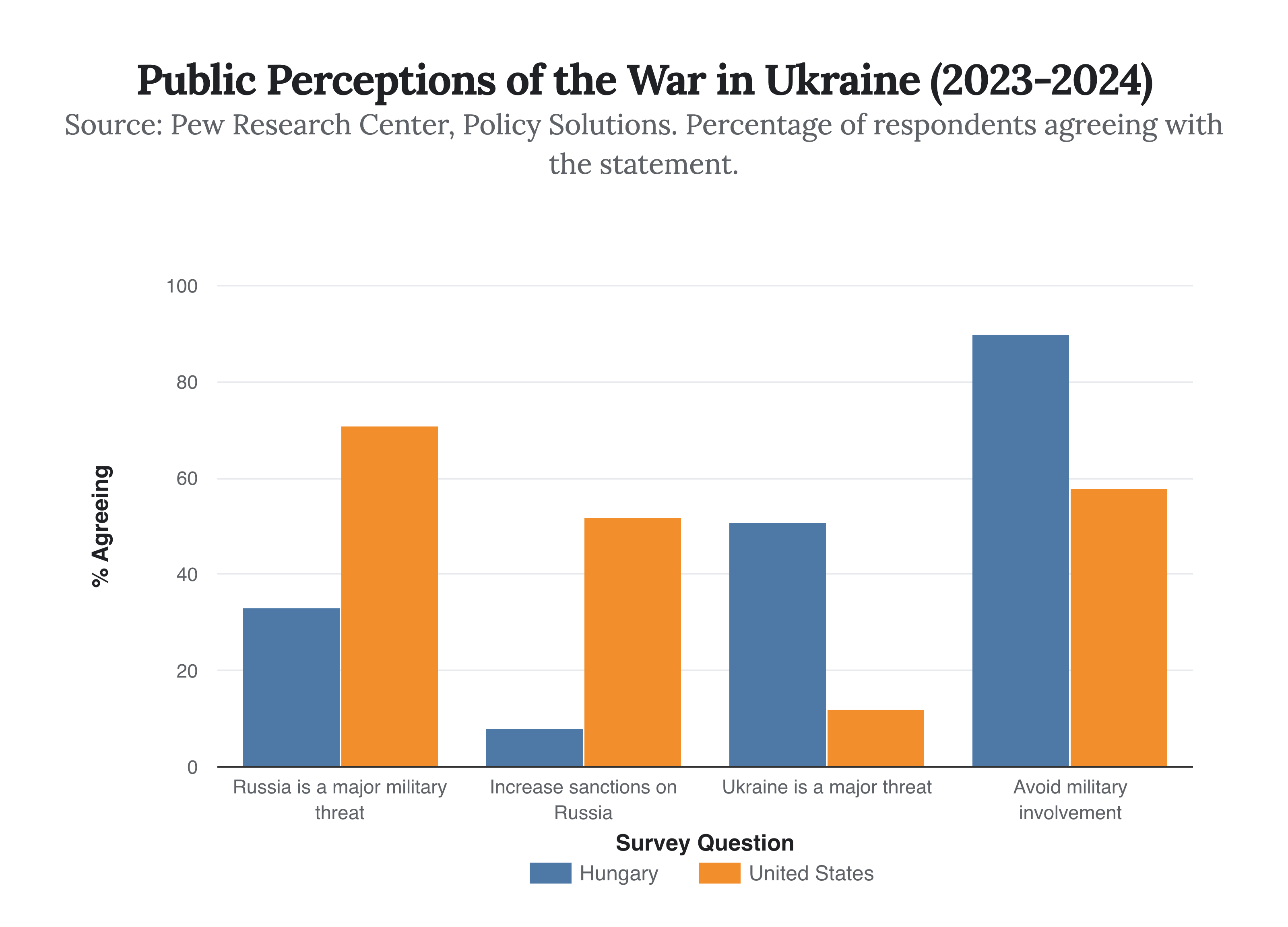
This chart starkly contrasts public opinion in Hungary and the United States on key issues related to the war in Ukraine. The profound differences in threat perception and policy preference illustrate the deep ideological and informational divide that underpins the two leaders’ differing approaches to the conflict.
The formalization of the Trump-Orbán axis at the White House is not merely a diplomatic curiosity; it is a leading indicator of a potential systemic shift in the transatlantic relationship. The key signposts to watch will be changes in NATO’s collective defense posture, the trajectory of U.S.-China trade policy (and whether the U.S. adopts a Hungary-style model of selective engagement), and the degree to which the united Western front on Ukraine begins to fray. The winners in this new arrangement are nation-states prioritizing bilateral deals and strategic autonomy. The losers are the institutions and advocates of a liberal, rules-based international order. For investors and policymakers, this meeting is a clear signal that the old assumptions about Western unity and the direction of globalization are no longer a reliable guide to the future.
The Orbán model—pragmatic engagement with the East, transactional relations with the West, and an unapologetic focus on national interest—is no longer a European outlier but a potential blueprint for American foreign policy.