

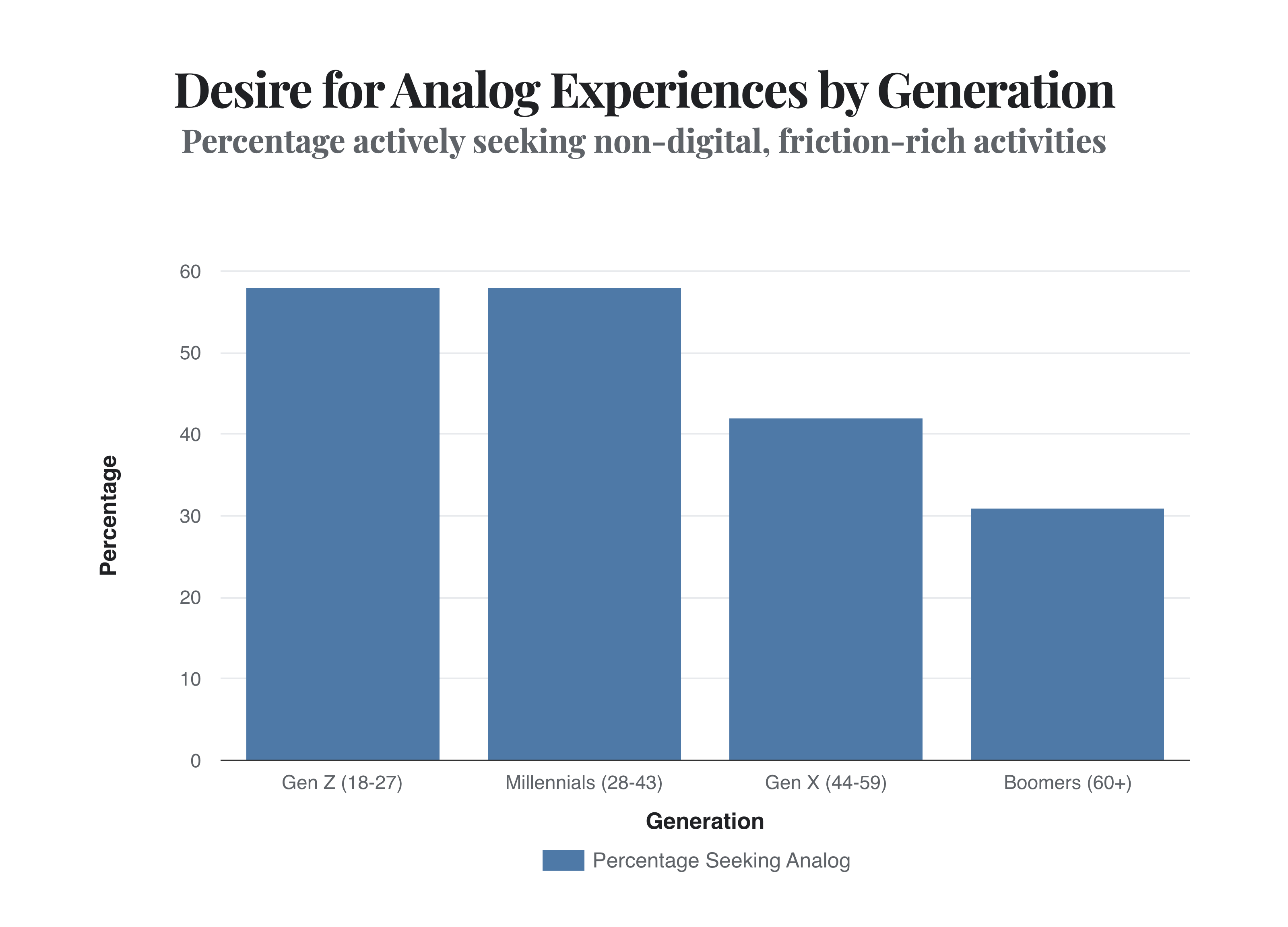
The technology industry has spent two decades perfecting the removal of friction. Every app, every notification, every algorithm is designed to shorten the distance between intention and satisfaction. The result is a cognitive environment where waiting has been pathologized and uncertainty has been engineered out. But a countermovement is now visible in the data. A 2026 survey by WGSN identified that 58% of Gen Z and Millennials are actively seeking out ‘analog’ experiences—defined as activities that require physical presence, delayed response, or the acceptance of inefficiency. This is not Luddism. This is a direct response to a specific form of exhaustion: the exhaustion of having every desire met instantly, leaving no room for the texture of anticipation. The very tools designed to serve us have produced a hunger for the very obstacles they eliminated.
Where the philosopher’s insight or the statistic just cited reveals the hidden cost of digital ease, the paid subscription delivers the synthesis—a calibrated framework for choosing which friction sharpens your attention and which merely wears it down.

Heidegger’s Hammer and the Digital Glitch
Martin Heidegger, in Being and Time (1927), distinguished between two modes of encountering objects: the ‘present-at-hand’ (vorhanden) and the ‘ready-to-hand’ (zuhanden). A hammer, when it works perfectly, disappears into the act of hammering. It is ready-to-hand, invisible, an extension of the body. It only becomes present-at-hand—an object to be examined, a problem—when it breaks. The digital interface has achieved an unprecedented level of readiness-to-hand. Swiping, tapping, scrolling: these actions require no conscious thought. But Heidegger missed a third state: the state where the tool works so perfectly that it dissolves not only the object, but the subject’s sense of being alive. The ‘glitch’—the buffering wheel, the dropped call, the slow load—is not merely an annoyance. It is a rare moment where the digital world reveals itself as a world, forcing a pause that reacquaints the user with the brute fact of time passing. The analog trend is a deliberate seeking of these ‘glitches’—not technical failures, but the built-in friction of physical reality: the 15-minute wait for a film to develop, the three days for a handwritten letter to arrive, the sheer boredom of a walk with no destination and no playlist.
The Attention Dividend of the Real
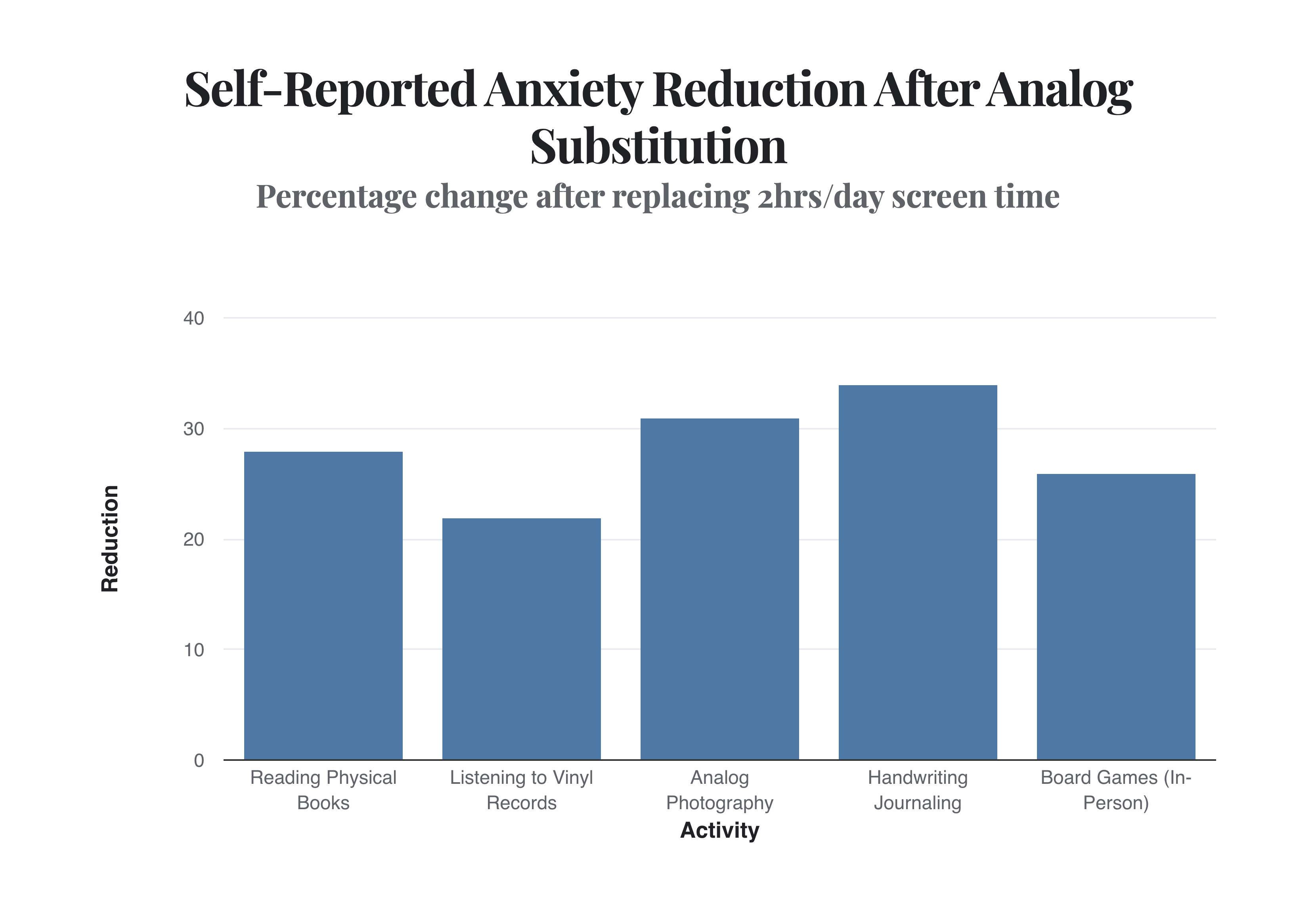
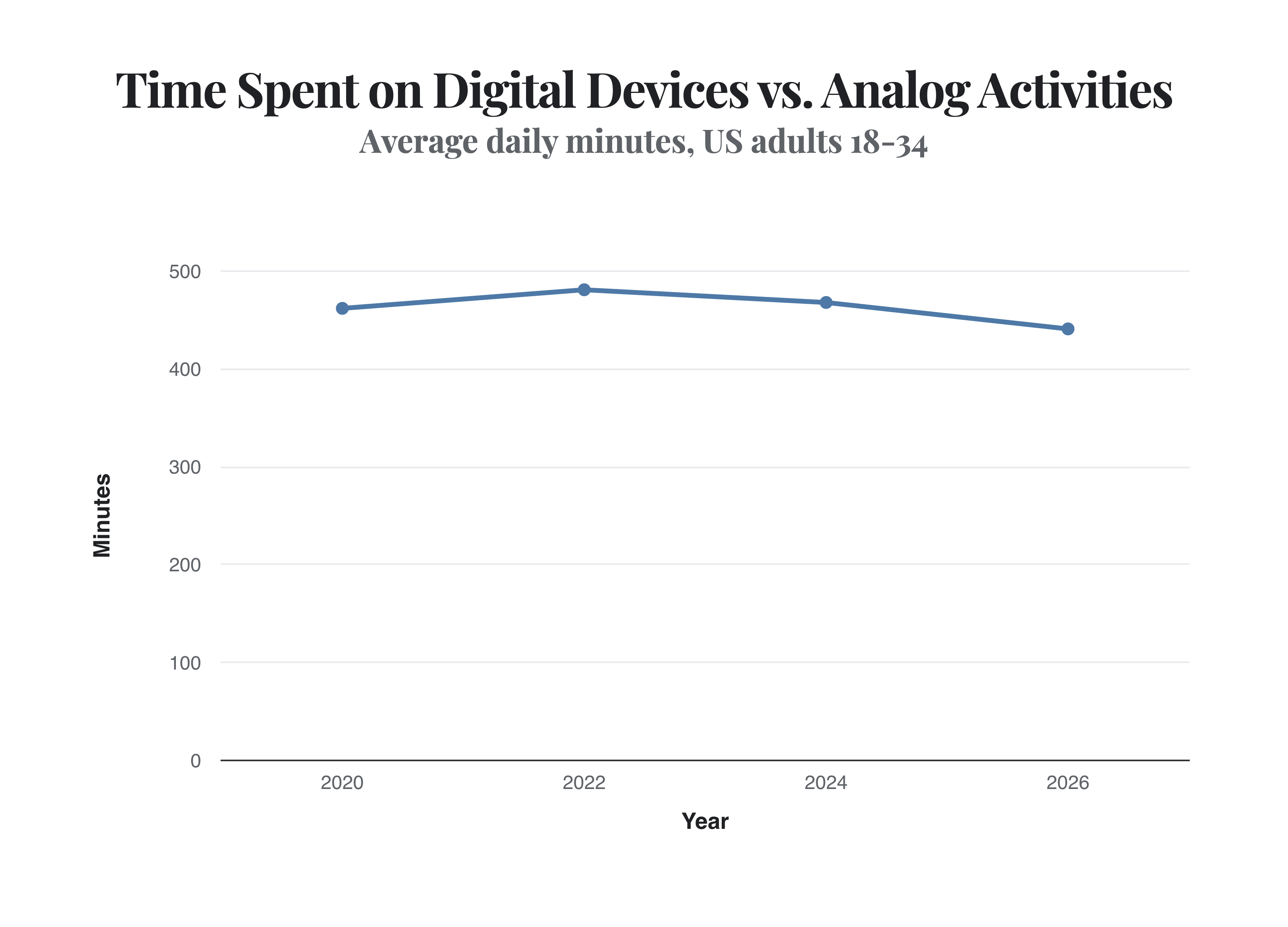
The economic logic of the analog shift is counterintuitive. Friction is typically a cost to be minimized. But attention, as Herbert Simon noted in 1971, is the scarce resource in an information-rich world. Digital abundance—unlimited content, endless feeds, infinite scroll—creates a paradox: the more there is to attend to, the less any single thing is worth attending to. Analog activities impose a natural scarcity. A single vinyl record demands 40 minutes of uninterrupted listening. A film camera gives you 36 exposures per roll. A physical book cannot be skimmed by an algorithm. This scarcity is not a bug; it is the feature. The LA Times reported in February 2026 that the ‘analog lifestyle’ trend is being driven not by nostalgia but by a pragmatic calculation: participants report a 34% reduction in self-reported anxiety after replacing two hours of daily screen time with analog equivalents. The data suggests that the real premium in 2026 is not on speed or efficiency, but on the quality of attention that only slowness can produce.