



In a move that redefines the landscape of American military power, the Pentagon’s research and engineering chief has executed the most significant strategic pivot in defense technology policy in over a decade. On November 17, 2025, Under Secretary for Research & Engineering Emil Michael announced the consolidation of the Department of Defense’s 14 Critical Technology Areas down to a hyper-focused list of just six imperatives.
This 57% reduction is not a simple housekeeping measure; it is a clear and urgent signal that the era of diffuse, long-term research is being decisively replaced by a series of high-velocity ‘sprints’ designed to deliver tangible, war-winning capabilities within 36 months. The core thesis of this new doctrine is brutally simple, as stated by Michael himself: “14 priorities, in truth, means no priorities at all.” This briefing deconstructs the new “Big Six,” analyzes the strategic rationale behind this consolidation, and projects the profound implications for the defense industry, global power competition, and the very character of future warfare.
The Great Consolidation: Deconstructing the New ‘Big Six’ Priorities
The strategic whiplash from 14 sprawling research areas to six focused imperatives represents a fundamental shift in the Pentagon’s approach to innovation. The previous list, which included everything from advanced materials to human-machine interfaces, was seen as diluting focus and resources. The new, streamlined agenda is designed to channel investment and intellectual capital into areas that promise the “greatest impact, the fastest results and the most decisive advantage on the battlefield.” This is a direct response to the pace of development by strategic competitors and an acknowledgment that future conflicts will be won by the side that can field advanced technology at speed and scale, not just invent it in a lab.
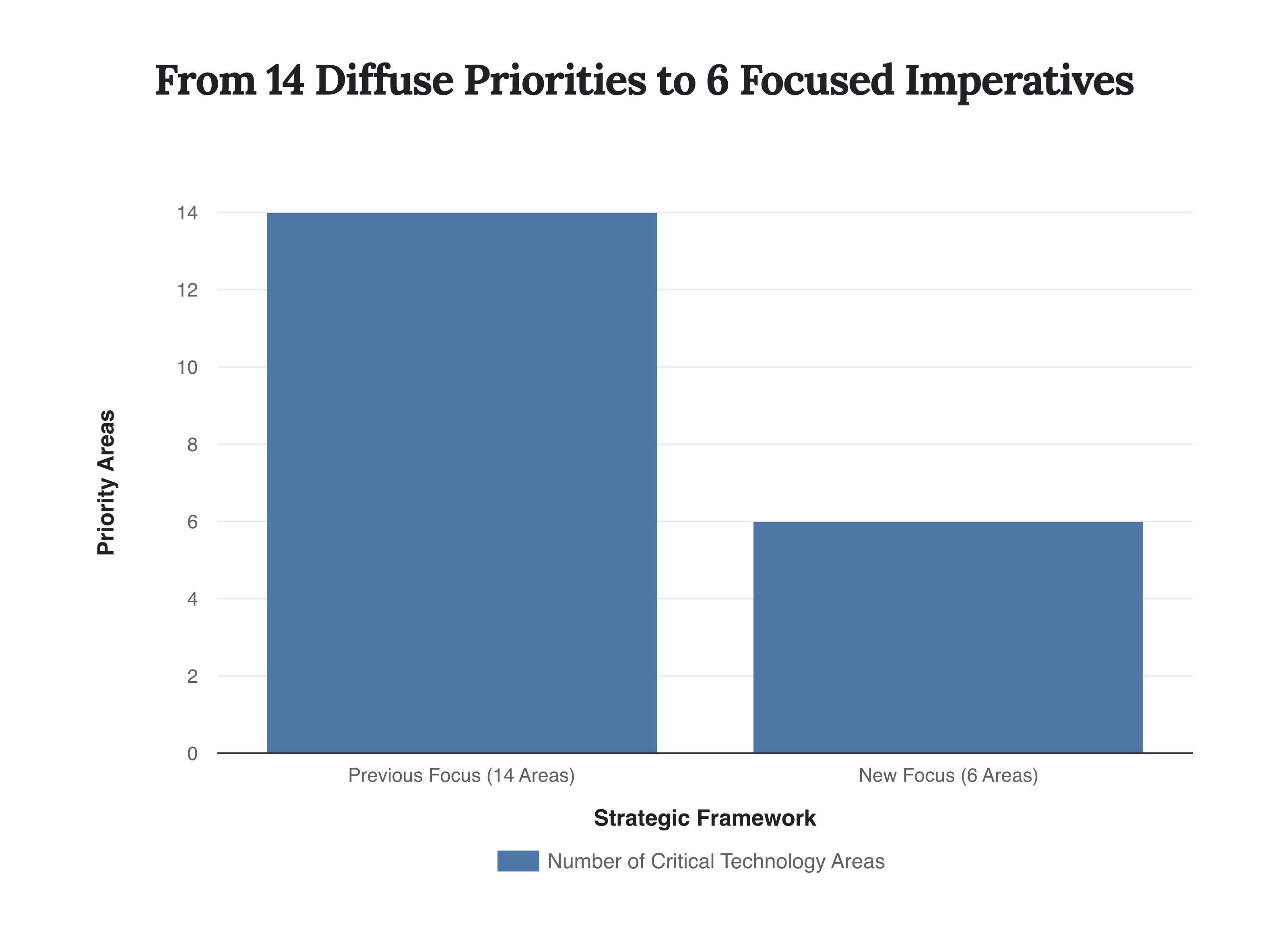
Caption: This chart illustrates the dramatic consolidation of US military technology priorities, reduced from 14 areas under the previous strategy to six focused imperatives announced in late 2025.
The Six Battlefield Imperatives
The condensed list represents the Pentagon’s assessment of where technology can provide a decisive, near-term edge. The six pillars of the new strategy are:
Applied Artificial Intelligence (AAI): To enhance decision-making and operational efficiency across all domains, from logistics to combat.
Biomanufacturing (BIO): To leverage living systems for the production of materials and capabilities, securing supply chains against disruption.
Contested Logistics Technologies (LOG): To ensure the military can supply and sustain its forces even in environments where logistics are actively targeted.
Quantum and Battlefield Information Dominance (Q-BID): A consolidated portfolio to ensure secure communications, navigation, and situational awareness in degraded or denied environments.
Scaled Directed Energy (SCADE): To move high-energy lasers and microwave weapons from prototype to mass production for defensive and offensive operations.
Scaled Hypersonics (SHY): To accelerate the transition of hypersonic missiles from development to large-scale fielding, providing rapid, long-range strike capabilities.
The ‘Scaled’ Imperatives: From Prototypes to Production Lines
Two of the new priorities—hypersonics and directed energy—are explicitly designated for ‘scaling’. This signals a critical transition point for these technologies, moving them out of the research and development phase and into the hands of warfighters in meaningful quantities. This push is a direct reaction to years of warnings that the U.S. was lagging behind competitors in fielding these game-changing weapons.
The Mach 5 Mandate: America’s Hypersonic Arsenal
For years, the U.S. has invested heavily in hypersonic weapons R&D, which involves systems that travel at speeds of Mach 5 or higher within the atmosphere. This investment is now being called to account, with the goal of moving from bespoke prototypes to scalable production. The urgency is palpable, with the objective of holding adversary targets at risk from operationally relevant ranges and creating a credible deterrent. A review of funding shows a massive build-up over the last decade, laying the groundwork for this strategic shift from development to deployment.
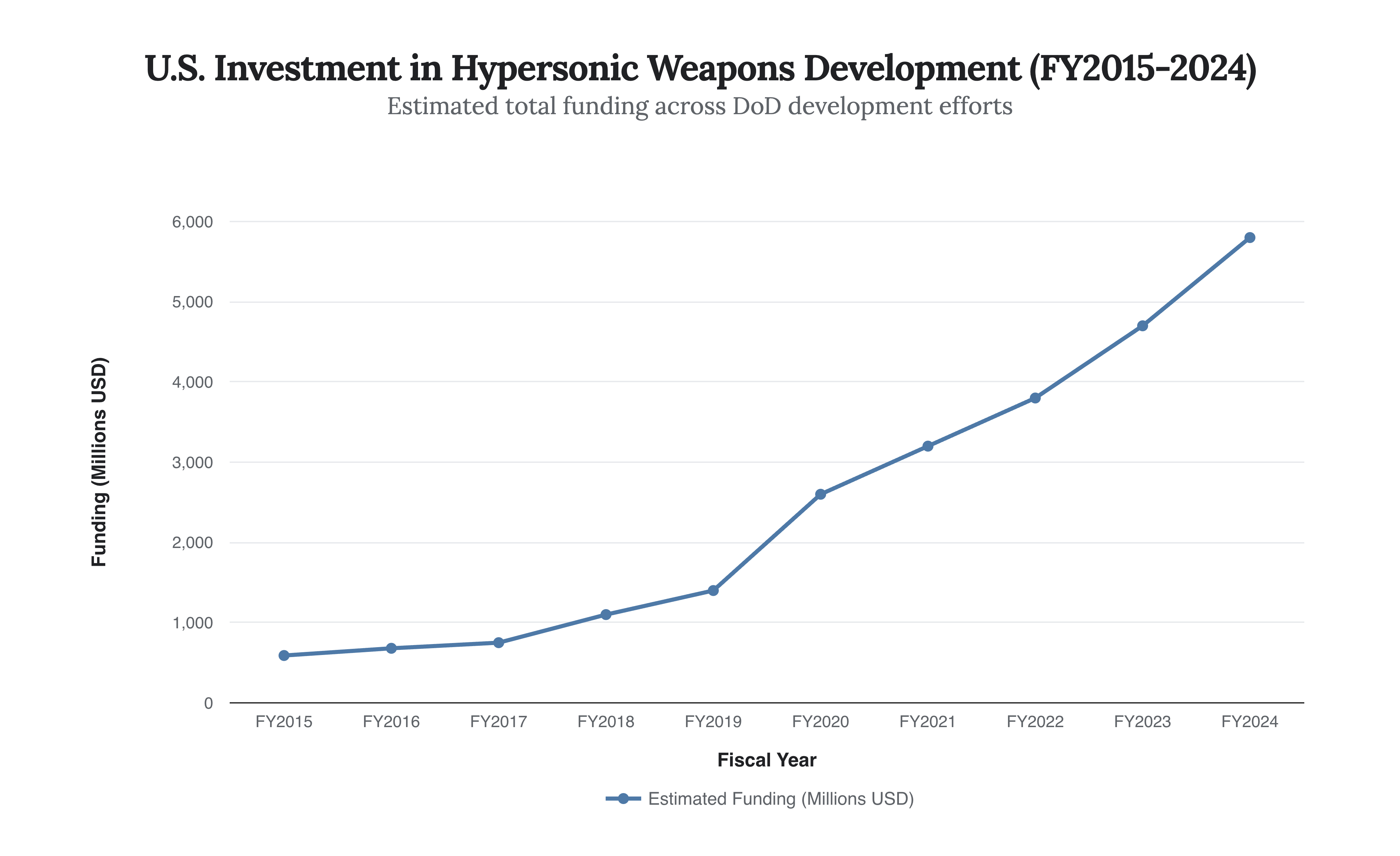
Caption: The chart displays the significant ramp-up in estimated U.S. funding for hypersonic weapons development, culminating in a near-$15 billion investment over a decade, which underpins the new strategic push to scale production.
The Economics of Energy: Directed Energy’s Moment Arrives
Directed Energy (DE) weapons, such as high-energy lasers and high-power microwaves, offer the promise of neutralizing threats like drones and missiles at a fraction of the cost of traditional interceptors. The challenge has always been moving from successful demonstrations to affordable, reliable, and mass-producible systems. The ‘Scaled’ designation indicates a determined effort to overcome these final hurdles. The focus is now on industrial base development and engineering for affordability, aiming to field these systems for applications like fleet defense and base protection.
“These six Critical Technology Areas are not just priorities; they are imperatives. The American warfighter will wield the most advanced technology to maximize lethality.”
The Digital Battlespace: Forging Dominance with AI and Quantum
The heart of the new strategy lies in controlling the information domain. The consolidation of multiple tech areas into the ‘Quantum and Battlefield Information Dominance’ portfolio, combined with the elevation of ‘Applied AI’ to the top of the list, underscores a vision where decision speed and data security are the ultimate force multipliers.
Applied AI: The Central Nervous System of the Future Force
Artificial Intelligence is no longer a niche capability; it is being positioned as the foundational technology for the entire defense enterprise. The FY2025 budget request includes a significant $1.8 billion specifically for AI, reflecting its central role. This focus, aligned with the White House AI Action Plan, aims to transform everything from back-office logistics to front-line combat analysis, seeking to achieve what the Pentagon calls “decision dominance”—the ability to orient, decide, and act faster and more effectively than any adversary.
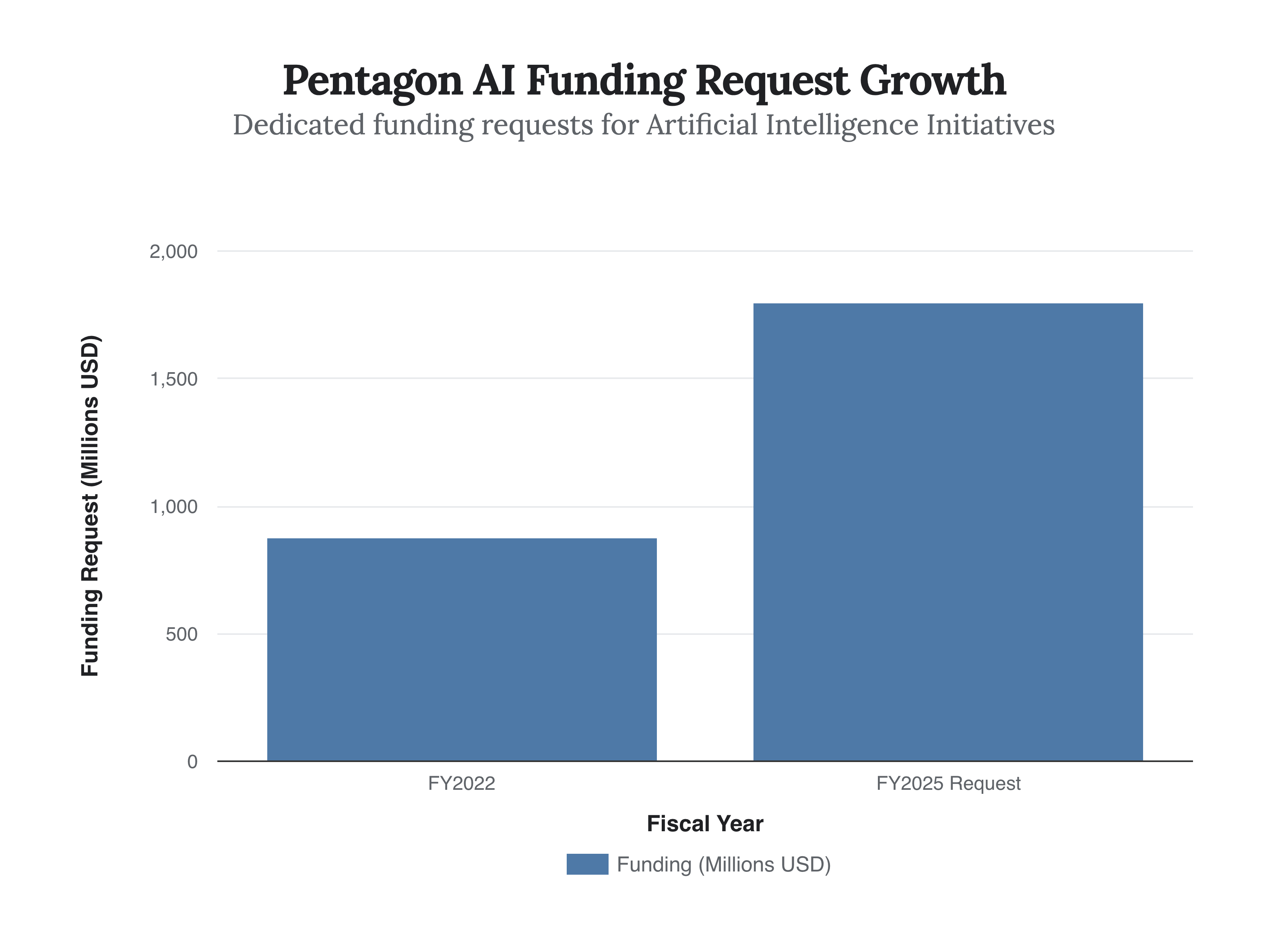
Caption: This chart highlights the doubling of dedicated Pentagon funding requests for Artificial Intelligence from FY2022 to the FY2025 proposal, demonstrating AI’s position as a top priority.
Q-BID: Securing the Spectrum of Conflict
The creation of the Quantum and Battlefield Information Dominance (Q-BID) portfolio is one of the most strategically significant aspects of the new doctrine. It merges previously separate efforts in quantum science, 5G/FutureG wireless, space technologies, and integrated sensing and cyber into a single, coherent line of effort. The goal is to provide warfighters with the ability to communicate, navigate, and maintain situational awareness even when GPS signals are jammed and traditional networks are under attack. This acknowledges the reality of a future battlefield where control of the electromagnetic spectrum is not guaranteed.
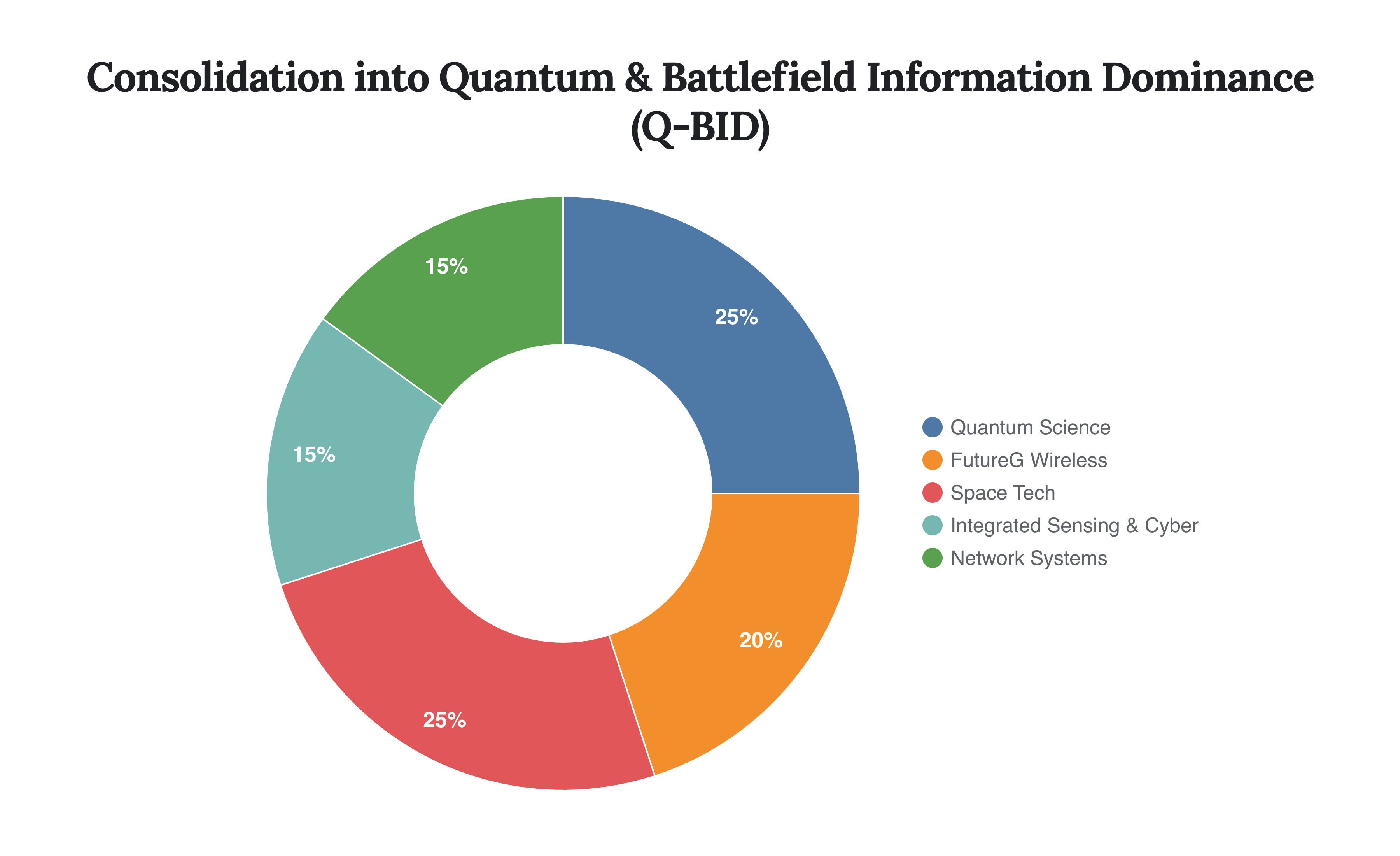
Caption: This chart provides a conceptual breakdown of how the new Q-BID priority consolidates several previously distinct technology areas into a unified portfolio aimed at ensuring information superiority.
The Unseen Pillars: Biomanufacturing and Logistics
Perhaps the most forward-looking elements of the new strategy are the two priorities that address the foundational resilience of the military: Biomanufacturing and Contested Logistics. These are not weapon systems, but enablers that will determine the military’s ability to sustain a high-intensity conflict over time.
Biomanufacturing: Forging Resilience from Living Systems
The inclusion of Biomanufacturing addresses a critical vulnerability: fragile global supply chains. By “harnessing living systems” to produce key materials, from specialized fuels and lubricants to critical components for electronics and munitions, the Pentagon aims to create resilient, domestic sources for essential military supplies. This initiative is designed to mitigate the risk of a strategic competitor cutting off access to vital materials during a crisis.
Contested Logistics: Winning the War of Sustainment
Modern warfare is a battle of logistics, and the Pentagon now explicitly recognizes that its supply lines are a primary target. The ‘Contested Logistics Technologies’ priority is less a single technology and more a broad mission to use AI, autonomous systems, and advanced networking to resupply forces in highly contested environments, such as a conflict in the vastness of the Pacific. It is an admission that the uncontested global commons the U.S. military has operated in for decades can no longer be taken for granted.
“Our adversaries are moving fast, but we will move faster. The warfighter is not asking for results tomorrow; they need them today.” - Emil Michael, Under Secretary of War for Research and Engineering
The Pentagon’s dramatic refocusing of its technology priorities is a high-stakes wager. It bets that depth is more important than breadth, and that speed to fielding is the most critical metric of success. By slashing the number of priorities and concentrating resources on six domains with near-term potential, the Department of Defense is sending an unmistakable message to its allies, its adversaries, and its industrial partners: the time for theoretical research has given way to an urgent, pragmatic drive for battlefield advantage.
The era of speculative, long-term defense research is over; the Pentagon is now in a three-year sprint to build the warfighting tools for a 2030 conflict.
as someone who “used to work in tech” it’s amazing to think they’re actually focusing on efficiency…