


We are witnessing the demographic inversion of the internet. For the first thirty years of the web, the primary challenge was onboarding the living. For the next thirty, the primary challenge will be offboarding the dead. The “Digital Afterlife” is no longer a science fiction trope; it is a burgeoning asset class, a massive infrastructure liability, and a legal minefield that has just witnessed its first major regulatory explosion with Tennessee’s ELVIS Act.
While the media focuses on the sentimental aspect of “grief tech”—chatbots that mimic deceased loved ones—the real story for investors and strategists is the unmanaged data gravity of the deceased. Current projections indicate that by 2100, deceased users on platforms like Facebook could number 4.9 billion, potentially outnumbering the living. This creates a “zombie data” crisis: vast servers powering accounts that generate no ad revenue, consume energy, and pose cybersecurity risks.
Simultaneously, we are seeing the rise of a $54 billion “Digital Immortality” market. This is the financialization of legacy. From AI-driven avatars to the recovery of lost crypto assets, the management of post-mortem data is becoming a critical sector. This briefing analyzes the collision of these trends: the rising cost of digital death and the lucrative, yet ethically perilous, business of digital resurrection.
The Infrastructure of Ghosts: Data Decay and Server Burden
The internet was built on a presumption of eternal activity. Terms of Service agreements rarely account for the biological reality of mortality. As a result, we are accumulating a massive “sedimentary layer” of inactive data. This is not merely digital clutter; it is an infrastructure tax on major tech platforms. Every gigabyte of deceased user data requires cooling, electricity, and security, yet it produces zero engagement metrics—the lifeblood of the ad-supported web.
Recent data suggests that in the United States alone, deceased Facebook accounts could reach nearly 279 million by 2100. If we extrapolate global storage costs based on current cloud pricing models, the industry faces a multi-billion dollar annual “maintenance fee” for users who can no longer click.
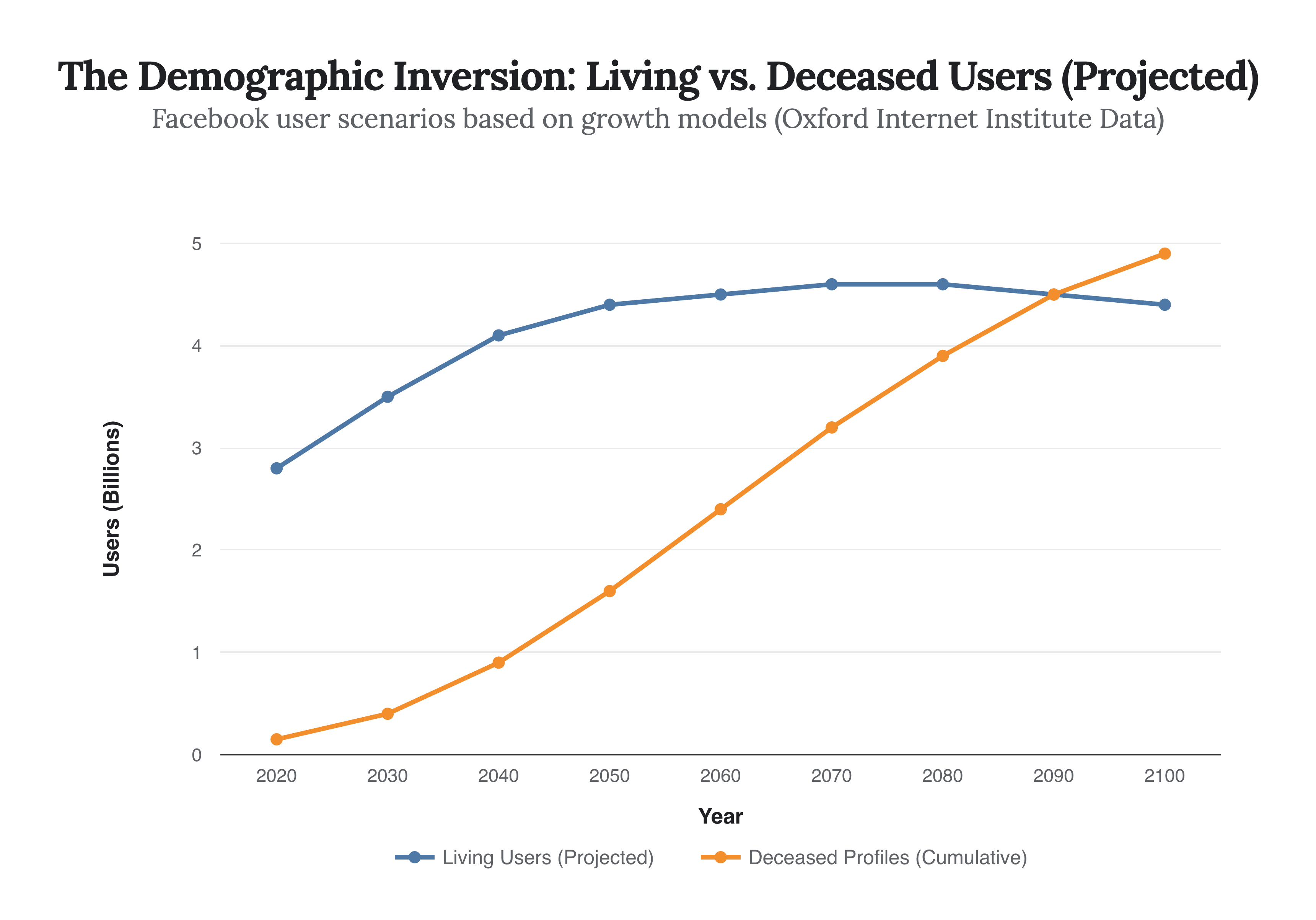
The chart above illustrates the inevitable “crossover point” where the digital dead begin to rival the living in volume. For hyperscalers (Meta, Google, Amazon), this presents a binary strategic choice: monetize the dead (through memorial fees or AI licensing) or delete them (risking immense public backlash). Most platforms are currently paralyzed, defaulting to a “keep everything” policy that is economically unsustainable in the long run.
The Cybersecurity of Silence
Beyond storage costs, these dormant accounts represent a massive attack surface. “Ghost” accounts are prime targets for identity theft and social engineering. Because there is no active user to report a breach, a compromised deceased account can be used as a botnet node or a phishing launchpad for months before detection. Enterprise security leaders must recognize that their corporate directories likely contain “zombie credentials” of deceased employees—vectors for intrusion that bypass standard offboarding protocols.
The Monetization of Grief: Anatomy of a $54 Billion Market
While platforms struggle with the cost of storage, a new industry is emerging to extract value from the data left behind. The “Digital Immortality” market—
