


The pervasive hum of digital life now commands a significant portion of our waking hours, and its impact extends far beyond mere duration; it actively reshapes our cognitive architecture. The relentless influx of notifications, the infinite scroll, and the precisely tuned algorithmic feeds cultivate a state of perpetual partial attention, rendering sustained, deep focus an increasingly elusive commodity. This isn’t merely about lost productivity or diminished output; it strikes at the very integrity of the self in an environment meticulously designed for constant, superficial engagement. The modern digital landscape, with its continuous and often subtle demands on our attentional resources, actively works to splinter the coherent self, distributing our cognitive energies across an ever-expanding and interconnected array of stimuli. This systemic fragmentation of attention represents a profound challenge to individual agency and the capacity for internal coherence.

Quantifying the Cognitive Cost: The Screen Time Imperative
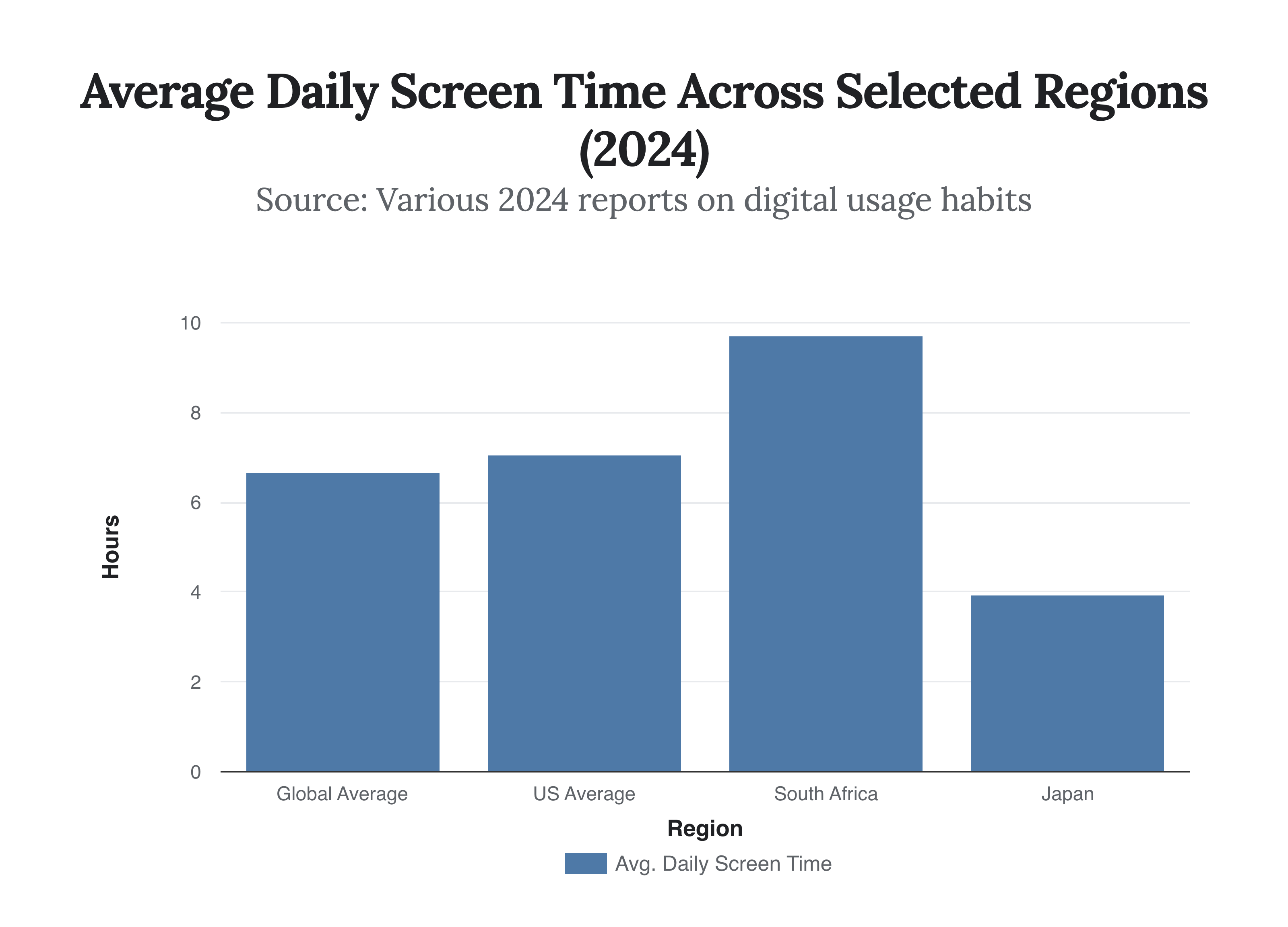
Recent empirical data provides stark evidence of this cognitive cost. The global average daily screen time now approaches a staggering seven hours, a duration that, for many, consumes nearly half of their waking day. Specific demographics face even greater pressure: a 2024 CDC report, for instance, revealed that 50.4% of U.S. teenagers spend four or more hours daily on screens for non-school-related activities. This statistic is not an isolated anomaly but indicative of a broader, systemic erosion of sustained attention across populations. In such an environment, the individual’s capacity for deep work, for reflective thought, for genuine introspection, and even for undisturbed presence in the physical world, is under constant, sophisticated assault. We are often not consciously choosing to consume information; rather, we are continuously being consumed by the demands and lures of the digital sphere, our inner life increasingly fragmented into a mosaic of micro-interactions and fleeting data points. This ubiquitous digital immersion creates a constant pressure on our cognitive faculties, making deliberate focus an act of conscious defiance rather than a natural state.
Just as Nietzsche’s ‘will to attention’ reveals the path to inner strength, a paid subscription grants you exclusive access to the synthesis and implications needed to master modern focus.
Join over 10,000 rational minds who choose to forge their will to attention against the digital tide.
Nietzsche’s Antidote: The Will to Attention as Self-Mastery
Friedrich Nietzsche, observing a different, yet analogous, form of societal fragmentation in the late 19th century—one born of waning traditional values and emerging nihilism—offered a powerful counter-narrative: the ‘will to power.’ In our contemporary context, this translates compellingly into a ‘will to attention.’ For Nietzsche, true strength and the potential for human flourishing lay not in passive acceptance or conformity, but in radical self-mastery, the conscious creation of one’s own values, and the disciplined direction of one’s energies. He vehemently admonished against the ‘herd mentality’ and the uncritical adoption of external norms, urging individuals to *overcome* their given circumstances through an act of resolute will. As he declared in *Thus Spoke Zarathustra*: “Man is something that shall be overcome. What have you done to overcome him?” This isn’t a call for Luddite rejection of technology, but for a deliberate, *active* engagement with the very forces that shape our inner world and define our experiences. Nietzsche’s philosophy compels us to view our attention not as a passive, vulnerable recipient of external stimuli, but as a sovereign domain to be fiercely guarded, purposefully cultivated, and strategically deployed. It becomes an imperative to choose to be the sculptor of one’s own focus, rather than merely a blank canvas for the projections of algorithmic design and commercial imperative. The cultivation of this inner strength—this ‘will to attention’—thus transforms into an act of defiant self-assertion against the powerful currents of digital diffusion and cognitive dissipation.
Reclaiming the Inner Citadel: Architecting Focus in a Distracted Age
To successfully navigate the digital age with intellectual integrity and psychological resilience requires a conscious and proactive architecting of our focus. This necessitates establishing intentional boundaries, rigorously practicing digital minimalism, and deliberately creating ‘sanctuaries’—both physical spaces and temporal windows—where sustained, uninterrupted thought can genuinely flourish. It is a strategic effort to reclaim cognitive sovereignty, not through outright denial of technology, but through the deliberate, disciplined allocation of our most precious resource: attention. Engaging with challenging, long-form texts, committing to single-task activities for extended periods, and cultivating moments of intentional solitude are not merely ascetic lifestyle choices; they are profound acts of resistance against fragmentation and powerful affirmations of one’s intrinsic capacity for deep, meaningful engagement. The overarching goal is not to escape the realities of modernity, but to master one’s engagement with its tools and temptations, thereby transforming passive consumption into the active, focused cultivation of a resilient and coherent self. This deliberate practice of attention is the contemporary equivalent of building an inner citadel, impervious to the siege of endless distractions.In a world that incessantly vies for every fragment of our awareness, what does it truly mean to cultivate and possess a ‘will to attention’? How do we effectively reconcile the undeniable utility and pervasive influence of digital tools with the profound imperative to safeguard our inner cognitive landscape from fragmentation, and what transformative potential might be unleashed when individuals and communities collectively commit to such an act of self-mastery?