




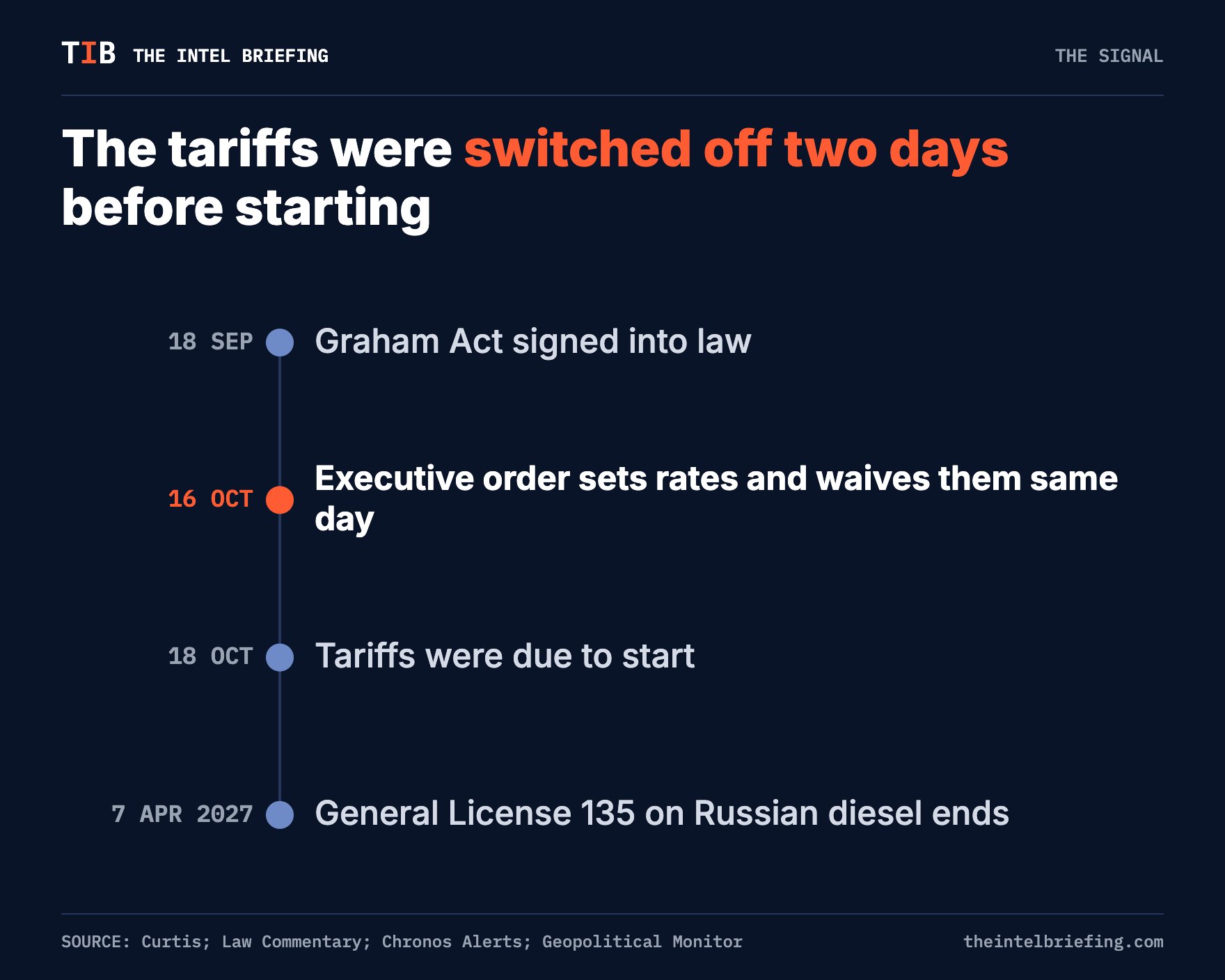
28 days. That is how long the Graham Act’s tariffs existed before the White House switched them off. The law was signed on 18 September and waived on 16 October, two days before the 18 October start. The waiver clause is written into the statute, so the penalties work as a switch the executive controls.
What changed
On 18 September 2026 the Lindsey O. Graham Sanctioning Russia and Iran Act became law. It sets a 500% duty on Russian goods, a 100% duty on the five largest importers of Russian crude and gas, and a 100% duty on the top five facilitators of sanctions evasion.
On 16 October an executive order set those rates and, in section 4, waived them the same day. The order cites section 115 and a national-interest certification to Congress.
The waiver has no fixed expiration date. It lasts until the President or the Secretary of State, consulting Treasury and the USTR, decides further action is appropriate.
Three things were not waived:
Sanctions under earlier Russia executive orders stay in force under section 4(b).
The ban on US persons buying Russian sovereign debt took effect on enactment day.
The Act itself was not repealed.
The reaction was immediate. The Los Angeles Times reported bipartisan backlash. Zelensky called the waiver a betrayal and lawmakers called it surrender, but the paper saw no quick counter.
The same week, Treasury’s General License 135 allowed some transactions in Russian-origin diesel until 7 April 2027.
The second-order effect
The law has two kinds of provision, and they work differently.
A waiver under section 115 needs a written certification to Congress and an unclassified report. No report is needed when the President only modifies a rate under section 113(b).