



A silent epidemic is unfolding across modern society, one not of viral origin but of social decay. Over the past three decades, the social fabric of American manhood has fundamentally degraded. Data from the Survey Center on American Life reveals a startling trend: the percentage of men reporting they have zero close friends has surged by 500%, from just 3% in 1990 to 15% today. For unmarried men, the figure is even starker, with one in five reporting a complete absence of close confidants. This “friendship recession” is not a mere social curiosity; it is a metastasizing crisis with deep, quantifiable consequences for economic productivity, public health, and national stability. The erosion of these foundational social structures represents a critical vulnerability, impacting everything from individual lifespans to corporate bottom lines. This briefing deconstructs the data behind this collapse, analyzes the second-order effects on our economy and healthcare systems, and provides strategic foresight into the cascading risks of a generation of disconnected men.
The Great Unraveling: Charting the Collapse of Male Social Networks
The decline in male friendships is a multi-decade trend that has accelerated dramatically. This is not a slight dip but a structural collapse of the traditional male social circle. The data paints a clear and alarming picture of men’s shrinking worlds, far outpacing the concurrent, though less severe, decline seen among women.
The Five-Fold Surge in Isolation
The most alarming metric is the exponential growth in the number of men who are completely socially isolated. A five-fold increase in any critical metric over 30 years would signal a paradigm shift; in the context of social bonds, it signals a societal emergency. This is the central finding of the research and the anchor for understanding the severity of the crisis.
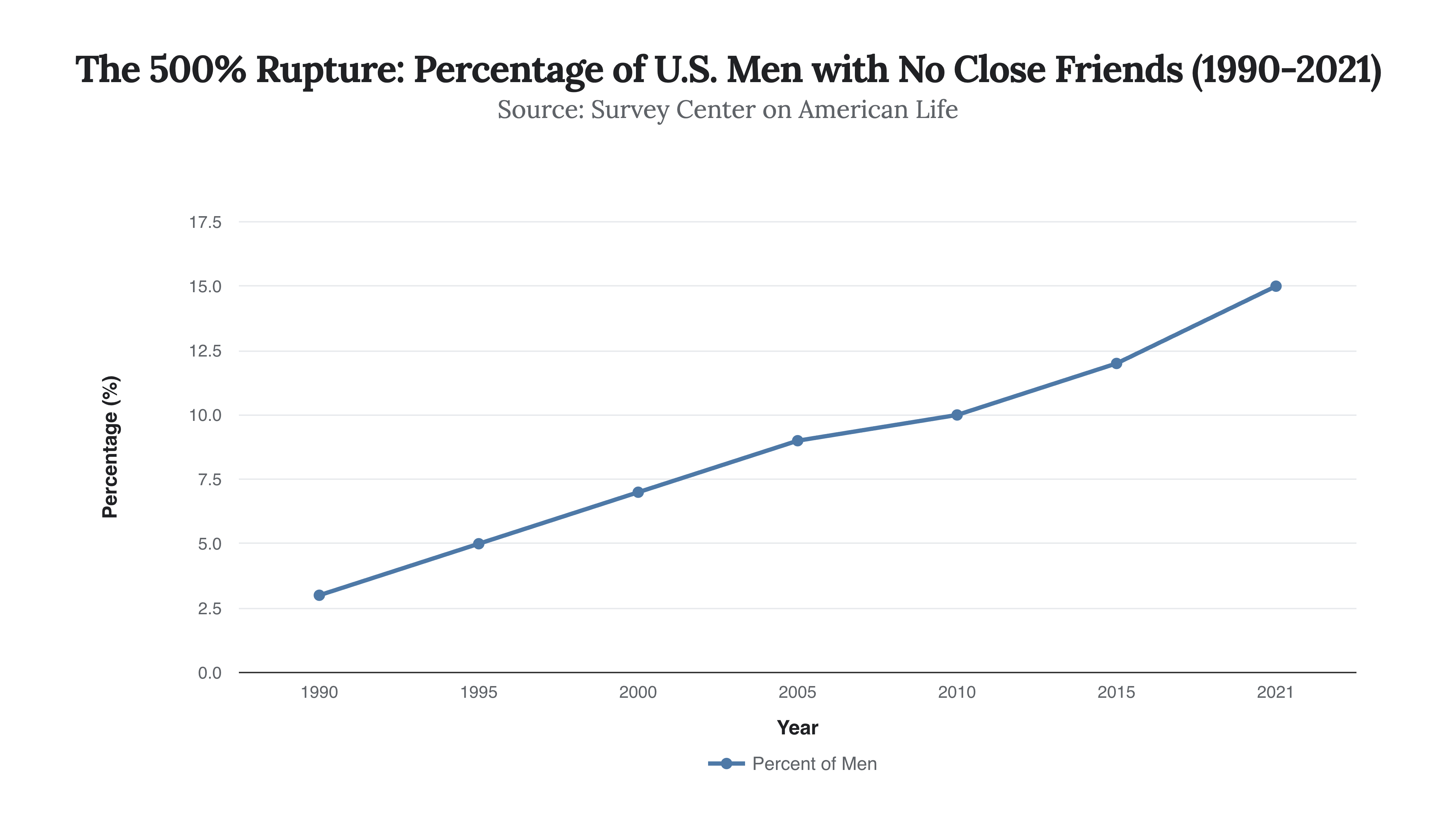
Caption: This chart illustrates the dramatic and steady increase of men reporting they have no close friends, a five-hundred percent rise from 1990 to 2021.
The Disappearing Posse: Larger Friend Groups Vanish
Beyond the rise of total isolation, there has been a concurrent collapse in the number of men with large, robust social networks. In 1990, a majority of men (55%) reported having six or more close friends, indicating a healthy and resilient support system. By 2021, that figure had been cut in half to just 27%. This hollowing out of the middle suggests that even men who are not completely friendless have significantly smaller and likely more fragile social circles. Women have also seen a decline, but the drop has been far less precipitous, from 41% with six or more friends in 1990 to 24% in 2021.
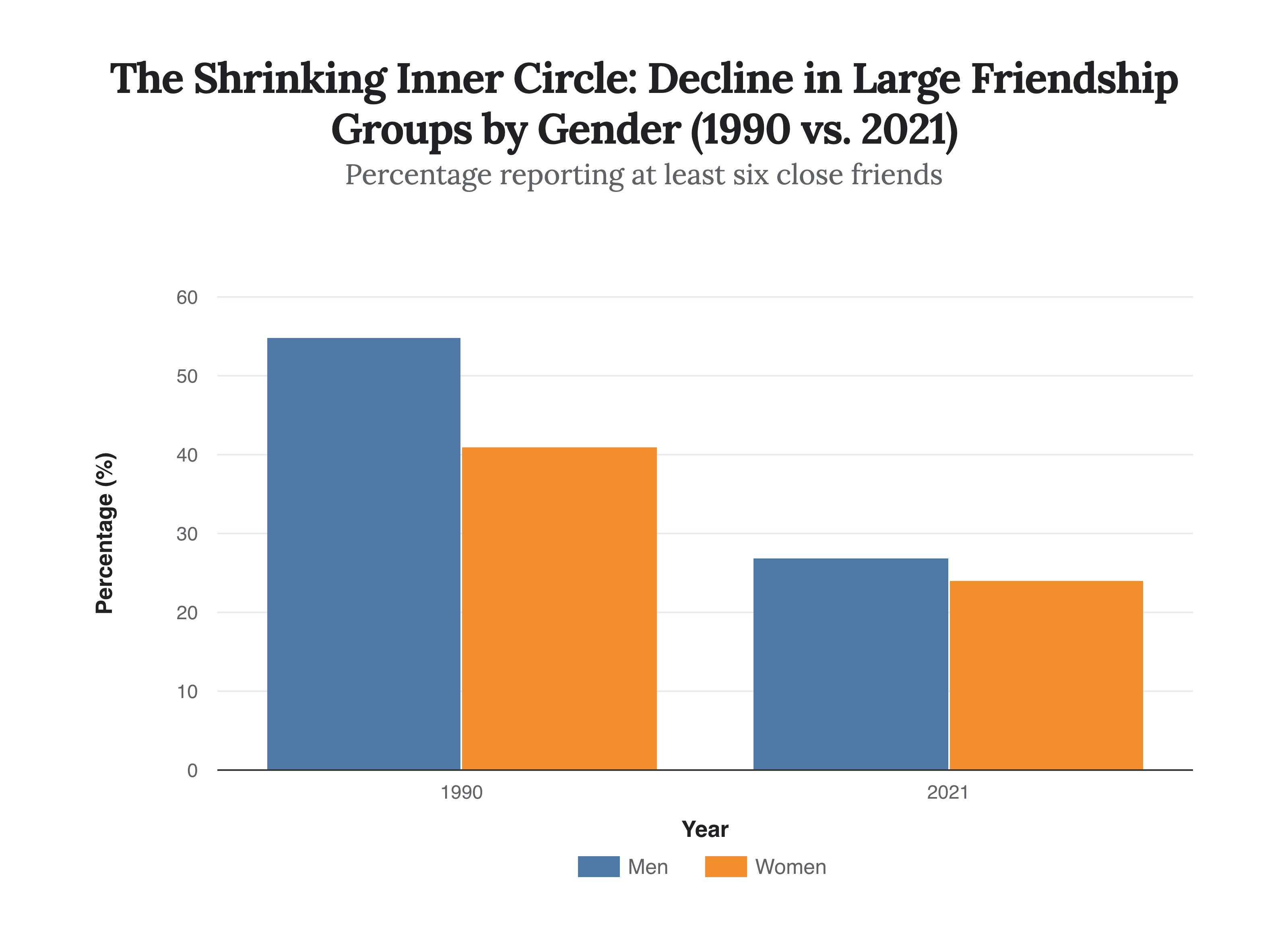
Caption: The chart compares the steep drop in the percentage of men with six or more close friends against the more moderate decline for women over the same period.
The Economic & Health Catastrophe of Loneliness
The friendship recession is not a victimless, abstract social trend. It carries a staggering cost, measured in both human lives and economic drag. The U.S. Surgeon General has declared that the mortality impact of being socially disconnected is comparable to smoking up to 15 cigarettes a day and is even greater than that associated with obesity and physical inactivity. This is a public health crisis hiding in plain sight.
“Loneliness is far more than just a bad feeling—it harms both individual and societal health. It is associated with a greater risk of cardiovascular disease, dementia, stroke, depression, anxiety, and premature death.” - Dr. Vivek Murthy, U.S. Surgeon General
A Mortal Threat Equivalent to Addiction
The health risks associated with loneliness are profound. Socially disconnected individuals face a 30% increased risk of stroke or heart disease and a 50% increased risk of developing dementia. These are not minor correlational links; they represent a causal pathway where the chronic stress of isolation degrades physical and mental health, leading to premature death. The scale of this impact places loneliness in the same category of public health threats as smoking and obesity.
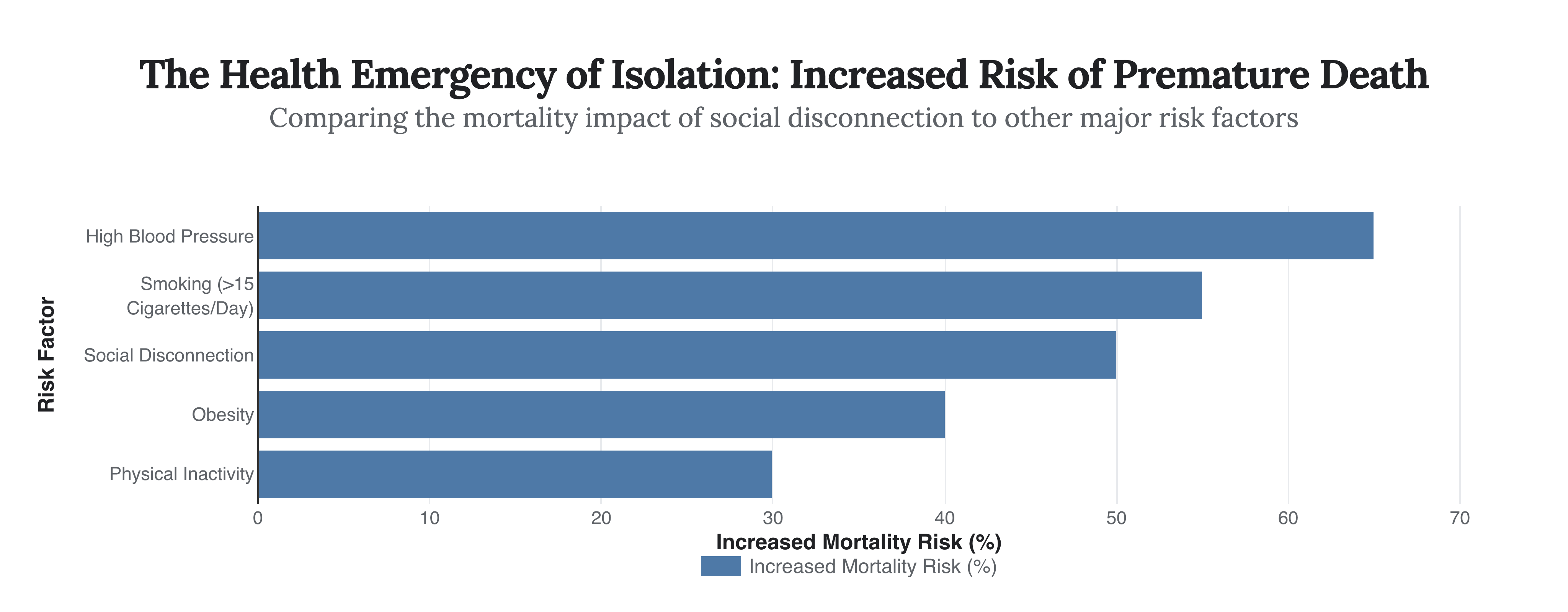
Caption: This chart benchmarks the significant mortality risk of loneliness against well-known public health crises, highlighting its severity.
The High Price of a Disconnected Workforce
The economic fallout is equally severe. In the workplace, loneliness reduces engagement and performance. The American economy bears a heavy burden from this trend, primarily through two channels: lost productivity and increased healthcare spending. Stress-related absenteeism attributed to loneliness is estimated to cost U.S. employers $154 billion annually. Furthermore, social isolation among older adults alone accounts for an estimated $6.7 billion in excess Medicare spending each year, driven by higher rates of hospitalization and nursing facility care. This is a direct tax on the economy, paid by businesses and taxpayers, stemming from a breakdown in social infrastructure.
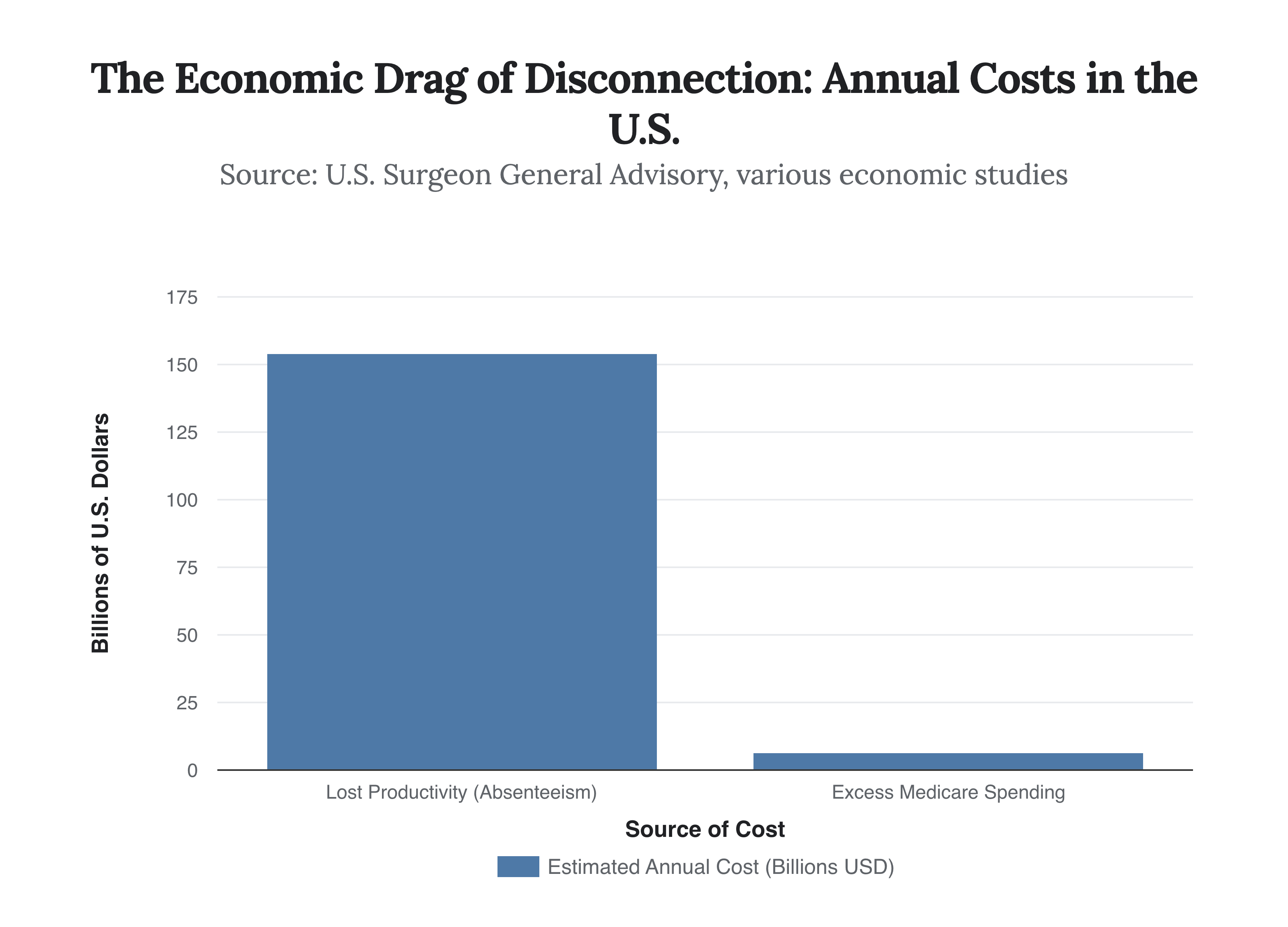
Caption: This chart quantifies the significant annual economic costs directly attributable to widespread social isolation and loneliness.
Drivers of the Disconnect: Deconstructing the ‘Why’
The collapse of male friendship is the result of powerful, intersecting societal shifts that have dismantled the traditional pillars of male community. These drivers include changes in the workplace, community engagement, and family structure, which collectively have left men with fewer avenues for building and maintaining deep social ties.
The Erosion of ‘Third Places’ and Community Hubs
Historically, men forged bonds in spaces outside of home and work—so-called “third places” like community organizations, religious institutions, and recreational clubs. Participation in these groups has declined. Factors like declining religious involvement, the shift away from unionized labor, and a general decrease in civic engagement mean fewer men are embedded in the kinds of communities where friendships naturally form. The rise of remote work, while offering flexibility, has further atomized the workforce, removing a primary, albeit often superficial, source of daily social contact.
The Shift in Support Structures
As men’s friendship circles have withered, they have become increasingly reliant on other sources for emotional support—primarily their parents and romantic partners. In 1990, nearly half (45%) of young men reported that they would turn to their friends first when facing a personal problem. Today, that figure has been cut in half to just 22%. In their place, parents have become the primary confidants for 36% of young men. This places an immense burden on aging parents and romantic partners, creating a fragile, centralized support system where the loss of a single relationship can lead to total social bankruptcy.
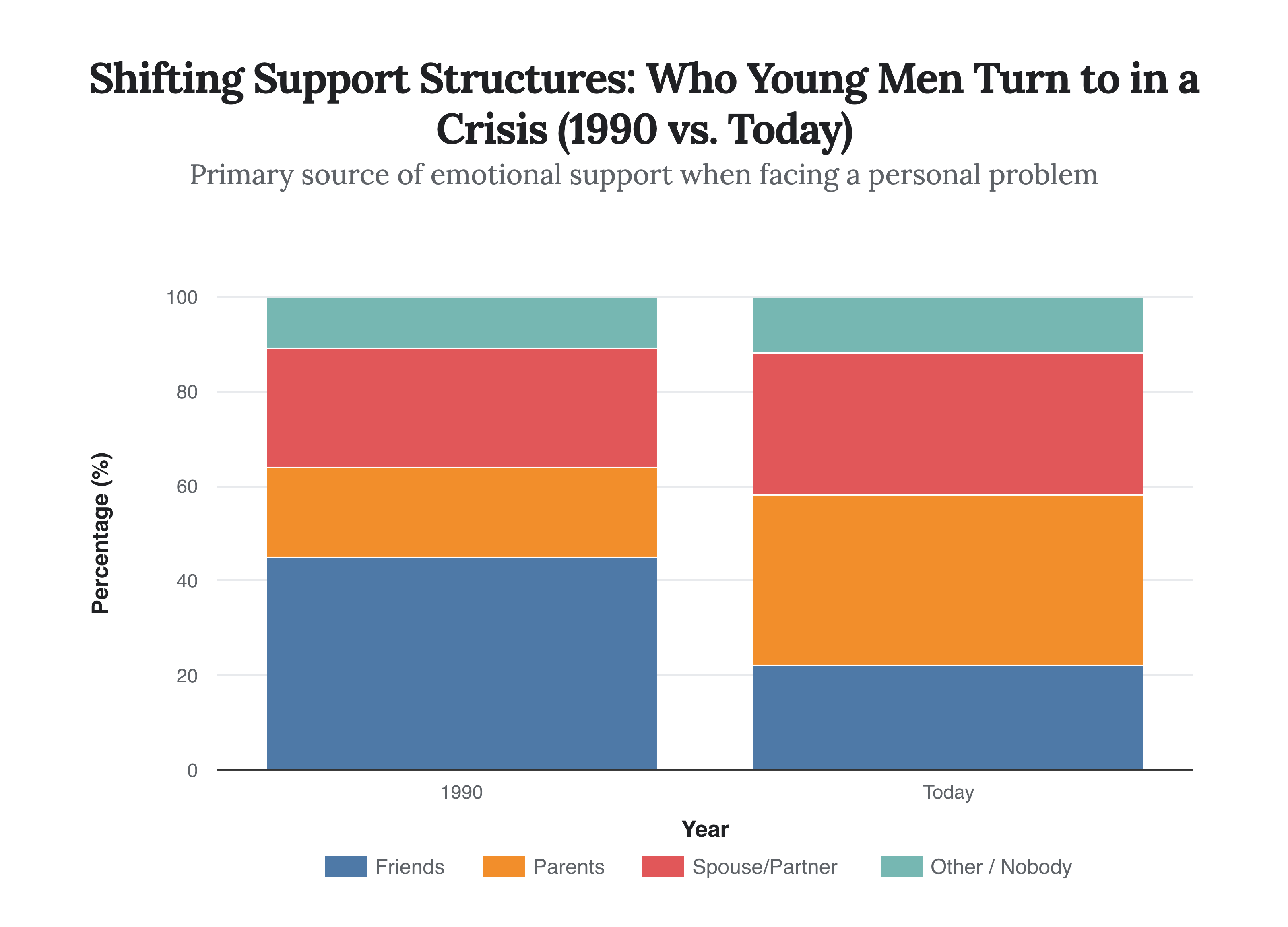
Caption: This chart visualizes the dramatic reconfiguration of young men’s support networks over the past three decades, showing a clear pivot from friends to parents.
“Many guys say they see or speak to their best friends every two or three years and ‘we just pick up where we left off.’ That may be true. But in the intervening years, men deny themselves the benefit that more regular contact could provide.” - Robert Garfield, Psychotherapist
The Vulnerability of the Single Man
Nowhere is this crisis more acute than among unmarried men. While marriage often provides a central source of social and emotional support, men who are not in a romantic relationship are exceptionally vulnerable. Data shows that 20% of unmarried men have no close friends whatsoever, a rate significantly higher than their married peers and the general male population. This highlights a critical societal failure: the institutions that once provided social safety nets for single men have largely dissolved, leaving a significant and growing demographic profoundly isolated.
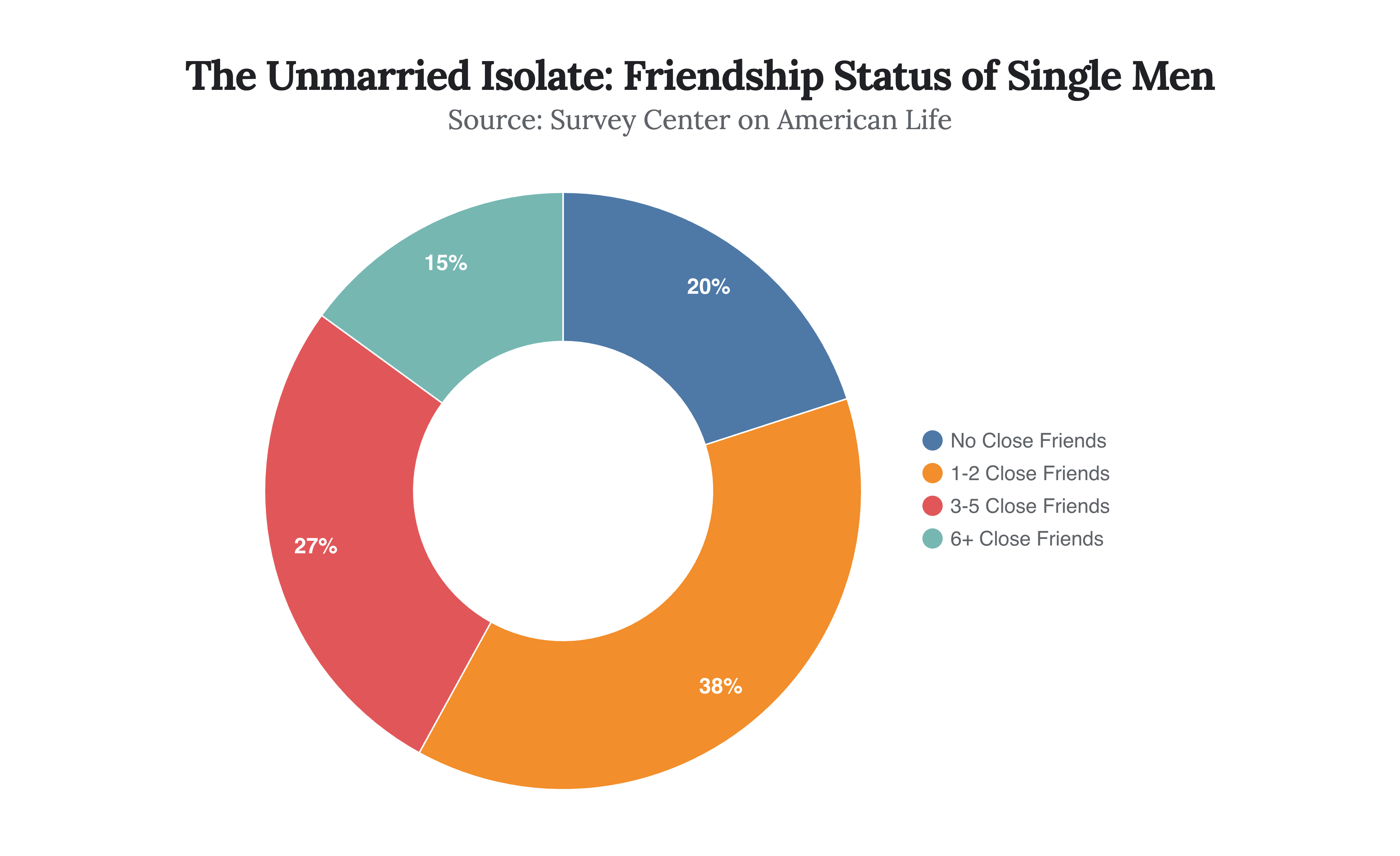
Caption: The chart reveals the precarious social situation of unmarried men, with a full fifth reporting a complete lack of close friendships.
Strategic Outlook & Future Trajectories
The trajectory of male social disconnection points toward significant future instability. The second and third-order effects of this trend will not be confined to the personal lives of isolated men but will ripple outward, impacting political polarization, community safety, and long-term economic competitiveness. As a generation of men ages with weaker social skills and nonexistent support networks, we can anticipate several key developments.
First, expect rising healthcare expenditures to become a permanent structural burden. The long-term health consequences of loneliness—dementia, heart disease, and chronic mental health issues—will manifest more acutely in the coming decades, placing sustained pressure on Medicare and private insurers. Second, the crisis will likely fuel greater social and political fragmentation. Isolated individuals are more susceptible to extremist ideologies and online disinformation, posing a risk to civic cohesion. Third, corporations will face a human capital crisis characterized by a workforce with diminished soft skills like communication, collaboration, and empathy—competencies that are forged and honed through friendship.
Addressing this challenge requires a multi-faceted strategy focused on rebuilding the social infrastructure that has been lost. This includes public and private investment in “third places,” promoting community-based organizations, and developing corporate wellness programs that move beyond superficial perks to actively foster genuine human connection. The alternative is to accept a future where a significant portion of the male population lives in a state of quiet desperation, with society bearing the heavy cost.
The data is unequivocal: we are witnessing a fundamental breakdown in the social architecture of manhood. The consequences are already upon us, exacting a heavy toll on our health systems, our economy, and the lives of millions of fathers, sons, and brothers. Ignoring this 500% increase in profound isolation is not an option. This is a leading indicator of societal decline, and the bill is coming due.