



The global energy transition is currently betting its future on a geographic paradox. The “Lithium Triangle”—spanning the high-altitude salt flats of Chile, Argentina, and Bolivia—holds nearly 60% of the world’s identified lithium resources. Yet, in 2024, this region accounted for less than one-third of global production. The widening gap between geological potential and market reality is not a failure of chemistry or exploration; it is a failure of logistics.
While investors obsess over spot prices and battery chemistries, the real war is being fought on single-lane gravel roads in the Puna de Atacama and at the congested breakwaters of Antofagasta. Our analysis reveals a staggering inefficiency: logistics costs in the northern Argentine provinces are running up to 50% higher than in neighboring regions, effectively imposing a “remoteness tax” that threatens to derail billions in CAPEX. Furthermore, the reliance on the Panama Canal creates a 14-day detour for Asian exports—a delay that the emerging Bi-Oceanic Corridor aims to eliminate, potentially unlocking $5 billion in annual logistics savings for major importers like China.
This briefing deconstructs the physical, operational, and resource-based choke points strangling the Lithium Triangle, moving beyond the macro headlines to map the specific arteries where the supply chain is suffering cardiac arrest.
1. The Geography of Friction: The “First Mile” Deficit
The defining feature of the Lithium Triangle is not just its altitude (averaging 3,700 meters above sea level) but its isolation. The salt flats (salars) are located in hyper-arid, endorheic basins hundreds of kilometers from industrial hubs. The “first mile” of logistics—getting reagents in and product out—is the most expensive.
The Argentina-Bolivia Disconnect
Bolivia represents the extreme case of infrastructure paralysis. Despite possessing the world’s largest lithium reserves (23 million tons), its landlocked status and lack of industrial rail capacity have capped its production at a negligible fraction of the global total. In contrast, Argentina is aggressively expanding, but it relies on a patchwork of provincial roads (like Route 51) that are frequently impassable due to weather or accidents. The data below highlights the stark disconnect between resource endowment and the ability to move it.
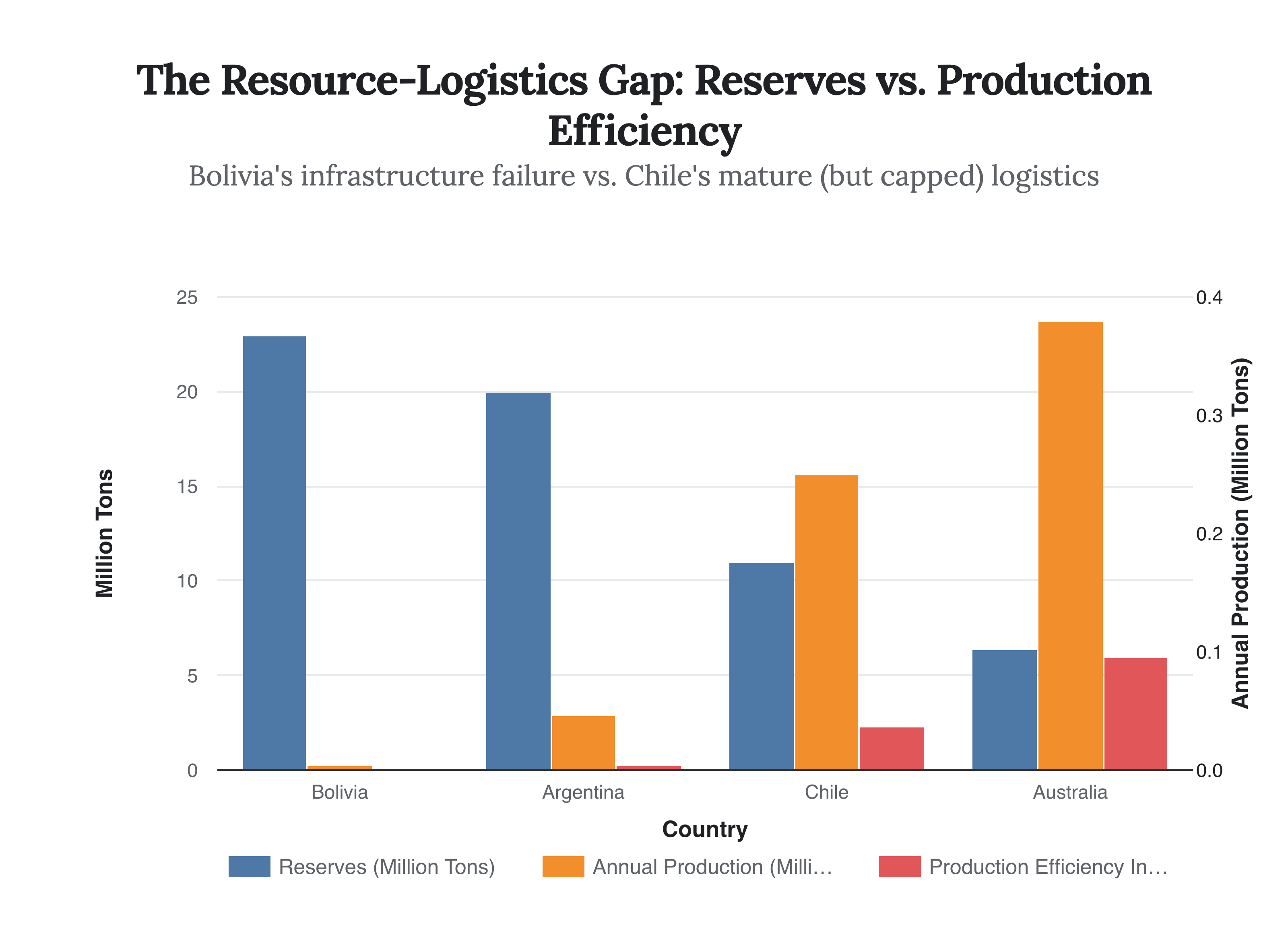
The chart above illustrates a critical strategic insight: Reserves are meaningless without rails. Australia, with a fraction of the Triangle’s reserves, dominates production largely due to its proximity to ports and established mining infrastructure. Bolivia’s “efficiency index” is near zero, a direct quantifiable result of its logistical isolation.
2. The “Last Mile” Bottle Neck: Port Congestion
For Chile and Argentina, the Pacific ports of Antofagasta, Mejillones, and Iquique are the lungs of the lithium trade. However, they are gasping for air. As copper exports remain high and lithium volumes surge, these ports are facing
