


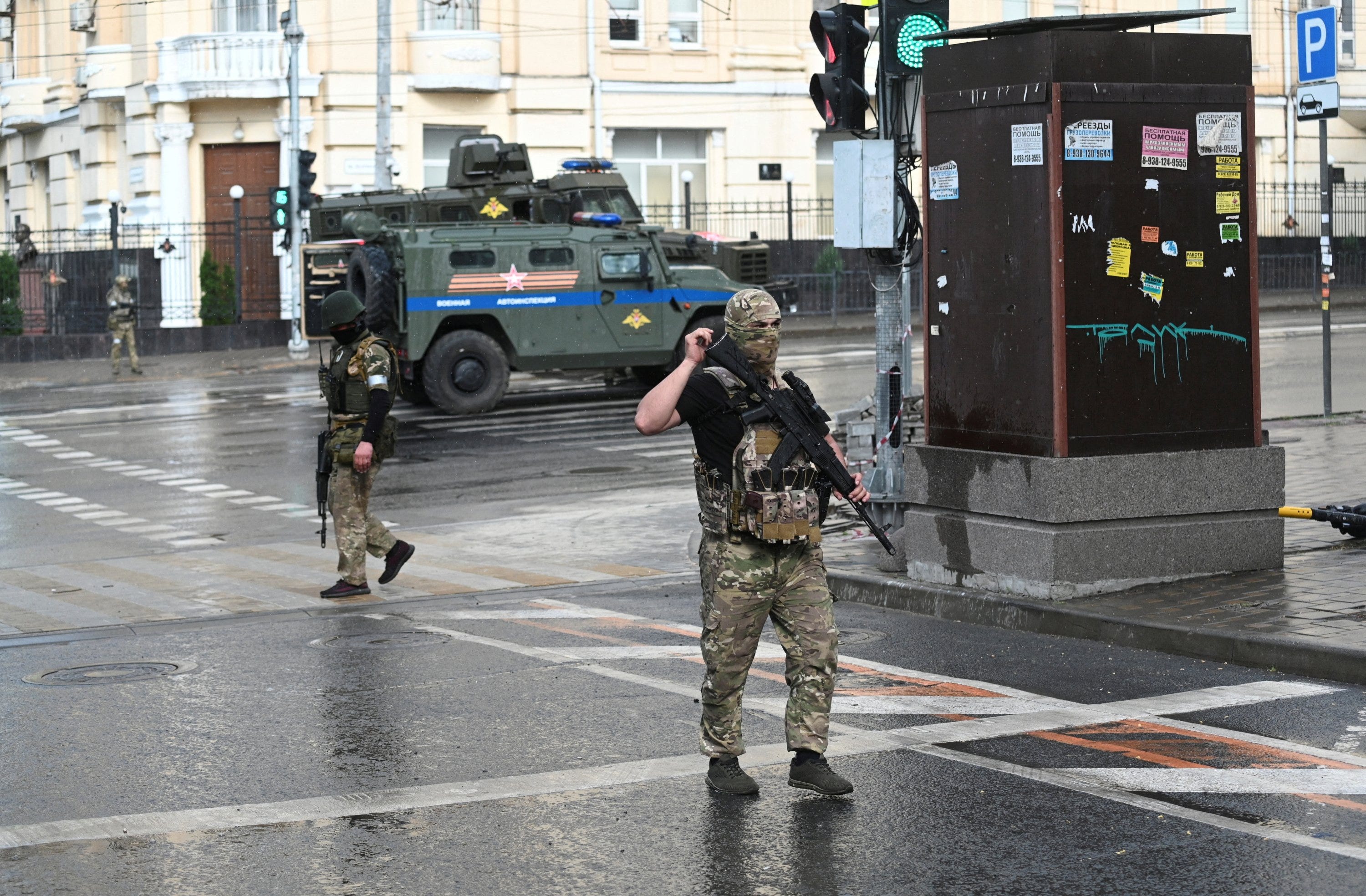
The era of the “plausible deniability” mercenary is ending. In its place, a new, far more robust industry is emerging—one that is integrated, digitized, and rapidly scaling toward half a trillion dollars. While the world watched the dramatic rise and fall of the Wagner Group, a quiet revolution was taking place in the global defense ledger. According to new 2025 market projections, the global Private Military and Security Services (PMSC) market is not just surviving the scrutiny; it is thriving on it, with a trajectory set to breach $488 billion by 2034.
The most immediate signal of this shift comes from the chaos of the Ukraine war. While Western firms tread carefully through legal grey zones, Russian defense contractors—now operating under tighter state control following the Wagner mutiny—have posted staggering numbers. Data released in late 2024 reveals that Russian defense firms saw a 40% revenue surge year-over-year, outpacing nearly every other national sector. This is not merely wartime inflation; it is the economic footprint of the “Return of the Privateer.”
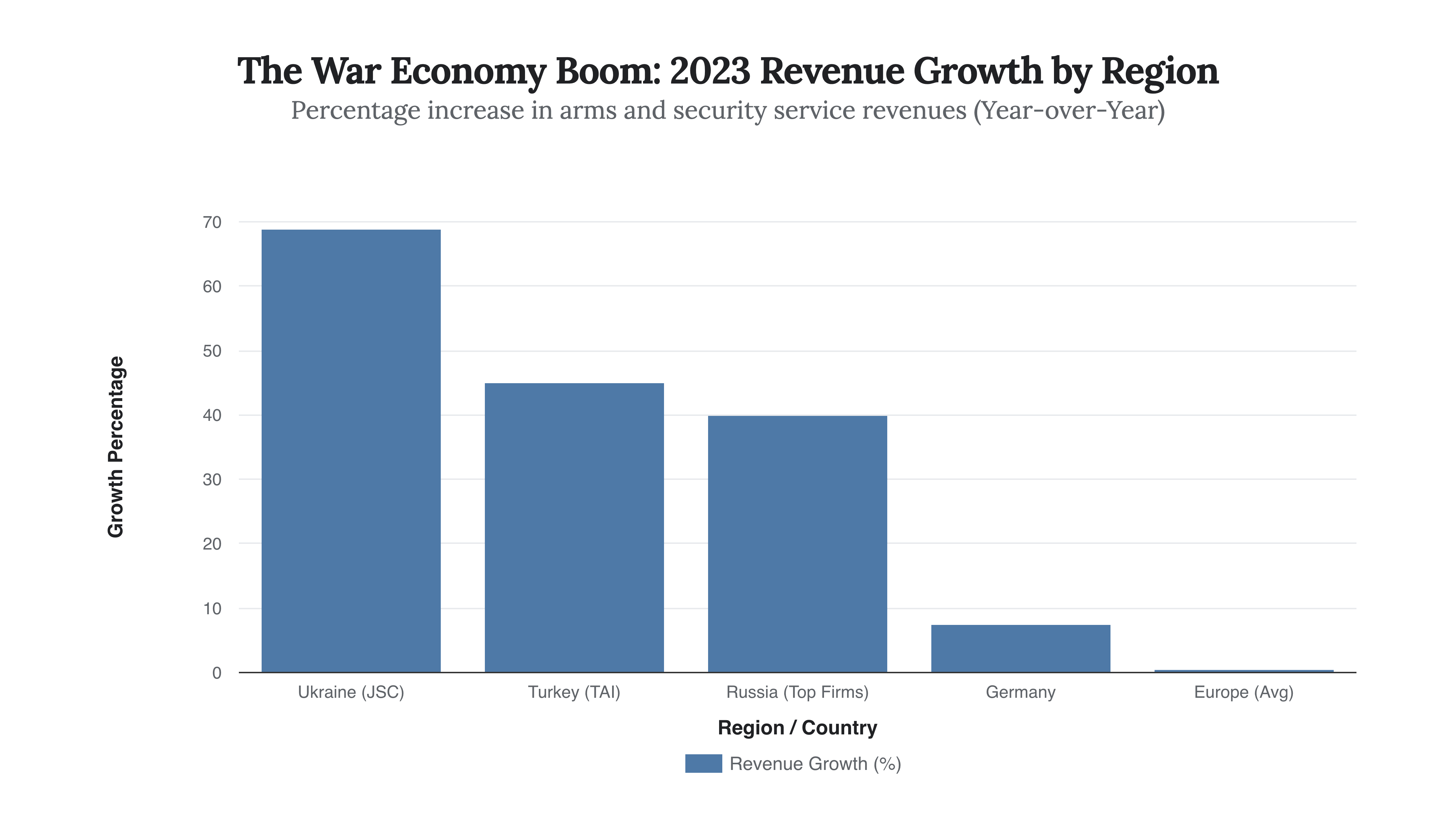
The data above illustrates a stark divergence. While European defense industries remained largely flat with a 0.5% average growth, the frontline actors—Ukraine and Russia—are experiencing an industrial metamorphosis. For Russia, this growth represents the consolidation of the privateering model. The “Africa Corps,” which has effectively subsumed Wagner’s operations in Mali and Niger, operates not as a rogue entity but as a direct extension of the Ministry of Defense. This shift from mercenary to state-contractor removes the veil of separation, allowing for direct heavy weapon supplies and integrated logistics that were previously impossible.
“The commercialisation of conflict is no longer a subtext – it is the text. Since the 1990s, private military and security companies have evolved from manpower providers to system integrators and data brokers.”
Growth Vector 1: The Digitization of Force
Perhaps the most overlooked growth vector is the shift from kinetic to digital privateering. The modern PMSC is as likely to employ a Python developer as a rifleman. As the conflict in Ukraine serves as a global laboratory for drone warfare and electronic countermeasures, a new segment of “cyber-intelligence add-ons” has emerged, now accounting for nearly 19% of market demand drivers.
This “invisible layer” of the battlespace includes private sector offensive actors (PSOAs) who sell intrusion tools and surveillance data. In 2024, venture capital investment in defense-tech startups operating in these grey zones surged, driven by the realization that in modern warfare, whoever owns the data kill-chain owns the battlefield. This digital vector allows PMSCs to project power globally without the logistical footprint of deploying boots on the ground.
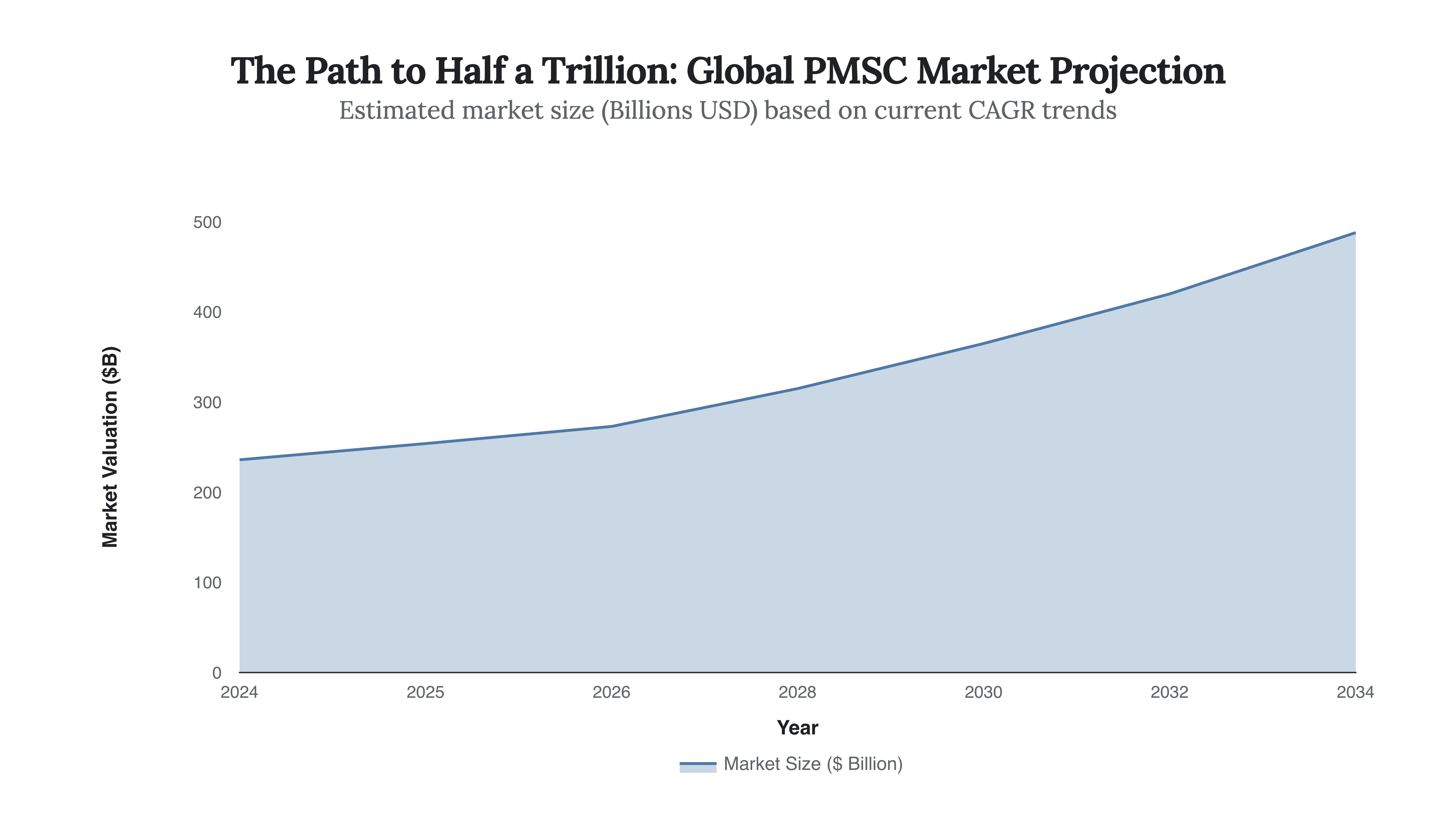
The trajectory is undeniable. From a valuation of $236 billion in 2024, the sector is compounding at a rate that outpaces global GDP growth. By 2034, the private military industry is projected to reach nearly half a trillion dollars. This growth is not evenly distributed; it is concentrated in regions of high instability where state capacity is failing.
Growth Vector 2: The Red Sea and the Belt & Road
While Russia rewrites the rules in the Sahel, a different model is expanding in the East. The Red Sea crisis, driven by Houthi attacks on commercial shipping, has revitalized the maritime security sector. Ship demand and time charter rates spiked by 41% in early 2024, dragging with them a surge in demand for armed overwatch.
China’s approach to this vacuum offers a sharp contrast to the Russian model. With over 5,000 registered security companies, Beijing is exporting a “protection-first” model along the Belt and Road Initiative. Unlike the combat-heavy Russian units, Chinese PSCs focus on asset guarding, employing roughly 3,200 personnel internationally. However, as threats to Chinese assets in Pakistan and Africa grow, the pressure to arm these contractors is mounting, potentially opening a massive new frontier for the industry.
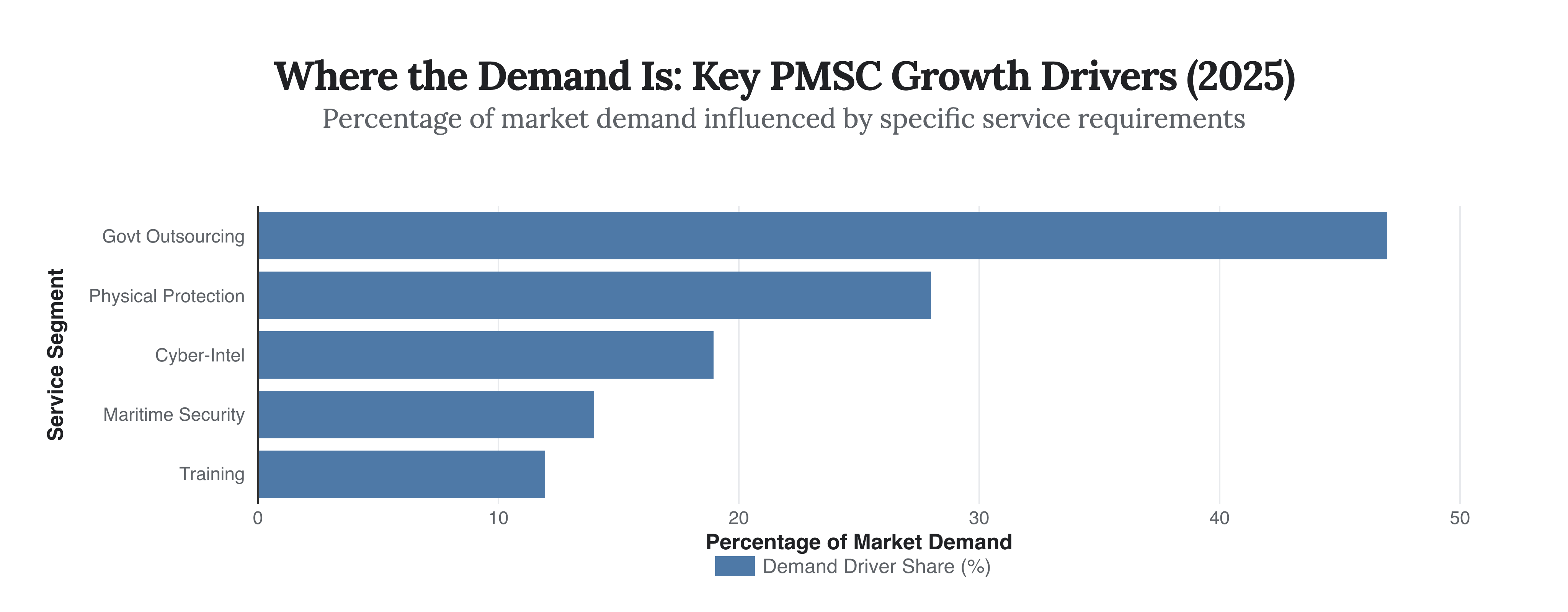
The chart above highlights the reality of the modern market: it is dominated by government outsourcing. The romanticized image of the rogue soldier of fortune is outdated; the modern privateer is a government subcontractor. With 47% of demand driven by state outsourcing, the industry has effectively become a fourth branch of the armed services for many nations—one that is flexible, deniable, and increasingly indispensable.
The Return of the Privateer
We are witnessing the normalization of the private military actor. Whether it is the U.S. considering the deployment of contractors to Ukraine for maintenance, or Russia formally integrating the Africa Corps into its foreign policy apparatus, the stigma is fading. The privateer has returned not as an outlaw, but as a systemic necessity in a world of fragmented order.
“Contracting Wagner may have solved a short-term security challenge for new juntas, but that solution has the potential to create serious and lasting internal challenges... relying on Russian PMCs is a costly proposition.”
As the market barrels toward the $488 billion mark, the line between public and private warfare will continue to blur. The growth vectors—state integration, cyber warfare, and critical infrastructure protection—suggest that the future of war will not be fought solely by standing armies, but by a complex hybrid of national interests and corporate balance sheets. The privateer is no longer at the gates; he is in the boardroom.