


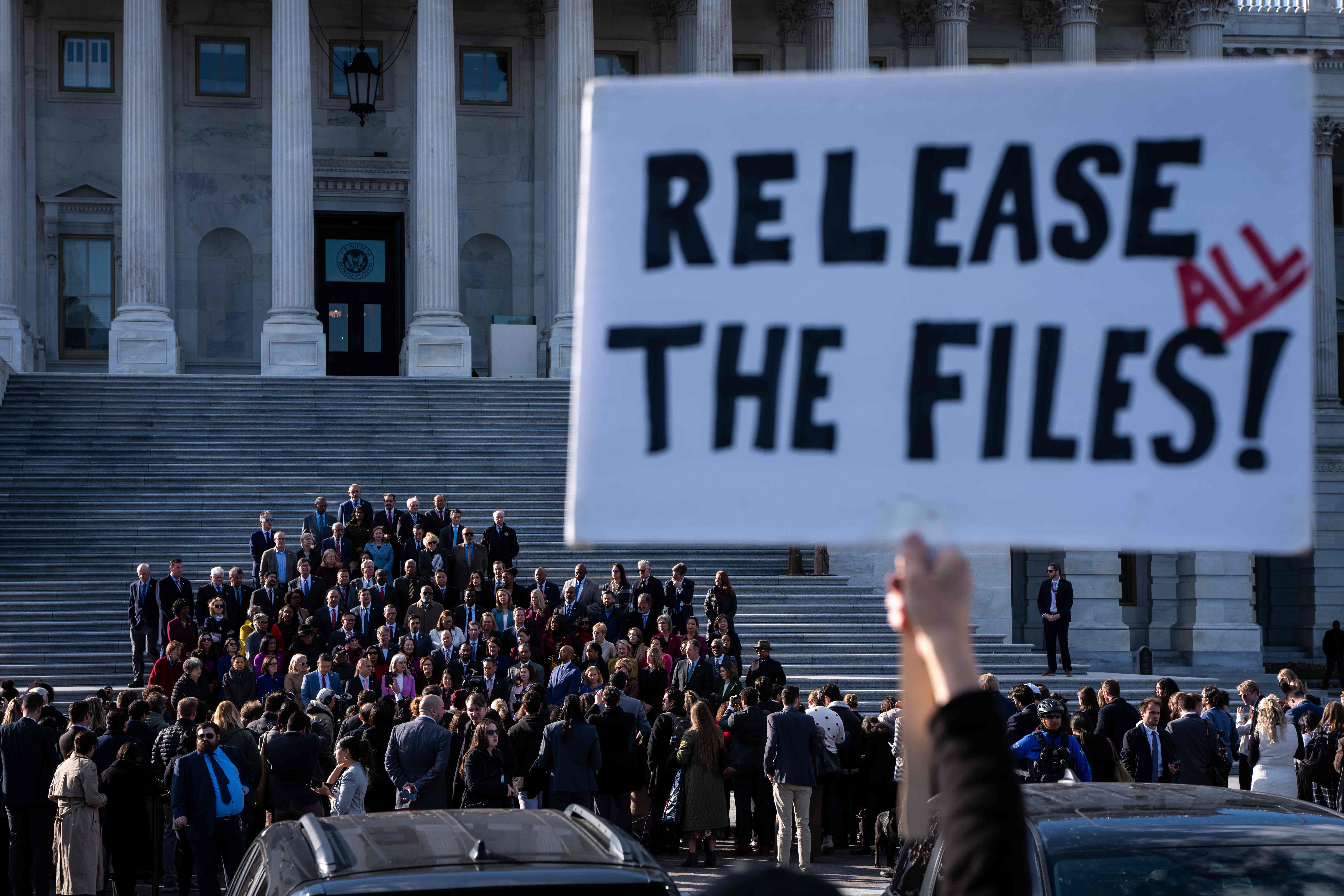
In a rare and seismic display of bipartisan unity, the U.S. House of Representatives voted 427-to-1 to pass the Epstein Files Transparency Act, compelling the Department of Justice to release its vast cache of investigative records on the late financier and convicted sex offender Jeffrey Epstein. This vote was not a simple legislative process; it was the culmination of a months-long political insurgency that pitted a small, determined bipartisan coalition against their own leadership and a resistant White House.
The result is a mandate for transparency that will have profound and unpredictable consequences for the political and financial elite in the United States and abroad. This briefing deconstructs the intricate power dynamics that led to this moment, analyzes the separate but converging tracks of congressional investigation, and provides a forward-looking assessment of the strategic risks and opportunities that lie ahead as Washington braces for a data deluge of potentially explosive proportions. The core of this story is not merely what is in the files, but the fierce battle over who controls their release—a battle that has reshaped political alliances and exposed deep fractures within both parties.
The Anatomy of a Legislative Rebellion
The passage of the Epstein Files Transparency Act was not achieved through conventional channels. It was forced into existence by a procedural gambit that highlights a growing impatience with institutional gatekeepers. Understanding this mechanism is critical to appreciating the political forces now in play.
The Discharge Petition: A Tool of Last Resort
For months, the bill languished, effectively blocked by House leadership and opposed by the President, who labeled the effort a politically motivated “hoax.” The breakthrough came via a discharge petition, a rarely successful parliamentary maneuver that allows a majority of House members (218) to force a bill out of committee and onto the floor for a vote, bypassing the Speaker’s authority. Sponsored by Democratic Rep. Ro Khanna and Republican Rep. Thomas Massie, the petition became a slow-burning proxy war for control of the transparency agenda.
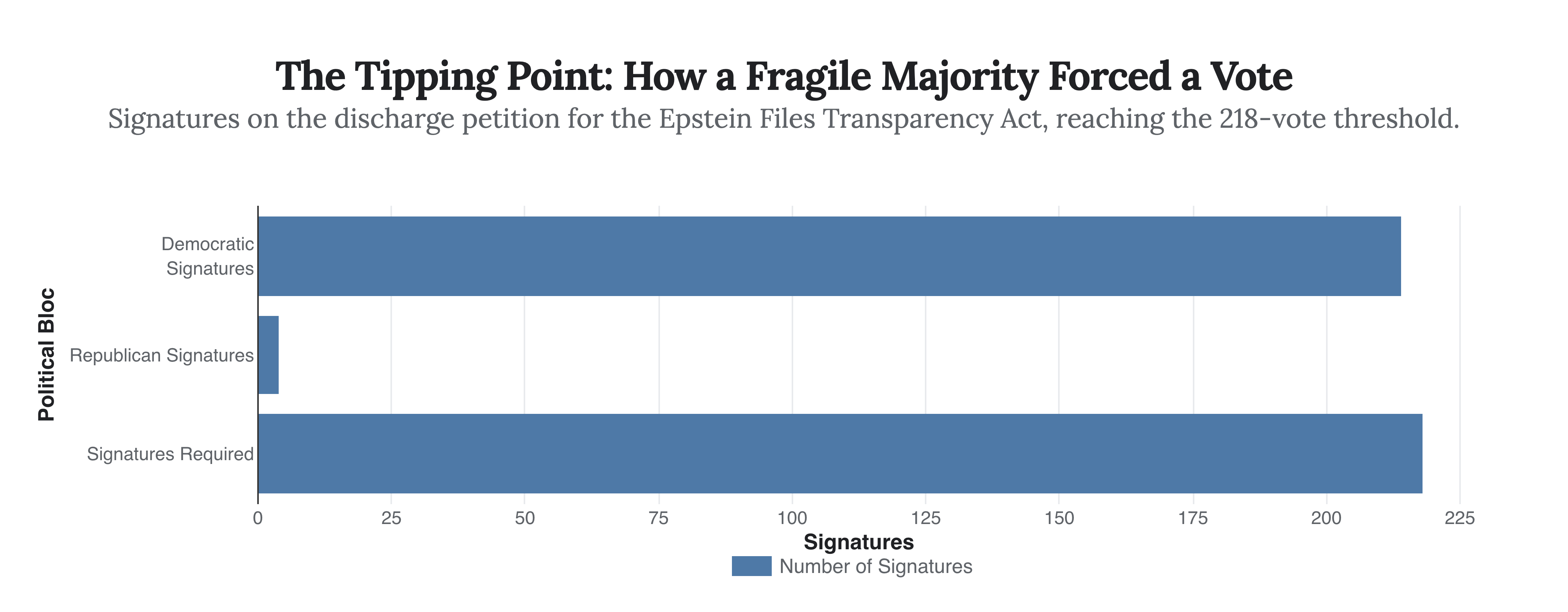
The discharge petition’s success hinged on a small group of four Republican lawmakers who broke with their party’s leadership to join all 214 Democrats, creating the bare minimum majority needed to compel a vote.
The petition’s journey was fraught with political tension. The decisive 218th signature was added by a newly sworn-in Democratic representative, Adelita Grijalva, moments after taking office, an event Democrats claimed was deliberately delayed by House leadership to stall the vote. This procedural battle underscores the deep institutional resistance the bill’s proponents overcame.
The Unraveling of Opposition
Faced with an unstoppable vote, the opposition that had held for months crumbled in a matter of days. President Trump, who had previously urged Republicans to remove their names from the petition, executed a stunning reversal, encouraging the entire party to vote in favor of the bill and promising he would sign it into law. This pivot transformed the vote from a contentious showdown into an overwhelming display of consensus. The final tally was a political spectacle: 216 Republicans and 211 Democrats voted in favor, with Rep. Clay Higgins of Louisiana casting the sole dissenting vote, citing concerns over the privacy of innocent individuals who might be named in the files.
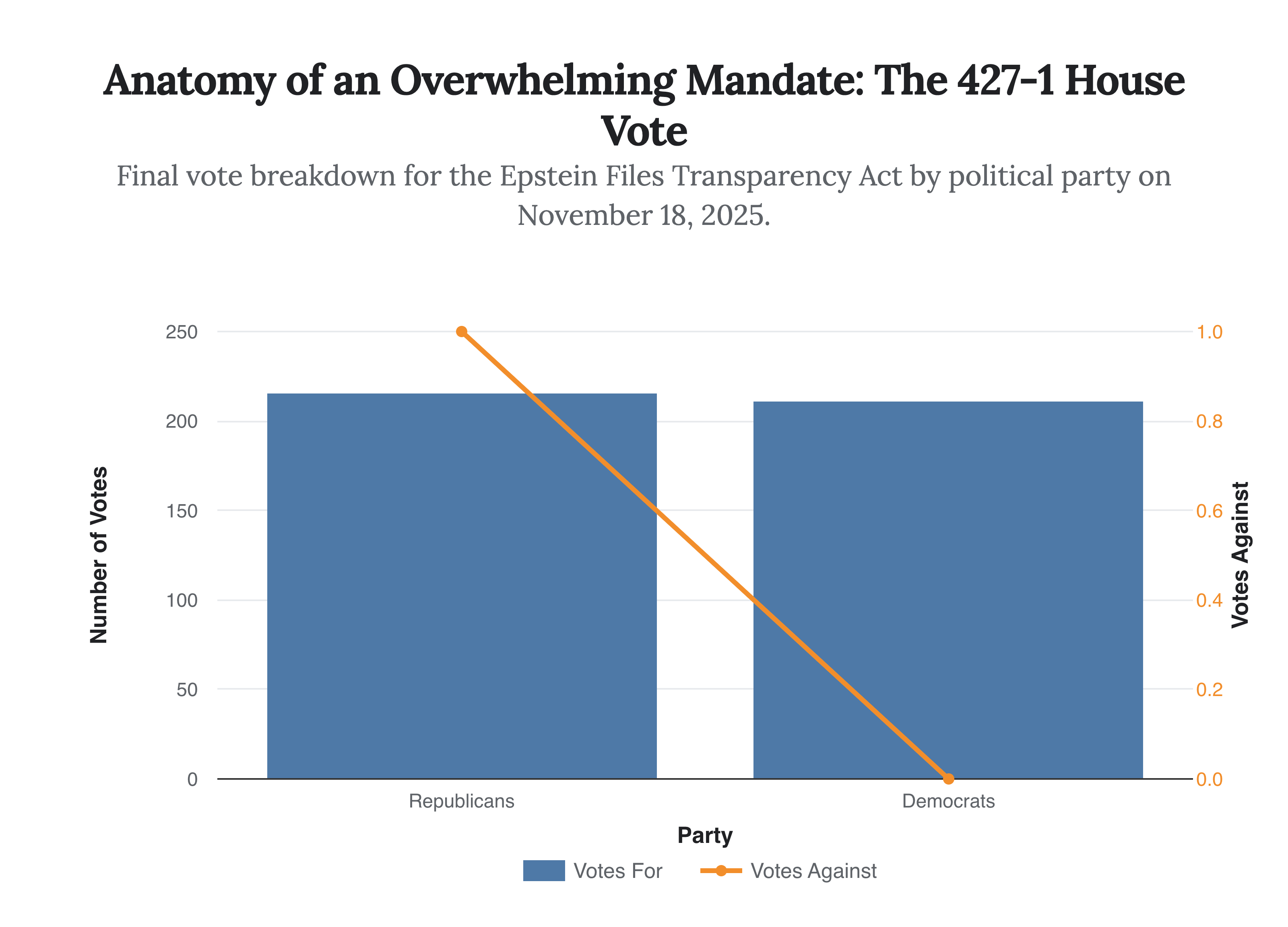
The near-unanimous vote reflects a dramatic shift from entrenched opposition to a politically necessary embrace of transparency, effectively isolating the lone dissenter.
“Today is the first day of real reckoning for the Epstein class... Because survivors spoke up, because of their courage, the truth is finally going to come out, and when it comes out, this country is really going to have a moral reckoning.”
- Rep. Ro Khanna (D-CA)
Two Tracks of Investigation: The Committee and the DOJ
It is a strategic error to view the Epstein Files Transparency Act in isolation. The legislative push is just one of two major fronts in the congressional effort to uncover the full scope of Epstein’s network. The other is a parallel, aggressive investigation being conducted by the House Oversight Committee, which has been using its subpoena power to acquire and release documents independently of the DOJ.
The Oversight Committee’s Document Trove
Led by Chairman James Comer, the House Oversight Committee has already released tens of thousands of pages of documents obtained directly from Epstein’s estate. These releases, including over 65,000 pages to date, have provided initial, headline-grabbing glimpses into Epstein’s correspondence, revealing his efforts to maintain his network of influence long after his first conviction. This track is significant because it is not bound by the DOJ’s internal review processes and has served to maintain public pressure for a broader release. However, this has also led to accusations of politically motivated selective leaks from both sides of the aisle.
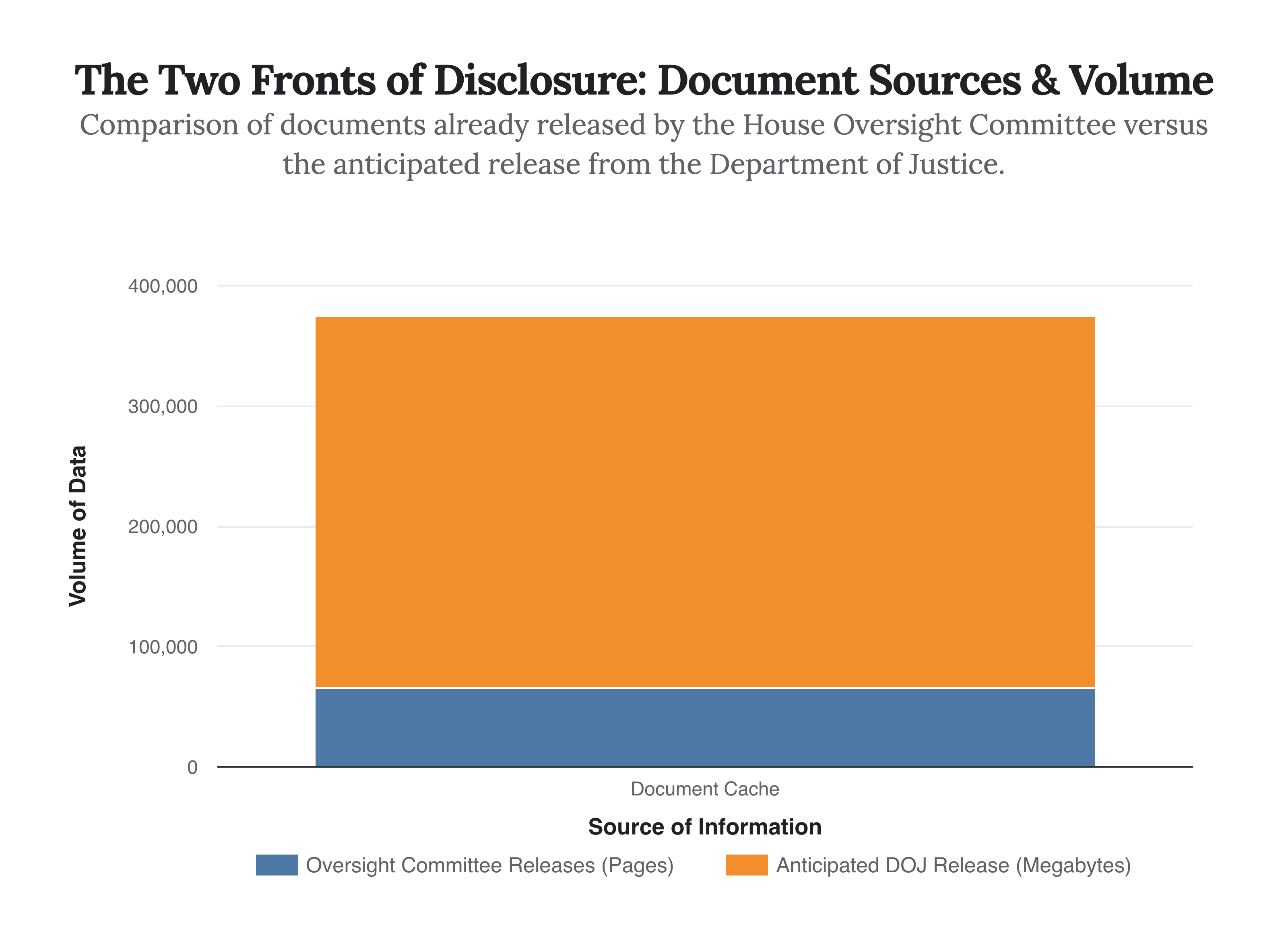
The Oversight Committee’s releases, measured in pages, have set the stage for the much larger, data-intensive release expected from the DOJ, which is reported to hold over 300 gigabytes of files.
The Subpoena Dragnet
The Oversight Committee has also cast a wide net with its subpoena power, compelling testimony from a list of high-profile figures that spans multiple presidential administrations. This includes subpoenas for former Presidents Bill Clinton, former Secretary of State Hillary Clinton, and a succession of former Attorneys General and FBI Directors from both parties. This demonstrates a commitment to investigating not only Epstein’s crimes but also the institutional failures that may have enabled them for decades.
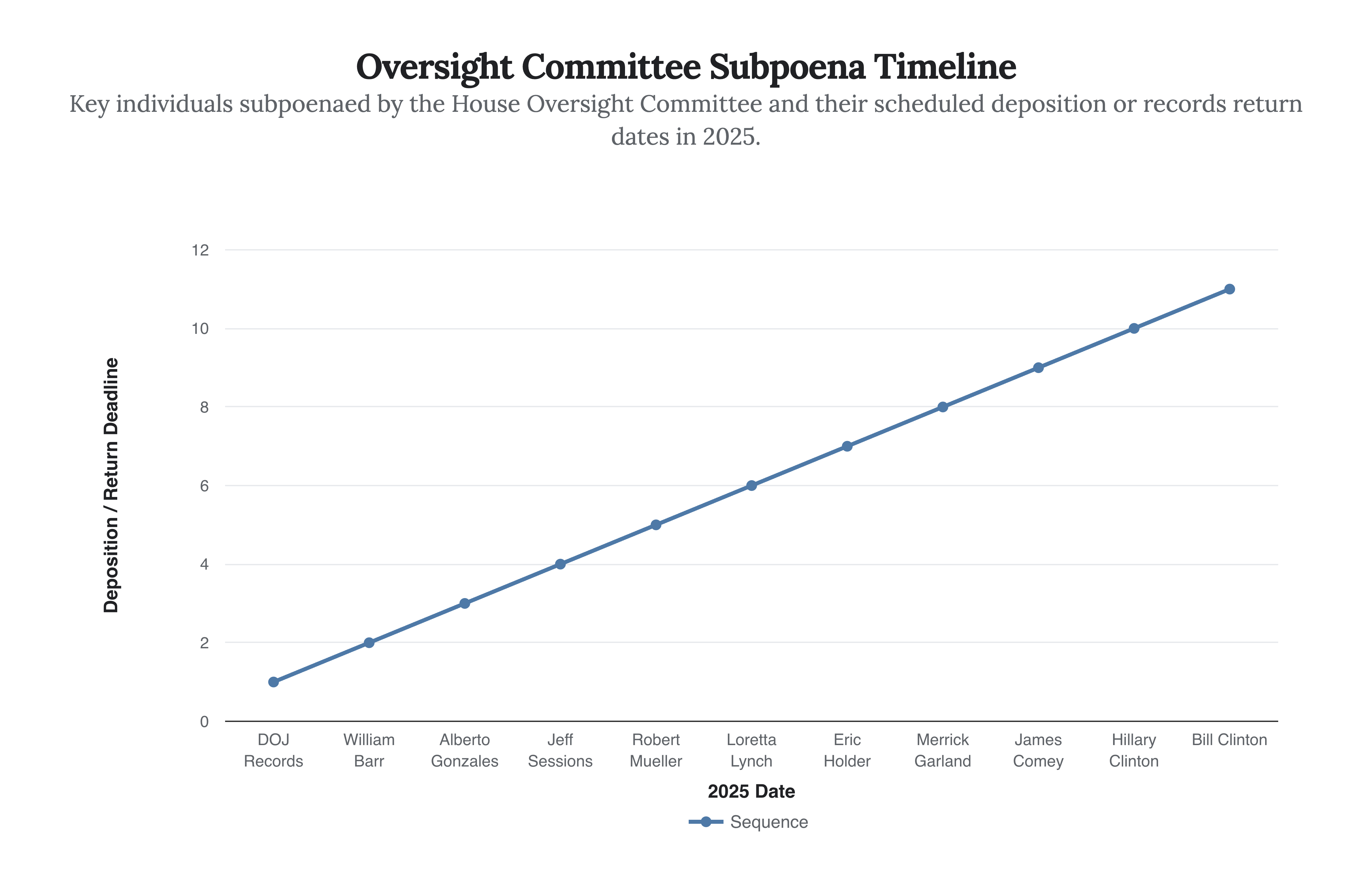
The committee has established an aggressive timeline for depositions, indicating a methodical investigation into potential misconduct and negligence at the highest levels of the U.S. government.
Strategic Foresight: Navigating the Coming Storm
With the bill now heading to the Senate, where Majority Leader John Thune has indicated it will be taken up “fairly quickly,” the focus shifts from the political process to the practical consequences of the release. The Act mandates that the Attorney General publish the files within 30 days of the bill becoming law. While certain redactions are permitted—for victims’ privacy, national security, and ongoing investigations—the bill explicitly forbids withholding information due to potential “embarrassment, reputational harm, or political sensitivity.”
Market and Political Volatility
The release of these documents introduces a significant variable into the political and financial landscape. The individuals and institutions named in the files, regardless of the context, will face immediate and intense public scrutiny. This creates several strategic risks:
Reputational Risk: Companies, investment funds, and non-profits associated with named individuals could face shareholder revolts, donor flight, and consumer boycotts. Proactive crisis communications and internal reviews are now essential for any organization with even tangential links to Epstein’s network.
Political Fallout: The files will become a political weapon. Regardless of the substance, expect excerpts to be used in attack ads, fundraising appeals, and social media campaigns to damage political opponents. The bipartisan support for the bill’s passage will quickly evaporate into partisan warfare over its contents.
Legal Exposure: While much of the information may be old, the comprehensive release could reveal new patterns of behavior or previously unknown connections, potentially opening avenues for new civil litigation or even prompting prosecutors to re-examine charging decisions.
“If enacted in its current form, this type of broad reveal of criminal investigative files, released to a rabid media, will absolutely result in innocent people being hurt.”
- Rep. Clay Higgins (R-LA), the sole vote against the bill
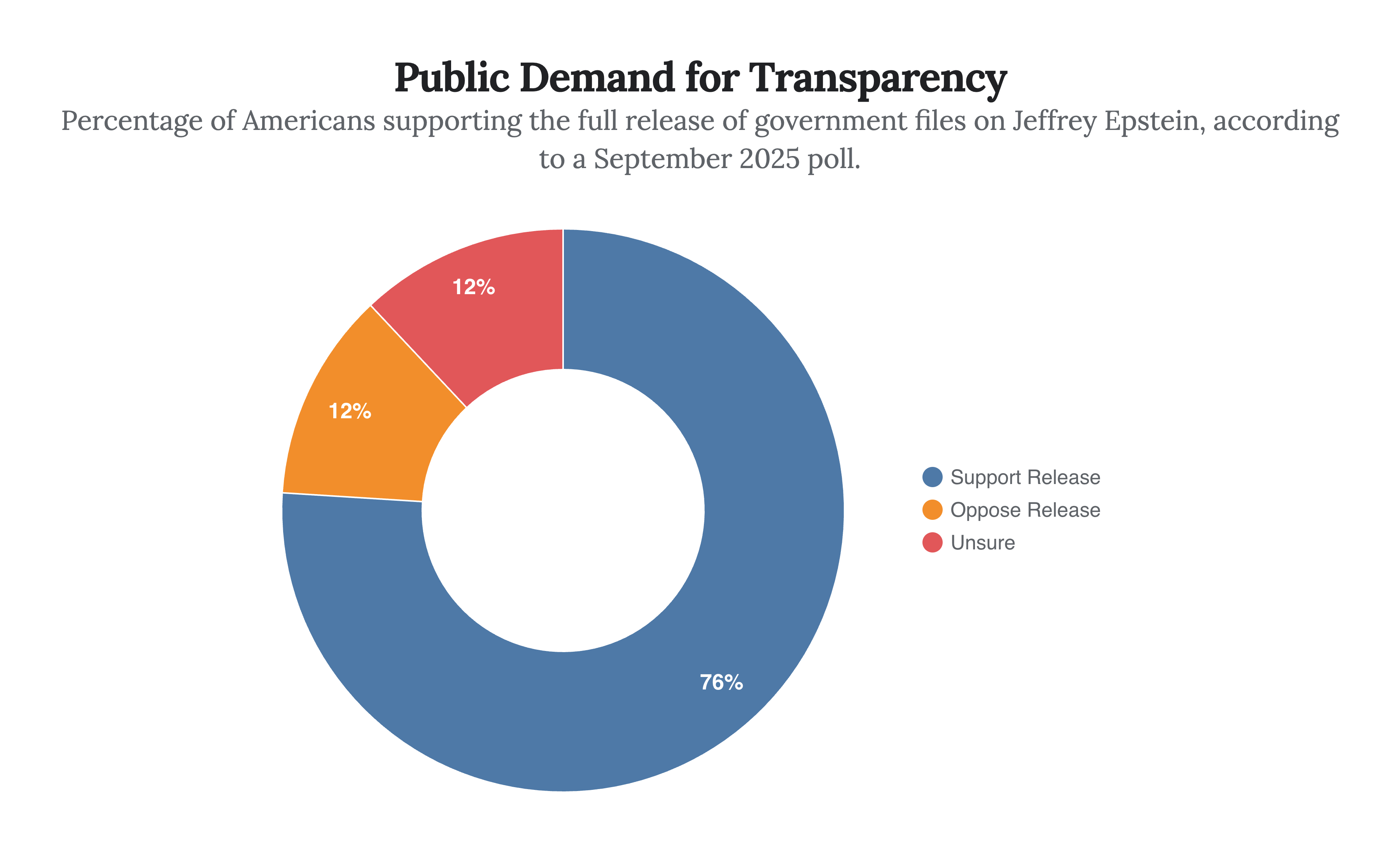
The overwhelming legislative vote is mirrored by strong public opinion, with polling showing more than three-quarters of Americans support the release of the files, giving political actors a powerful mandate to act on the information revealed.
The Known Unknowns
The critical question remains: what is actually in the DOJ files? While the Oversight Committee’s releases have focused on emails from Epstein’s estate, the DOJ’s cache is expected to be far more comprehensive, potentially including FBI interview summaries (302s), grand jury materials, financial transaction records, and internal communications about prosecutorial decisions. It is the official, investigative nature of these documents that makes their release so potent. The 2007 non-prosecution agreement in Florida, widely seen as exceedingly lenient, will be a key area of focus, as will details surrounding Epstein’s death in federal custody in 2019.
The passage of the Epstein Files Transparency Act is a watershed moment, born from a rare confluence of populist outrage, bipartisan defiance, and strategic political capitulation. The focus will now shift from Washington’s procedural battles to the substantive, and likely shocking, details contained within decades of sealed records. For industry leaders, investors, and policymakers, the period of speculation is ending, and a period of reactive crisis management is about to begin. The key signpost to watch is the Senate’s timeline for a vote and any last-minute attempts to amend the bill’s redaction criteria. Any delay will signal that the institutional battle for control over this information is not yet over.
The true impact of the 427-to-1 vote is not just the release of files, but the precedent it sets: a clear demonstration that a determined, bipartisan coalition can successfully use procedural tools to force transparency on a resistant executive branch, fundamentally altering the balance of power on matters of national significance.