



November 2024
The narrative on Wall Street is seductive, comforting, and almost certainly wrong. Following the Federal Reserve’s 25-basis-point cut in November 2024—bringing the target range to 4.50-4.75%—the consensus trade has coalesced around a singular, optimistic outcome: a smooth glide path down to a terminal rate of 3.0% by 2026. Futures markets are pricing in a return to the low-rate regime that defined the post-GFC era, betting nearly $12 trillion in duration assets on the assumption that inflation has been conquered.
This guide argues the opposite. We are not witnessing a return to normal; we are entering a new regime of structural scarcity where the “Neutral Rate” (r*)—the theoretical rate that neither stimulates nor restricts the economy—has quietly vaulted from 2.5% to a floor of roughly 4.2%. The disconnect between the market’s pricing of a dovish pivot and the fiscal and demographic reality of the US economy represents the single largest capital misallocation risk of the decade. The Fed isn’t just fighting inflation; it is fighting a structural reset of the cost of capital.
The “Supercore” Trap: Why the Last Mile is a Cliff
The headline inflation numbers—Consumer Price Index (CPI) and Personal Consumption Expenditures (PCE)—have indeed cooled from their 2022 peaks. But for the sophisticated strategist, headline numbers are noise. The signal lies in “Supercore” inflation (Core Services ex-Housing), a metric that strips away the lag of shelter data and the volatility of commodities to reveal the true pulse of wage-driven price pressure.
In October 2024, while headline PCE drifted toward 2.3%, Supercore inflation accelerated, posting a month-over-month rise of nearly 0.4% (annualized ~4.8%). This divergence is critical. It signals that while goods deflation (driven by supply chain normalization) has done the heavy lifting, the service economy remains structurally overheated. The Fed is cutting rates into a service sector that is still expanding, risking a 1970s-style resurgence of price instability.
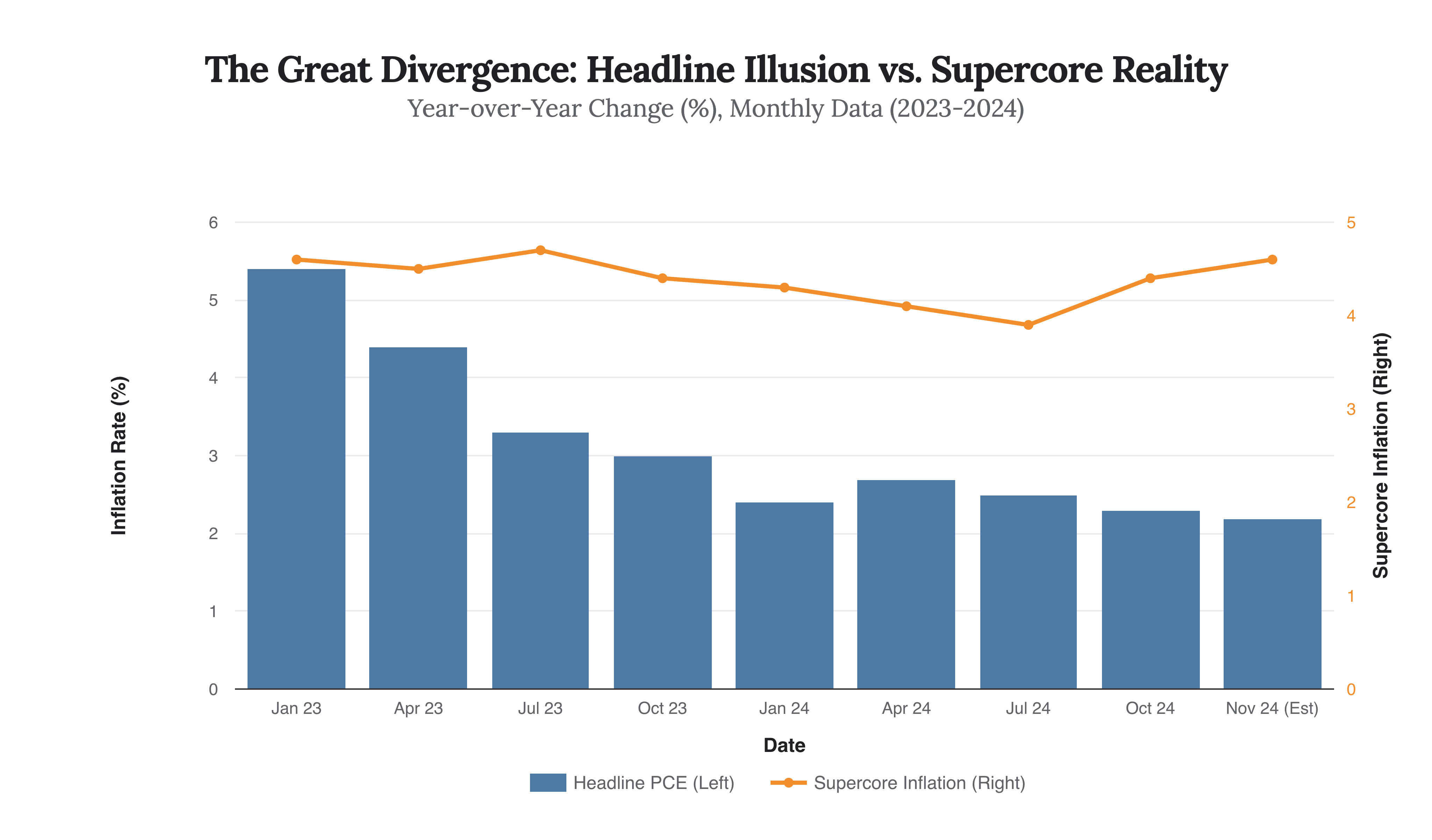
Strategic Implication: The Fed’s November cut was a tactical concession to the bond market, not a strategic victory over inflation. With Supercore re-accelerating, the Fed’s “put” is further out of the money than investors realize. Expect the pace of cuts to stall in Q1 2025 as services inflation proves sticky, forcing a violent repricing of short-term rate futures.
The Ghost of R-Star: The 4.2% Floor
For fifteen years, the financial world operated on the assumption that r* (the neutral rate) was roughly 0.5% in real terms, or 2.5% nominal. This “secular stagnation” thesis justified infinite leverage and soaring equity valuations. That era is dead. Three structural forces have conspired to raise the floor of r* to approximately 4.2%:
Fiscal Dominance: With a US deficit running at 6-7% of GDP during an expansion, the Treasury’s insatiable demand for capital is structurally raising the cost of money.
AI & Industrial Capex: The re-industrialization of the US (chips, green energy, AI data centers) requires massive capital deepening, increasing the demand for investment and pushing rates higher.
Demographics: As Boomers retire and begin drawing down assets rather than saving, the global savings glut that suppressed rates is unwinding.
The Cleveland Fed’s latest models suggest the nominal neutral rate may have drifted as high as 3.7% to 4.5%. Yet, the Fed’s “Dot Plot” median still anchors to a long-run rate of roughly 2.9%. This 130-basis-point gap is the “kill zone” for asset allocators.
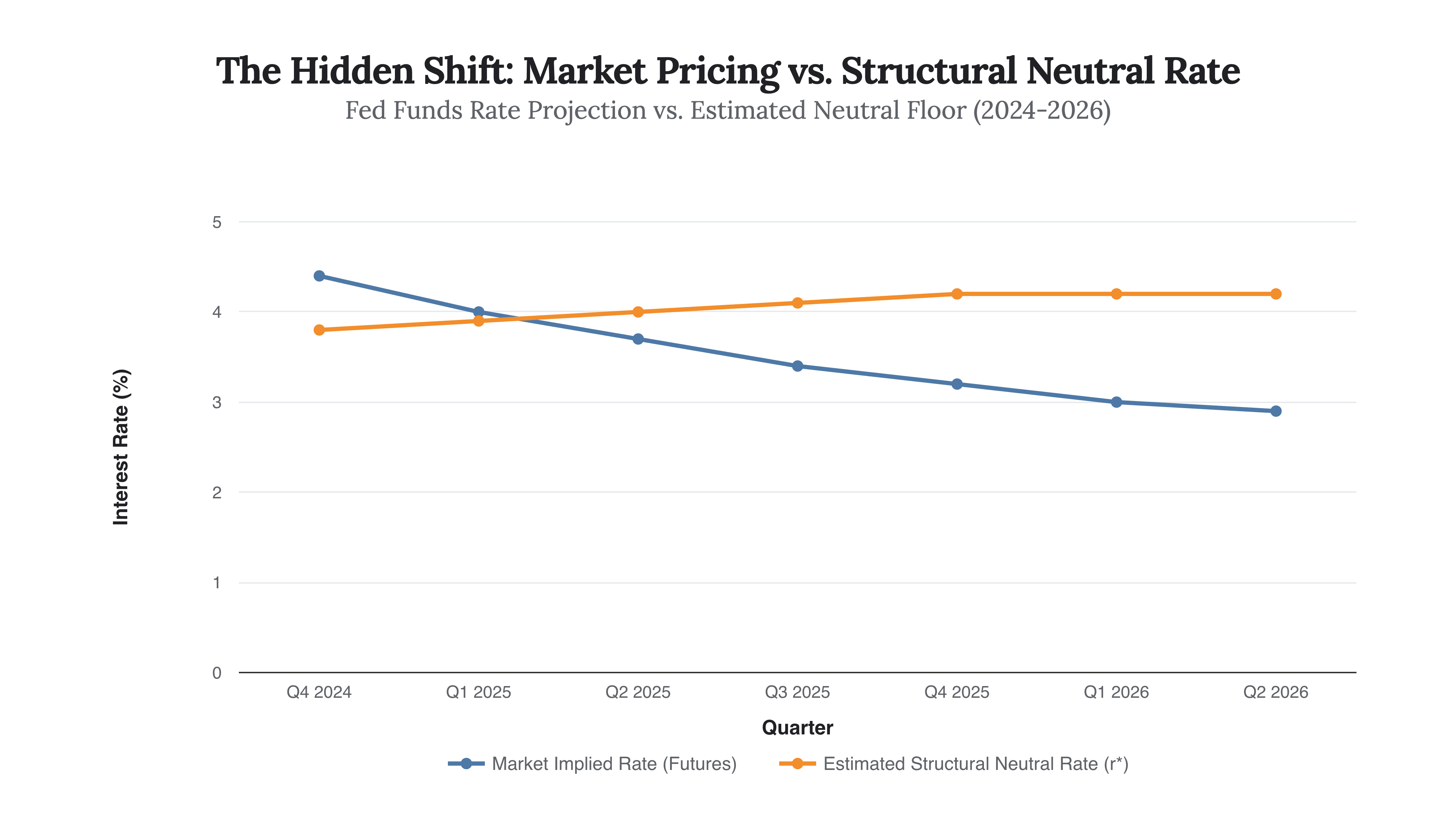
So What? If the neutral rate is indeed 4.2%, a Fed Funds rate of 4.5% is barely restrictive. It means the Fed is currently providing almost no braking power to the economy, explaining why GDP growth remains robust despite “high” rates. It also means the terminal rate for this cutting cycle isn’t 3.0%—it’s likely 4.0%.
The Fiscal Vise: When Treasury Crowds Out the Fed
The most underappreciated variable in the rate outlook is the Treasury Department. We are witnessing a regime change from Monetary Dominance (where the Fed sets the tempo) to Fiscal Dominance (where the Treasury’s issuance needs dictate market liquidity). In Q4 2024 alone, the Treasury is set to issue hundreds of billions in net new debt. This supply flood is hitting a market where the Fed is still conducting Quantitative Tightening (QT), shedding assets from its balance sheet.
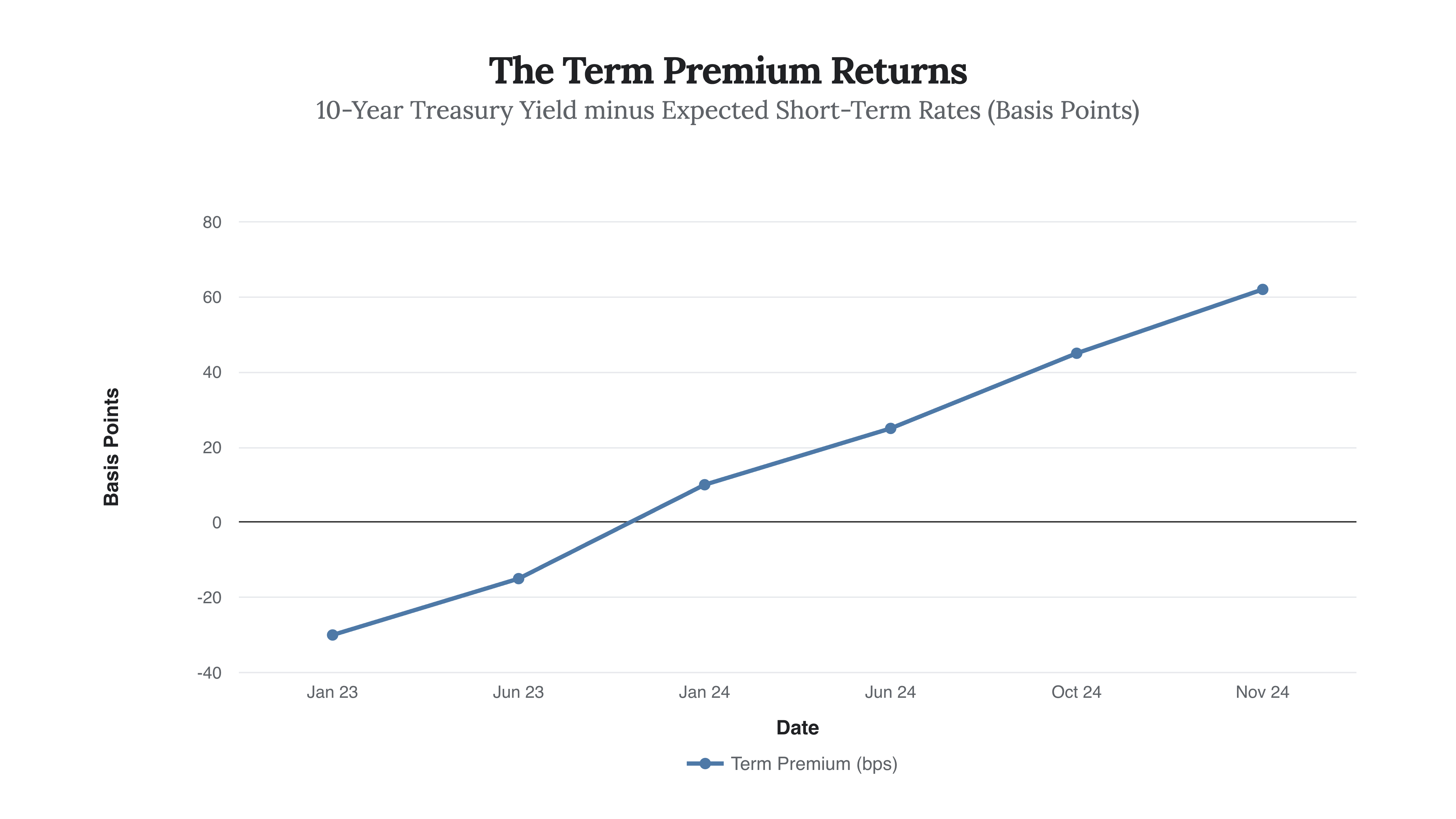
This creates a mechanical floor for yields. To attract buyers for this tsunami of debt without the Fed as a buyer of last resort, yields must stay elevated. The “Term Premium”—the extra compensation investors demand for holding long-term debt—has spiked to multi-year highs. This is the bond market vigilantes signaling that they will not fund the US deficit at 3.5%.
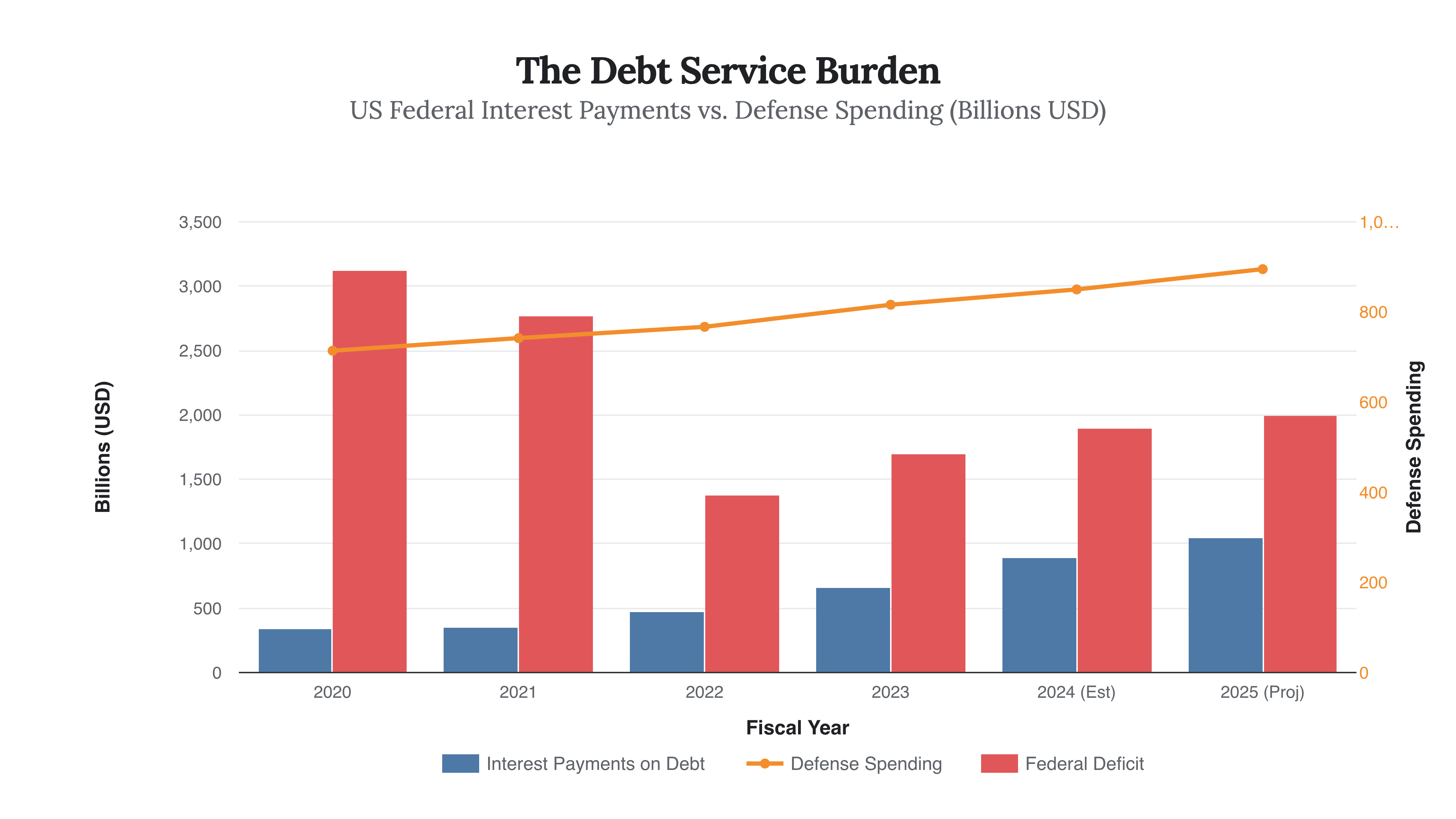
Strategic Insight: Watch the spread between the 10-year Treasury yield and the Fed Funds rate. Historically, an inverted curve predicts recession. Today, the “bear steepening” (long-end rates rising faster than short-end) signals fiscal concern. If the 10-year yield breaks above 4.75% while the Fed cuts, it will tighten financial conditions for the Fed, potentially forcing them to halt cuts early to defend the currency and the bond market.
Sector-Specific Risks: Who Bleeds at 4%?
If the “higher for longer” narrative shifts to “high floor forever,” the repricing will not be uniform. The pain will concentrate in sectors that rely on cheap leverage to engineer returns.
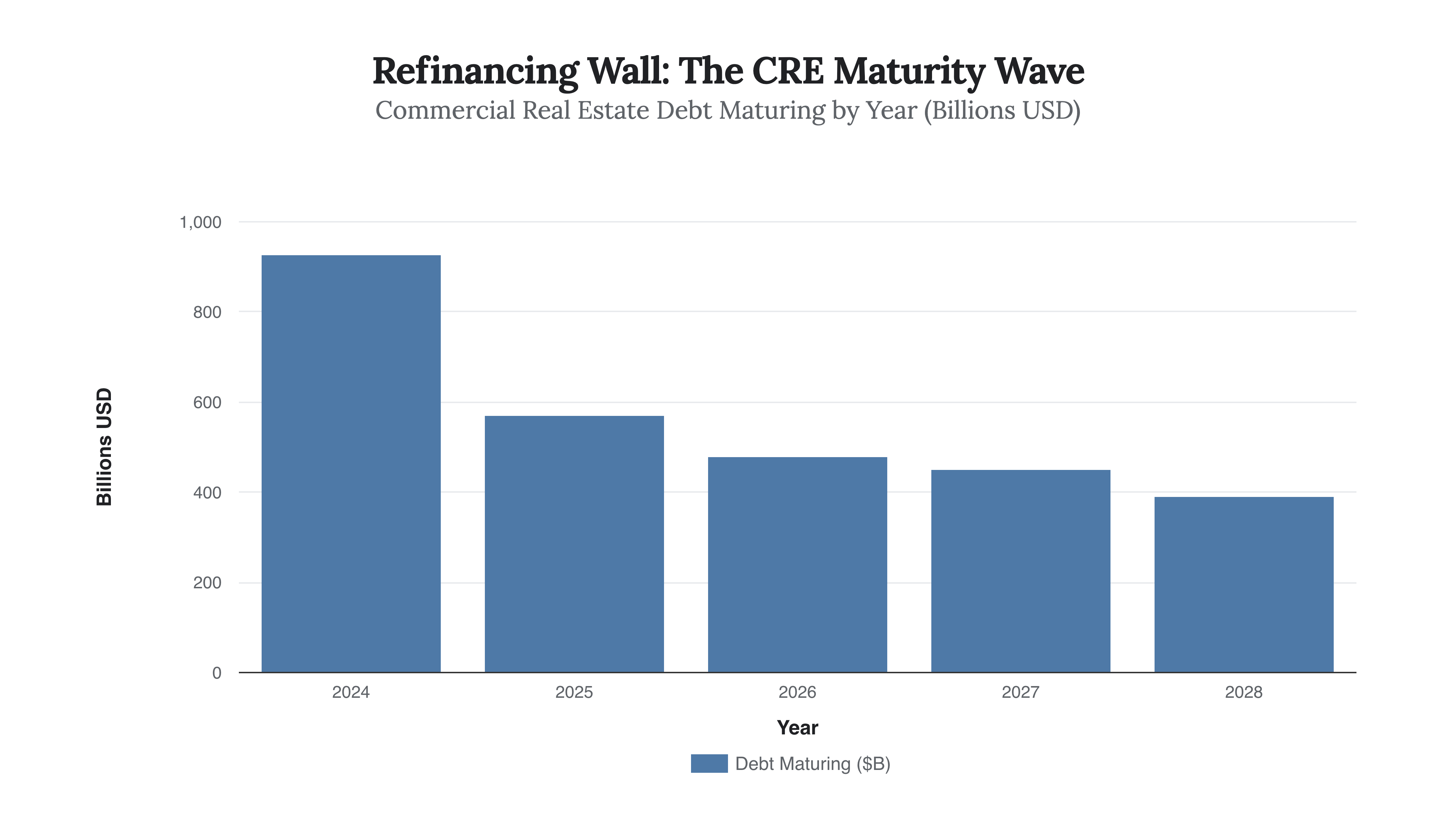
Commercial Real Estate (CRE): Trillions in refinancing walls are approaching in 2025. These loans were originated at 3-4% caps; they will refinance at 7-8%. A 4% Fed Funds floor implies a mass equity wipeout in office and non-prime multifamily.
Private Equity: The “carry trade” of buying companies with cheap debt is over. Deal velocity will remain frozen until valuations adjust down to reflect a 4.5% cost of debt capital.
Tech Growth: While Big Tech has cash fortresses, the mid-cap speculative growth sector is highly sensitive to the discount rate. A floor of 4% compresses multiples permanently.
Forward Outlook: The “No Landing” Scenario
The market is debating a “Soft Landing” vs. a “Hard Landing.” The data points to a third, more complex scenario: No Landing. In this outcome, the economy re-accelerates due to fiscal stimulus and loose financial conditions, keeping inflation stuck above 3%.
In a “No Landing” world, the Fed’s rate cuts in late 2024 will be viewed in hindsight as a policy error—a premature celebration similar to the 1967 pivot that unleashed the Great Inflation. The market is currently assigning a less than 15% probability to the Fed hiking again in 2025. We believe the true probability is closer to 35%.
“The market has priced out the risk of a resurgence in inflation entirely. That is the definition of complacency. When the term premium spikes, it’s not just a trade; it’s a vote of no confidence in the fiscal trajectory.”
Concluding Insight
The Federal Reserve is no longer the master of the universe; it is a prisoner of the Treasury. The rate outlook for 2025 is not a descent into the comfort of 3%, but a volatile struggle to maintain a floor of 4-4.25% against the tides of fiscal profligacy and structural inflation. Investors positioned for a return to 2019 valuation multiples are betting on a world that no longer exists.
Strategic Takeaway: The 4.2% neutral rate is the new gravity. Allocate away from duration-sensitive assets and toward cash-rich operators with pricing power, because the cost of capital isn’t coming down—it’s just finding its true price.