


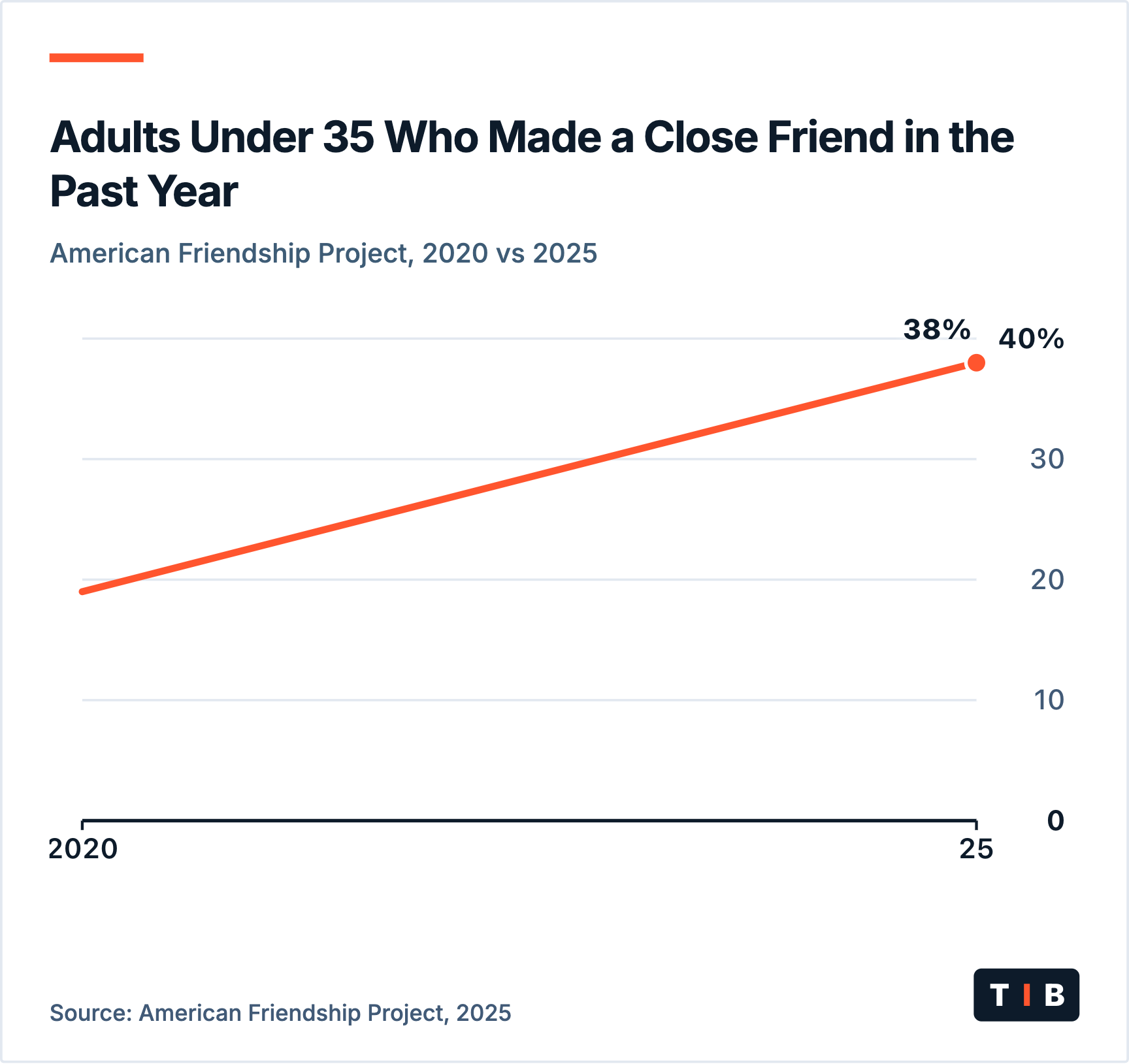
The 40-year decline in American adult friendship has reversed. The American Friendship Project’s 2025 survey finds that 38% of adults aged 18–34 made a close friend in the past year, double the 19% it recorded in its 2020 baseline. This is not a return to a pre-digital idyll, nor a sudden outbreak of social warmth. It is a structural reallocation of belonging away from the workplace and toward voluntary association. The claim is specific and falsifiable: under-35s are rebuilding their social fabric outside the office, and that shift will reduce work’s claim on their identity, time, and loyalty. For two generations, the office was the primary friendship engine for adults; its weakening was mistaken for a friendship recession. The rebound proves the opposite: the recession was a work problem.

Aristotle’s Utility Trap: Why Workplace Friendships Were Always Fragile
Work did not always carry the burden of adult friendship. Aristotle’s Nicomachean Ethics divided friendship into three species: utility, pleasure, and character. The first two are inherently self-regarding and dissolve when the benefit ceases. Aristotle wrote: ‘Those who love for the sake of utility love for the sake of what is good for themselves, and those who love for the sake of pleasure do so for the sake of what is pleasant to themselves, and not in so far as the other person is the person loved but in so far as he is useful or pleasant’ (Nicomachean Ethics VIII.3, 1156a10–19, trans. Terence Irwin, Hackett, 1999). This predicts the modern office relationship with precision. Workplace friendships are utility friendships: they form around shared projects, shared managers, shared commutes, and shared enemies. When the job changes, the friendship typically ends, because its foundation was not the person but the position. The American Friendship Project’s 2025 finding that 38% of under-35s made a close friend in the past year—doubling since 2020—is not evidence that workplaces became warmer. It is evidence that younger adults shifted their friendship-generating hours out of the hierarchical, instrumental setting of work and into settings where the relationship is not contingent on a payroll. The chart below shows the discontinuity: a near-vertical rise in new close friendships among the cohort that also gained the most remote-work flexibility.
The 38% of under-35s forming close friendships isn’t a warm headline—it’s a structural signal about trust, loneliness, and the future of institutions; a paid subscription is how you get the full synthesis of that signal, including what it means for your work, your community, and your own relationships.
The Rebound Happened Off the Clock
The mechanics of the rebound are not mysterious. When the pandemic forced a large segment of white-collar work into remote and hybrid arrangements, it destroyed the accidental social infrastructure of the office—the hallway conversations, the post-meeting debriefs, the lunches. It also returned to workers a finite resource: the 45 to 90 minutes per day previously spent commuting. The U.S. Census Bureau’s American Community Survey recorded an average one-way commute of 27.6 minutes in 2019; even a conservative estimate puts the daily reclaimed time at 55 minutes. That hour did not remain empty. Under-35s redirected it toward deliberate social activities: intramural sports, running clubs, book groups, church and synagogue communities, neighborhood mutual aid. Aristotle called the result friendship of character: ‘complete friendship is the friendship of good people similar in virtue’ (Nicomachean Ethics VIII.3, 1156b7–8, trans. Terence Irwin). Unlike utility friendships, character friendships survive job changes because they are built on shared activity and moral similarity, not shared employment. The American Friendship Project data does not ask where the new close friends came from, but the timing is unmistakable: the doubling occurred during the exact five years in which remote and hybrid work became a permanent feature of the labor market. The friendship recession was never about a lack of social desire; it was about the absence of unscheduled time outside the org chart.The implication follows: the office’s monopoly on adult belonging is over. Employers who built retention models around coworker friendship will find them degrading, because a workforce that makes friends outside work has a lower cost of exit. Expect voluntary turnover to rise among under-35s—not because they dislike their colleagues, but because friendship no longer tethers them to a payroll. The 40-year friendship recession did not end because work became friendlier; it ended because people stopped expecting work to supply friends.