


How the Purge of Thomas Massie Redefines Legislative Risk and Fiscal Expansion
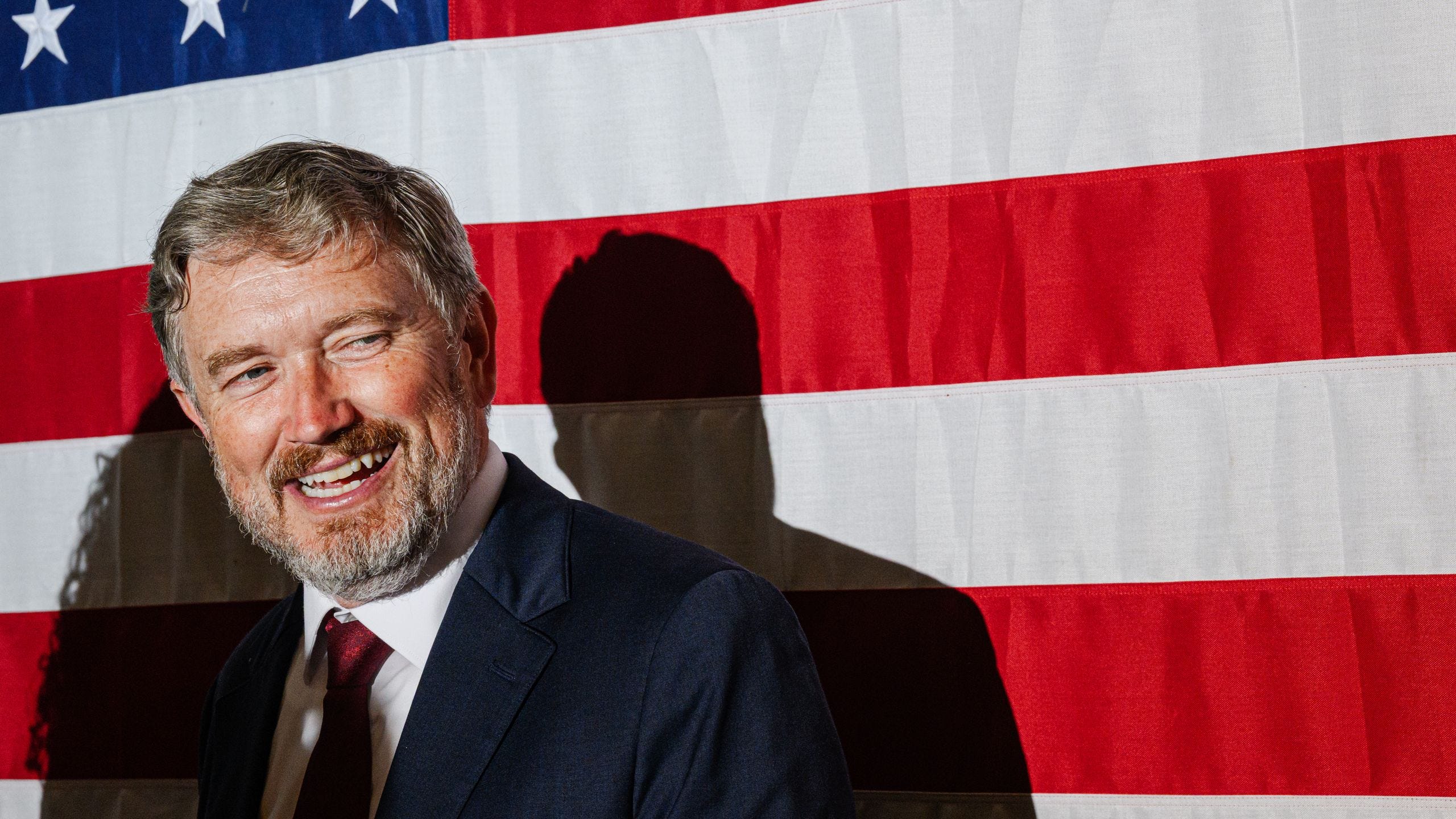
On May 19, 2026, the architecture of the Republican Party underwent a permanent structural shift. Thomas Massie, the seven-term U.S. Representative from Kentucky’s 4th Congressional District and the GOP’s most entrenched libertarian anchor, was ousted by Trump-endorsed primary challenger Ed Gallrein. This event is not a standard electoral defeat; it is a targeted, capital-intensive liquidation engineered to enforce total executive alignment within the legislative branch. By deploying unprecedented financial resources to unseat a safe incumbent, the executive branch and its allied political action committees have established a new baseline for congressional behavior: absolute fealty or political extinction.
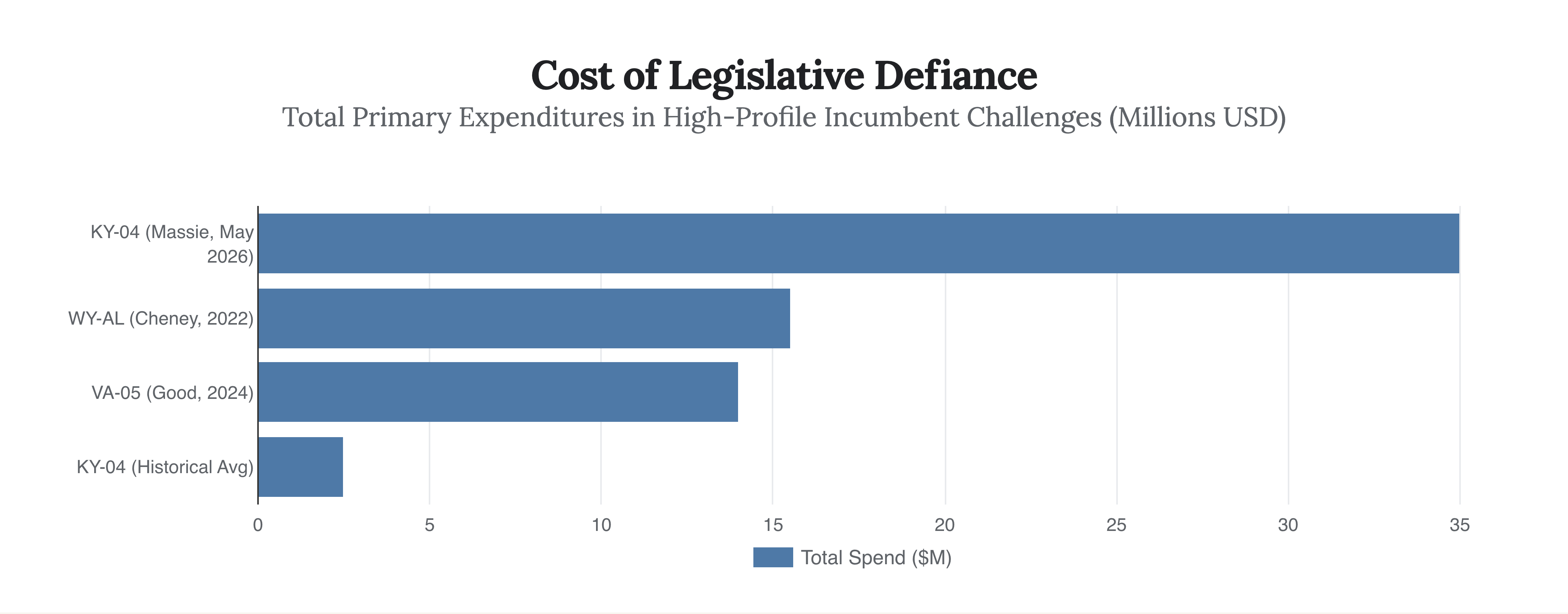
The financial mechanics of Massie’s defeat rewrite the calculus of congressional survival. Upwards of $35 million was deployed into KY-04, making it the most expensive U.S. House primary in history. This staggering sum was not raised organically from local constituents but was precision-guided by a coalition of executive-aligned super PACs and single-issue foreign policy lobbying organizations. The data reveals a dramatic escalation in the cost of unseating an incumbent, weaponized specifically to break the back of the remaining Tea Party and libertarian holdouts.
The defeat of Thomas Massie is not merely an electoral outcome; it is the final liquidation of the GOP’s libertarian wing, proving that fiscal conservatism is now viewed as an actionable threat to executive authority. For over a decade, Massie operated with a high degree of impunity, routinely winning re-election despite carrying the moniker “Mr. No” for his consistent opposition to omnibus spending, foreign aid, and the expansion of the surveillance state. His May 2026 concession speech—“If the legislative branch always votes with the president, we do have a king”—highlights the transition of the U.S. House from a coequal, deliberative body into a rubber-stamp mechanism for the Oval Office.
The Anatomy of Institutional Friction
To understand the ferocity of the $35 million execution, one must examine the specific friction points Massie generated between Q1 2025 and Q2 2026. The strategic pivot point occurred in the post-election transition of late 2024. Massie, leveraging his rural Kentucky base, openly signaled his availability to serve as Secretary of Agriculture in the incoming Trump administration. Supported by Robert F. Kennedy Jr.’s “Make America Healthy Again” initiatives, Massie represented a radical, decentralized approach to food supply deregulation. However, the appointment of Brooke Rollins to the USDA post in early 2025 effectively sidelined Massie. Stripped of executive integration and relegated to the House backbenches, Massie’s subsequent legislative decisions were immediately classified as acts of insubordination.
Massie’s unseating was triggered by a sequence of precise legislative divergences. In March 2025, he announced his uncompromising opposition to a short-term government funding bill, prompting the President to declare on social media that he would “lead the charge” against the Congressman. Months later, Massie led a bipartisan push to force the release of the Department of Justice files regarding Jeffrey Epstein, passing the transparency act overwhelmingly despite vehement opposition from the White House. The terminal breach occurred in July 2025, when Massie became one of the only House Republicans to vote against the administration’s signature “One Big Beautiful Bill,” clinically labeling the legislation a “debt bomb.”
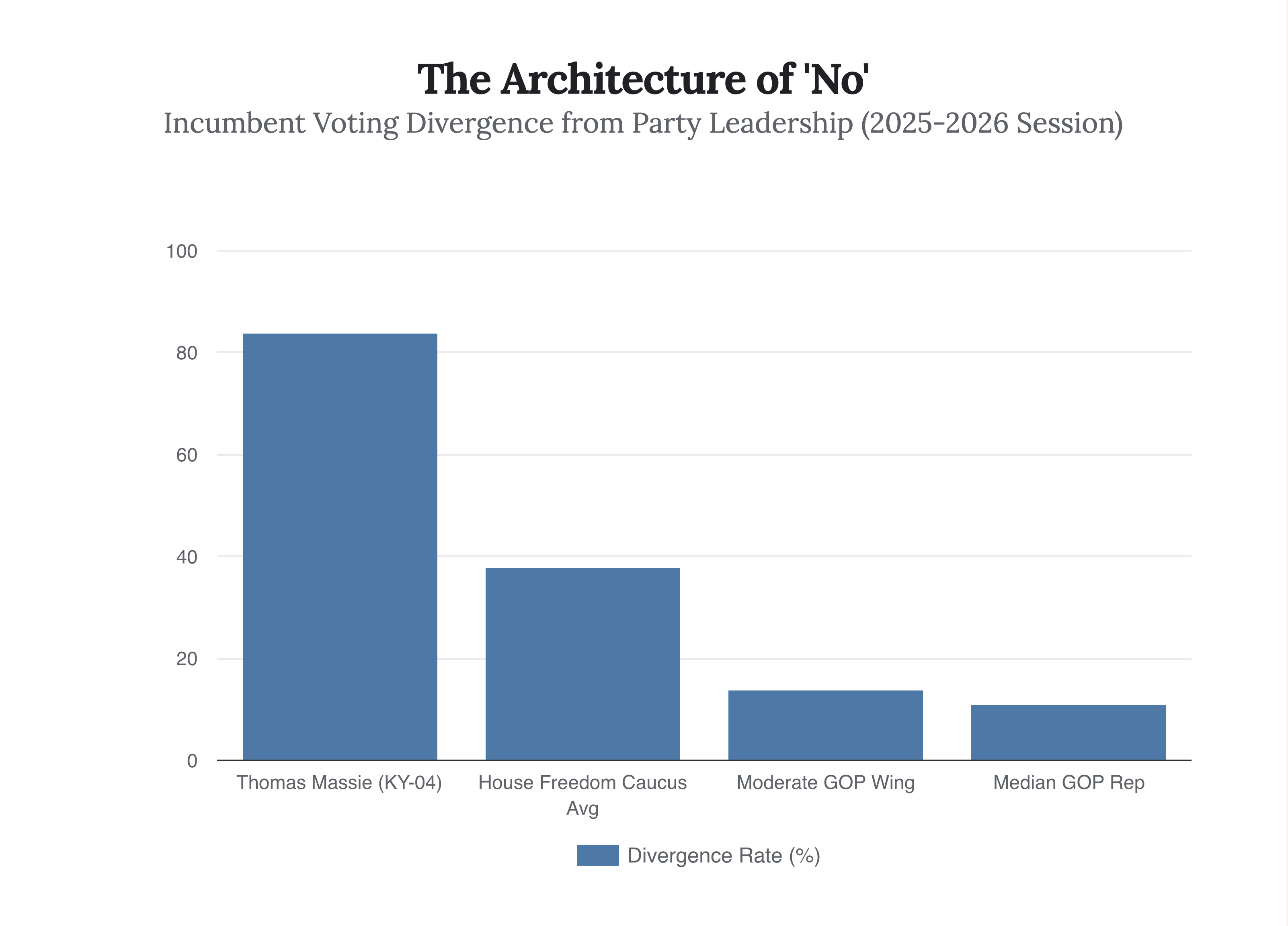
In the modern legislative environment, ideological consistency is no longer an asset—it is a fatal vulnerability that practically guarantees a multimillion-dollar primary execution. Beyond domestic fiscal policy, Massie routinely opposed foreign military appropriations, drawing the ire—and the immense capital—of pro-Israel lobbying organizations such as AIPAC. The convergence of Trump’s political revenge tour with billionaire donors like Miriam Adelson created an inescapable financial singularity in Northern Kentucky. The sheer density of attack advertisements saturated the media market, demonstrating that any representative who attempts to assert Article I powers against a unified executive-lobbyist consensus will be outspent by a ratio of ten to one.

The Consolidation of Executive Primacy
The May 2026 primary cycle illustrates a refined, highly effective mechanism for executive control over the legislative branch. Massie’s defeat did not occur in a vacuum; it was executed alongside the mid-May 2026 ousting of Senator Bill Cassidy in Louisiana, another incumbent who had previously broken rank with the President. The strategy is clinical: identify the most visible dissenters, isolate them from committee influence, and overwhelm their local districts with nationalized capital. This establishes a deterrence model that paralyzes the rest of the caucus.
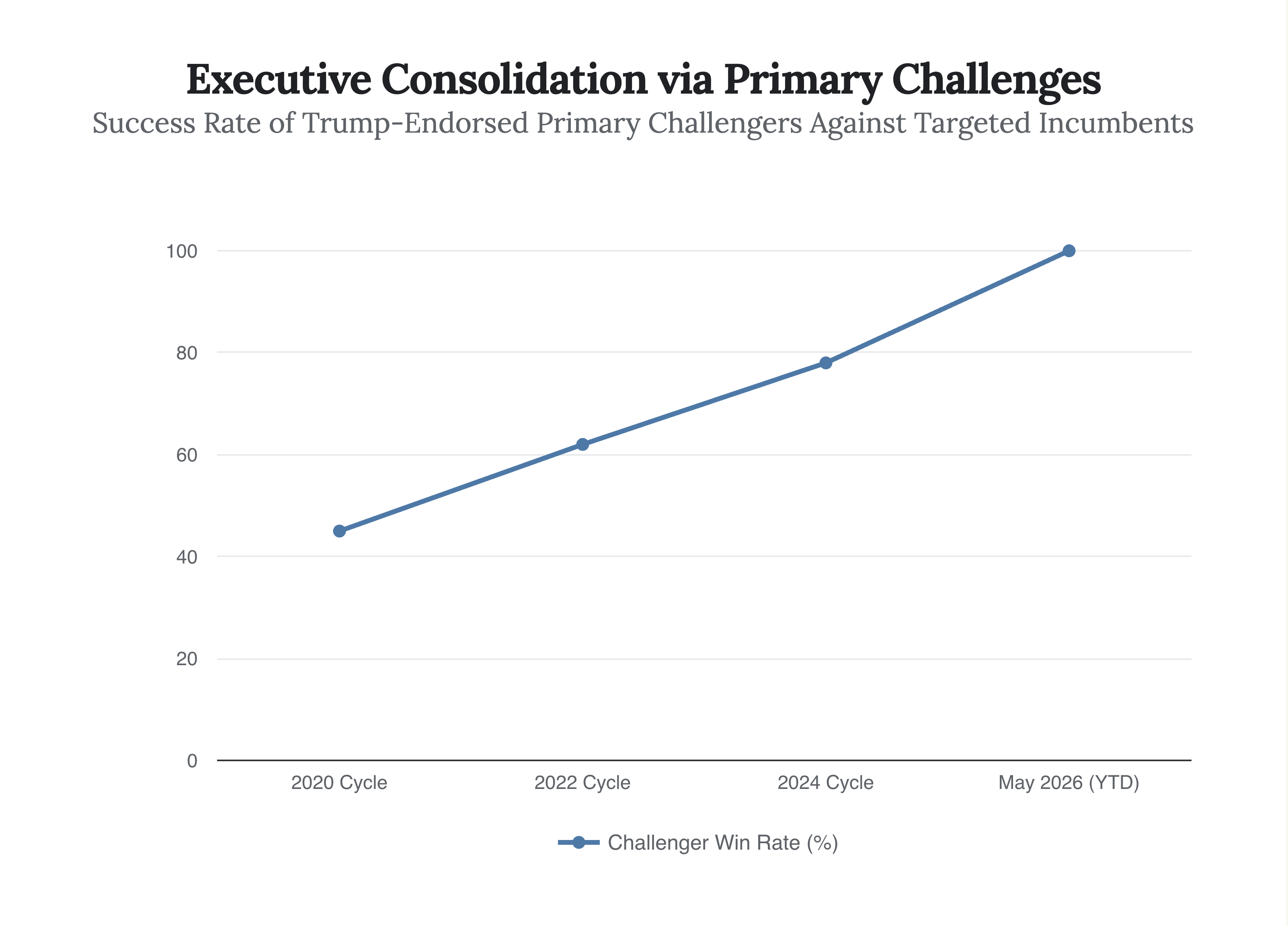
When the executive branch can successfully dictate the survival of local representatives, the traditional system of checks and balances undergoes a silent, structural failure. Lawmakers are no longer optimizing for the economic prosperity of their districts or the long-term solvency of the federal government; they are optimizing for the avoidance of a presidential Truth Social post. Congress is rapidly transitioning from a coequal branch of government into a synchronized voting bloc managed by the executive, effectively stripping the legislative branch of its constitutional mandate to dissent. This dynamic fundamentally alters the risk profile of American policy-making, replacing deliberation with velocity.
Second-Order Market Effects: Frictionless Deficits
For institutional investors, macroeconomic strategists, and bond markets, the removal of Thomas Massie from the House is a massive, flashing signal regarding the future of federal spending. Massie was famous for wearing a digital debt clock on his lapel—a physical manifestation of his commitment to austerity and a constant irritant to party leadership eager to pass multi-trillion-dollar spending packages. With his departure, the organic friction against massive omnibus spending, continuous continuing resolutions (CRs), and unchecked debt ceiling suspensions evaporates completely.
The current Congress, thoroughly sanitized of deficit hawks by the 2026 primaries, will present zero resistance to future inflationary spending initiated by the executive. The “One Big Beautiful Bill” of 2025 was merely the prologue. Without a libertarian or Tea Party flank to demand spending cuts or threaten government shutdowns over fiscal irresponsibility, the path of least resistance is continuous deficit expansion. Bond vigilantes must reprice U.S. Treasuries to reflect a political reality where austerity is practically illegal within the majority party.
Institutional investors must now calibrate for an era of frictionless deficit expansion, as the political cost of opposing federal spending has simply become too lethal for any incumbent to bear. If a $35 million bounty is the price of demanding a balanced budget or questioning a foreign aid package, no rationally acting politician will ever cast a “No” vote again. The defenestration of Thomas Massie confirms that the era of the ideological maverick is over. What remains is a streamlined, highly disciplined machine designed to execute the will of the Oval Office—regardless of the macroeconomic consequences or the final tally on the national debt clock.