


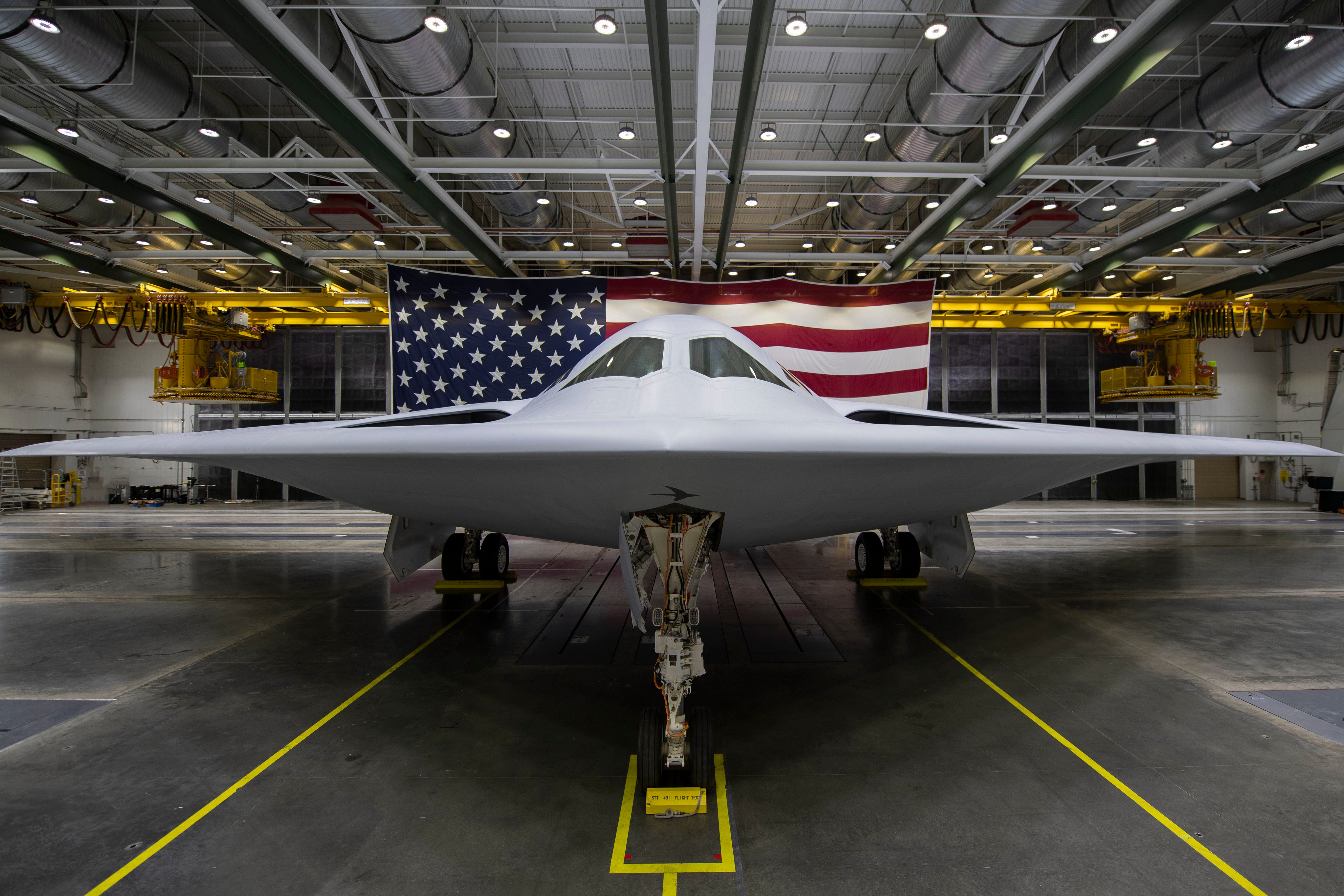
In a move that reverberated across the globe, former President Donald Trump announced on Thursday his directive to the Pentagon to immediately resume the testing of nuclear weapons, ending a moratorium that has held for 33 years. The surprise declaration, made on the social media platform Truth Social, cited the testing programs of other nations as the primary driver for this monumental policy shift. “Because of other countries testing programs, I have instructed the Department of War to start testing our Nuclear Weapons on an equal basis,” Trump wrote, adding, “That process will begin immediately.” This decision dismantles a cornerstone of post-Cold War arms control and signals a potential return to the high-stakes brinkmanship of a bygone era.
The United States has not conducted a nuclear explosive test since September 23, 1992. That final test, named “Divider,” was one of 1,054 conducted by the U.S. since the Trinity test ushered in the atomic age in 1945. For over three decades, a bipartisan consensus held that the nation’s security was best served by maintaining its arsenal through advanced simulations and scientific stewardship, rather than explosive tests that could provoke a global arms race. The abrupt end to this policy raises profound questions about strategic stability and the future of non-proliferation efforts.
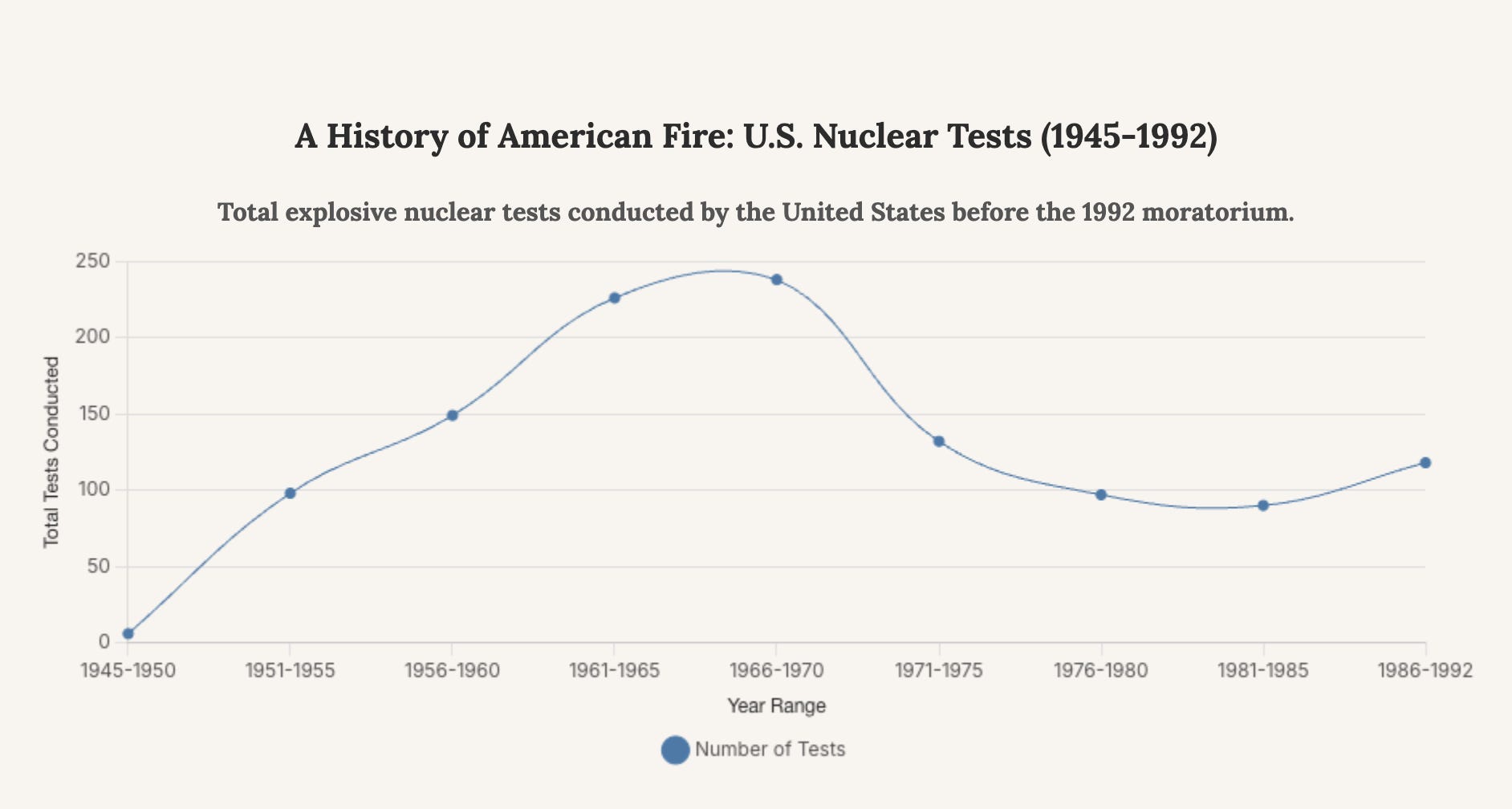
The chart above illustrates the frequency of U.S. nuclear testing, which peaked during the height of the Cold War in the 1960s before ceasing entirely in 1992.
The context for this decision appears rooted in recent actions by Russia and the rapid expansion of China’s nuclear capabilities. Reports indicate Russia has recently tested new strategic weapons, including the Burevestnik nuclear-powered cruise missile and the Poseidon underwater drone. Simultaneously, assessments from the Center for Strategic and International Studies suggest China has more than doubled its nuclear arsenal since 2020 and is on a trajectory to possess over 1,000 nuclear weapons by 2030. This creates a complex security landscape that has clearly prompted a re-evaluation in some U.S. political circles.
“I see them testing and I say, well, if they’re going to test, I guess we have to test.” - Donald Trump
While Trump’s statement incorrectly claims the U.S. has more nuclear weapons than any other country—a distinction that still belongs to Russia—the global distribution of these arsenals underscores the immense destructive power held by a handful of nations. Nearly 90% of all nuclear warheads are in the stockpiles of the United States and Russia. However, the growth of other arsenals, particularly China’s, is shifting the strategic calculus.
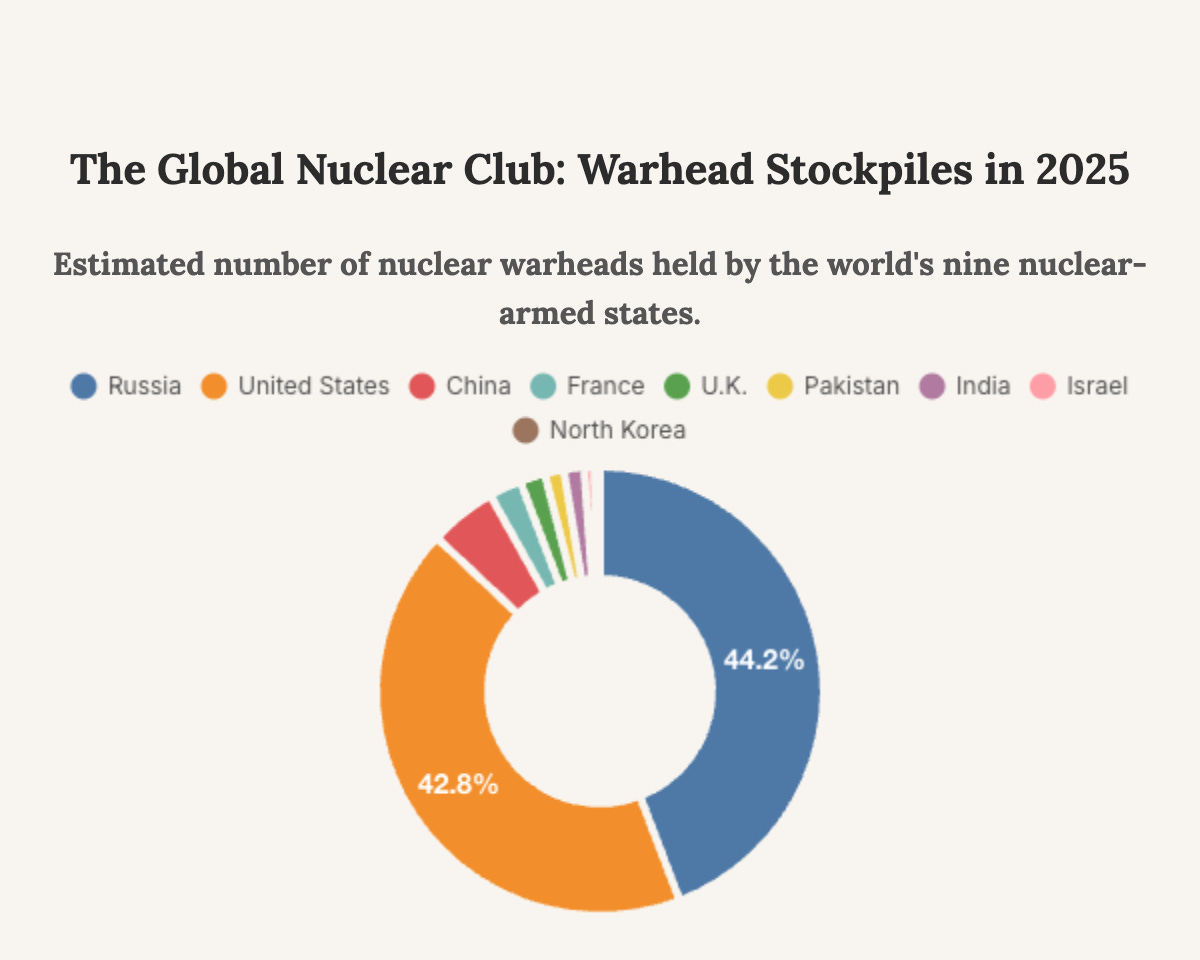
This donut chart visualizes the current distribution of global nuclear warheads, with Russia and the United States possessing the vast majority.
The decision to resume testing also directly challenges the international framework designed to prevent nuclear proliferation, chiefly the Comprehensive Nuclear-Test-Ban Treaty (CTBT). The CTBT was opened for signature in 1996 and aims to ban all nuclear explosions. However, it has never formally entered into force because several key nations, including the United States and China, have signed but never ratified it. Russia recently withdrew its ratification to “mirror” the U.S. stance. This fragile, informal agreement to refrain from testing has been a critical brake on nuclear competition. A U.S. resumption of testing would likely shatter it completely.
“The United States believes that Russia probably is not adhering to the nuclear testing moratorium in a manner consistent with the zero-yield standard.” - Lt. Gen. Robert P. Ashley Jr. (in 2019)
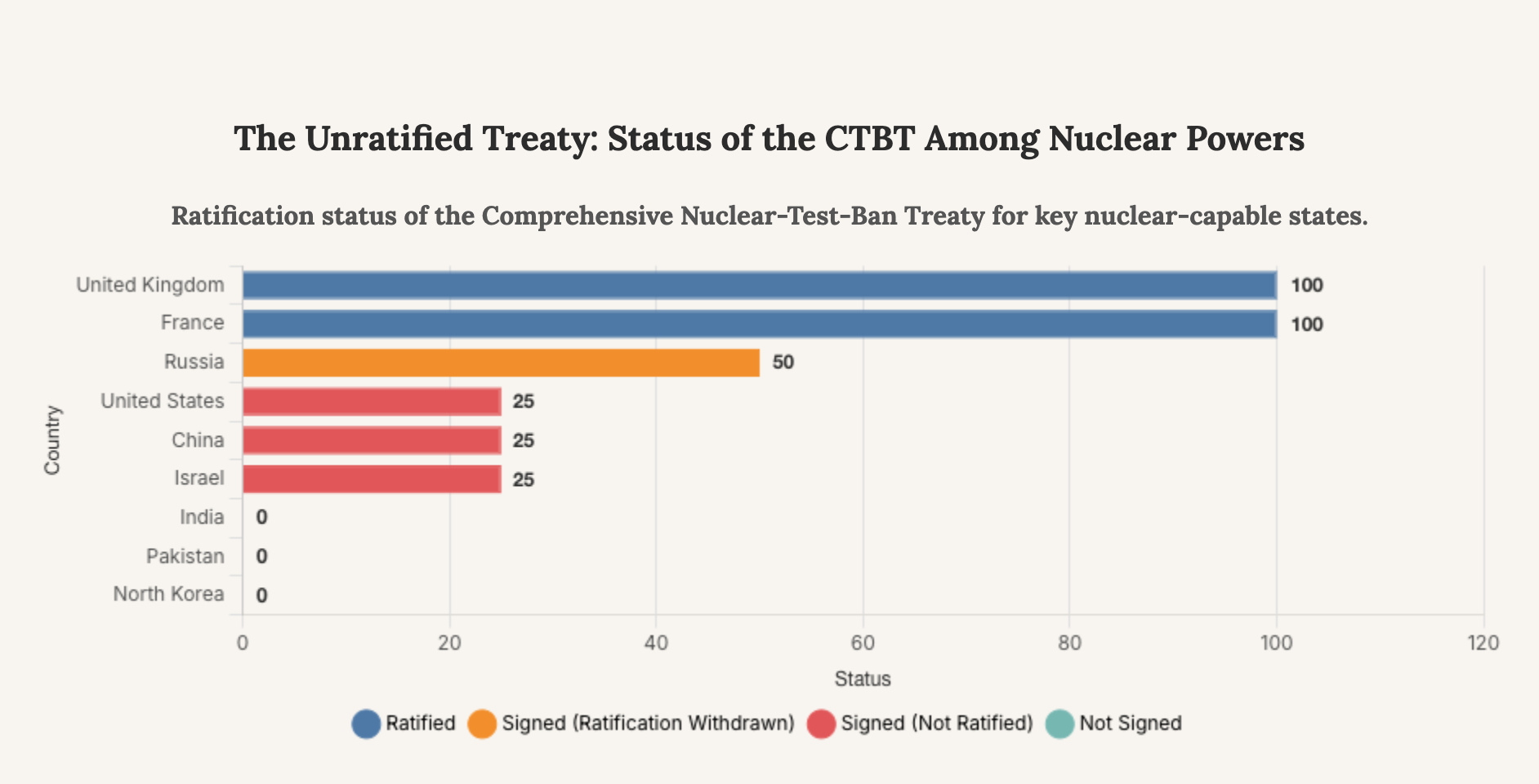
The status of the CTBT remains precarious, with several key nuclear-armed states having failed to ratify the treaty, preventing its official entry into force.
The reverberations of this announcement are immediate and far-reaching. Domestically, Representative Dina Titus of Nevada, the state that hosted the majority of past tests, has already vowed to introduce legislation to block the move. Internationally, it risks triggering a domino effect, providing justification for countries like China or India to conduct their own tests, thereby fueling a new and dangerous arms race. The path forward is now fraught with a level of nuclear risk not seen in a generation. By breaking the seal on explosive testing, the U.S. is not just revisiting a Cold War tactic, but is gambling with the very foundations of global strategic stability.