



In the rarefied air of corporate strategy, the threat of AI-driven job displacement has long been a subject of sophisticated, yet comfortably distant, debate—a forecast for 2030, perhaps 2035. That future, however, is no longer distant. It arrived with stunning velocity in October 2025. According to data from Challenger, Gray & Christmas, U.S. employers announced 153,074 job cuts in October, a 183% surge from the previous month and the highest October total in over two decades. While cost-cutting remained the primary driver, a disruptive technology was the clear secondary cause: Artificial Intelligence was explicitly cited for 31,039 of those job cuts.
This figure is not a projection; it is a hard data point reflecting a strategic shift that is now actively underway. This briefing deconstructs the new reality of AI automation layoffs, moving beyond macroeconomic forecasts to analyze the specific sectors, roles, and corporate strategies defining this transition. We will dissect the forces driving this acceleration, identify the emerging winners and losers, and outline the critical strategic foresight required for leaders, investors, and policymakers to navigate the coming wave of disruption.
The Anatomy of the Purge: Where Automation is Striking First
The initial wave of AI-driven layoffs is not a random event; it is a highly targeted campaign aimed at specific corporate functions where generative AI offers the most immediate and quantifiable return on investment. The data reveals a clear pattern of displacement centered on roles that involve structured data processing, customer interaction, and content generation. This is the low-hanging fruit for automation, and corporations are moving decisively to harvest it.
The Front Lines: Administrative and Customer-Facing Roles
Analysis of layoffs and high-exposure roles reveals a consistent theme: office support, customer service, and administrative positions are on the front lines of this transformation. A Goldman Sachs report identified that up to 46% of tasks in office and administrative support are susceptible to automation, the highest of any category. This is not a theoretical risk. Companies like Salesforce have been transparent about this strategy, with CEO Marc Benioff stating, “I need less heads” as AI agents now handle a significant portion of customer interactions. The company has already reduced its customer support workforce from 9,000 to 5,000. Similarly, fintech firm Klarna has implemented an AI capable of performing the work of 700 customer service agents. These are not augmentations; they are direct replacements, driven by a clear-eyed calculus of efficiency and cost reduction.
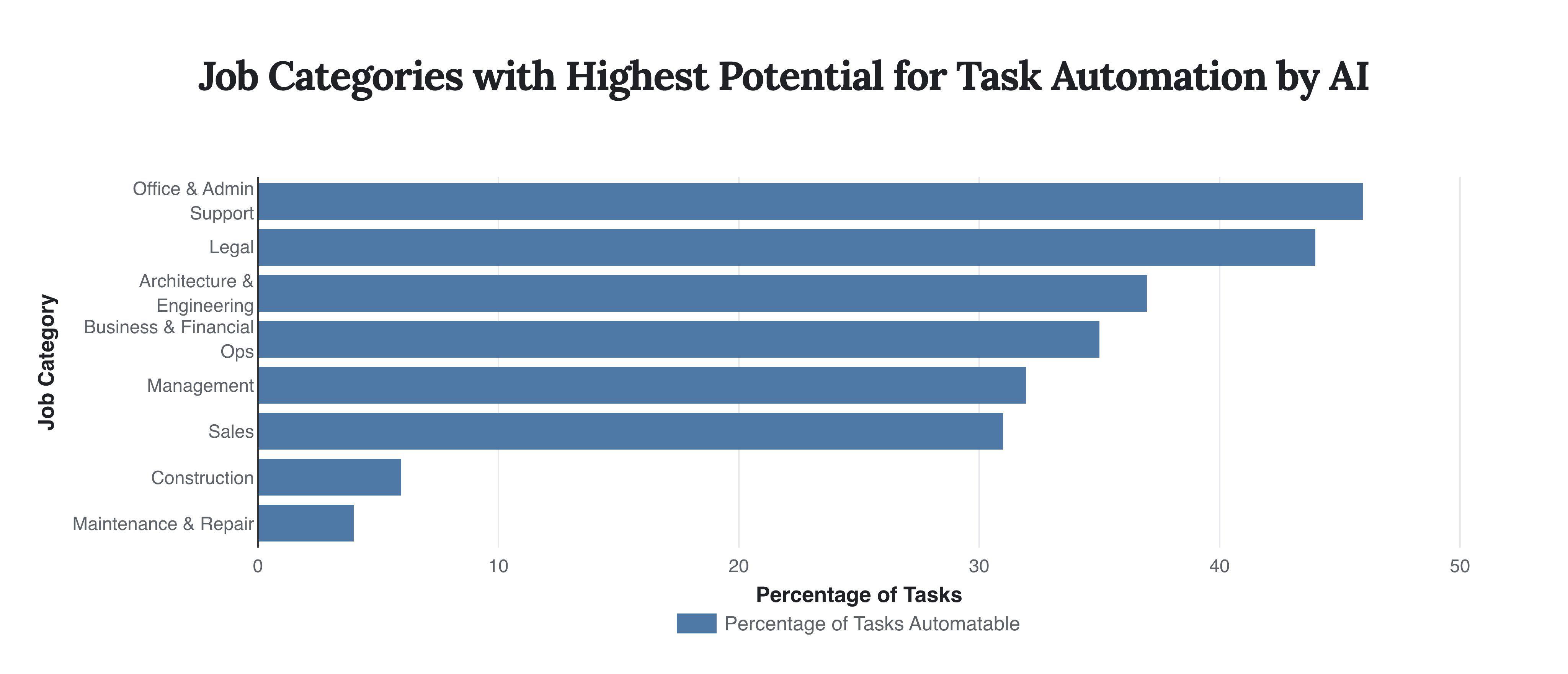
Caption: Analysis from Goldman Sachs shows that administrative and legal professions have the highest percentage of work tasks that are susceptible to automation by current AI capabilities, indicating where the initial impact of job displacement will be most severe.
This trend extends beyond simple customer service. In a move that sent a tremor through the tech industry, IBM announced plans to replace up to 30% of its back-office roles—approximately 7,800 positions—with AI over the next five years, specifically targeting non-customer-facing roles in departments like human resources. This signals a deeper, more structural shift where the internal machinery of corporations is being re-engineered around AI cores.
The Acceleration Curve: From Trickle to Torrent
For months, the narrative has been one of gradual adoption. The October 2025 data shatters that illusion. The jump in AI-cited layoffs reveals an inflection point where corporate experimentation has converted into full-scale implementation. The cumulative total of AI-linked job cuts since 2023 now exceeds 75,000, with the overwhelming majority occurring in the latter half of 2025, demonstrating a clear and dramatic acceleration.
“Like in 2003, a disruptive technology is changing the landscape. At a time when job creation is at its lowest point in years, the optics of announcing layoffs in the fourth quarter are particularly unfavorable.”
- Andy Challenger, Challenger, Gray & Christmas
This acceleration is not happening in a vacuum. It is the result of a confluence of factors: the maturation of generative AI platforms, intense pressure on corporations to boost productivity amidst economic uncertainty, and a strategic realignment of capital investment. Companies are no longer just investing in AI research; they are actively reallocating headcount budgets to fund AI-driven automation, a trend explicitly confirmed by firms like cybersecurity company Deepwatch, which cut nearly a third of its workforce to fund AI investments.
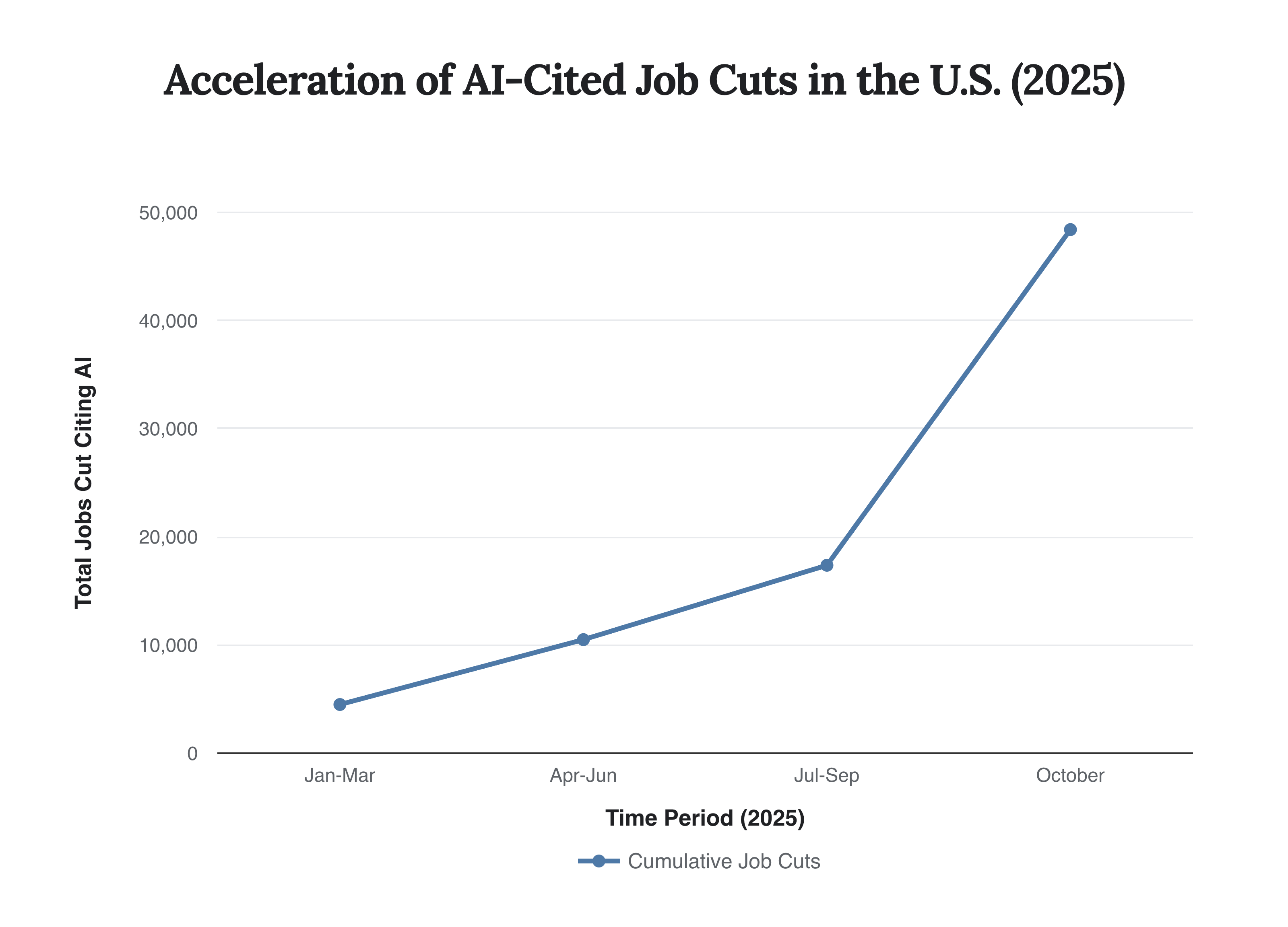
Caption: This chart illustrates the rapid acceleration of layoffs where AI was cited as a cause throughout 2025. The dramatic spike in October reflects a strategic turning point as companies moved from AI experimentation to large-scale implementation. Data synthesized from Challenger, Gray & Christmas reports.
The Demographic Impact: A Generational Squeeze
While the absolute number of layoffs is alarming, a more subtle and perhaps more pernicious trend is emerging: the disproportionate impact on early-career workers. An August 2025 Stanford working paper found that young workers (ages 22-25) in occupations most exposed to AI have already seen a 13% decline in employment relative to their peers in less-exposed fields. This is compounded by a reduction in entry-level hiring, with Big Tech companies reducing new graduate hiring by 25% in 2024 compared to the previous year. The implication is clear: AI is not just displacing current workers; it is closing the door on the next generation, automating away the very entry-level tasks that have historically been the first rung on the career ladder.
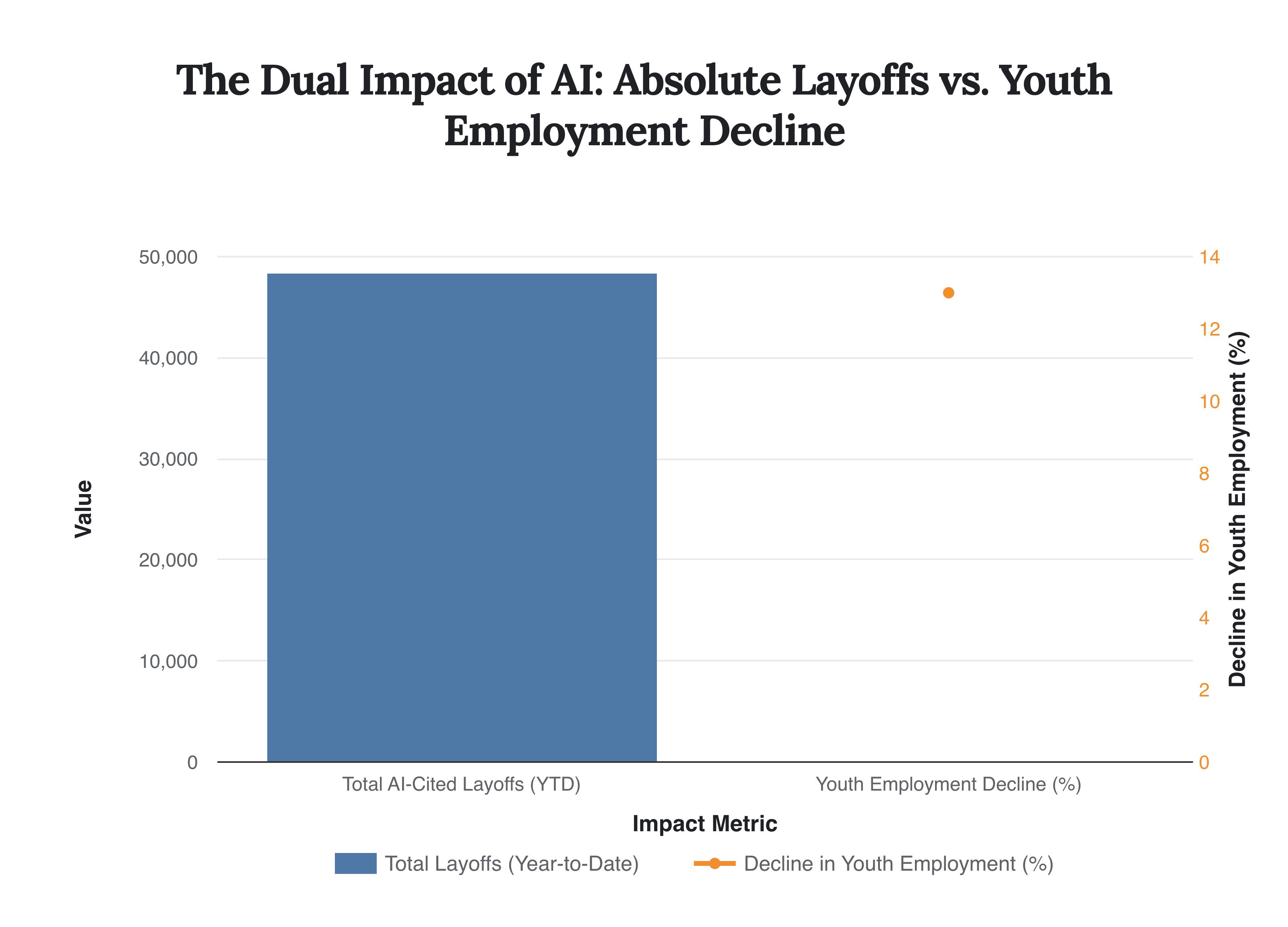
Caption: This chart juxtaposes the absolute number of AI-related layoffs in 2025 with the relative decline in employment for young workers in AI-exposed fields, highlighting two distinct but related impacts of automation on the workforce.
The Strategic Landscape: Re-engineering the Enterprise
The current wave of layoffs is not merely a cyclical cost-cutting measure; it is a fundamental restructuring of the enterprise. Companies are making a strategic bet that investing in AI will yield productivity gains that far outweigh the costs of human labor. This is a paradigm shift from viewing technology as a tool to support workers to viewing it as a direct replacement for them in certain functions.
The Productivity Promise vs. The Economic Reality
Major economic reports forecast massive productivity gains from AI. Goldman Sachs estimates that generative AI could ultimately increase annual global GDP by 7%. McKinsey sizes the long-term opportunity at $4.4 trillion in added productivity growth. These forecasts are the strategic justification for the layoffs we are now seeing. However, a productivity paradox remains: these massive investments and job cuts have yet to translate into broad, economy-wide productivity growth statistics. This suggests we are in a transitional period where the disruption is immediate, but the widespread benefits are still lagging. For investors and policymakers, this gap between disruptive cost and productive benefit is a critical area of risk and opportunity.
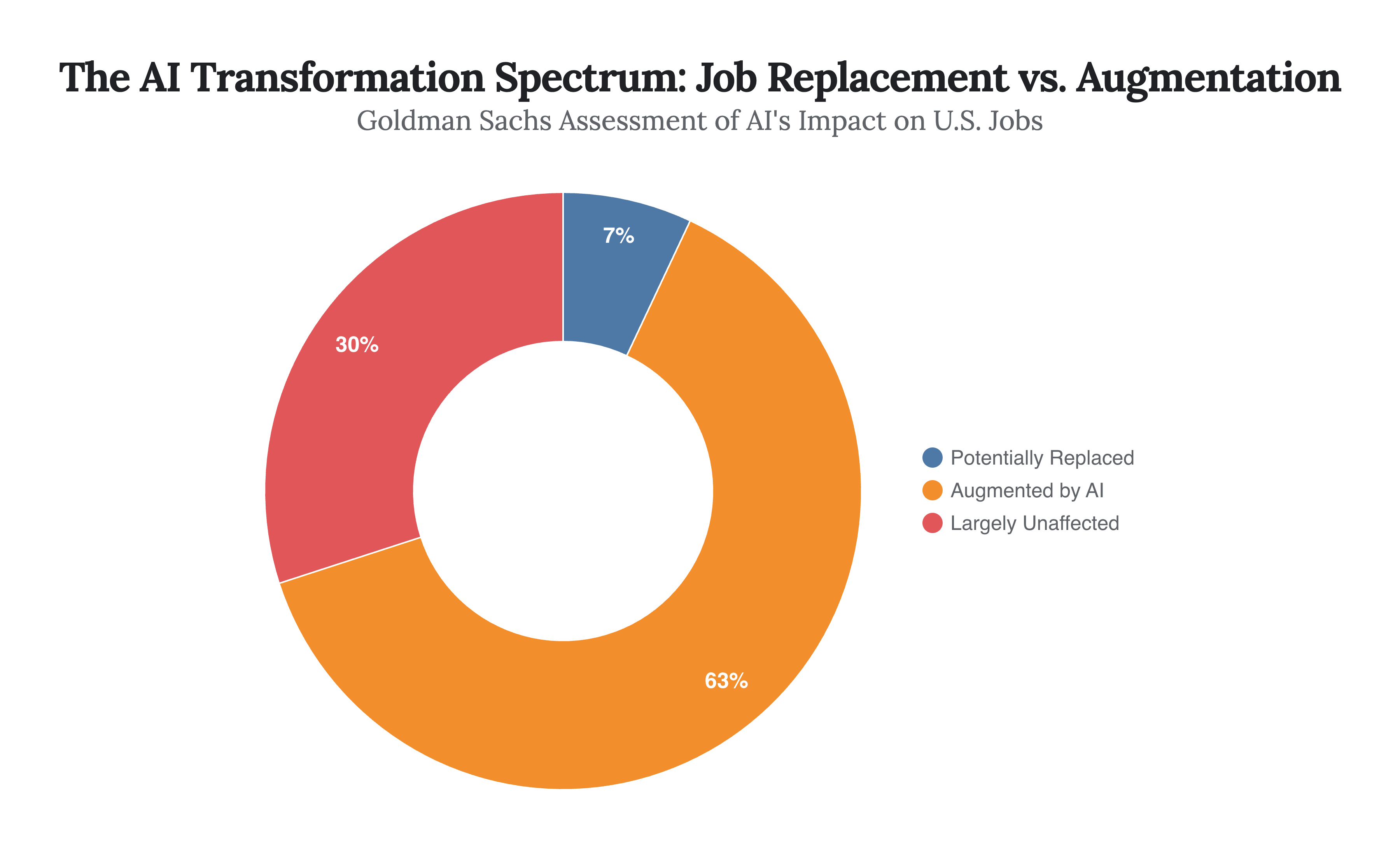
Caption: While the headlines focus on replacement, a significant portion of the workforce (63%) will see their jobs complemented and changed by AI, rather than eliminated entirely. This highlights the dual nature of the transition, involving both displacement and transformation.
Winners and Losers in the Corporate Arms Race
The companies leading this charge are not struggling; they are industry leaders like Microsoft, Amazon, and Meta, who are making deep cuts even as they pour billions into AI infrastructure. Amazon is cutting up to 30,000 corporate roles while simultaneously increasing its spending on AI. Microsoft has eliminated over 15,000 roles this year while making a multi-billion dollar investment in OpenAI. This is a strategic reallocation of resources on a massive scale. The winners will be the firms that can successfully integrate AI to not only cut costs but to fundamentally innovate and capture new market share. The losers will be those who either fail to adapt or who cut too deeply, sacrificing institutional knowledge and human creativity for short-term efficiency gains.
“If generative AI delivers on its promised capabilities, the labor market could face significant disruption.”
- Goldman Sachs Research Report
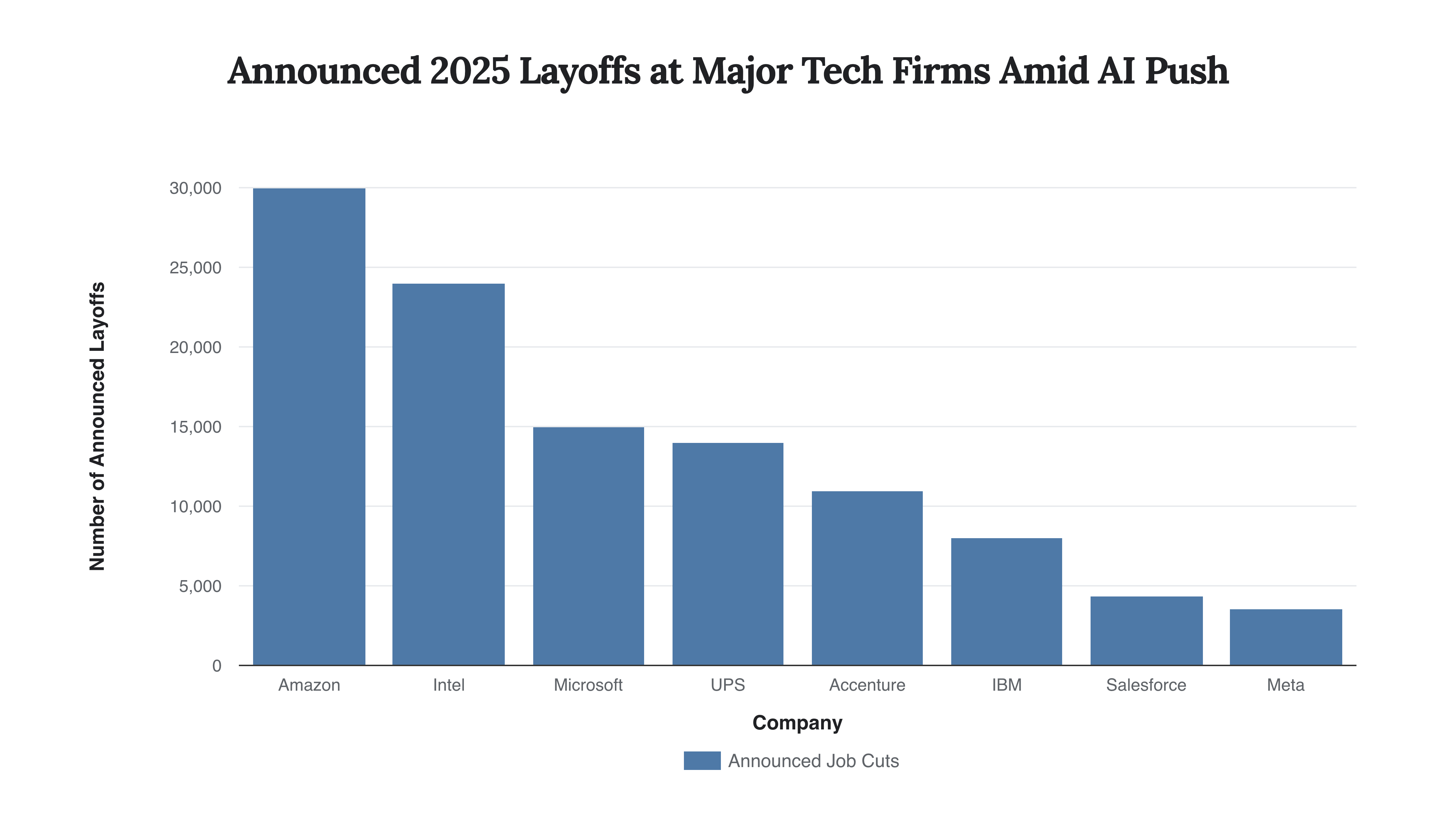
Caption: Major technology and logistics firms have announced significant workforce reductions in 2025, often happening concurrently with massive strategic investments in artificial intelligence and automation.
Strategic Foresight: Navigating the Next 24 Months
The data from October 2025 is not an anomaly; it is a harbinger. The rate of AI-driven displacement is likely to continue accelerating as the technology becomes more capable and accessible. Leaders must now move from observation to action.
Key Signposts to Monitor:
Mid-Level Knowledge Workers: The first wave targeted routine tasks. The next will target more complex knowledge work. Watch for announcements of AI adoption in roles like market research analysts, financial modelers, and even software developers, where AI is shifting from a tool to a collaborator and, in some cases, a substitute.
Regulatory and Policy Response: Governments have been largely reactive. Monitor for any shifts towards proactive policies regarding AI-driven unemployment, such as mandates for corporate retraining programs, changes to unemployment benefits, or incentives for human-centric job creation.
The Rise of the ‘Centaurs’: The most resilient professionals will be those who can effectively partner with AI, leveraging it to augment their own skills. Companies that invest in training and creating these ‘centaur’ roles—part human, part AI—will likely retain a competitive advantage in creativity and critical thinking.
The era of theoretical AI job displacement is over. We are now in the era of active, strategic, and accelerating workforce automation. The 31,039 jobs explicitly cut due to AI in a single month are the opening salvo in a transformation that will reshape the labor market for the next decade. The challenge for leaders is no longer to predict this change, but to navigate it with clear-eyed strategy and decisive action.
The single most critical insight for leaders is that viewing AI solely as a cost-cutting tool is a strategic failure; it must be leveraged as a value-creation engine, re-engineering workflows to empower human talent on higher-order tasks that machines cannot replicate.