


Every day, individuals increasingly outsource their cognitive processes to external digital architectures. This dependence redefines the very nature of memory, transforming it from an internal faculty into an accessible, searchable, and ultimately, manipulable database. Bernard Stiegler, in Technics and Time, 1: The Fault of Epimetheus, introduced the concept of technics as a “pharmakon”—both poison and cure. For Stiegler, external technological prostheses, ranging from ancient writing systems to contemporary digital media, function as ‘tertiary retentions.’ These retentions are externalized memory supports that shape not only what we remember but how we remember and even how we think. While these systems offer an unparalleled capacity for information storage and retrieval, providing immediate access to vast datasets, they simultaneously threaten the internal, lived experience of memory, particularly what Stiegler termed ‘primary’ and ‘secondary’ retentions—the immediate impressions and personal experiences that form our individual and collective consciousness

Stiegler argued that “the industrial exploitation of attention has destroyed the conditions of attention itself.” This means the very mechanisms designed to capture and hold our focus—algorithmic feeds, endless content, persuasive design—ultimately undermine our innate capacity for sustained thought, deep processing, and internal recollection. This paradox lies at the heart of our contemporary digital experience: systems engineered to enhance access to information may diminish our capacity to meaningfully retain, connect, or critically evaluate it. The constant flow of notifications and fragmented content, each vying for a micro-burst of attention, creates a highly fragmented cognitive landscape where the neural pathways for deep processing are starved, leading to a pervasive erosion of cognitive endurance. This constant externalization of memory not only risks the loss of individual recollections but fundamentally alters the structure of the self by reconfiguring the relationship between consciousness and its historical substratum.
Algorithmic Engineering of Cognitive Fragmentation
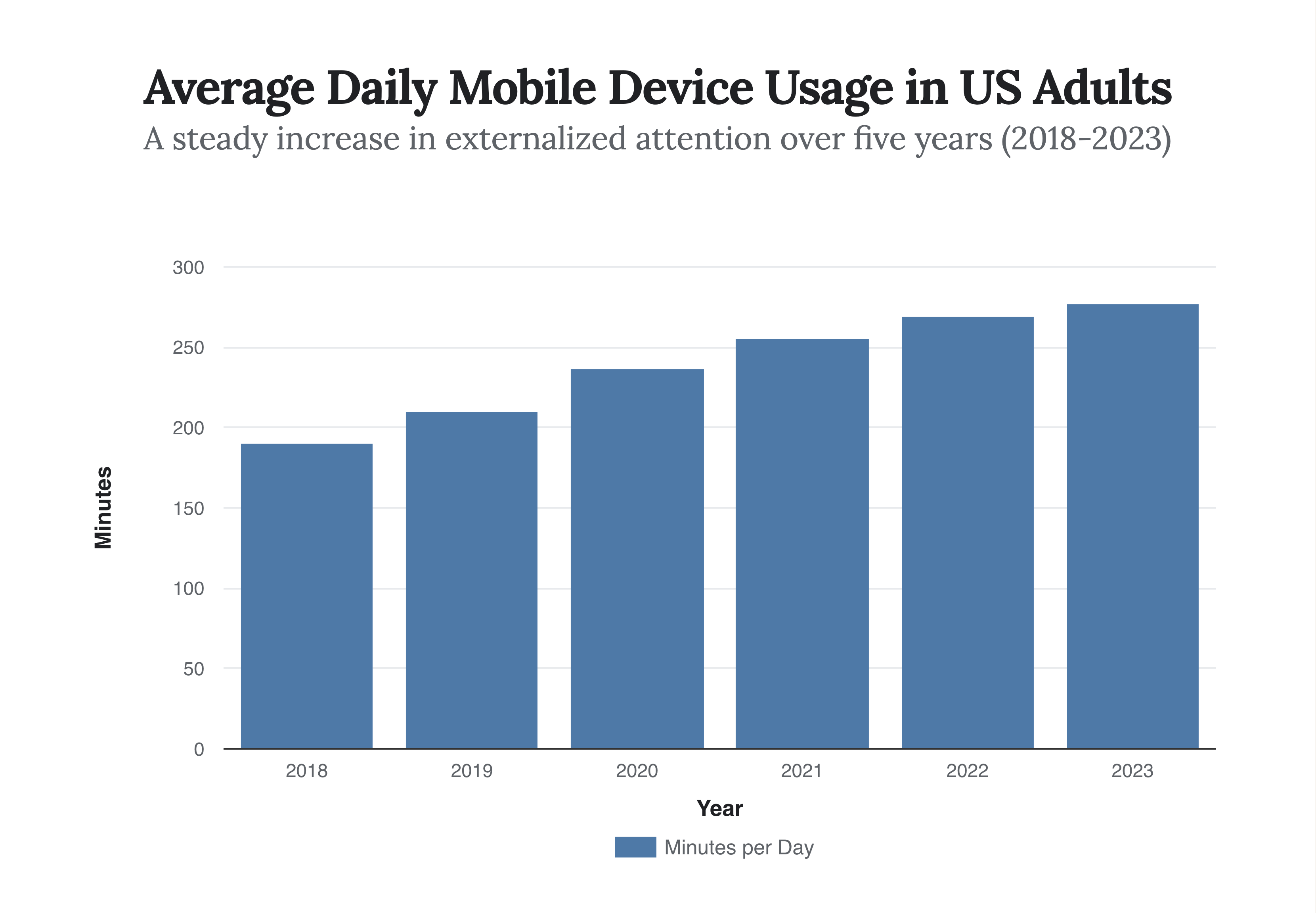
The deliberate design of digital platforms, guided by algorithms optimized for maximizing engagement, systematically fragments the sustained attention crucial for memory consolidation and cognitive depth. US adults now spend an average of 4 hours and 37 minutes daily on mobile devices, accounting for approximately 29% of an average 16-hour waking day (eMarketer, 2023). This pervasive engagement with externalized screens means a significant portion of conscious life is spent interacting with interfaces that prioritize novelty, immediacy, and rapid consumption over depth and retention. The constant switching between applications, the endless scroll through feeds, and the relentless stream of notifications actively prevent the sustained focus necessary for converting transient information into stable, long-term personal memory.
This environment fosters what cognitive scientists call “continuous partial attention,” where individuals constantly monitor multiple streams of information but rarely engage deeply with any single one. A 2022 Deloitte study revealed that average smartphone users receive 46 notifications per day, each representing a micro-interruption that pulls attention away from primary tasks. Research consistently demonstrates that multitasking—a default mode for many digital users—significantly impairs memory encoding and retrieval, leading to a form of structural forgetting. In this paradigm, individual experiences and facts struggle to find lasting anchors within our cognitive architecture because the conditions for their consolidation are systematically undermined. The brain’s capacity to filter, prioritize, and integrate information into a coherent narrative is continuously challenged, leading to a diminished ability to form robust, accessible memories. This continuous external stimulation does not merely distract; it reconfigures the very pathways by which memory is formed and accessed, making us increasingly reliant on the device itself to recall what we have seen or learned just moments prior, thus completing the circuit of externalized cognition that Stiegler described.
The Disintegration of the Self in the Digital Mirror
The algorithmic erosion of memory extends beyond mere factual recall; it impacts the very coherence of the self. Personal memory is not merely a collection of data points; it is the continuous narrative through which we understand who we are, where we have been, and what meaning our experiences hold. When these narratives are fragmented by externalized retention and constant digital interruption, the internal architecture of identity becomes unstable. Instead of constructing a self through reflective synthesis of lived experiences, individuals risk having their self-perception shaped by algorithmic feedback loops and curated digital personas. This creates a disconnect where the ‘remembered self’ becomes increasingly distinct from the ‘algorithmic self,’ a carefully constructed projection optimized for engagement within digital spaces. The consistent mediation of experience through screens means that the primary source of our own history is no longer our internal reflection, but a stream of data owned and organized by external entities. The profound implication is that our capacity for self-authorship, traditionally rooted in the subjective continuity of memory, is increasingly negotiated and even dictated by technological systems.
If our memories are increasingly outsourced and mediated by algorithms, what remains of the uniquely human capacity for subjective experience and the constitution of the self? What is the cost when our personal past becomes a function of a network, rather than a narrative we forge internally, and how does this redefine the foundations of identity and meaning in the digital age?
