


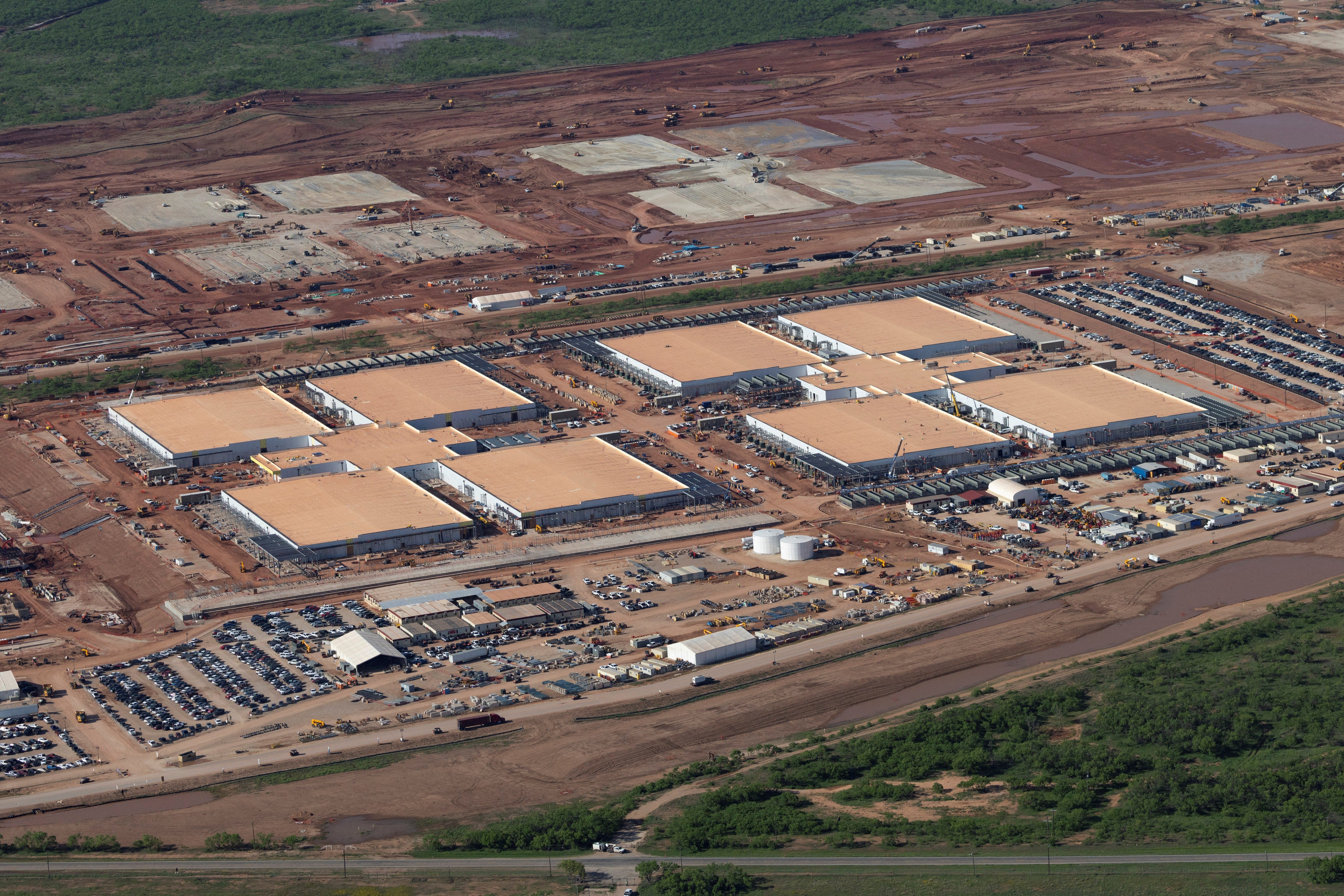
In the relentless global arms race for artificial intelligence dominance, the focus has overwhelmingly been on silicon and software. But a seismic shift is underway, moving from the ethereal world of algorithms to the terrestrial realm of concrete, steel, and substations.
This week, BlackRock, the world’s largest asset manager, unveiled a strategy of breathtaking scale and ambition through a newly minted joint venture with Spanish construction titan ACS Group. While the initial asset transfer is valued at €2 billion, the partnership’s framework outlines a potential capital deployment of nearly $27 billion, aimed at developing a multi-gigawatt pipeline of data centers across the globe.
This is not merely an infrastructure investment; it is a calculated bid to control the physical bedrock upon which the entire AI economy will be built. By fusing the unparalleled construction and engineering capabilities of ACS with the financial might of its own Global Infrastructure Partners (GIP) division, BlackRock is executing a pincer movement on the digital economy. It is simultaneously acquiring massive existing data center portfolios while creating a dedicated global pipeline to build the next generation of AI-ready facilities. This analysis will deconstruct the layers of this monumental deal, place it within BlackRock’s broader strategy of digital infrastructure domination, and project the second-order effects that will ripple through the technology, energy, and financial markets for the next decade.
The Colossus Awakens: Deconstructing the BlackRock-ACS Alliance
Announced on November 14, 2025, the 50-50 joint venture between BlackRock’s GIP and ACS Group marks a pivotal moment in the evolution of digital infrastructure as a premier institutional asset class. The deal’s structure is designed for both immediate impact and long-term, scalable growth, moving far beyond a simple capital-for-equity transaction.
The Anatomy of the Deal
The partnership launches with ACS transferring a portfolio of data center projects into the joint venture. These initial assets, valued at approximately €2 billion ($2.33 billion), represent a starting capacity of 1.7 gigawatts (GW) under development. The payment structure involves an upfront cash injection of around €1 billion from GIP, with up to another €1 billion in earn-outs tied to commercial milestones, ensuring alignment and performance. However, this is merely the opening act. The true scale of the ambition lies in the framework for future development, with reports indicating a potential for €5 billion ($5.8B) in equity and €18 billion ($20.9B) in debt financing to tackle a far larger pipeline.
The initial portfolio provides a strategic footprint across key global markets. While the headline figure is 1.7GW, a closer look at ACS’s most recent disclosures reveals a more detailed 1.1GW of capacity already in motion, forming the core of the new venture. This geographic diversity is a critical hedge against regional regulatory risks and power constraints.
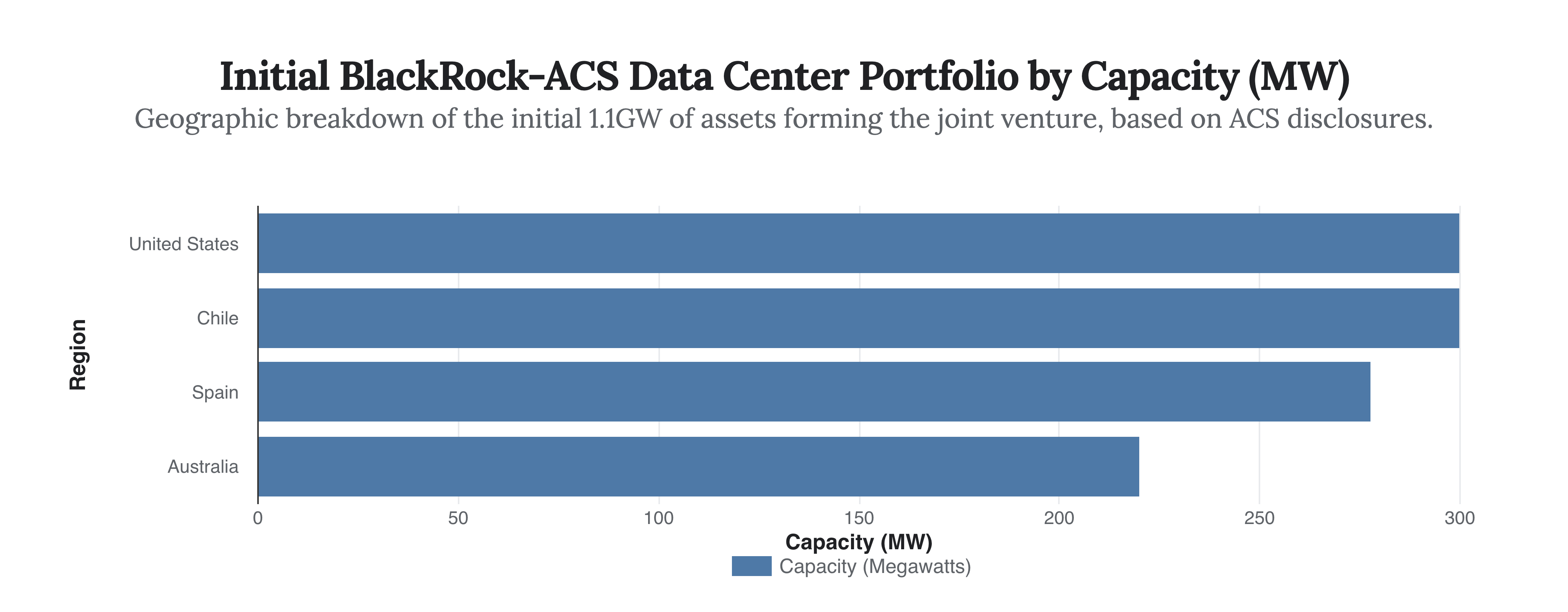
The joint venture’s initial assets are strategically distributed across the Americas, Europe, and Asia-Pacific, providing a global platform for expansion from day one.
Beyond Capital: Why ACS is the Strategic Linchpin
To view this partnership as BlackRock simply hiring a contractor would be a profound misinterpretation. ACS is not just a builder; it is one of the world’s most sophisticated engineering and construction conglomerates, owning firms like Turner Construction in the US and Hochtief in Germany. These subsidiaries have already delivered over 5.5 GW of data center capacity for the world’s most demanding clients, including Meta and CoreWeave. This provides the joint venture with two critical, non-replicable advantages:
Execution Certainty: In a market plagued by supply chain disruptions, labor shortages, and complex permitting, ACS’s proven ability to deliver highly technical, large-scale projects on time and on budget is an invaluable asset. It de-risks the development process in a way that pure financial investors cannot.
Global Supply Chain & Expertise: ACS’s global reach provides access to materials, specialized labor, and deep local regulatory knowledge. This industrial expertise is essential for navigating the complexities of building next-generation facilities that require advanced liquid cooling and direct integration with renewable energy sources.
As ACS Group CEO Juan Santamaría stated, “By joining forces with GIP, we are combining ACS’s development, engineering, and construction expertise with the deep investment capacity and industry experience of one of the world’s leading infrastructure investors.”
A Pattern of Domination: The Broader Strategy in Focus
The ACS venture is not an isolated bet but a cornerstone of a much larger, multi-pronged strategy to dominate the digital infrastructure landscape. It follows a clear pattern of massive capital deployment designed to control every layer of the AI value chain, from existing assets to future development pipelines.
The $40 Billion Precedent: Acquiring Scale with Aligned
Just weeks before the ACS announcement, a BlackRock-led consortium acquired Aligned Data Centers for an estimated $40 billion, one of the largest transactions in the sector’s history. Aligned brings an enormous existing footprint of over 50 campuses and 5 GW of capacity across the Americas. This move serves a complementary purpose to the ACS deal: while ACS provides the capability to *build* the future, the Aligned acquisition provides immediate, massive scale and an established operational platform. Together, they represent a classic “buy *and* build” strategy executed at an unprecedented level.
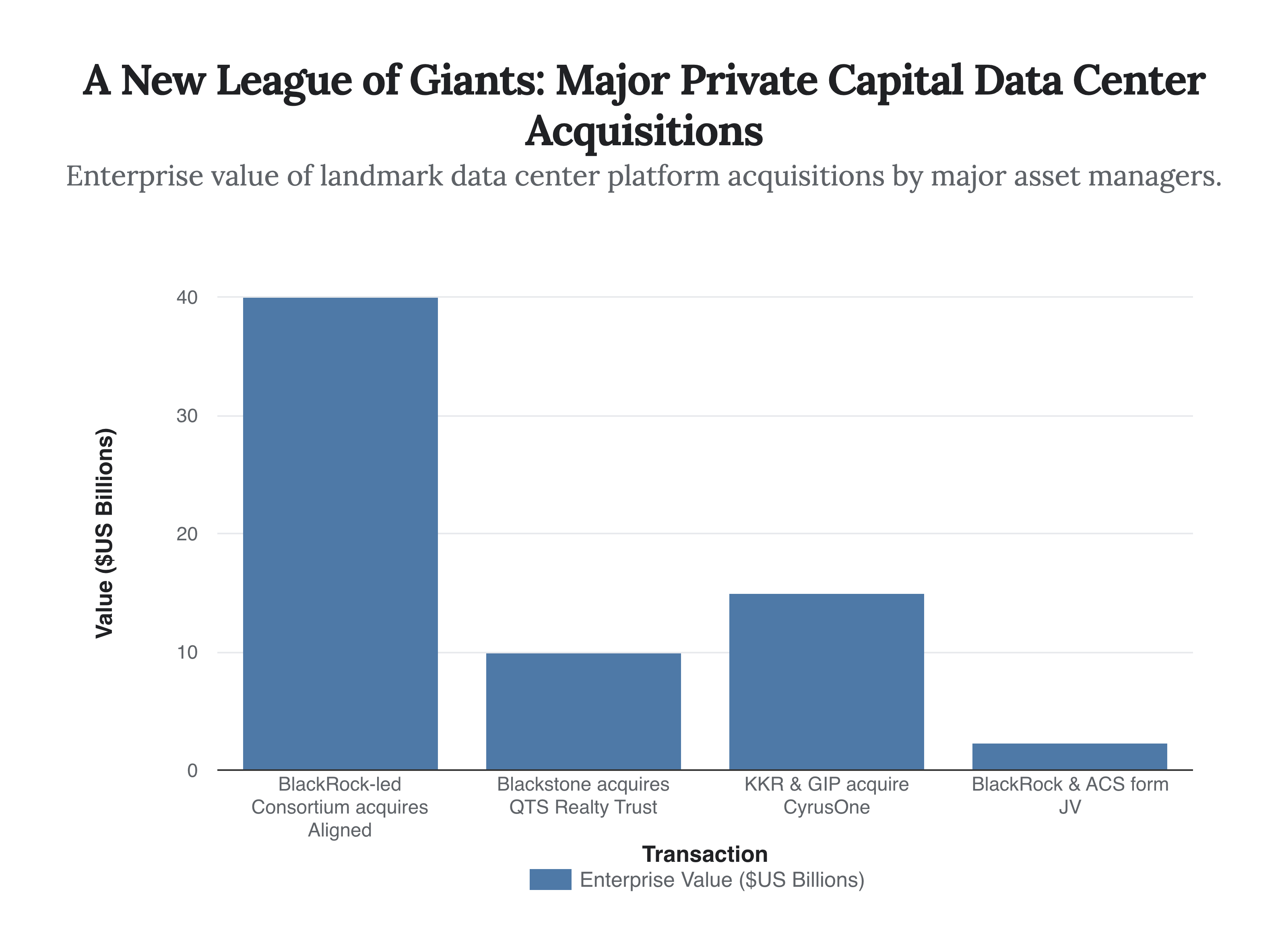
BlackRock’s recent acquisitions, particularly of Aligned Data Centers, dwarf previous blockbuster deals in the sector, signaling a dramatic escalation in capital deployment.
The AI Infrastructure Partnership (AIP): Building an Ecosystem
These colossal deals exist under an even larger strategic umbrella. In late 2024, BlackRock co-founded the AI Infrastructure Partnership (AIP) alongside Microsoft, MGX, NVIDIA, and others. This platform aims to mobilize up to $100 billion in combined equity and debt to fund the data centers *and* the energy infrastructure required to power them. The ACS deal is a direct execution of the AIP’s mandate. It creates a dedicated development vehicle, backed by the world’s most important technology companies, to address the core bottlenecks hindering AI’s growth.
“Mobilizing private capital to build AI infrastructure like data centers and power will unlock a multi-trillion-dollar long-term investment opportunity. Data centers are the bedrock of the digital economy, and these investments will help power economic growth, create jobs, and drive AI technology innovation.”
- Larry Fink, Chairman and CEO of BlackRock
With the Aligned and ACS assets combined, BlackRock’s portfolio now represents a formidable force in the data center market, rivaling established public players and setting a new bar for private capital competitors.
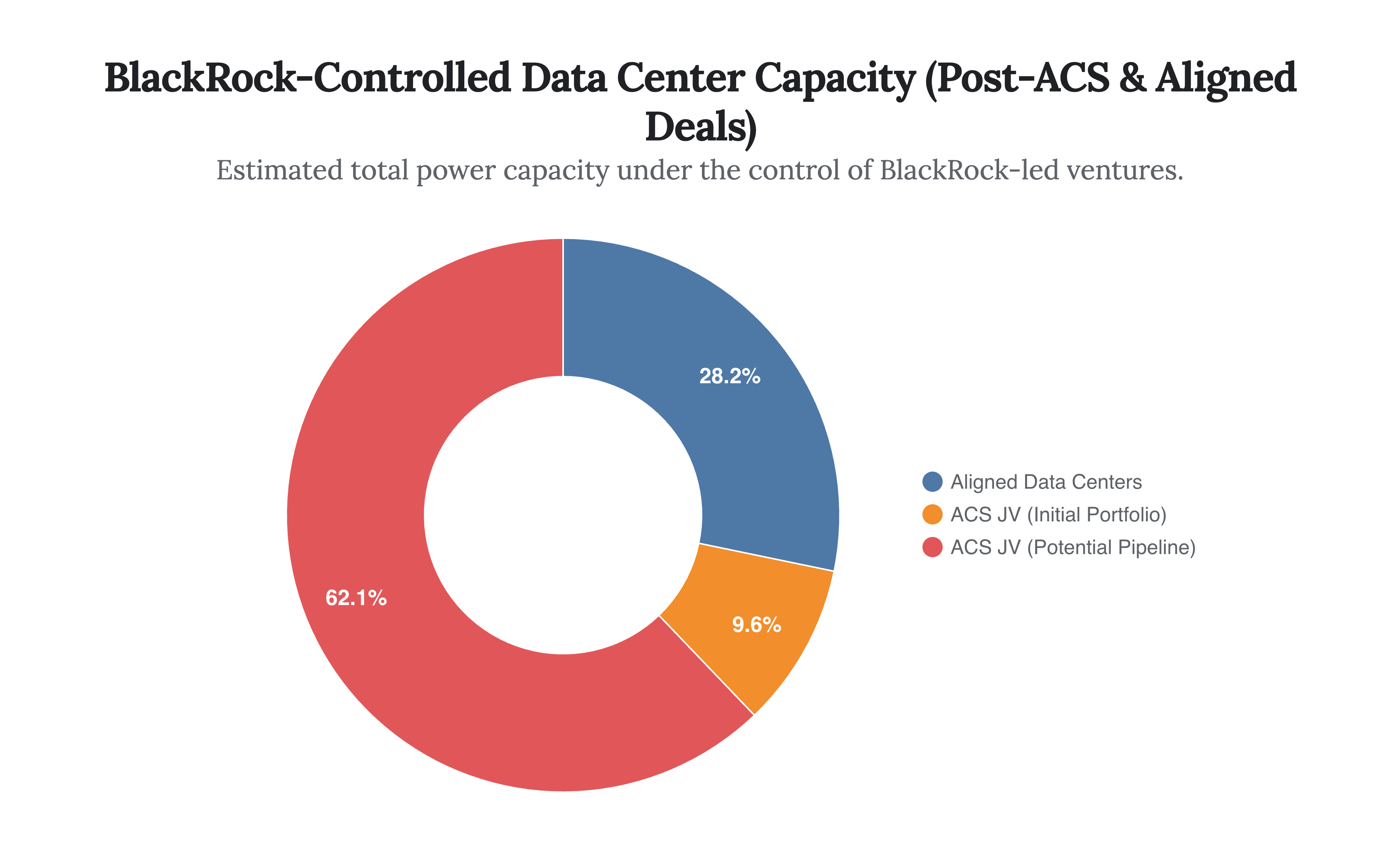
The combined capacity from the Aligned acquisition and the full ACS pipeline would position BlackRock as one of the largest data center landlords globally, with a potential portfolio exceeding 17 GW.
The New Geopolitics of Power (And Power Grids)
The insatiable energy demand of AI is the industry’s great, unsolved challenge. Projections show that data center power consumption is set to explode in the coming years, creating unprecedented strain on aging power grids. This energy bottleneck is rapidly becoming the primary constraint on AI development, eclipsing even the availability of GPUs.
The Unseen Bottleneck: Energy
A single AI data center can consume as much electricity as a small city. As hyperscalers and AI companies race to build larger and more powerful models, securing long-term, stable, and preferably green power has become a matter of strategic survival. This has triggered a global scramble for locations that possess two key attributes: ample fiber connectivity and, more importantly, available power capacity. This dynamic fundamentally changes the economics of data center development.
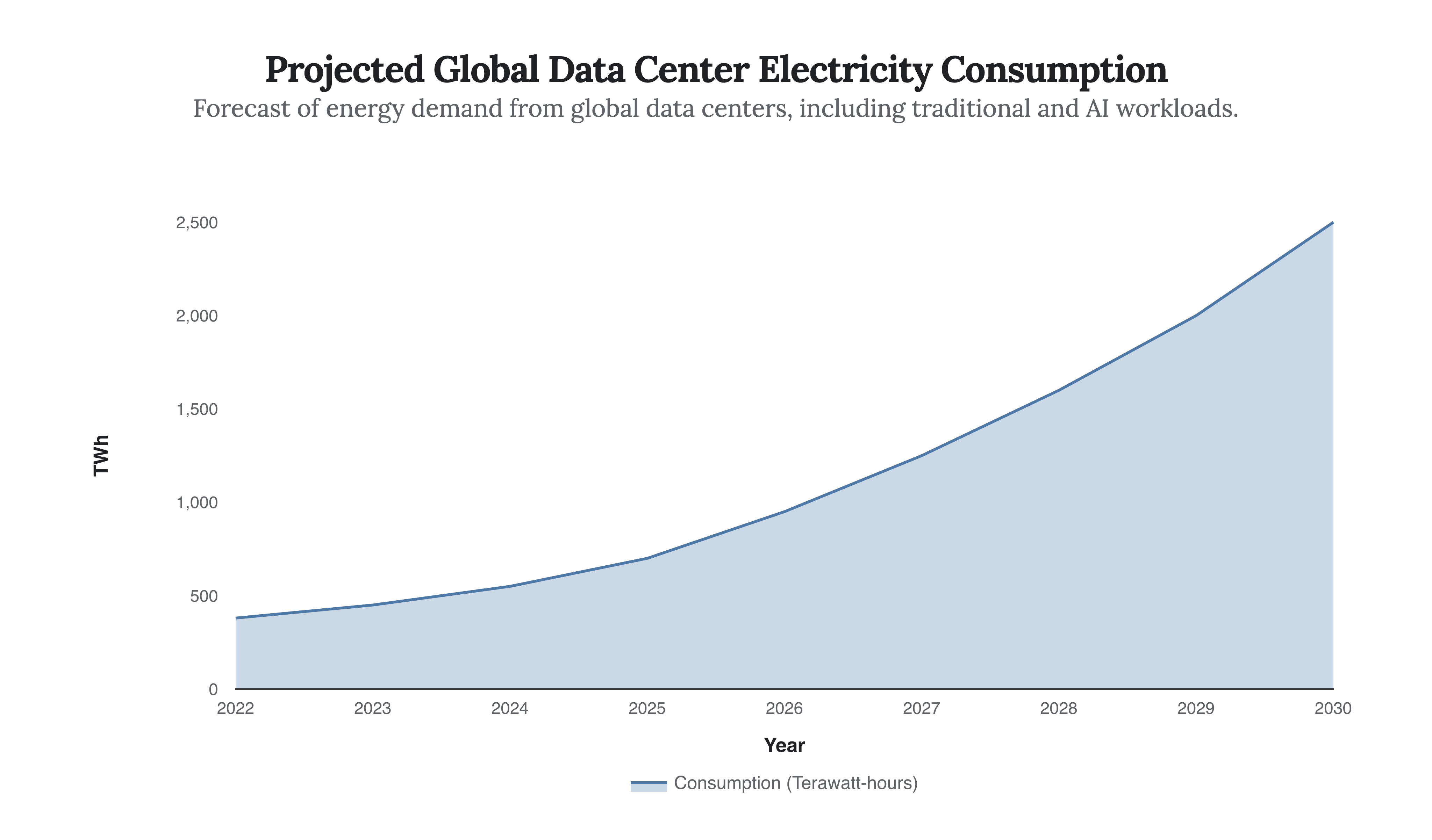
The exponential growth in AI workloads is expected to more than double global data center power demand by 2030, creating a critical need for new energy generation and grid infrastructure.
From Builder to Power Broker
By controlling a vast portfolio of data centers, BlackRock and ACS are not just landlords; they are becoming among the world’s largest consumers of power. This scale provides immense leverage. The joint venture’s focus on integrating renewable power sourcing and advanced cooling is not just an ESG talking point—it’s a core business strategy. They can negotiate large-scale Power Purchase Agreements (PPAs) directly with energy producers, co-locate renewable generation assets with their data centers, and invest in grid stabilization technologies. This vertical integration—controlling both the point of consumption (the data center) and influencing the source of generation—is the ultimate competitive moat in an energy-constrained world.
Strategic Foresight: Winners, Losers, and Future Shockwaves
The BlackRock-ACS alliance is a tectonic event that will reconfigure the competitive landscape. Its sheer scale and integrated model create clear winners and losers and signal a new phase of maturation for the digital infrastructure market.
The New Competitive Arena
The venture directly challenges the established order. Publicly traded data center REITs like Digital Realty and Equinix, which have long dominated the market, now face a private competitor with a lower cost of capital and a direct pipeline for at-cost development. Other private equity giants like Blackstone and KKR, despite their own significant investments, must now contend with a rival that has integrated world-class construction capabilities directly into its platform. The hyperscalers themselves (Amazon, Google, Microsoft) face a more consolidated and powerful set of landlords, potentially shifting the balance of power in leasing negotiations over the long term.
“Hyperscalers are increasingly leaning toward leasing rather than owning, which expands the role for colocation developers to deliver build-to-suit capacity and creates steady pipelines for private capital.”
Signposts to Watch
For investors and policymakers, the implications of this new paradigm require careful monitoring. Three areas will be critical:
Regulatory Scrutiny: As a handful of mega-players come to dominate this critical infrastructure layer, questions around market concentration, national security, and data sovereignty are inevitable. Antitrust regulators, particularly in the US and Europe, will be watching closely.
The Land and Power Grab: The race is now on to secure the most valuable resource: shovel-ready sites with pre-approved power access. Expect to see a surge in the valuation of land near major grid interconnects, as well as increased investment in private energy generation to support these digital hubs.
Financing Innovation: The massive capital requirements—as evidenced by the $18 billion debt component of the potential ACS deal—will necessitate new financial instruments. We anticipate the growth of dedicated infrastructure debt funds, securitization of data center leases, and new public-private partnerships to upgrade national power grids.
The BlackRock-ACS joint venture is far more than a real estate transaction; it is the industrialization of AI’s physical foundation. It represents a convergence of global finance, engineering, and technology aimed at solving the single greatest constraint to progress in artificial intelligence: the physical world itself. By mastering the complexities of power, land, and construction at a global scale, BlackRock is not just investing in the AI revolution—it is building the ground it stands on.
This strategy transforms BlackRock from a mere asset manager into a foundational owner of the world’s AI-driven future.