


In a stunning reversal of a multi-year strategy, the United States has fundamentally altered its approach to the high-stakes world of artificial intelligence hardware. In mid-January 2026, the Commerce Department’s Bureau of Industry and Security (BIS) officially pivoted from a strict “presumption of denial” for advanced AI chip exports to China to a more flexible “case-by-case review.”
This move, however, comes with a monumental catch: a new 25% tariff on the very chips that were, until recently, completely banned for export. This policy shift effectively creates a high-priced, highly-monitored toll road for American chip designers like Nvidia and AMD to re-enter the lucrative Chinese market, trading a hard security line for a complex blend of economics and control.
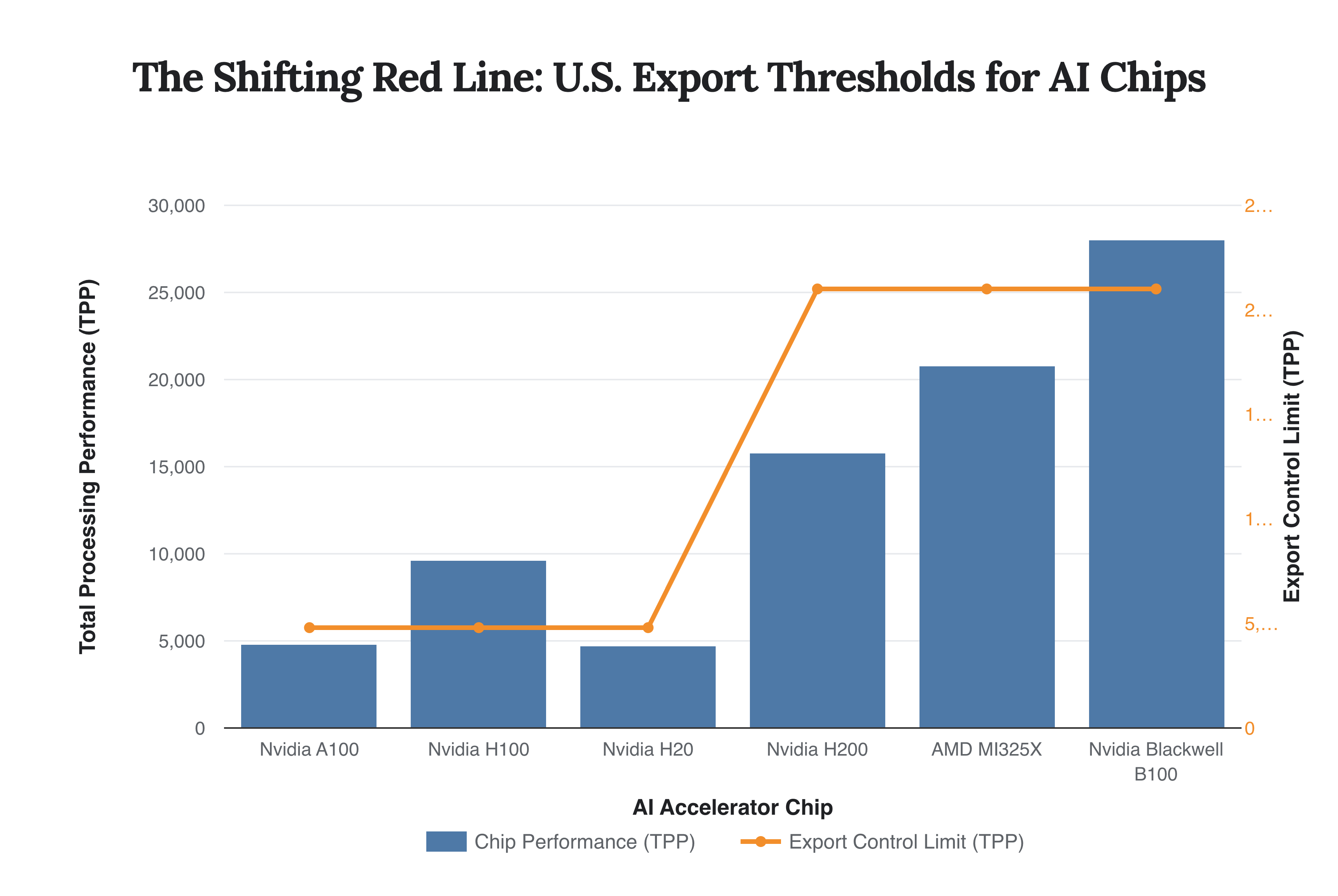
The new regulations, effective January 15, 2026, are surgically precise. They abandon the previous, broader restrictions for a new system based on specific performance thresholds. The policy sets a ceiling based on a Total Processing Performance (TPP) of 21,000 and a DRAM memory bandwidth of 6,500 GB/s. This opens the door for the export of powerful chips like Nvidia’s H200 and AMD’s MI325X—processors specifically designed to be compliant with older rules yet powerful enough to train sophisticated AI models. The chart below illustrates how these new rules redraw the technological battlefield, permitting chips that are significantly more powerful than what was allowed under the 2023 regulations, while still aiming to keep the absolute cutting-edge technology out of China’s hands.
To qualify for this case-by-case review, exporters face a labyrinth of new requirements. Chips must first be imported into the United States for third-party security testing before being re-exported, a process that triggers the 25% tariff. Furthermore, companies must certify that sales to China will not divert foundry capacity or delay orders for U.S. customers, and that shipments to China will not exceed 50% of the volume sold domestically.
This policy marks a dramatic departure from the strategy initiated in October 2022, which sought to severely restrict China’s ability to develop advanced AI for military purposes. That initial salvo was tightened in October 2023, closing loopholes that allowed sales of slightly less powerful, custom-designed chips for the Chinese market. The motivation behind the original ban was clear, as articulated by officials at the time.
“As AI becomes more powerful, the risks to our national security become even more intense. [The framework] is designed to safeguard the most advanced AI technology and ensure that it stays out of the hands of our foreign adversaries.”
The new tariff-based model suggests a tacit admission that a complete technological blockade is perhaps unsustainable or even counterproductive. However, this pivot has ignited a firestorm of criticism in Washington. A bipartisan group of lawmakers argues that treating advanced semiconductors like a commodity to be taxed, rather than a critical national security asset to be guarded, is a grave error. This sentiment is driving new legislative efforts to claw back control from the executive branch.
“Should Congress have oversight when selling missiles to other countries? Yes, the same should be said for chips.” - Rep. Brian Mast (R-FL), Chairman of the House Foreign Affairs Committee
The long-term risk of the U.S. export controls—both the old ban and the new tariff—is that they have created a powerful incentive for China to achieve semiconductor independence. Before the strictest controls, U.S. firms like Nvidia dominated the Chinese AI market. Recent analyst projections, however, paint a starkly different future. The restrictions have accelerated the growth of domestic Chinese competitors like Huawei to the point where they are expected to capture the vast majority of their home market, leaving American firms with only a sliver of what was once a multi-billion dollar revenue stream.
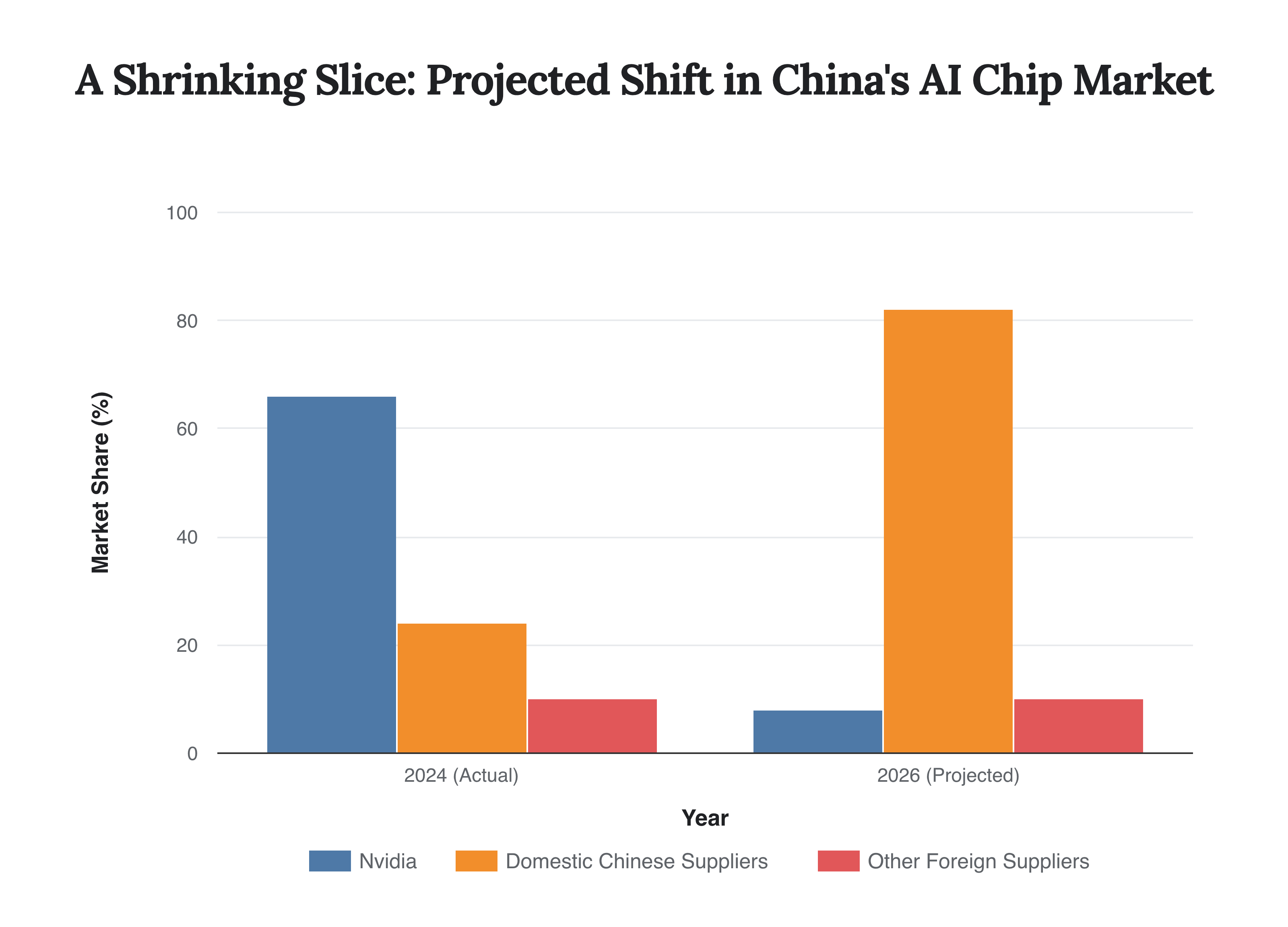
The data suggests a potential exodus from U.S. technology, accelerated by U.S. policy itself. While the new 2026 rules may allow Nvidia to reclaim some sales, the 25% tariff makes its chips significantly more expensive, effectively subsidizing the development of its Chinese rivals. Nvidia, which once derived up to a quarter of its data center revenue from China, faces a dramatically reshaped landscape.
Ultimately, the United States is placing a complex and audacious bet. It has swapped a high fence for a gated community, believing it can manage the flow of technology through economic leverage rather than an outright ban. This new strategy attempts to thread an incredibly fine needle: slowing China’s military AI development, preventing the complete decoupling of U.S. tech firms from a massive market, and generating tariff revenue in the process. Yet, in doing so, it may be fueling the very self-sufficiency it was designed to prevent. The U.S. is no longer trying to starve its rival of AI compute, but rather to sell it that compute by the spoonful—for a price—betting that a managed dependency is better than losing visibility and influence entirely.