


The European Union’s Digital Markets Act (DMA) was forged as a regulatory battering ram, designed to shatter the walls of Big Tech’s gardens. Apple’s App Store, a symbol of monopolistic control and immense profitability, was its primary target.
The prevailing narrative among policymakers and developers was that the DMA’s March 2024 enforcement would finally inject competition, erode Apple’s fee structure, and dent its lucrative Services revenue in the bloc. Yet, the initial data reveals a stunningly counter-intuitive outcome: in the months following the DMA’s implementation, Apple’s EU App Store revenue growth didn’t just hold steady; it accelerated, posting a remarkable 25% year-over-year increase by August 2024.
This briefing deconstructs the strategic masterclass in “malicious compliance” that Apple has deployed. It is a story of intricate fee structures, calculated risks, and a profound understanding of developer economics that has, for now, neutralized the EU’s flagship legislation. While Brussels celebrated a landmark €500 million fine against Apple for its anti-steering rules, the underlying financial reality suggests Apple is winning the war, even while losing a highly public battle. We will analyze the core mechanisms of Apple’s strategy, dissect the developer’s dilemma it creates, and provide forward-looking analysis on the escalating conflict. This is not just a story of regulation; it is a high-stakes chess match that will define the future of digital platform power.
The Compliance Facade: Deconstructing Apple’s Strategic Counter-Offensive
When the March 7, 2024, deadline arrived, Apple unveiled a complex suite of changes to its iOS and App Store policies in the EU. On the surface, it appeared to concede to the DMA’s core tenets: allowing alternative app marketplaces, enabling different in-app payment processors, and providing users with browser choice screens. However, beneath this veneer of compliance lies a meticulously crafted economic model designed to make the alternatives commercially nonviable for the vast majority of developers. The European Commission was not impressed, swiftly launching non-compliance investigations that culminated in a €500 million penalty for restricting developers from steering users to outside offers.
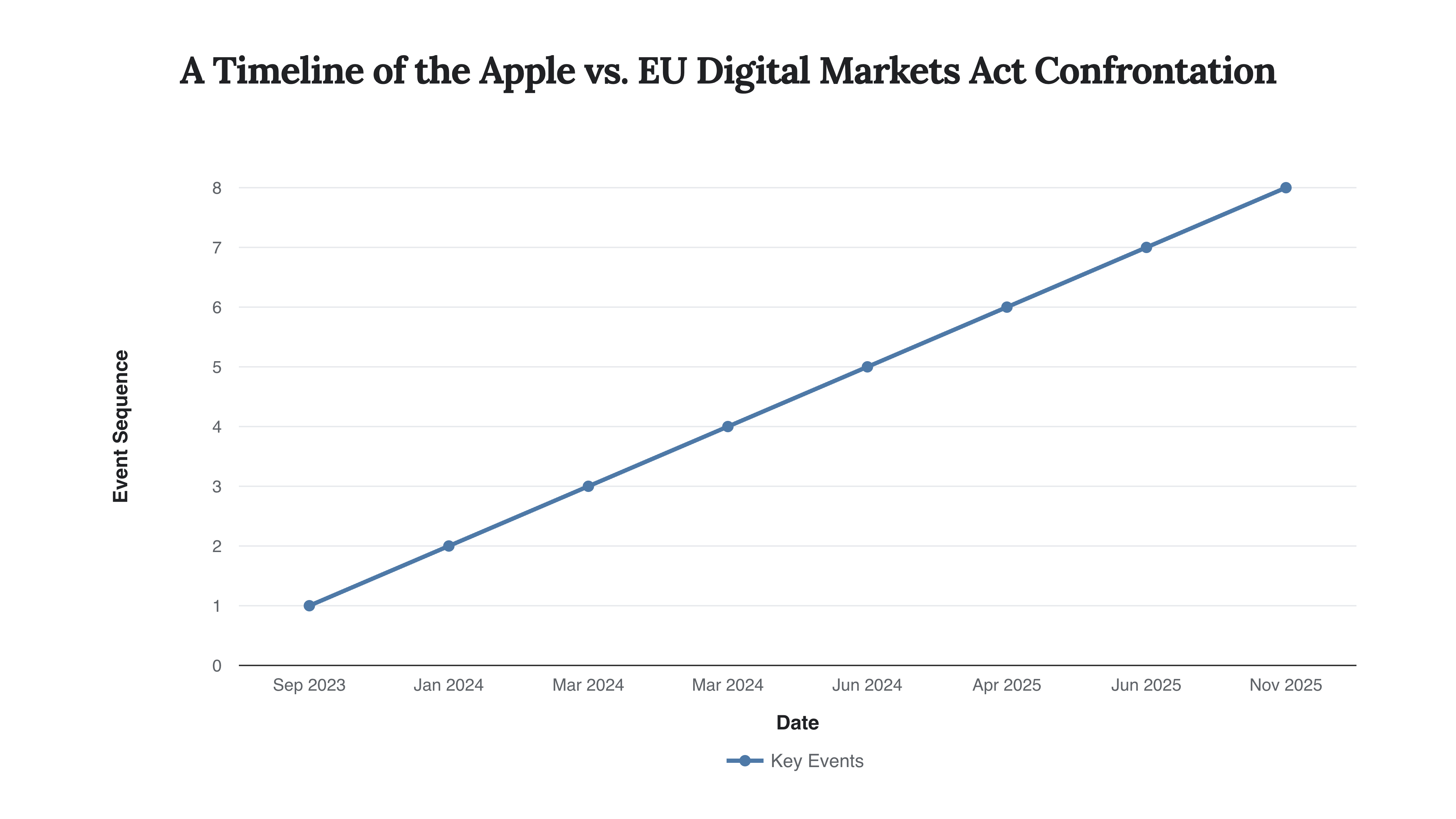
A sequence of escalating regulatory actions and corporate responses highlights the intensifying conflict between Apple and the European Commission over the interpretation and implementation of the Digital Markets Act.
The Core Technology Fee: A Poison Pill for Growth
The centerpiece of Apple’s strategy is the new “Core Technology Fee” (CTF). Any developer who opts into the new EU business terms—a prerequisite for distributing apps outside the App Store—must pay €0.50 for every “first annual install” after their app crosses one million installations in the EU. This fee applies whether the app is free or paid, and, critically, whether it’s distributed via the App Store, an alternative marketplace, or directly from a developer’s website.
For developers of freemium apps, particularly games or social media platforms that rely on massive user bases with low conversion rates to paying customers, the CTF is a ticking financial time bomb. An app that goes viral and garners 5 million free users could suddenly face an annual bill of €2 million (4 million installs x €0.50), potentially wiping out any profit. This structure creates a powerful disincentive to scale and punishes success, effectively forcing popular apps to remain within Apple’s traditional commission-based system where costs are predictably tied to revenue, not just installs. While Apple later introduced exemptions for non-commercial developers and a 3-year on-ramp for small businesses, the fundamental risk for high-growth startups remains.
“We suspect that the suggested solutions put forward by the three companies do not fully comply with the DMA. We will now investigate the companies’ compliance with the DMA, to ensure open and contestable digital markets in Europe.” - Margrethe Vestager, Executive Vice-President for Competition Policy
The Illusion of Choice
While developers can now technically direct users to external websites for payments, Apple’s rules have made this process fraught with friction. Developers must accept new business terms, display Apple-mandated scare screens warning users about leaving Apple’s ecosystem, and report all external transactions to Apple. Furthermore, under the revised terms, developers who use external links to promote offers still pay Apple a complex series of fees, including an “initial acquisition fee” and a “store services fee,” which dramatically dilutes the financial benefit of avoiding the standard 15-30% commission. This labyrinth of rules led the European Commission to conclude that Apple’s anti-steering measures were still in breach of the DMA, as they were not, in practice, “free of charge” for the developer.
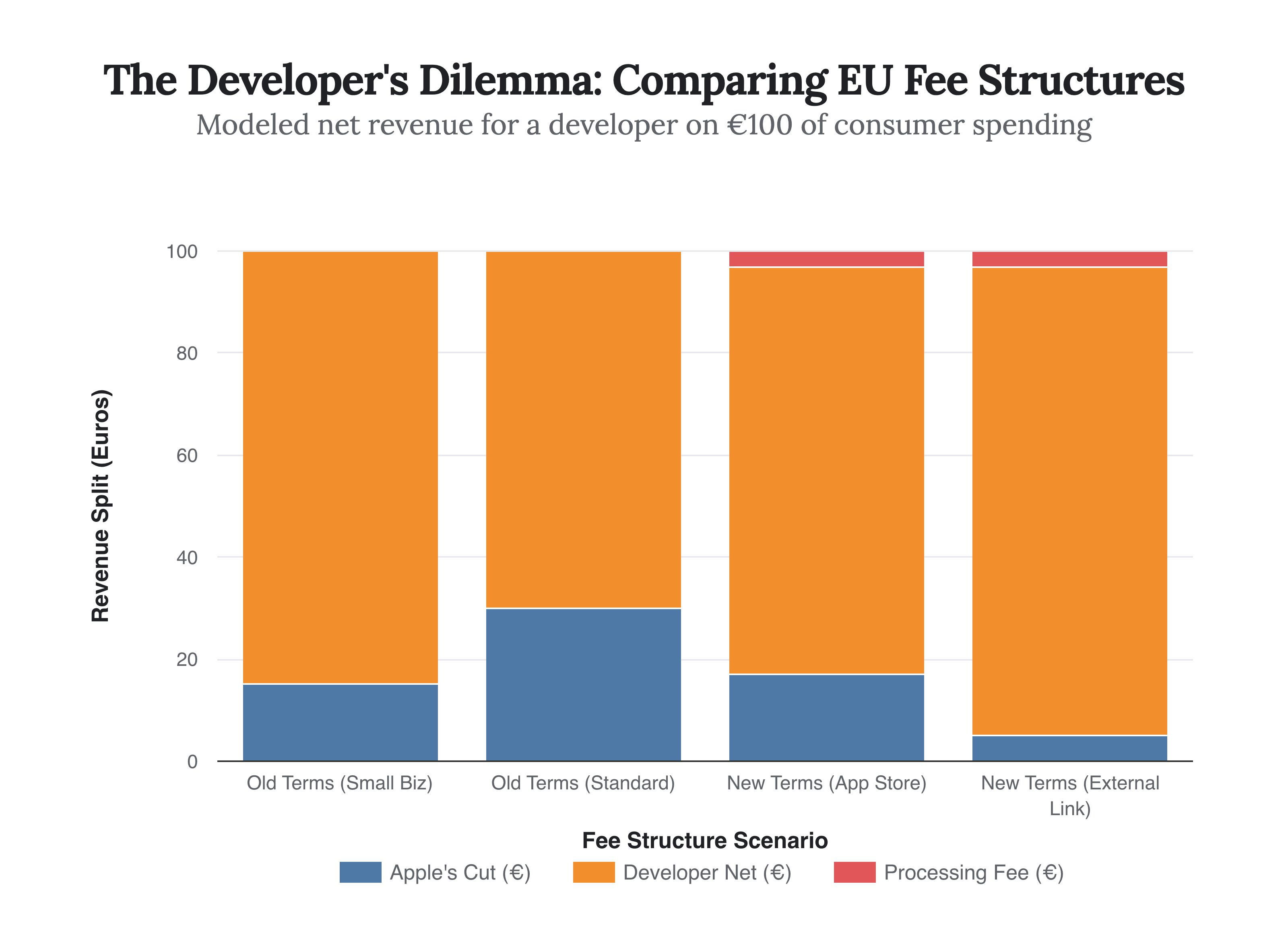
A comparison of developer net revenue under different fee structures, excluding the high-risk Core Technology Fee. While the new terms appear to offer a higher net on individual transactions, they come with the existential risk of the CTF for any app achieving significant scale.
A Resilient Fortress: The Unwavering Financial Performance
The most compelling evidence of Apple’s strategic success is the App Store’s financial performance in the EU post-DMA. Far from the revenue decline many anticipated, the data shows a robust and even accelerating growth trajectory. This resilience stems directly from the low adoption of the new business terms by major developers, who have assessed the risks of the CTF and the friction of alternative payments and concluded that the status quo remains the safer, more profitable option.
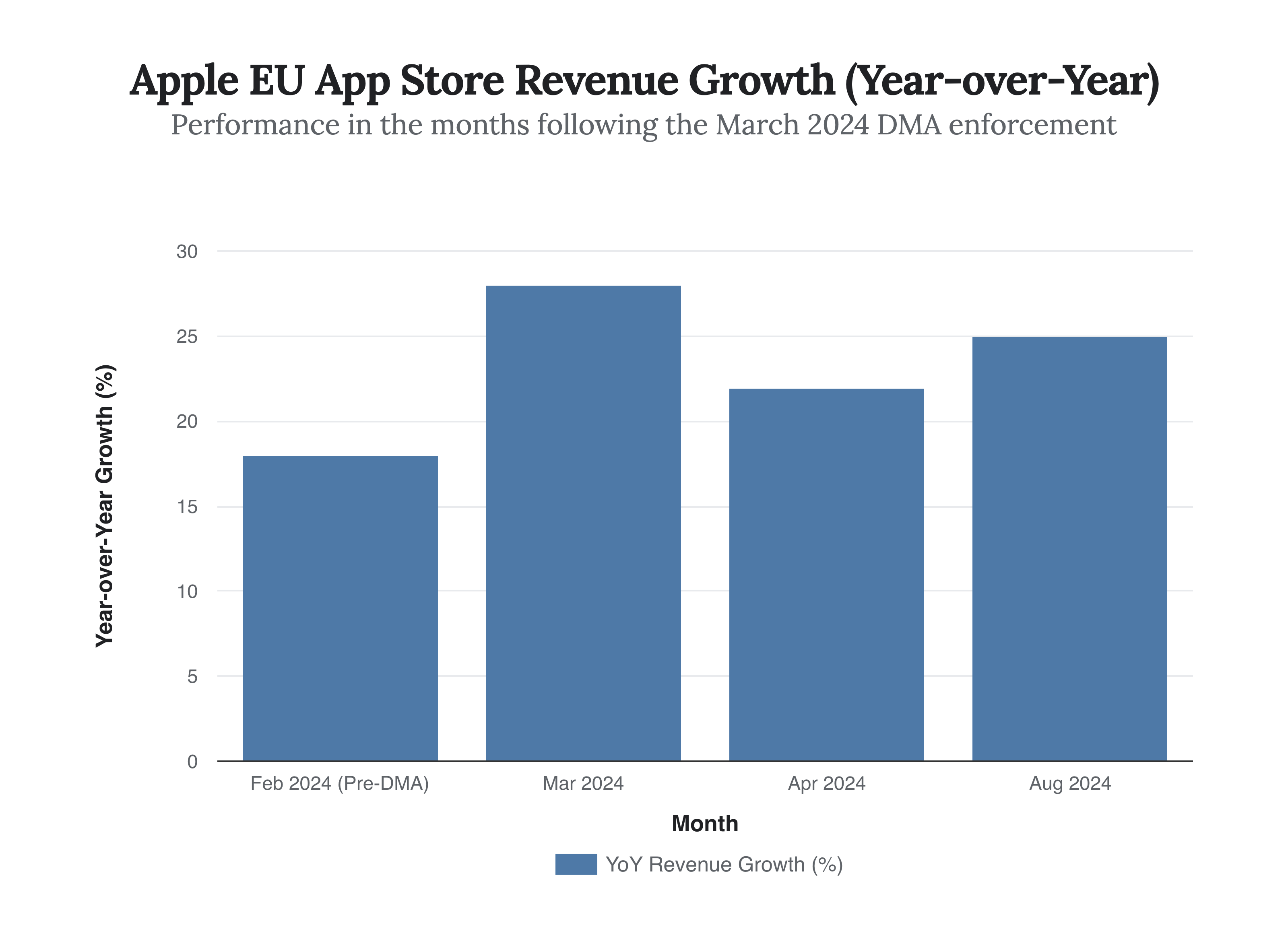
Despite the implementation of the Digital Markets Act, Apple’s EU App Store revenue growth showed no signs of slowing, with August 2024 posting a 25% year-over-year increase, indicating the limited initial impact of the regulation on its business model.
The Market’s Verdict
Analysts noted that the lack of impact was directly attributable to the design of Apple’s compliance mechanism. By making the path outside the walled garden financially perilous, Apple ensured there would be no mass exodus. The Core Technology Fee, in particular, acts as a powerful deterrent. For a successful app with millions of free European users, the choice is between a predictable 15-30% revenue share and an unpredictable, potentially catastrophic, per-install cost. Faced with this choice, developers have overwhelmingly chosen predictability.
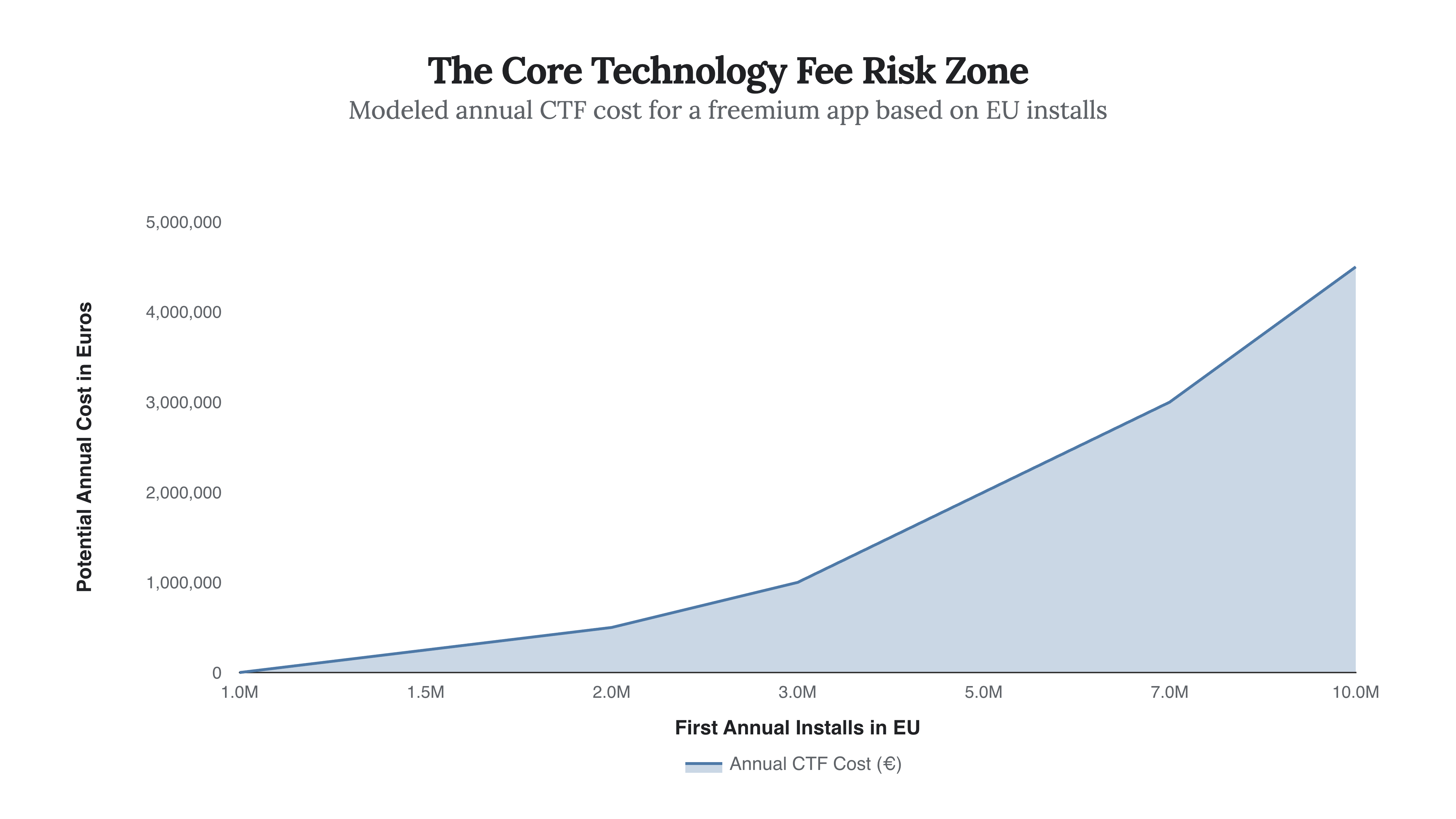
This model illustrates how the Core Technology Fee scales dramatically after the 1 million install threshold, creating significant financial risk for developers of popular freemium applications that choose to operate under the DMA’s alternative business terms.
The Next Move: An Escalating Enforcement Battle
The European Commission is playing a long game. The initial €500 million fine, while substantial, represents a fraction of Apple’s global turnover. The real threat lies in the potential for much larger penalties and the Commission’s ongoing second investigation into the Core Technology Fee itself. Officials have made it clear they are prepared to use the full force of the DMA, which allows for fines of up to 10% of a company’s total worldwide turnover for initial infringements, and up to 20% for repeated violations.
“If the proposed solutions are not good enough, we will not hesitate to take strong action.” - Thierry Breton, Commissioner for Internal Market
Untapped Consumer Demand vs. Developer Inertia
While developers remain hesitant, consumer interest in alternatives is high. A 2024 survey revealed that 80% of EU iOS users are open to exploring third-party app stores. However, the same study showed that only 43% were even aware that such alternatives were now possible. This highlights a significant awareness gap and a potential market opportunity that remains latent. The success of the first few alternative marketplaces, such as Setapp Mobile and Aptoide, will be a critical bellwether. If they can offer unique content and a compelling user experience, they might create a pull effect that forces more developers to reconsider Apple’s new terms, despite the risks.
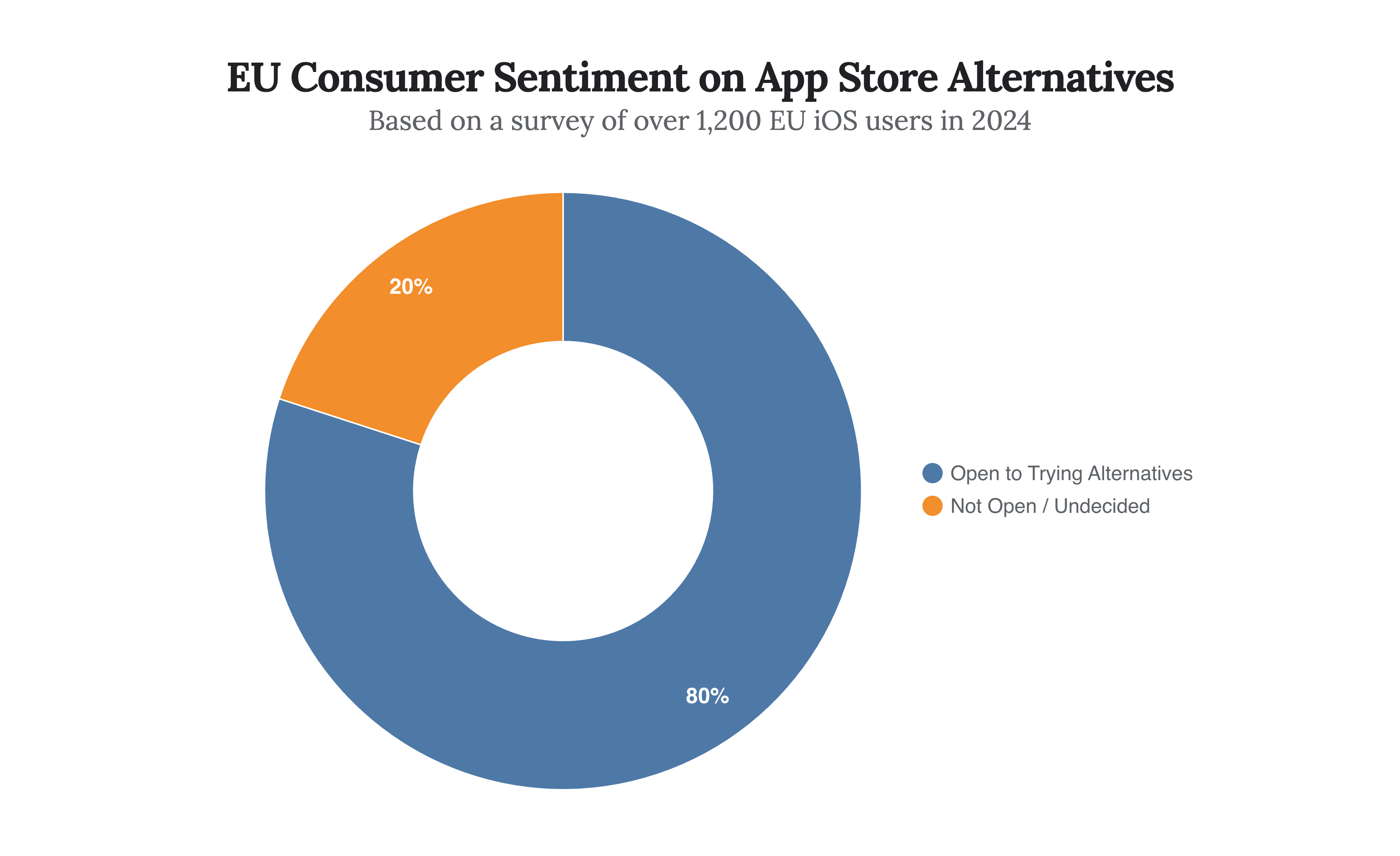
A significant majority of EU iOS users express interest in trying third-party app stores, indicating a large potential market. However, the success of these new marketplaces hinges on overcoming low consumer awareness of their existence.
Strategic Foresight: Signposts to Watch
The confrontation between Apple and the EU is far from over. Industry leaders and investors must monitor several key signposts that will indicate the future trajectory of this conflict:
The Outcome of the CTF Investigation: This is the most critical pending action. If the EC rules that the Core Technology Fee is a breach of the DMA’s principles of fairness and contestability, it could force Apple back to the drawing board and fundamentally alter the economics of the EU app ecosystem.
Adoption Rates of New Terms: Track the percentage of top EU developers who opt into the new business terms. A sudden increase would signal a shift in the risk-reward calculation, likely prompted by changes from Apple or new opportunities from alternative marketplaces.
Growth of Alternative Marketplaces: The user numbers and exclusive app offerings of stores like Setapp and Aptoide will be the first real-world test of whether a viable alternative ecosystem can emerge on iOS.
Further Enforcement Actions: Brussels has shown its willingness to act. Any further preliminary findings or Statements of Objections will signal new fronts in the regulatory war. The scale of future fines will be a clear indicator of the Commission’s resolve.
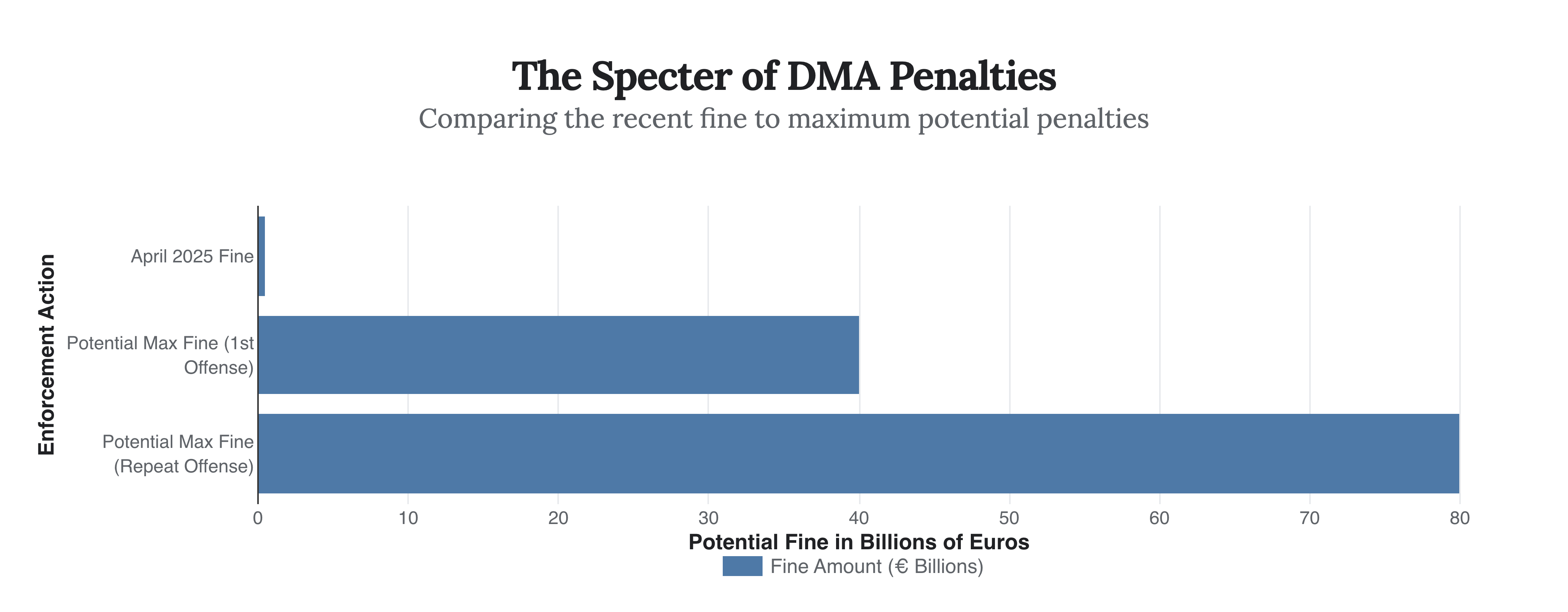
The €500 million fine is a warning shot. The DMA empowers the European Commission to levy fines that are orders of magnitude larger, representing a significant material risk based on a percentage of Apple’s global turnover.
Ultimately, Apple has constructed a brilliant, if cynical, response to the Digital Markets Act. It has complied with the letter of the law while erecting economic barriers that subvert its spirit. The result is a fragile stasis: revenue remains strong, the App Store’s dominance is intact, and the EU’s vision of a vibrant, competitive app market on iOS remains unrealized. The initial skirmish ended with a headline-grabbing fine, but the strategic landscape barely shifted. The next phase of this conflict, centered on the legitimacy of the Core Technology Fee, will determine whether the DMA becomes the market-shaping force it was intended to be or a case study in the limits of regulation against unparalleled corporate power.
The core strategic takeaway is that in the modern platform economy, true market power is not just defended by technical walls, but by the sophisticated architecture of fees and perceived risks presented to its ecosystem participants.