



The “public square” is not empty; it has been condemned. While pundits lament the decline of civic engagement, they are missing the most critical structural shift of the decade: we are not witnessing an era of apathy, but of mass migration. According to the latest 2025 data, 76% of global internet users have now actively integrated into online communities, marking a definitive shift from the “Attention Economy” to the “Affiliation Economy.”
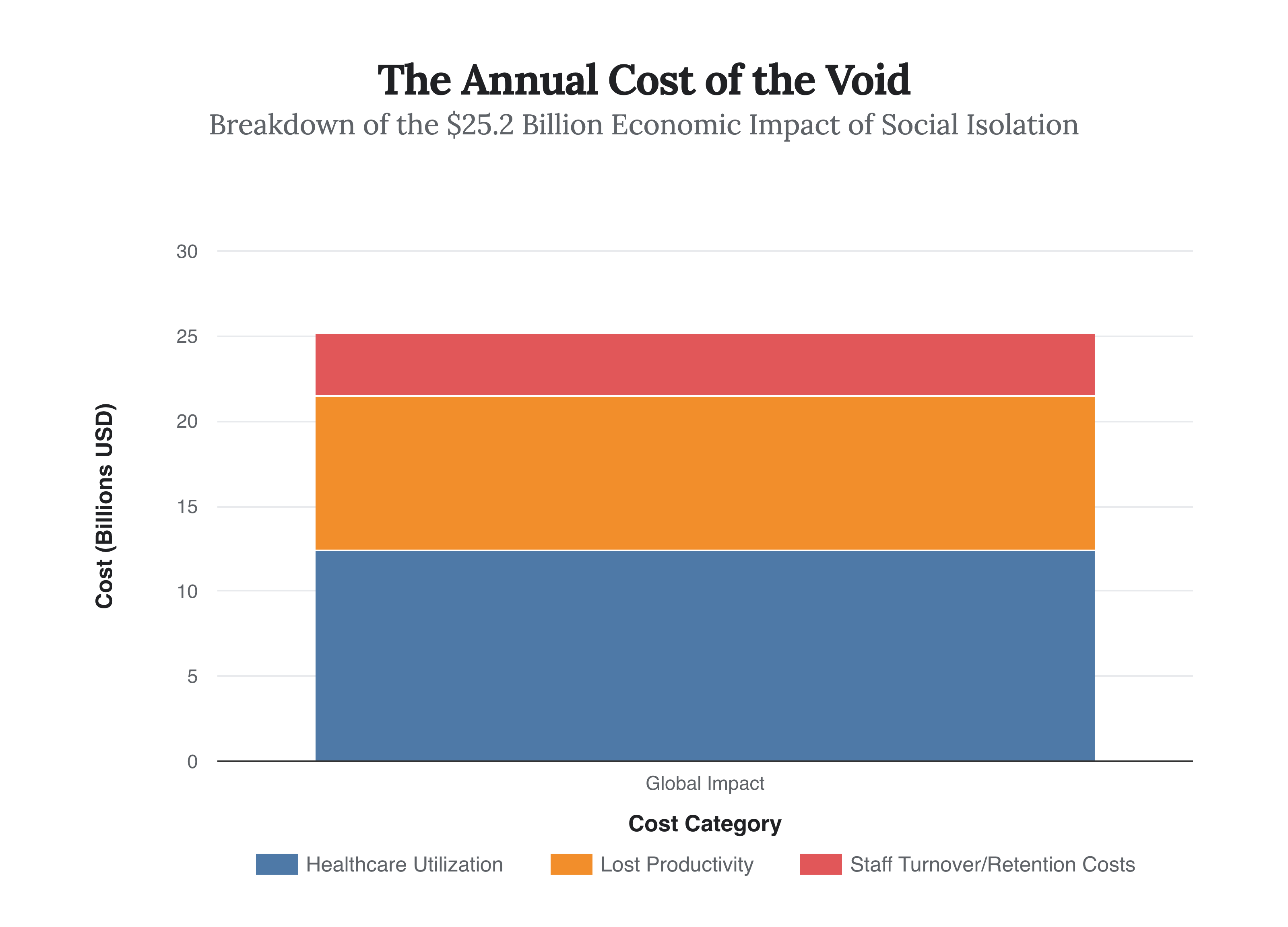
This is not merely a change in media consumption habits; it is a fundamental reordering of human identity. We are re-allocating our social capital from physical, geographic communities—which require compromise and tolerance—to frictionless, algorithmically curated “digital tribes” that demand purity and outrage. The result is a paradox: we are more connected than ever, yet the World Health Organization’s 2025 report identifies loneliness as a global epidemic costing the economy upwards of $25 billion annually in lost productivity and healthcare strains.
In this intelligence briefing, we analyze the mechanics of this “Digital Tribalism,” quantify the economic costs of the resulting polarization, and forecast the rise of “Dark Forest” networks as the new centers of influence.
The Great Migration: From Zip Codes to Discords
For most of the 20th century, community was a function of geography. You associated with your neighbors, your local union, or your parish because physical proximity dictated your social graph. Today, geography is a secondary characteristic. The primary driver of association is now shared interest and shared reality, facilitated by platforms that monetize homogeneity.
The Collapse of “Third Places”
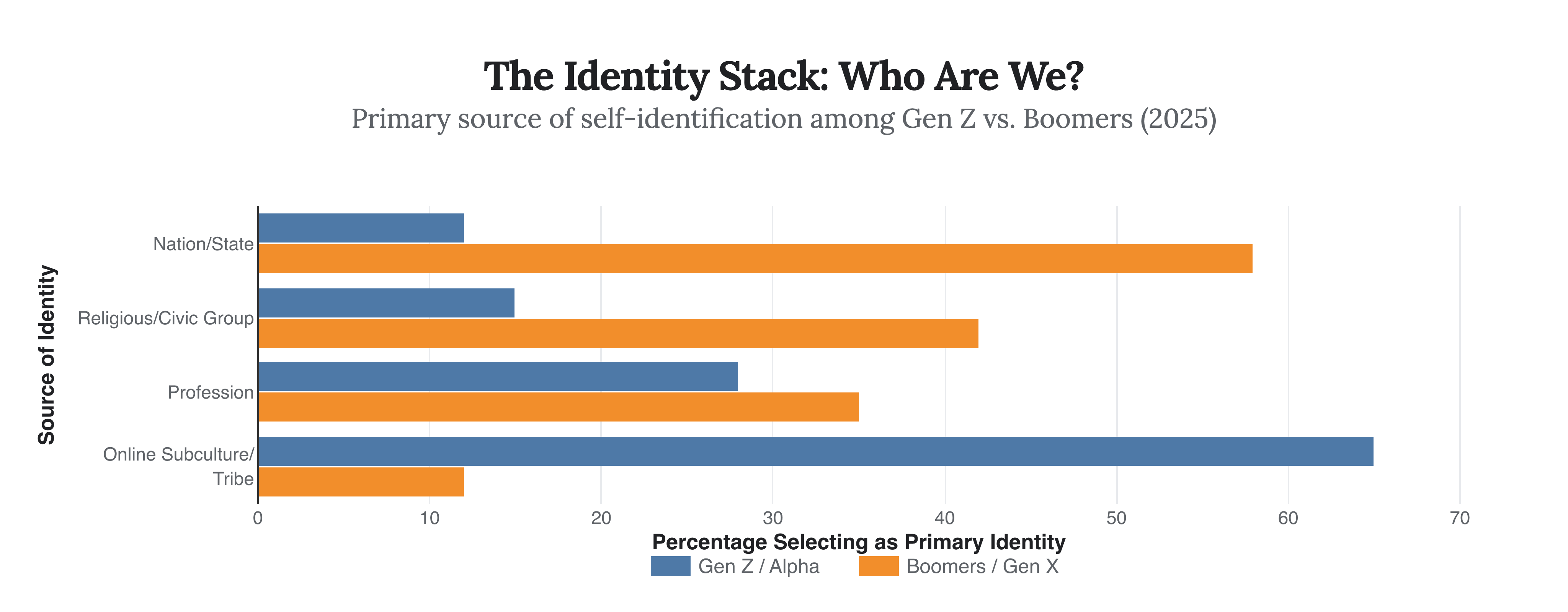
The decline of physical “third places”—bowling alleys, community centers, local civic groups—has been well-documented since Putnam’s Bowling Alone. However, the 2024-2025 data reveals where that energy went. It didn’t evaporate; it digitized. As physical participation creates friction (traffic, scheduling, opposing viewpoints), digital participation offers immediate, low-friction dopamine loops.
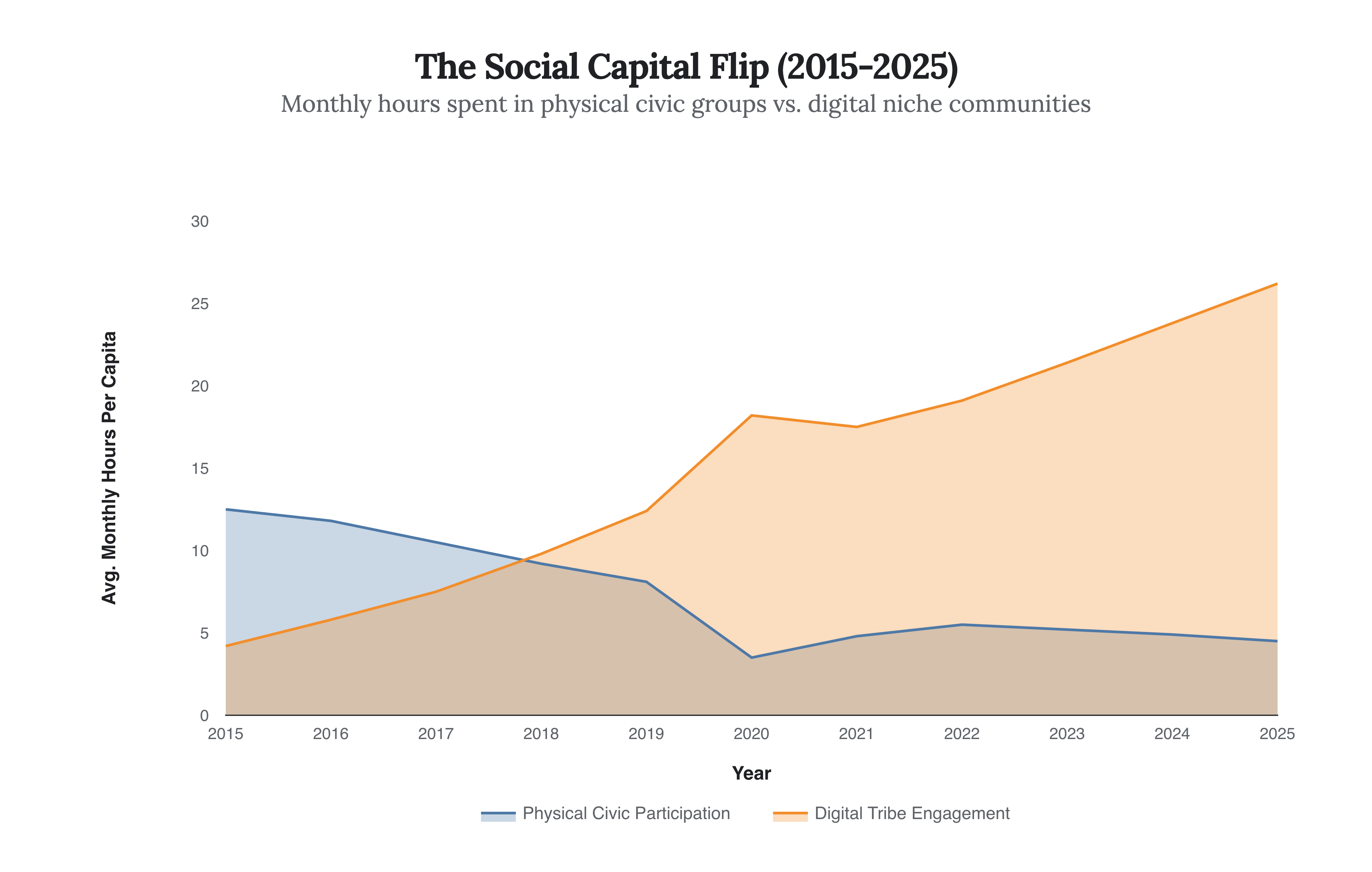
Strategic Implication: The chart above illustrates the “crossover point”—accelerated by the pandemic but sustained by choice. The implications for policymakers are profound: local governance relies on physical stakeholders, but the constituents’ mental energy is invested in non-local digital skirmishes. We are governing ghosts.
The Algorithmic Radicalization Engine
Why do these digital tribes inevitably drift toward extremism? The answer lies in the incentive structure of the platforms hosting them. Recent 2025 experiments on the X (formerly Twitter) algorithm revealed a terrifying efficiency: small tweaks to the “For You” feed that prioritized high-arousal content resulted in a polarization shift equivalent to three years of historical drift in just one week.
The “Outrage Premium”
Algorithms are agnostic to truth but sensitive to engagement. “Moral outrage”—language that attacks an out-group to signal loyalty to an in-group—generates the highest engagement velocity. Consequently, digital tribes are not formed around shared loves, but shared enemies. This creates an “Epistemic Closure,” where the tribe becomes the sole arbiter of truth, and outside information is rejected as heresy.
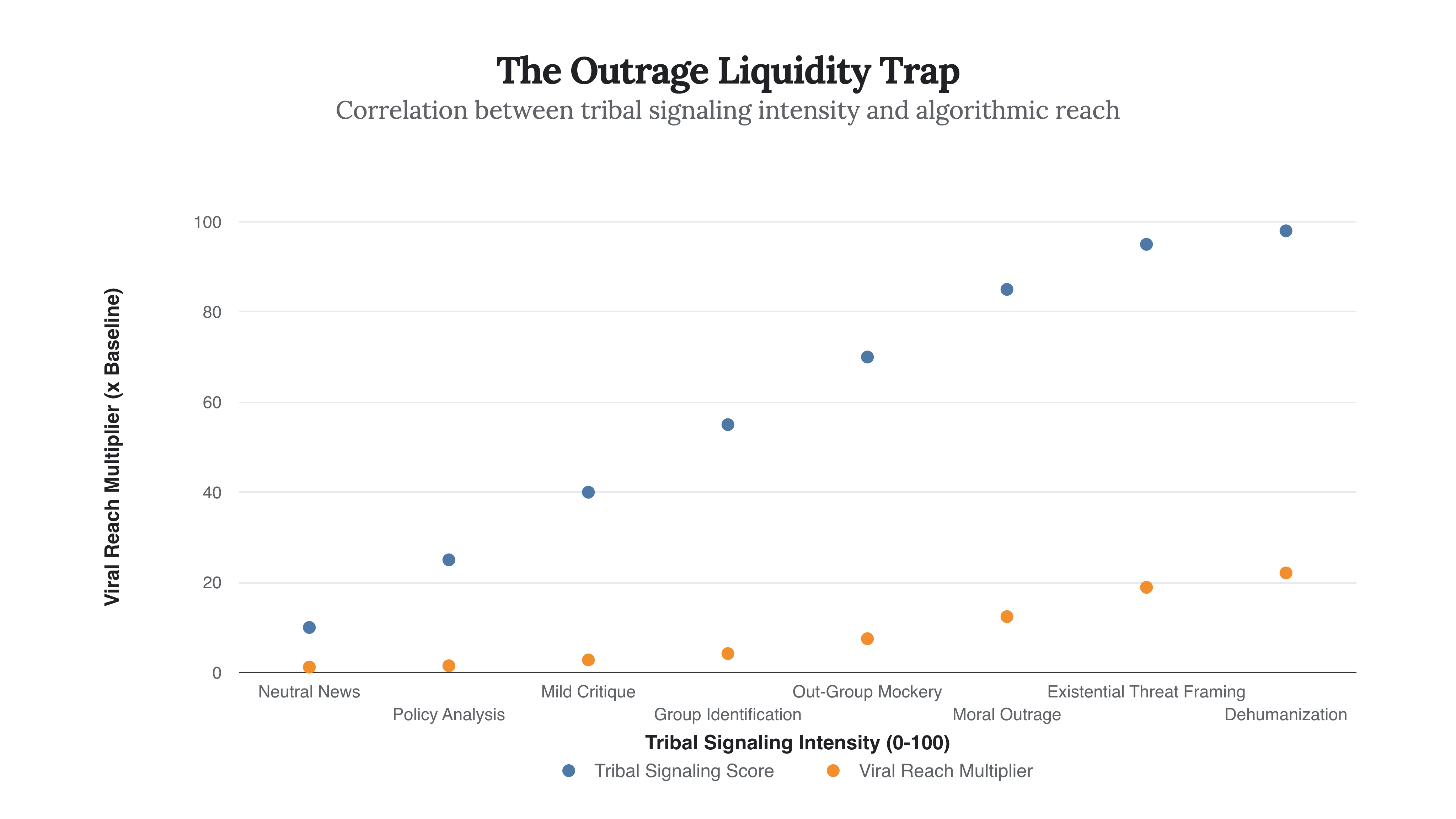
So What? Brands and leaders attempting to navigate this landscape are finding that neutrality is invisible. The algorithm imposes a “Polarization Tax”: to be seen, you must pick a side. This destroys the middle ground necessary for broad-based consensus or mass-market advertising.
The Economics of Distrust: The “Trust Inverse”
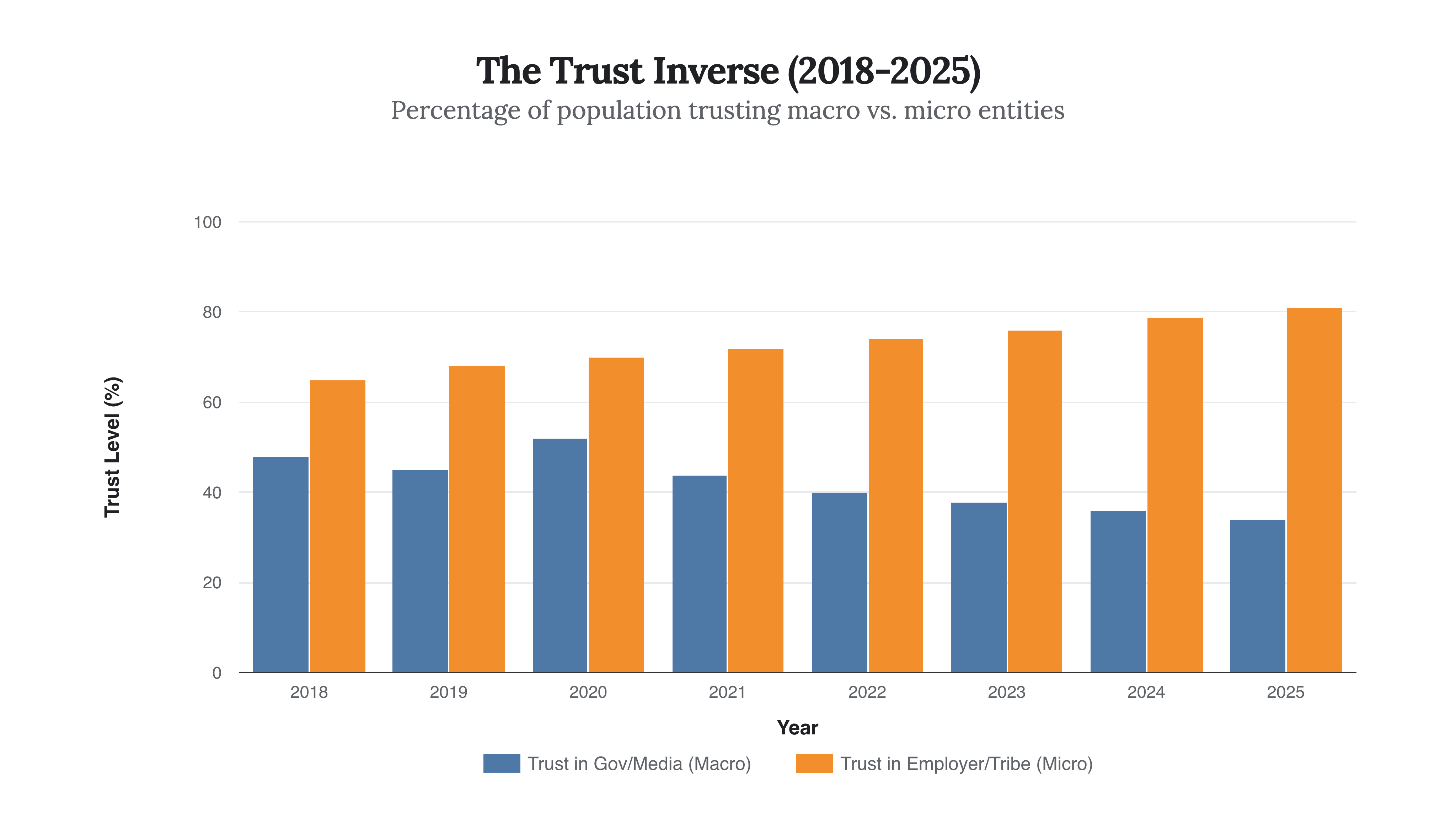
As we retreat into our digital fortresses, our trust in macro-institutions (government, mainstream media) has collapsed, replaced by a high-fidelity trust in micro-institutions (our employer, our Discord server, our specific influencer). The 2024 Edelman Trust Barometer highlights a shocking 39-point gap in economic optimism, but even more telling is the divergence between institutional and tribal trust.
We are witnessing a “Trust Inverse.” People no longer trust the “Village Elder” (the state); they trust the “War Chief” (the tribal leader). This fragmentation makes implementing broad structural changes nearly impossible, as there is no single authority recognized by all tribes.
“The most dangerous deficit today is not fiscal, but social. We have printed trillions of dollars of information, but the velocity of trust has dropped to zero.”
The $25 Billion Isolation Tax
The irony of hyper-connection is the resulting isolation. Digital tribalism fosters “parasocial” relationships—one-sided emotional bonds with online figures—that mimic community but provide no actual social support. The biological cost is real. The WHO’s 2025 report links this “connected loneliness” to a massive economic drag.
Loneliness is not just a feeling; it is an expense line item. It manifests in higher healthcare utilization (due to inflammation and stress response), reduced productivity, and higher employee turnover. For the corporate sector, this is a hidden tax on the P&L that no amount of “virtual happy hours” can offset.
The Rise of the “Dark Forest” Internet
In response to the weaponization of the public feed, we are seeing a secondary migration: the flight to the “Dark Forest.” This theory posits that the public internet is becoming a dangerous place where visibility equals vulnerability. As a result, meaningful discourse is moving into private, invite-only spaces (Group chats, gated Discords, paid Substacks).
This creates a “Reality Liquidity Crisis.” Public discourse becomes a performative wasteland of bots and extremists, while the actual, high-value intellectual exchange happens in closed loops, inaccessible to the broader public. The public square is dead; long live the private salon.
Predictions & Strategic Signposts
As we look toward 2026 and beyond, the trend of digital tribalism will likely evolve into formalized “Network States.”
The Rise of “Identity Wallets”: We will see the emergence of cryptographic proofs of community membership that unlock real-world benefits. Your digital tribe will insure you, bank you, and perhaps eventually, govern you.
The Fragmentation of Mass Markets: The era of the “Super Bowl Commercial” cultural monolith is over. Marketing will require a “federated” strategy, treating different digital tribes as distinct nations with distinct languages and values.
The Truth Premium: As AI floods the zone with synthetic outrage, “verified human reality” and trusted, gated communities will become premium luxury goods.
The leaders who win in this new environment will not be those who try to shout the loudest in the public square, but those who build the most resilient, high-trust micro-communities in the dark forest.
Strategic Takeaway: Stop trying to win the public debate. The audience isn’t there anymore. They have moved to the tribes. Build your embassy there.