


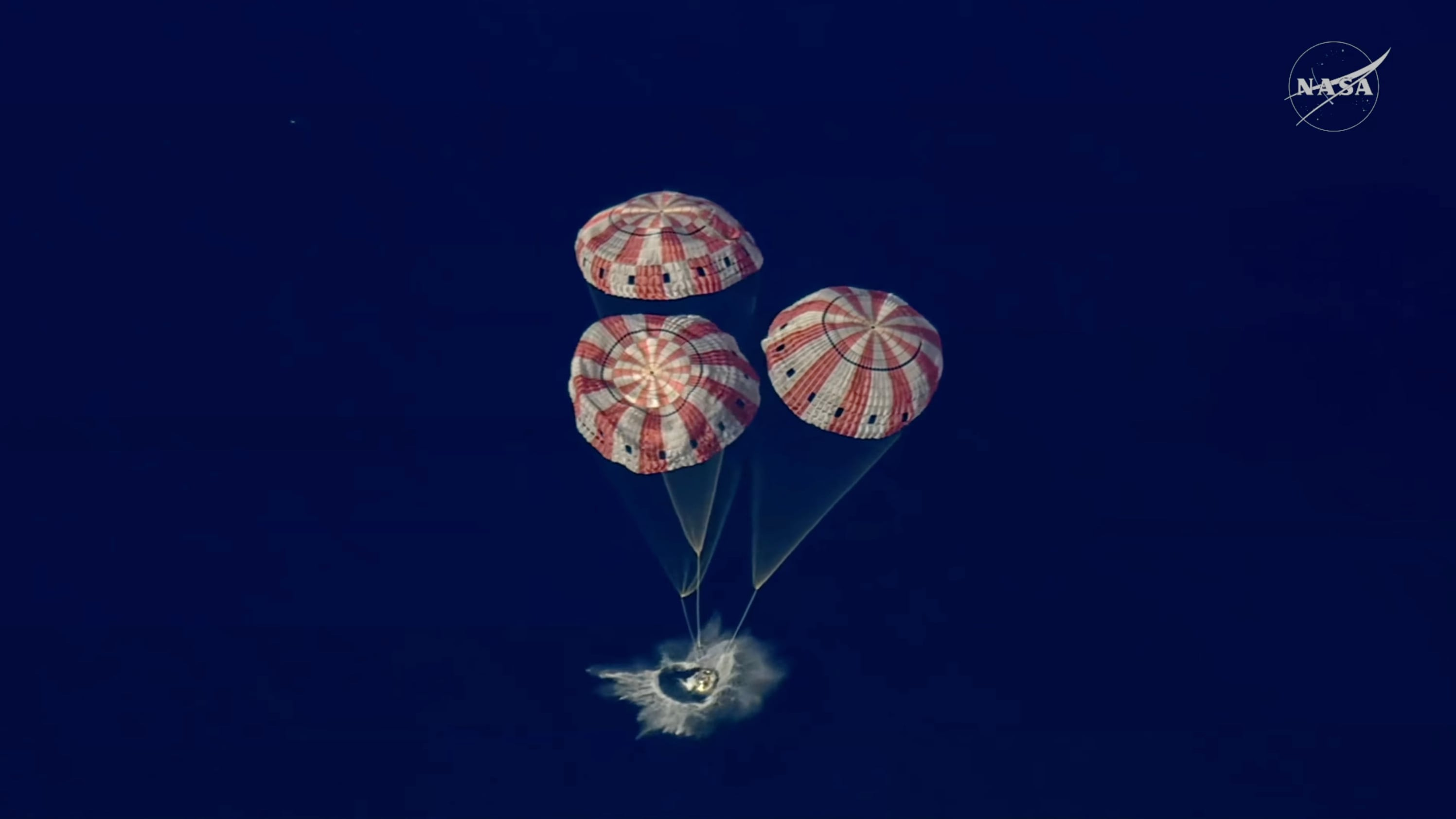
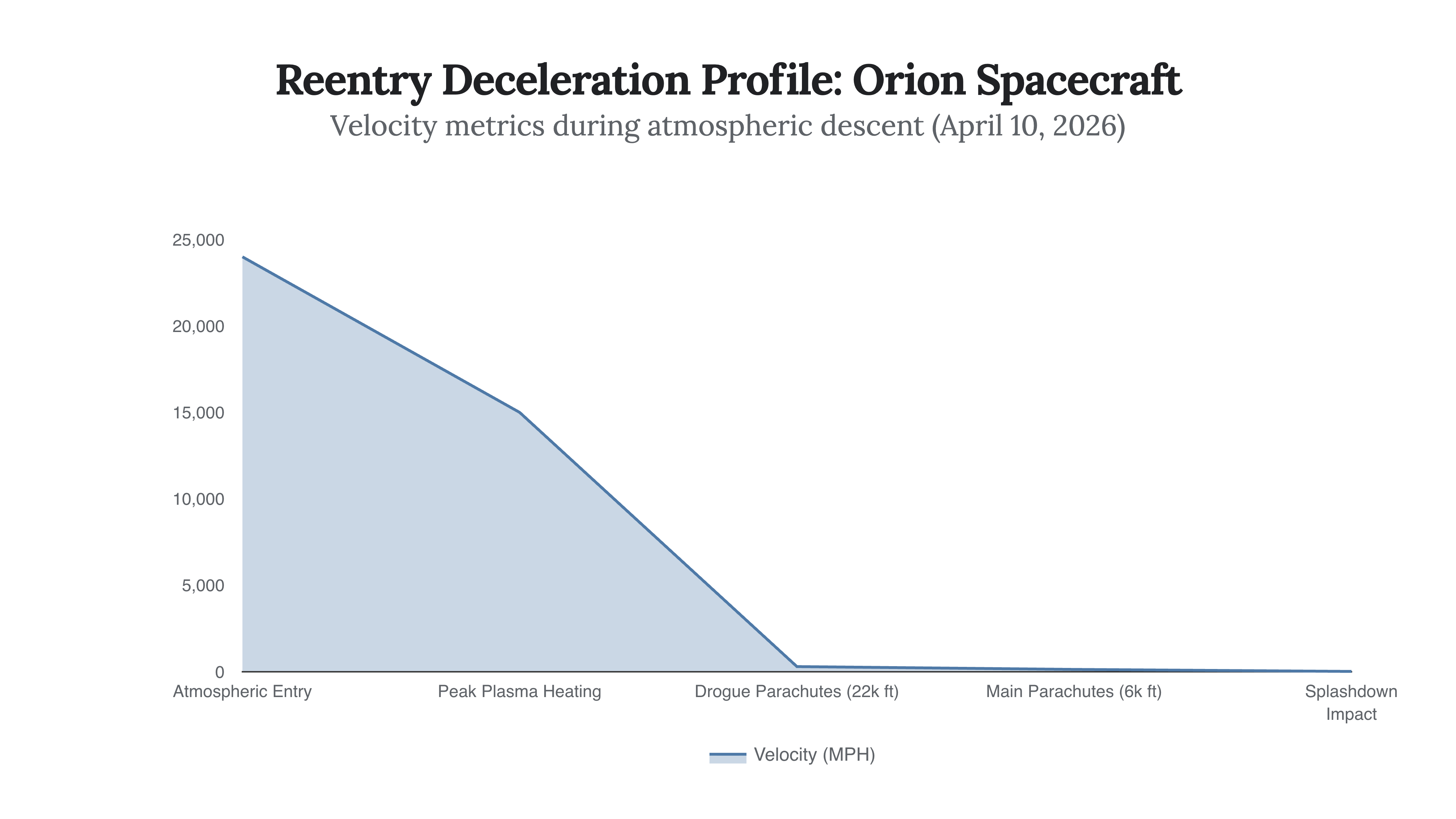
At precisely 8:07 p.m. EDT on Friday, April 10, 2026, a 20,500-pound cone of scorched metal slammed into the Pacific Ocean at 20 miles per hour. Inside the Orion capsule—dubbed Integrity—four astronauts endured nearly four times the force of Earth’s gravity after hitting the upper atmosphere at a staggering 24,000 miles per hour. The splashdown, centered at coordinates 32.7°N 118.2°W roughly 60 miles off the coast of San Diego, marked the successful conclusion of NASA’s historic Artemis II mission. But the true weight bearing down on this 695,081-mile journey was never gravitational. It was profoundly geopolitical.
While the public marveled at the flawless extraction executed by U.S. Navy divers from Explosive Ordnance Disposal Group One (EODGRU-1) and the medical triage teams aboard the amphibious transport dock USS John P. Murtha, a brutal strategic calculus was unfolding behind the scenes. The mission was a triumph of human endurance, safely returning astronauts Reid Wiseman, Victor Glover, Christina Koch, and Jeremy Hansen to Earth. However, it also laid bare the immense, inefficient friction of America’s legacy aerospace apparatus and the urgent pivot required to maintain dominance in orbit.
Look closely at the operational footprint of the launch and recovery, and a stark information asymmetry emerges between public perception and aerospace reality. While commercial entities like SpaceX reliably execute automated booster landings with minimal oversight, the Boeing-built Space Launch System (SLS) rocket that propelled Artemis II required an archaic level of manual babysitting. Because the SLS was controversially designed without an Autonomous Flight Safety System (AFSS)—a modern standard that automatically aborts catastrophic anomalies—the Space Force was forced to staff 28 operators at Cape Canaveral’s Space Launch Delta 45. For context, a standard commercial launch requires only four or five personnel.
The Human Cost of Legacy Infrastructure
To safely recover a spacecraft lacking modern automated safety systems, the Department of Defense deployed a small army—proving that the actual cost of legacy aerospace engineering is paid in military manpower. The 1st Air Force’s Detachment 3 had to keep multiple helicopters on standby solely to mitigate the operational risks of an older, unautomated architecture. This technological bloat is exactly why the financial and strategic architecture of American spaceflight is undergoing a violent restructuring.
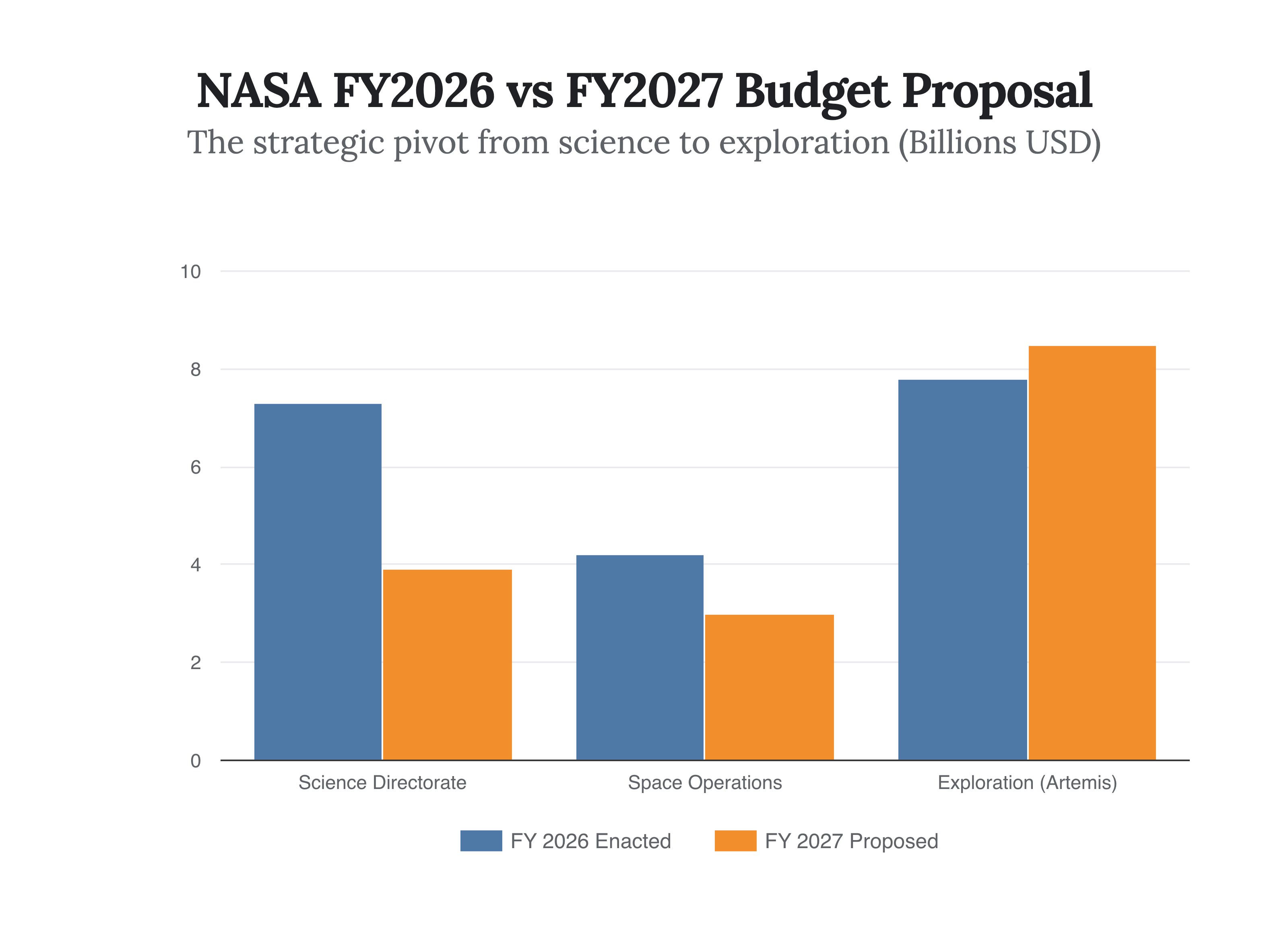
Enter Jared Isaacman. The newly appointed NASA Administrator—a billionaire private astronaut who commands commercial orbital missions—has taken the helm under a mandate of ruthless efficiency. In the second week of April 2026, the administration proposed a draconian FY 2027 budget that shrinks NASA’s overall spending allowance from $24.4 billion down to $18.8 billion. But the underlying reallocation of those funds is where the game theory intuition becomes strikingly clear. It is a textbook execution of “Costly Signaling” on a macroeconomic scale.
To fund the Artemis lunar campaign and fast-track deep-space infrastructure, Isaacman and the White House are proposing a near 50% liquidation of NASA’s science budget, dropping it from $7.3 billion to an anemic $3.9 billion. Decades of planetary science and lower-priority exploratory missions are being actively cannibalized to feed the development of lunar landers and surface habitats. Bolstered by a $10 billion supplemental injection from the recently passed Working Family Tax Cut Act, the human exploration budget is being aggressively shielded at the expense of pure research.
Weaponizing the Orbital Budget
By installing a billionaire private astronaut to liquidate NASA’s legacy science budget, the administration is executing a ruthless strategic pivot: abandoning the pursuit of pure knowledge to secure the ultimate military and economic high ground before Beijing can claim it. The dinner table translation is simple: The United States has realized that the Moon is not a museum. It is a strategic military and economic outpost.
Unlock deeper strategic alpha with a 10% discount on the annual plan.
Support the data-driven foresight required to navigate an era of radical uncertainty and join a community of institutional-grade analysts committed to the truth.
Why the immense rush? Why is the Space Force concurrently requesting a massive $71 billion for fiscal 2027—an 80% funding boost—specifically to develop “bodyguard” satellites to protect American orbital assets? Because China is no longer a distant competitor; they are a credible, accelerating threat operating outside the sluggish bounds of democratic contracting.
The China Manned Space Agency (CMSA) is operating with a streamlined, autocratic efficiency that creates a profound strategic headache for the Pentagon. In early 2026, Beijing quietly completed a series of devastatingly successful tests for their own lunar program. They achieved zero-altitude escape validation for their next-generation Mengzhou crewed spacecraft, executed landing and liftoff tests for the Lanyue lunar lander, and validated the tethered ignition of the Long March-10 heavy-lift rocket.
The Chinese Accelerant and Cislunar Real Estate
China is officially targeting a crewed lunar landing by 2030, and their timeline is devoid of the partisan budgetary warfare that routinely paralyzes Washington. China’s methodical, closed-loop development of the Mengzhou spacecraft creates a credible threat to American hegemony, fundamentally transforming the Moon from a scientific frontier into the ultimate military high ground.
If China establishes a permanent operational base at the water-rich lunar south pole first, they establish an unassailable first-mover advantage. This would allow Beijing to dictate the terms of lunar mineral extraction, satellite shielding, and cislunar traffic management. The United States defense apparatus recognizes a harsh geopolitical reality: international frameworks like the Artemis Accords are practically meaningless if America does not possess the physical, boots-on-the-lunar-regolith footprint required to enforce them.
This is where the $100 billion sunk cost of the Artemis program begins to look less like a scientific venture and more like an existential defense expenditure. Critics correctly point out that the private economy is already winning the space race. SpaceX currently launches approximately 90% of the world’s payload mass into orbit. NASA’s own verified estimates conclude that developing a rocket comparable to the Falcon 9 through traditional public contracting would have cost roughly $4 billion; SpaceX accomplished it for $390 million.
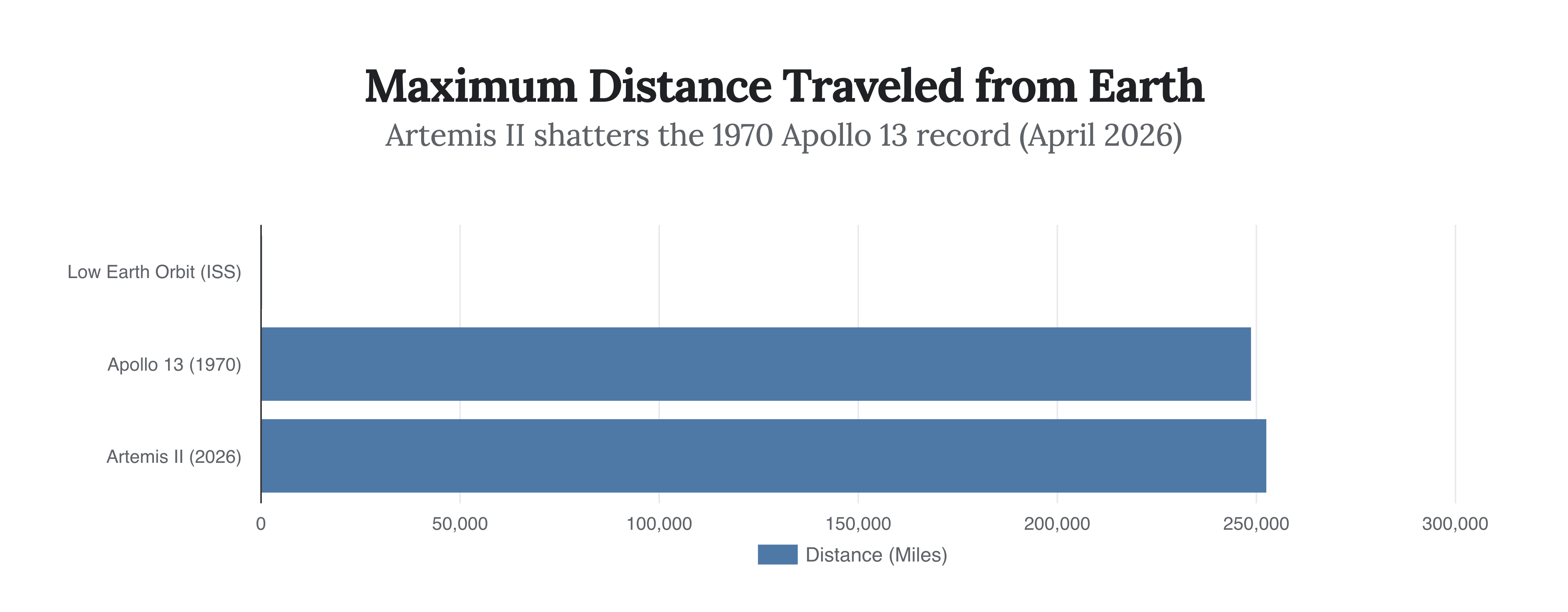
Yet, the Artemis II mission achieved something that private enterprise cannot yet do alone: it served as a massive, multi-billion-dollar demonstration of sovereign American resolve. On April 6, 2026, the four astronauts aboard Integrity broke the 1970 Apollo 13 record for the farthest humans have ever traveled from Earth, reaching a maximum distance of 252,760 miles during their lunar flyby. Beating the Apollo 13 record by over 4,100 miles was not merely a trivia metric; it was a loud, undeniable broadcast to the CMSA and the Kremlin that the United States retains the capacity to project human power deeper into the solar system than any competitor.
The Strategic Outlook for Capital Allocators
For institutional investors, defense contractors, and strategic analysts, the successful April 2026 splashdown of Artemis II is the starting gun for a multi-trillion-dollar cislunar economy. The bloated era of cost-plus government contracting is being aggressively unwound. NASA Administrator Isaacman is already embedding subject matter experts directly into the supply chains of primary contractors and sub-tier vendors to force accountability and prevent the multi-year delays that plagued the SLS.
The future belongs to hybrid commercial-military entities that can deliver payload mass at a fraction of the legacy cost, freeing up federal capital for the deployment of deep-space logistics and the Space Force’s rapidly expanding orbital defense network. As Lt. Cmdr. Jesse Wang and his dive medical team pulled the crew from the bobbing capsule in the Pacific, they weren’t just rescuing explorers. They were recovering the vanguard of America’s new space-combat infrastructure. The geopolitical checkmate is in motion, and the board now extends a quarter of a million miles into the dark.