


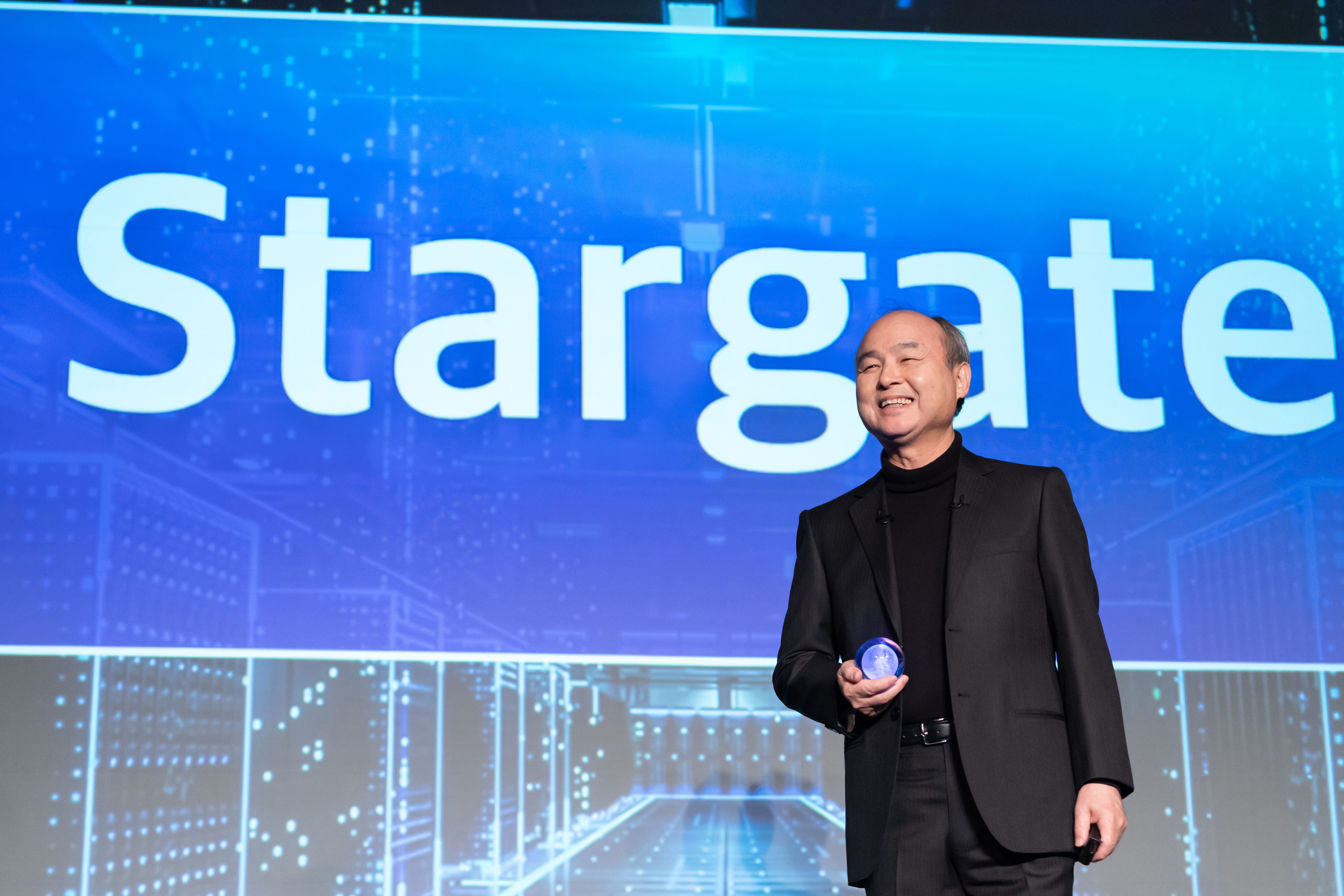
The Analyst’s Briefing: Anatomy of a Historic “What If”
In the annals of technology investment, there are wins, losses, and then there are the monumental “what ifs”—decisions so consequential they reshape fortunes and become legendary cautionary tales. SoftBank’s 2019 sale of its entire 4.9% stake in Nvidia for approximately $3.6 billion is firmly in the latter category. At the time, locking in a multi-billion dollar profit seemed prudent. Today, with that same stake hypothetically valued at over $237 billion, the decision stands as one of the most significant premature exits in venture capital history. The opportunity cost is staggering, a ghost of immense wealth that now haunts SoftBank’s strategic narrative.
This briefing moves beyond the headline number to dissect the anatomy of that fateful decision. We will explore the immense pressures within the first Vision Fund that likely forced the sale, quantify the true scale of the missed AI hardware super-cycle, and analyze SoftBank’s subsequent high-stakes pivot to Arm Holdings and OpenAI as its chosen champions for the AI revolution. Was the Nvidia sale an unforced error driven by short-term pressures, or was it a calculated, albeit flawed, strategic choice to redeploy capital into what it believed were even greater opportunities? The answer reveals critical lessons about conviction, long-term vision, and the brutal cost of blinking in the face of a technological tsunami.
Anatomy of a Premature Exit: The Pressures of 2019
To understand the 2019 sale, one must appreciate the turbulent environment surrounding the SoftBank Vision Fund at the time. The fund was grappling with immense pressure to deliver returns following a series of high-profile, capital-intensive bets on companies like WeWork and Uber, whose paths to profitability were far from certain. Nvidia’s stock, having enjoyed a strong run, experienced a significant drawdown in late 2018, its value halving in just a few months amid the “crypto winter” that depressed GPU demand. For a fund needing to demonstrate tangible wins to its limited partners, crystallizing a $3.3 billion gain on an initial investment of around $700 million was an attractive, and perhaps necessary, move.
The Trillion-Dollar Rally That SoftBank Missed
The chart below starkly illustrates the sheer magnitude of the missed opportunity. While SoftBank locked in its profits in early 2019, Nvidia was on the cusp of an unprecedented surge, fueled by the explosion in demand for its chips to power data centers and train generative AI models. The sale occurred just before Nvidia’s ascent into the stratosphere, cementing its role as the indispensable hardware provider of the AI era.
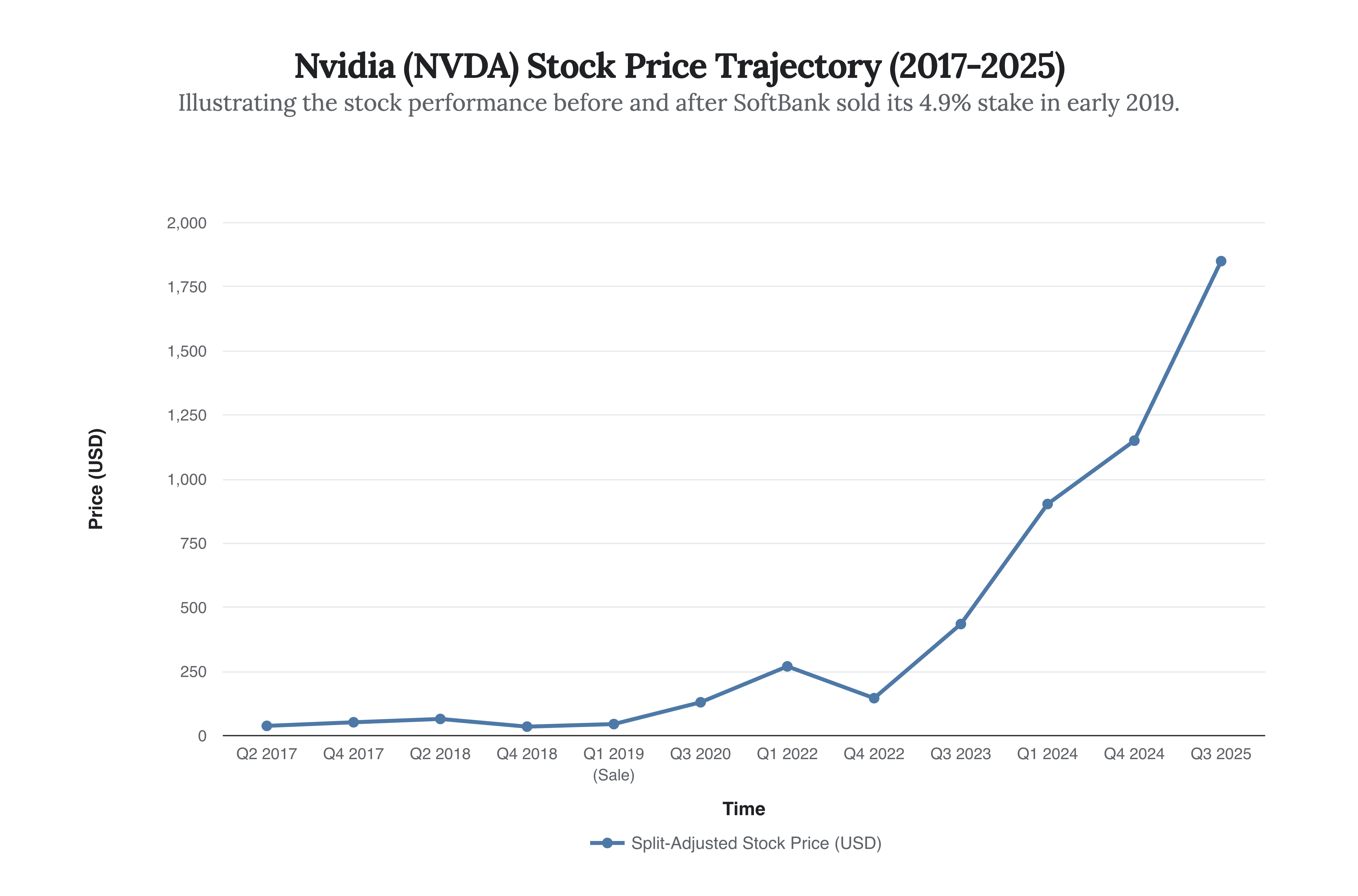
This chart traces Nvidia’s stock price, highlighting the exponential growth SoftBank missed by exiting its position in early 2019.
The Vision Fund 1 Portfolio: A Story of Hits and Misses
The pressure to take profits from Nvidia becomes clearer when viewed in the context of Vision Fund 1’s broader portfolio. The fund was a collection of massive, often illiquid, bets on late-stage startups. While it had successes, high-profile write-downs, most notably WeWork, created a pressing need for liquidity and realized gains to balance the books and satisfy investors. The Nvidia stake was one of the few large, publicly-traded, and profitable positions that could be easily liquidated.
“I had to tearfully sell the shares. The fish that got away was big.” - Masayoshi Son, Founder & CEO, SoftBank Group
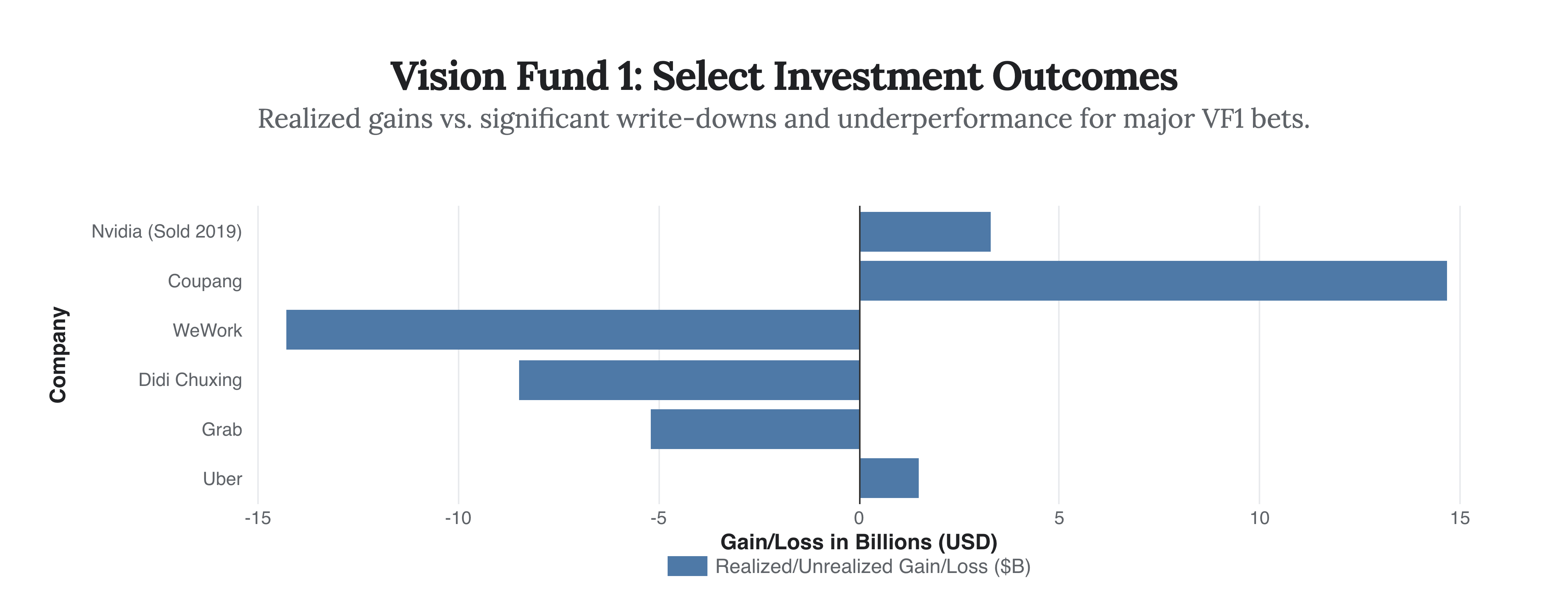
This chart illustrates the mixed performance of some of Vision Fund 1’s most prominent investments, contextualizing the pressure to secure a win with the Nvidia sale.
The Arm Gambit: A Strategic Pivot or Costly Consolation?
In the wake of the Nvidia exit, SoftBank’s AI strategy has coalesced around Arm Holdings, the British chip designer it acquired in 2016 and took public in 2023. The strategic narrative is that while Nvidia builds the powerful engines for AI, Arm designs the fundamental, energy-efficient architecture that will enable AI to run on trillions of devices, from smartphones to sensors. This represents a bet on breadth and ubiquity over concentrated data center dominance.
However, the market’s valuation of these two strategies tells a different story. While Arm’s IPO was successful and its market cap is substantial, it is dwarfed by the sheer value creation of Nvidia. The dominance of Nvidia is built on its CUDA software ecosystem, a deep competitive moat that locks developers into its platform and makes its hardware the default choice for serious AI training. Nvidia currently commands the vast majority of the data center GPU market, a segment crucial for the AI revolution.
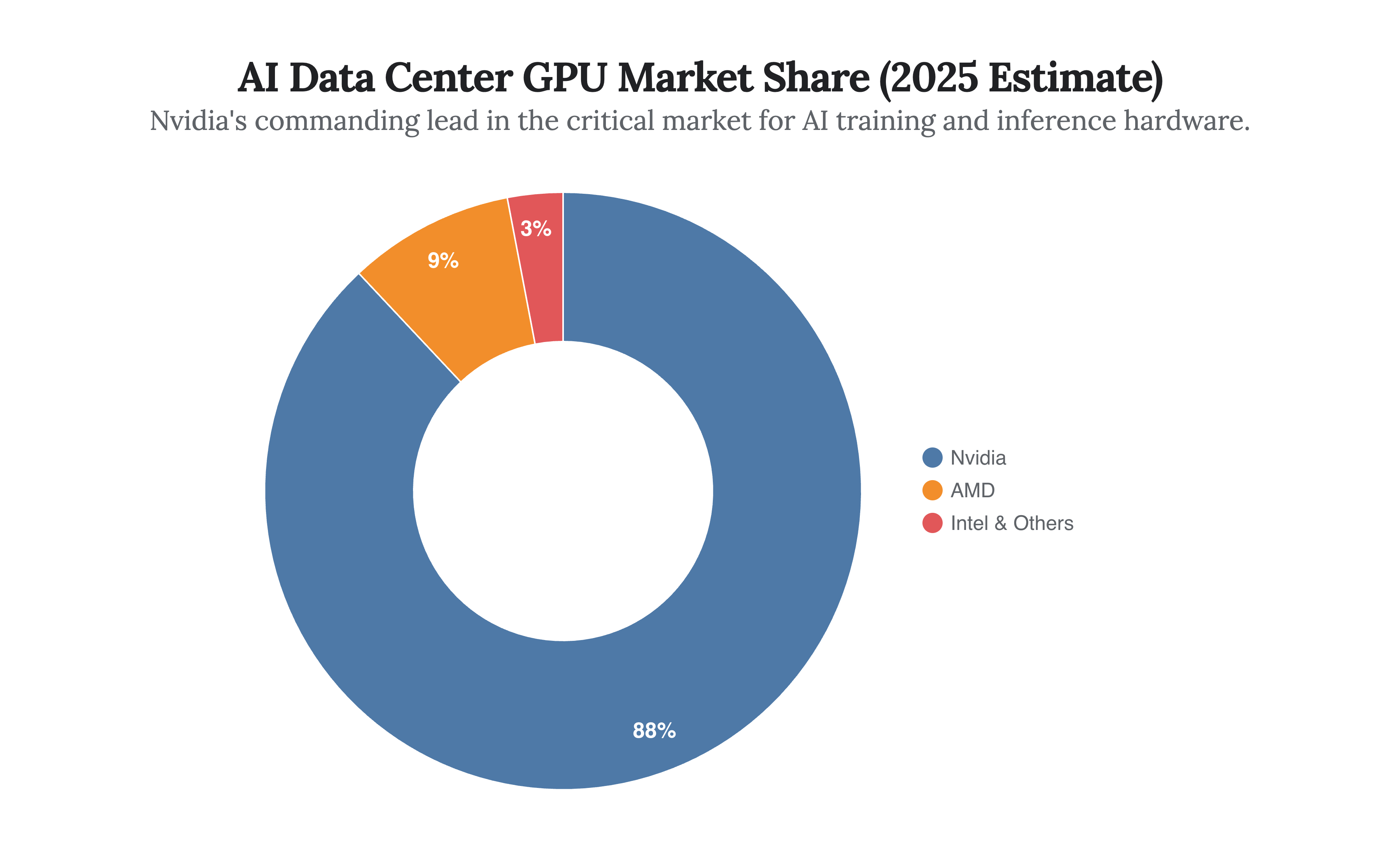
Nvidia’s overwhelming market share in data center GPUs underscores the strategic value of the asset SoftBank sold.
Comparing the Titans: Nvidia’s Runaway Value vs. Arm’s Steady Climb
Since Arm’s IPO, its performance has been respectable, but Nvidia’s growth trajectory has continued at a historic pace. This divergence highlights the market’s current premium on the immediate, high-margin business of selling AI hardware for data centers over the longer-term, licensing-based model of Arm. An investor’s challenge is to determine whether Arm’s future potential in edge AI and custom silicon can ever compensate for the value SoftBank left on the table with Nvidia.
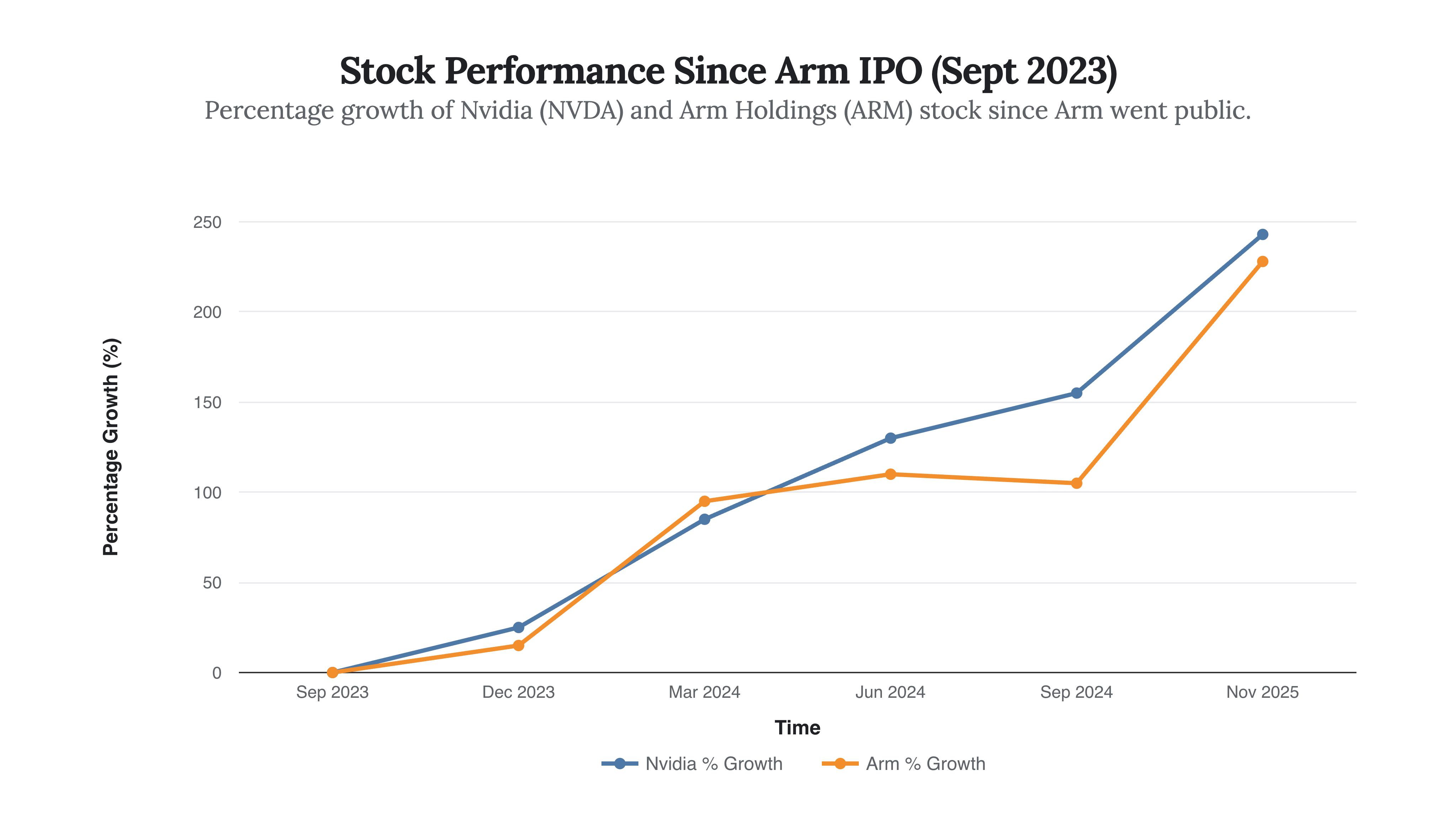
While both stocks have performed strongly, Nvidia’s growth since the Arm IPO has continued to outpace its peer, widening the gap from the 2019 sale.
Lessons Learned: A New Vision for AI Investment?
The painful lesson of the Nvidia sale appears to have reshaped SoftBank’s strategy. Having missed the dominant hardware play, the firm is now making aggressive, concentrated bets further up the AI stack and on enabling infrastructure. Recent reports indicate SoftBank has once again sold off a smaller, repurchased Nvidia stake to help fund a massive, multi-billion dollar investment in OpenAI. This is a move from selling the picks and shovels (Nvidia) to funding the most ambitious gold miner (OpenAI).
“This year our investment in OpenAI is large – more than $30bn needs to be made – so for that we do need to divest our existing portfolios.” - Yoshimitsu Goto, CFO, SoftBank Group
This strategic shift is visible in the investment thesis of Vision Fund 2 compared to its predecessor. While VF1 was characterized by its broad, sometimes scattered bets across mobility, SaaS, and real estate, later investments show a clearer focus on foundational AI, robotics, and the infrastructure needed to support artificial superintelligence. It’s a pivot born from a multi-billion-dollar lesson in the power of conviction.
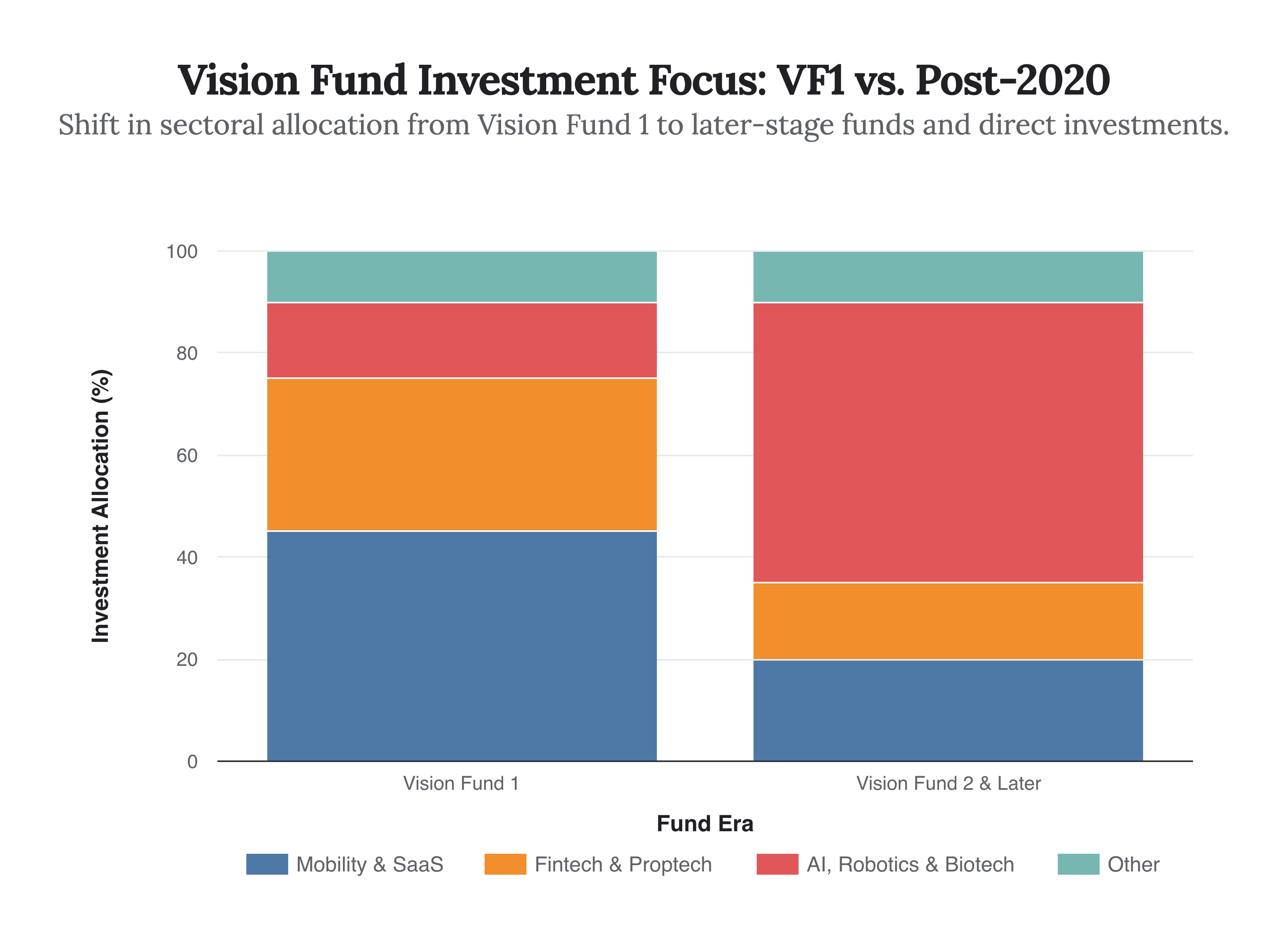
The chart shows a distinct strategic shift in SoftBank’s investment focus, with a significantly larger allocation towards deep tech and AI in its more recent funding vehicles.
Strategic Foresight: The Future of SoftBank’s AI Gambit
The Nvidia sale, while a historic miss, has paradoxically clarified SoftBank’s path forward. No longer a passive holder of the AI revolution’s key enabler, Masayoshi Son is now attempting to become an active architect of its future. The strategy is twofold: control the blueprint (Arm) and empower the brain (OpenAI). This high-risk, high-reward approach leaves no room for half-measures. The key signposts to watch will be Arm’s ability to translate its CPU dominance into the AI data center market and OpenAI’s capacity to maintain its lead against hyperscale competitors like Google and Microsoft.
The ultimate irony is that SoftBank’s future ambitions, particularly vast AI data center projects, will require purchasing billions of dollars worth of Nvidia GPUs. They have moved from being an owner of the foundational technology to one of its largest future customers. This dynamic perfectly encapsulates the inescapable gravity of Nvidia’s position in the AI ecosystem. For investors and policymakers, the lesson from SoftBank’s journey is profound. In a technological revolution defined by exponential growth and winner-take-all dynamics, the greatest risk is not volatility, but a lack of conviction. The cost of selling a generational asset early can far exceed the loss from holding through turbulent times.
The ultimate measure of SoftBank’s strategy will be whether its massive, concentrated bets on Arm and OpenAI can generate returns that eclipse the ghost of the $233 billion it left behind.
It's interesting how you framed this as a 'what if' then just a straight-up misstep, really gets you thinking about the pressures involved. I'm curious, considering the immense pressure of the first Vision Fund you mentioned, how much of that 'unforced error' was truly a failure of conviction versus an unavoidable, almost algorithmic, capital redeployment strategy they felt boxed into at the time?