


We are currently witnessing the collapse of a central dogma of modern business: the belief that efficiency is a proxy for effectiveness. For the last two decades, the global operating model has been predicated on a single, relentless directive: remove friction, increase speed, and optimize every second of human and machine output. The result? We have built the fastest, most measured, and most fragile economic engine in history.
The latest intelligence paints a stark picture. Despite a projected $3.4 trillion in global digital transformation spending by 2026, global Total Factor Productivity (TFP) growth remains stubbornly stagnant, hovering near historic lows. We are spending trillions to make the wheels spin faster, but the vehicle is not moving forward. This is the Cult of Optimization—a systemic fixation on proxy metrics that has decoupled activity from value.
This briefing analyzes the hidden mechanics of this failure. We are seeing a critical divergence where ‘frictionless’ systems create massive cognitive drag, where ‘lean’ supply chains amplify systemic risk, and where the pursuit of algorithmic perfection is hitting the hard wall of diminishing returns. The strategic imperative for 2025 is no longer about how fast you can run; it is about whether you are running a race that actually matters.
The Optimization Paradox: The $2.3 Trillion ‘Tax’
The most alarming statistic to emerge from recent 2024-2025 market analysis is not the speed of AI adoption, but the cost of its mismanagement. Data indicates that approximately $2.3 trillion is wasted annually in failed digital transformation and optimization programs. These initiatives, designed to streamline operations, often result in increased complexity, technical debt, and organizational paralysis. The failure rate for these high-stakes transformations sits at a staggering 70%.
This is the “Optimization Paradox.” As organizations invest heavily in tools to measure and optimize granular processes, the aggregate output fails to rise. We have confused utilization (keeping people busy) with throughput (generating value). The chart below illustrates the widening gap between technology investment and actual productivity gains, a divergence that signals a fundamental flaw in our current capital allocation strategies.
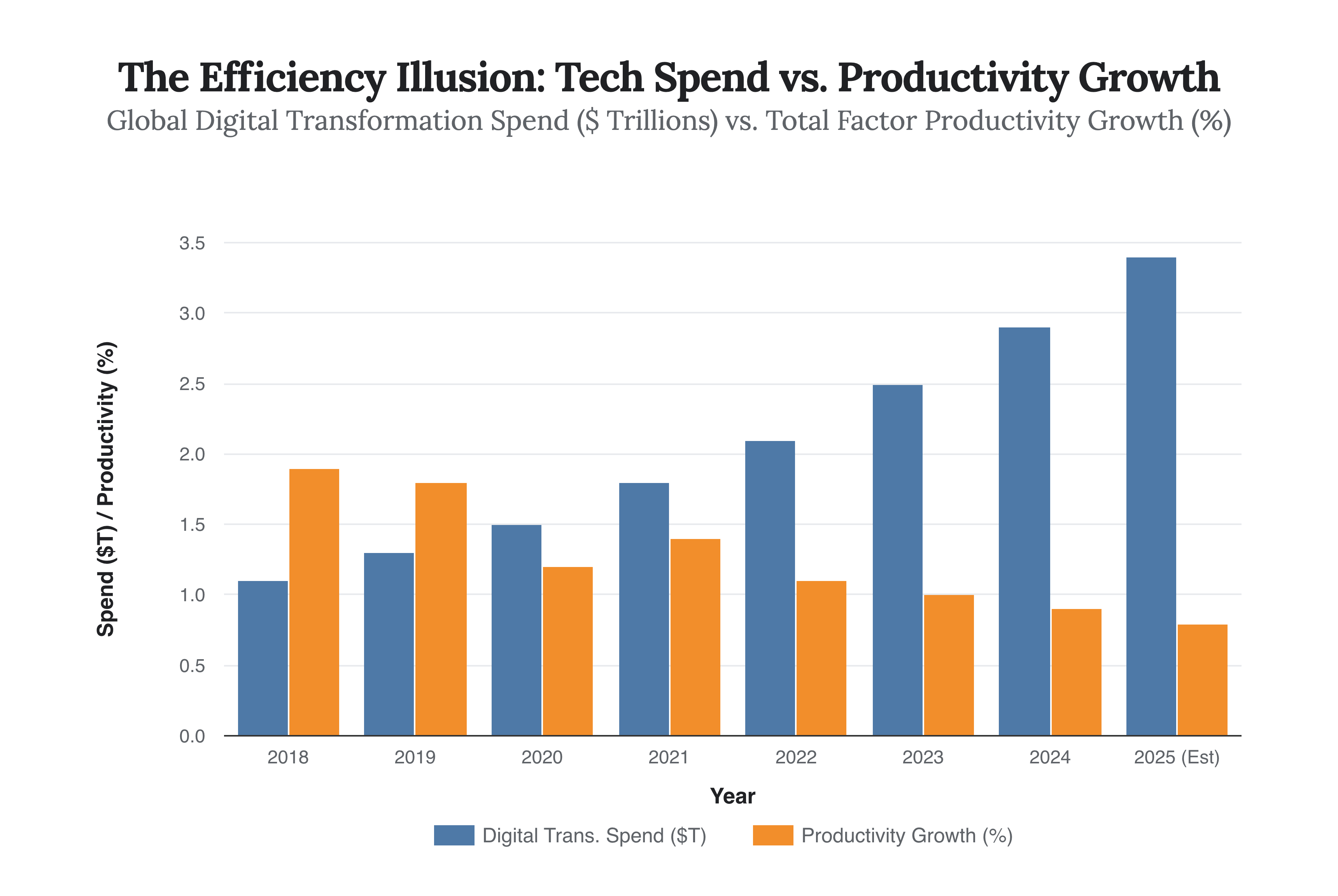
Figure 1: While investment in optimization technologies has tripled, global productivity growth has essentially flatlined, suggesting a massive misallocation of capital toward tools that optimize local maxima without improving systemic output.
Metric Fixation and Goodhart’s Revenge
The root of this paradox lies in a phenomenon economists call Goodhart’s Law: “When a measure becomes a target, it ceases to be a good measure.” In the Cult of Optimization, companies have become obsessed with proxy metrics—lines of code written, hours logged, tickets closed—rather than terminal values like customer satisfaction or long-term retention.
We are seeing this play out in real-time with “Productivity Paranoia.” Leaders, unable to see physical output in hybrid environments, have turned to surveillance tools that track keystrokes and “active time.” The strategic error here is profound: by optimizing for visible activity, companies are incentivizing performative work. Employees are now gaming the metrics to appear productive, effectively hollowing out the actual value creation process.
The Human Latency Bottleneck: The Cost of ‘Frictionless’
The second failure point is the human interface. Modern optimization theory treats human attention as a constant resource, akin to server uptime. It is not. The drive for a “frictionless” workplace has ironically created the most friction-heavy environment in history. By integrating every workflow into a seamless digital stream, we have destroyed the natural buffers required for deep cognition.
Recent behavioral data reveals that the average knowledge worker toggles between applications nearly 1,200 times per day. This constant context
