


In the fog-shrouded fields of Zaporizhzhia Oblast, the strategic calculus of the Russo-Ukrainian War has entered a brutal new phase. Just over a year after its much-vaunted counteroffensive clawed back territory settlement by settlement, Kyiv is now engaged in a series of deliberate, painful retreats.
Recent withdrawals from at least five settlements near the critical Huliaipole sector are not a sign of a wholesale collapse, but rather a grim testament to a battlefield dominated by overwhelming Russian firepower. Under a daily deluge of over 400 artillery strikes expending some 2,000 munitions, Ukrainian forces are being forced to trade space to preserve their most valuable asset: experienced soldiers. This shift to an “active defense” is a high-stakes gamble, born of necessity amid a critical ammunition famine. The core dilemma facing Ukrainian command is whether this strategic withdrawal can bleed the advancing Russian army and stabilize the front, or if it risks ceding the strategic initiative and unraveling the hard-won gains of 2023 entirely.
The Anatomy of a Forced Retreat
The recent developments on the Zaporizhzhia front are not a sudden rout, but a methodical, if forced, consolidation of Ukrainian lines under unbearable pressure. The tactical situation has deteriorated significantly in the Oleksandrivka and Huliaipole directions, forcing a stark re-evaluation of defensive positions that were, until recently, considered relatively stable.
From Offensive to Defensive: The Huliaipole Fulcrum
On November 11, 2025, Ukraine’s Southern Defense Forces confirmed that troops had pulled back from positions near Novouspenivske, Nove, Okhotnyche, Uspenivka, and Novomykolaivka. Commander-in-Chief Oleksandr Syrskyi later acknowledged that fierce battles had resulted in the Russian capture of three settlements in the region. This area is strategically vital, with Russian forces now pressing an offensive to encircle the city of Huliaipole from the east, aiming to sever critical logistics routes from Pokrovske in the north. The fighting is described as intense, with up to a hundred combat engagements recorded over just a few days.
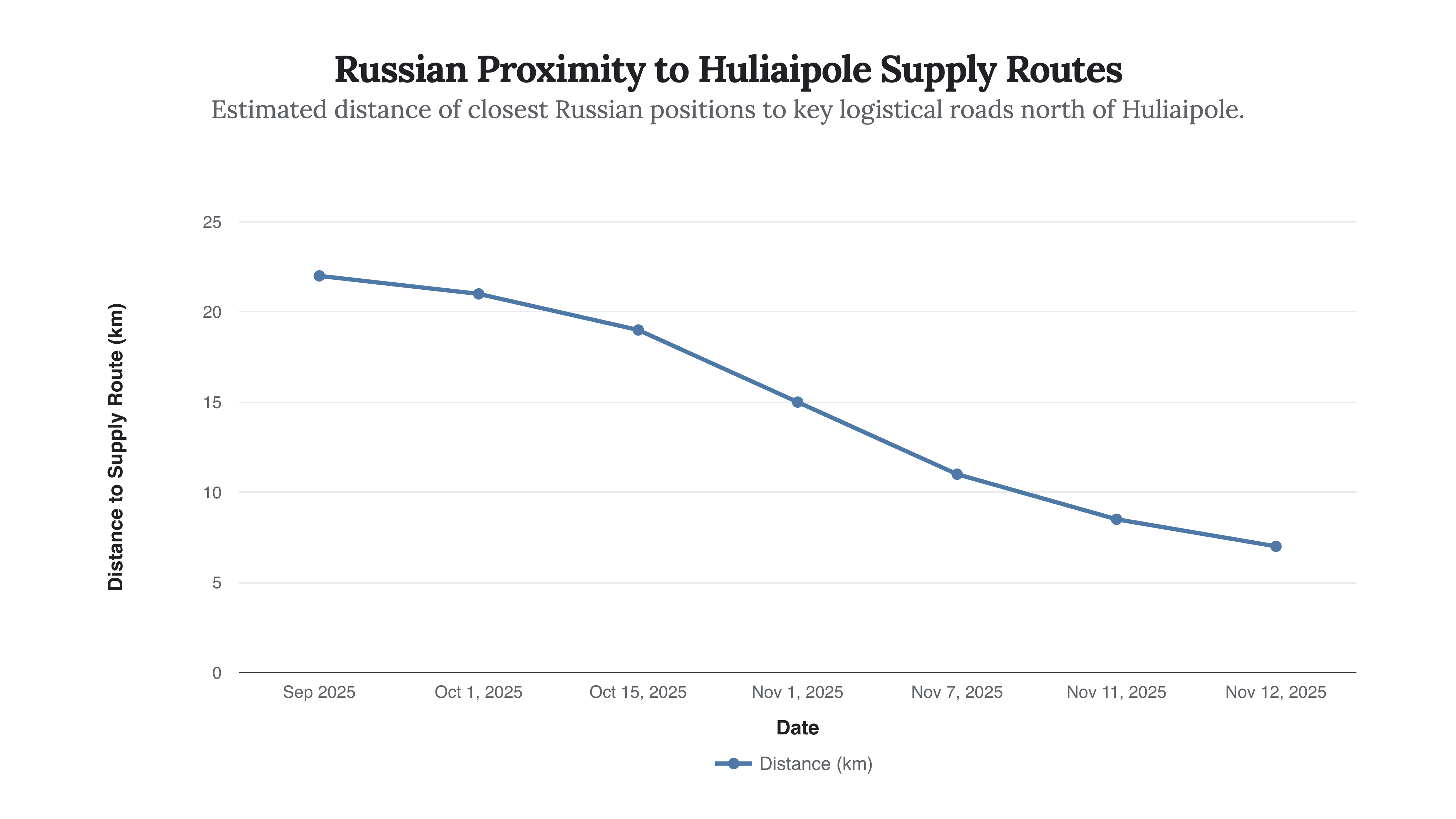
This chart illustrates the creeping threat to Huliaipole’s logistics, showing a steady and accelerating Russian advance that has more than halved the buffer zone around the city’s supply lines in just two months.
The Firepower Imbalance: A War of Attrition
The primary driver of these Ukrainian withdrawals is an almost unsustainable disparity in firepower. According to Ukrainian military officials, Russian forces are unleashing over 400 artillery attacks daily in this sector, using approximately 2,000 shells. This relentless bombardment has led to the “virtual destruction of all shelters and fortifications,” leaving defenders exposed and making positions untenable. The decision to retreat is a direct consequence of this pressure, aimed at preserving personnel who would otherwise be lost in pulverized trenches.
“Due to intensified enemy assault actions... heavy and sustained fire on our positions... and the virtual destruction of all shelters and fortifications, the Defense Forces had to withdraw... to preserve the lives of personnel.” - Southern Defense Forces Statement
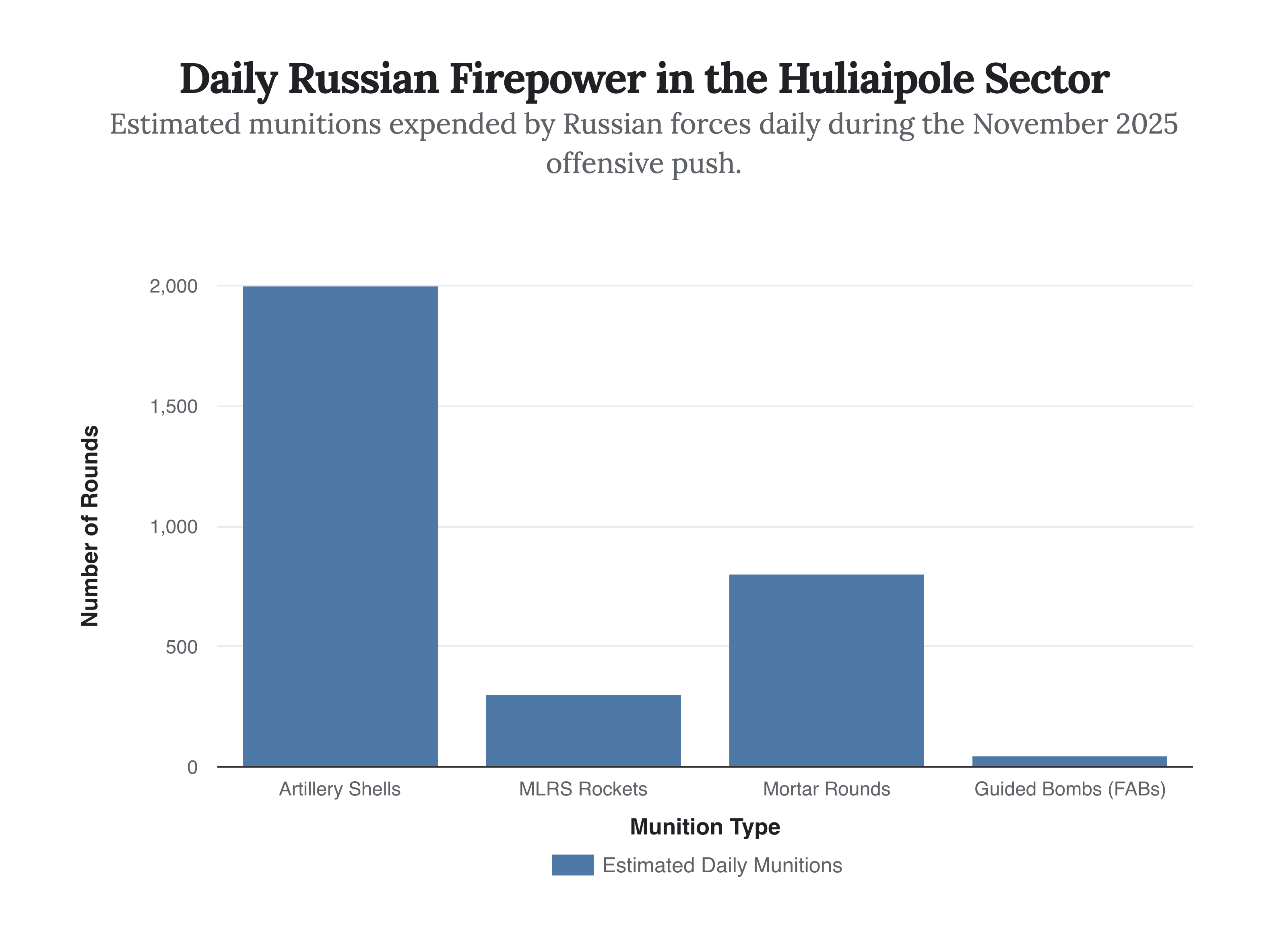
The sheer volume of Russian artillery fire, as shown in the chart, creates a battlefield where static defense becomes nearly impossible, forcing a shift towards more mobile and flexible defensive operations.
The Strategic Calculus: A High-Risk Doctrine of ‘Active Defense’
Kyiv’s response to this overwhelming pressure is being framed as an “active defense.” This doctrine accepts territorial fluidity in exchange for inflicting higher costs on the attacking force and preserving Ukraine’s own limited manpower. However, this strategy is fraught with risk and is a direct result of constraints, not a first-choice preference.
Exploiting the Gaps: Russia’s New Tactics
Russian forces are adapting their tactics to capitalize on Ukrainian vulnerabilities. They are increasingly taking advantage of adverse weather, such as dense fog, which degrades the effectiveness of Ukraine’s reconnaissance drones, to infiltrate defensive lines with small assault groups. These infiltrations are followed by attempts to bring in more substantial “consolidation groups” to secure the new positions. This tactical evolution, combined with a months-long campaign of air and drone strikes against Ukrainian rear logistics, has created the conditions for the recent advances.
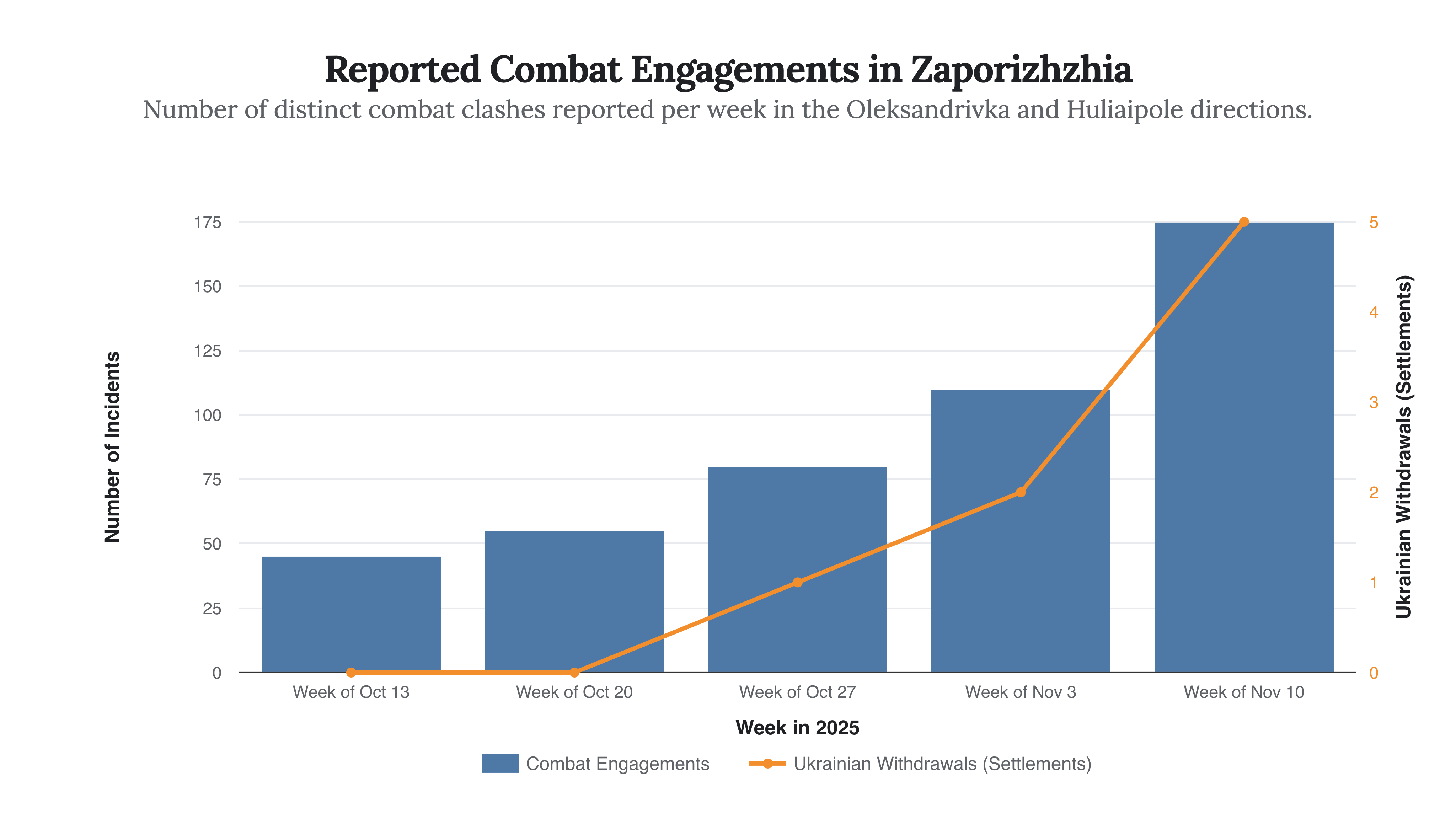
This data highlights the direct correlation between the rising tempo of Russian assaults and the increase in Ukrainian withdrawals, demonstrating the escalating pressure on the front lines.
The Ammunition Famine’s Bitter Harvest
Underpinning Ukraine’s defensive dilemma is a severe and protracted shortage of artillery ammunition. For over a year, analysts have warned that Ukraine is expending shells far faster than its Western partners can produce or supply them. That warning has now become a battlefield reality. While Russia can sustain firing rates of thousands of shells per day in a single sector, Ukrainian batteries are forced to ration, firing perhaps only 2,000 rounds across the entire 750-mile front. This “shell hunger” not only limits Ukraine’s ability to break up Russian assaults but also makes its own artillery pieces more vulnerable to counter-battery fire as they are forced to stay in one place longer to achieve the desired effect.
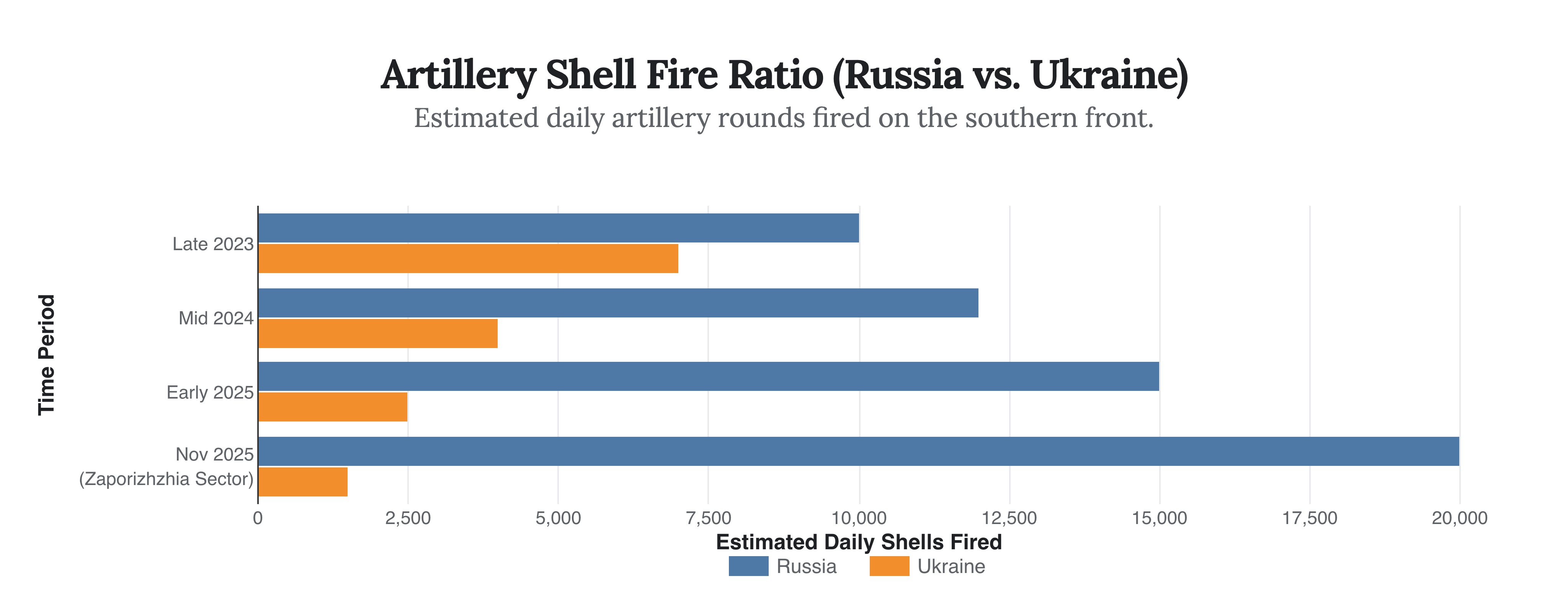
The growing disparity in available firepower, visualized above, is the single most critical factor shaping the current dynamics on the Zaporizhzhia front, forcing Ukraine into a defensive posture.
Future Scenarios and Strategic Implications
The retreats in Zaporizhzhia, while tactically necessary, create a series of cascading risks and potential futures for the southern front. The immediate goal is to stabilize the line on more defensible terrain, but the long-term consequences are uncertain.
“The aggressor has increased activity in Zaporizhzhia Oblast, using weather conditions — dense fog — to infiltrate between our positions... the situation has significantly worsened.” - Commander-in-Chief Oleksandr Syrskyi
Scenario 1: Successful Consolidation
In the best-case scenario for Kyiv, the current withdrawals allow forces to fall back to better-prepared defensive lines. By trading territory with a low population density for Russian lives and equipment, Ukraine could successfully attrit the Russian offensive, forcing it to culminate before it reaches major strategic objectives like Huliaipole or threatens Zaporizhzhia city. This outcome depends on a steady, if limited, supply of ammunition and the rapid construction of new fortifications.
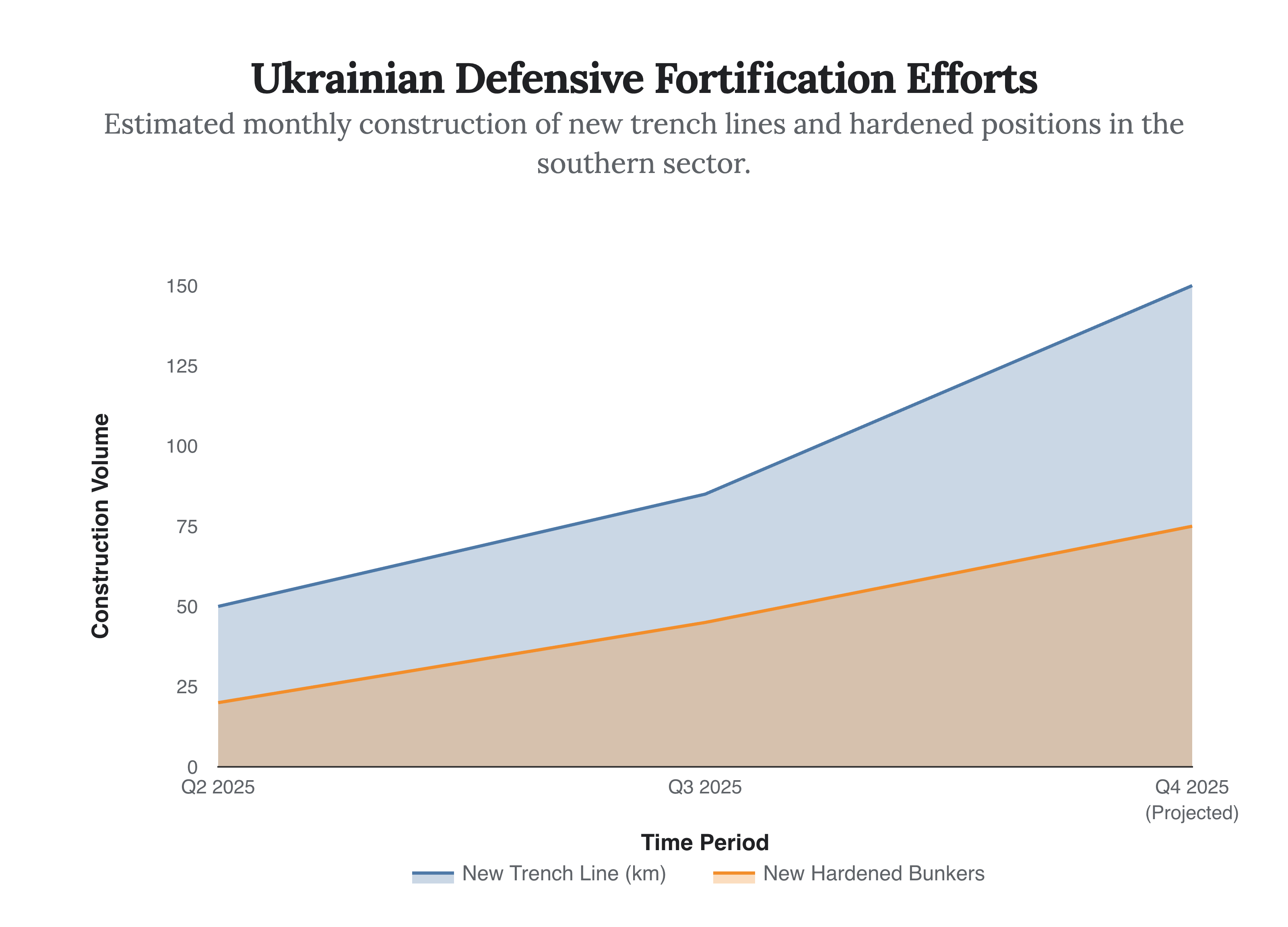
This chart projects an acceleration in Ukrainian defensive construction, a critical requirement for a successful consolidation strategy.
Scenario 2: A Contested ‘Gray Zone’
A more likely near-term outcome is the expansion of the contested “gray zone.” Neither side may have the combat power to decisively seize and hold the evacuated settlements, leading to a fluid and chaotic frontline characterized by raids, drone strikes, and artillery duels. This prevents a major Russian breakthrough but also cedes the initiative to Moscow and makes it difficult for Ukraine to re-establish stable defensive lines, leading to a constant drain on resources.
Scenario 3: Russian Breakthrough
The most dangerous scenario involves Russia using its momentum to achieve a deeper operational breakthrough. If Ukrainian forces cannot establish a new, stable defensive line, Russia could leverage its success to fully encircle Huliaipole and open a path toward the regional capital of Zaporizhzhia. This would represent a major strategic defeat for Ukraine, effectively erasing the gains of the 2023 counteroffensive and putting the entire southern front at risk.
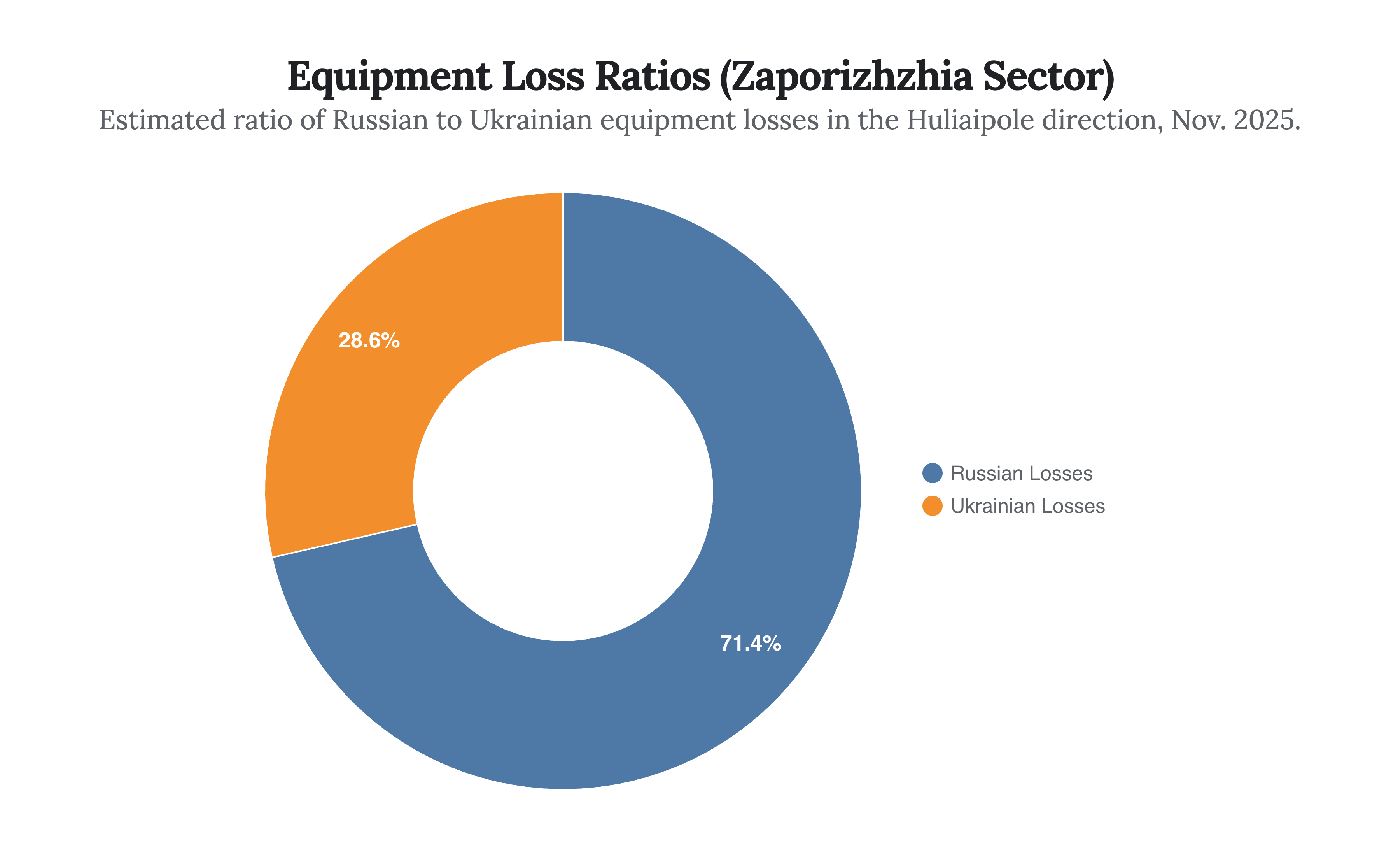
Even in retreat, Ukraine must maintain a favorable loss ratio, inflicting significantly more damage than it sustains. As this chart shows, while Russia is losing more equipment, the ratio is likely tighter than the 3:1 ratio Ukraine’s military aims for, indicating the high cost of these defensive battles.
The dilemma in Zaporizhzhia is a microcosm of the entire war in late 2025. Faced with a larger, better-supplied adversary, Ukraine is forced to make unpalatable choices. The ongoing retreats are a calculated, logical response to an overwhelming material disadvantage, primarily in artillery. It is a strategy to conserve its fighting force for a future where, it hopes, the scales of international support and domestic production have tipped back in its favor. However, every meter of ground ceded is a political and morale blow that tests the resolve of both the Ukrainian people and their international partners.
The ultimate success or failure of this ‘active defense’ will be determined not in the fields of Zaporizhzhia, but in the factories and parliaments of the West.