



In a dramatic reversal that sent shockwaves through the global trade community, the United States has agreed to slash the punitive 39% tariff on Swiss goods to 15%, ending a months-long standoff that threatened to cripple key sectors of the Swiss economy. This is not, however, a simple de-escalation. The price for this relief is a monumental $200 billion direct investment commitment from Swiss companies into the U.S. by 2028, a move that fundamentally reframes the tariff rollback as a high-stakes transactional negotiation.
This briefing deconstructs the anatomy of this trade shock, analyzes the strategic concessions at the heart of the deal, and forecasts how this new playbook—leveraging tariff threats to compel massive foreign direct investment—is set to become a central pillar of American economic statecraft. The agreement is far more than a bilateral settlement; it is a blueprint for a new era of geoeconomic policy where market access is explicitly tied to domestic industrial investment.
From Unilateral Idealism to Bilateral Brutalism: The Anatomy of a Trade Shock
The recent trade dispute did not occur in a vacuum. It was preceded by starkly contrasting policy decisions from Bern and Washington, creating a strategic dissonance that culminated in the tariff crisis. Understanding these opposing maneuvers is critical to grasping the full context of the final agreement.
Switzerland’s Open-Door Policy
Effective January 1, 2024, Switzerland took a bold and unilateral step rooted in classic free-trade principles: it completely abolished tariffs on all industrial goods (Harmonized System chapters 25-97) from every country. This was not a negotiated deal but an autonomous measure designed to enhance its own economic competitiveness, lower input costs for its sophisticated manufacturing base, and reduce consumer prices. The Swiss government estimated the move would generate an annual welfare gain of over CHF 860 million (approximately $1 billion). By eliminating duties on everything from machinery and chemicals to consumer goods like cars and clothing, Switzerland sent a clear signal in favor of open markets, standing in stark contrast to the rising tide of global protectionism.
The 39% Retort: Washington’s Asymmetric Response
Just months after Switzerland opened its doors, Washington slammed its own. In August 2025, the U.S. imposed a shocking 39% flat tariff on most Swiss goods, the highest rate levied on any developed economy. The move stunned Swiss politicians and business leaders, who believed they were close to securing a far more favorable rate. The official justification centered on the ballooning U.S. goods trade deficit with Switzerland, which reached $38.3 billion in 2024. This punitive tariff created an immediate and severe disadvantage for Swiss exporters compared to their European Union competitors, who faced a 15% rate. The stark disparity between Switzerland’s free-trade gesture and the subsequent U.S. tariff wall set the stage for a tense and unavoidable negotiation.
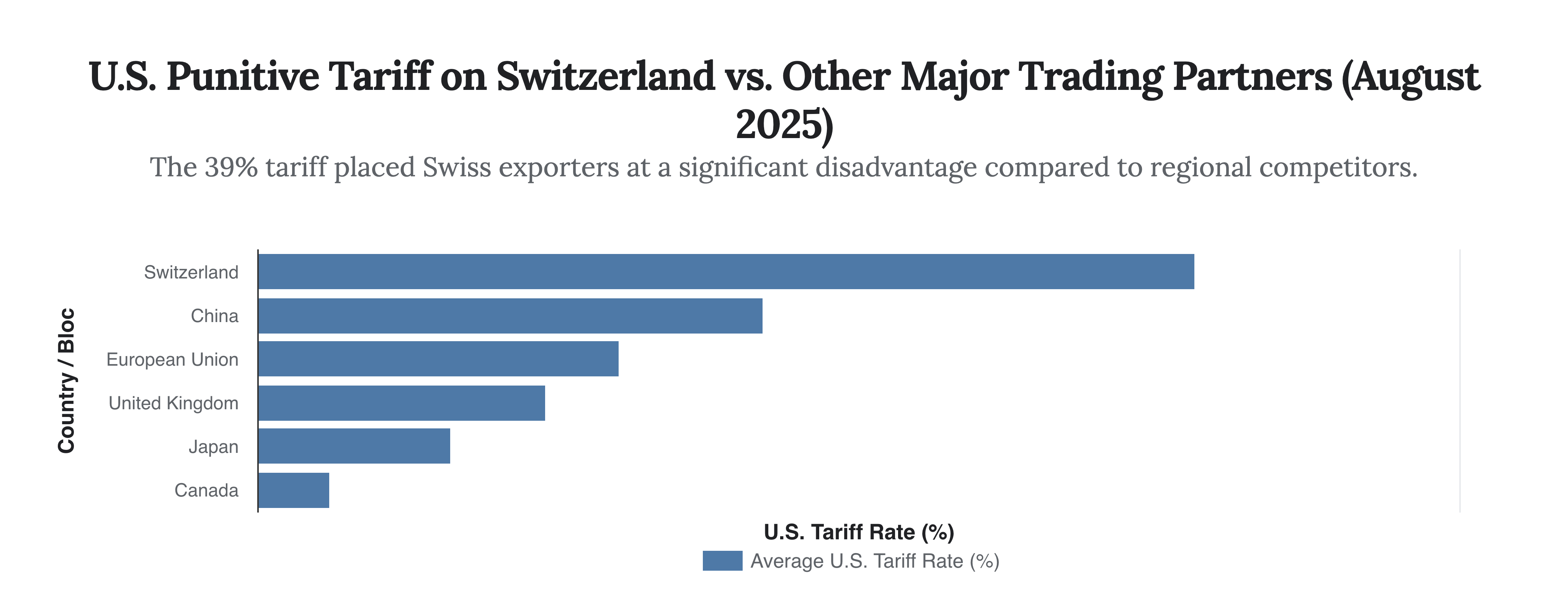
The 39% tariff imposed on Switzerland was more than double the rate applied to the European Union, creating an unlevel playing field and forcing Swiss exporters into a competitive crisis.
The High-Stakes Negotiation: Unpacking the $200 Billion Quid Pro Quo
The resolution to the tariff crisis was not a return to the status quo but the creation of a new arrangement with significant, long-term commitments. The deal’s core is a direct trade-off: a tariff reduction in exchange for a massive, targeted investment package, revealing the transactional nature of modern U.S. trade policy.
The Investment Centerpiece
The headline achievement for Switzerland was the reduction of the U.S. tariff from 39% to a more manageable 15%, aligning it with the EU rate. However, the centerpiece of the deal from the American perspective is the binding commitment from Swiss companies to invest $200 billion in the United States by the end of 2028. U.S. Trade Representative Jamieson Greer stated the deal would bring “a lot of manufacturing” to the U.S., specifically citing pharmaceuticals, gold smelting, and railway equipment. The White House further specified that $67 billion of this investment is slated for 2026 alone, indicating an accelerated timeline for this capital injection.
“This deal builds upon the success of America first Trade Policy by correcting chronic trade imbalances, opening new markets for U.S. goods, and welcoming massive Swiss investment to help reduce our deficit in pharmaceuticals and other key sectors.”- Jamieson Greer, U.S. Trade Representative
The Collateral Damage Averted
The urgency for a deal was underscored by the severe impact the 39% tariff had during its short tenure. The Swiss technology industry association, Swissmem, reported that exports to the U.S. fell by 14% in the three months ending in September 2025, with machine-tool makers seeing shipments plummet by a staggering 43%. The country’s most iconic industries, particularly watchmaking, precision instruments, and machinery, were among the hardest hit, facing the prospect of ceding significant market share. The deal averts what could have been a recessionary blow to Switzerland’s export-oriented economy, which counts the U.S. as its single largest export market.
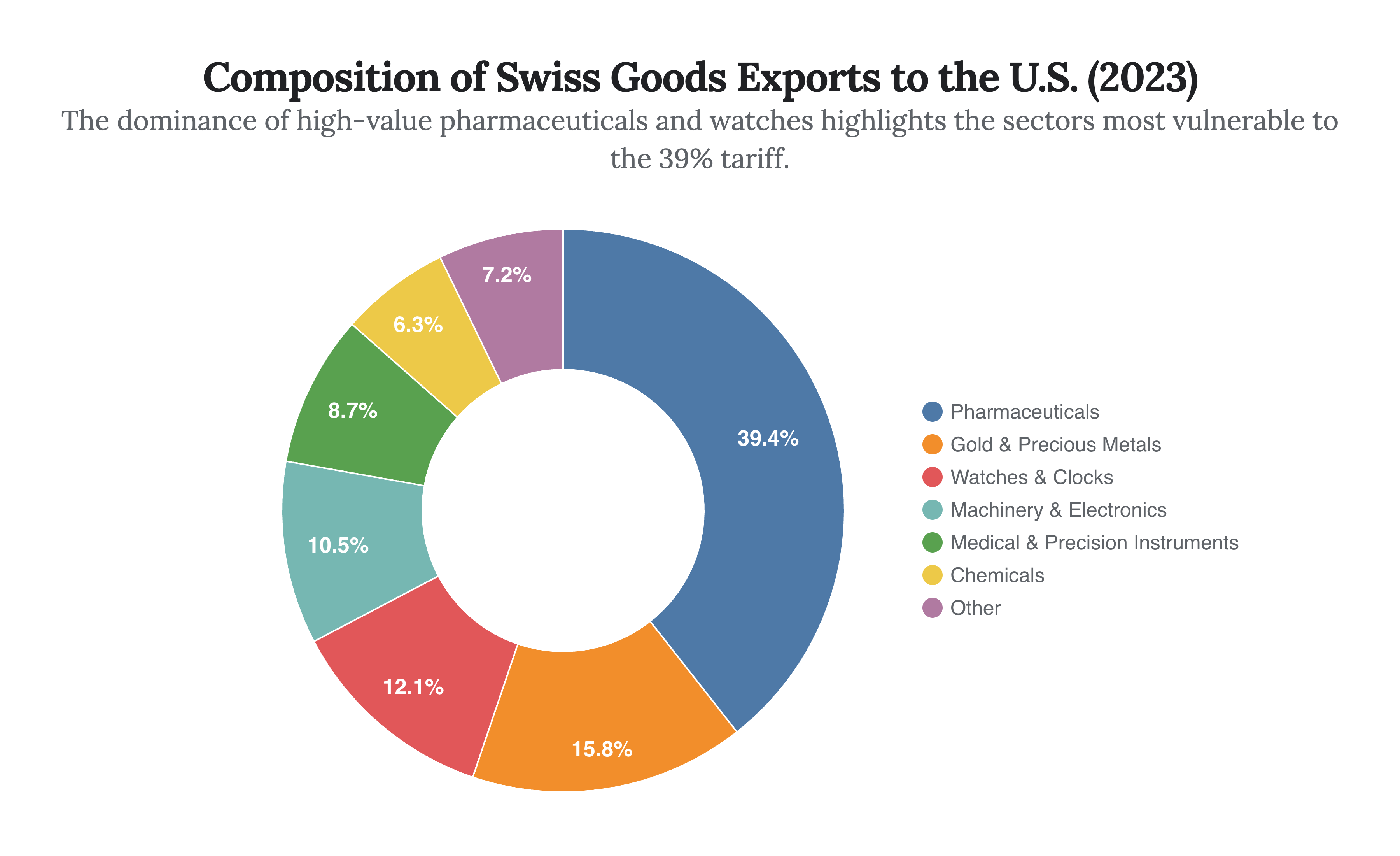
Pharmaceuticals and watches, two pillars of the Swiss export economy, together accounted for over half of all goods exports to the U.S., making them highly exposed to the tariff pressure.
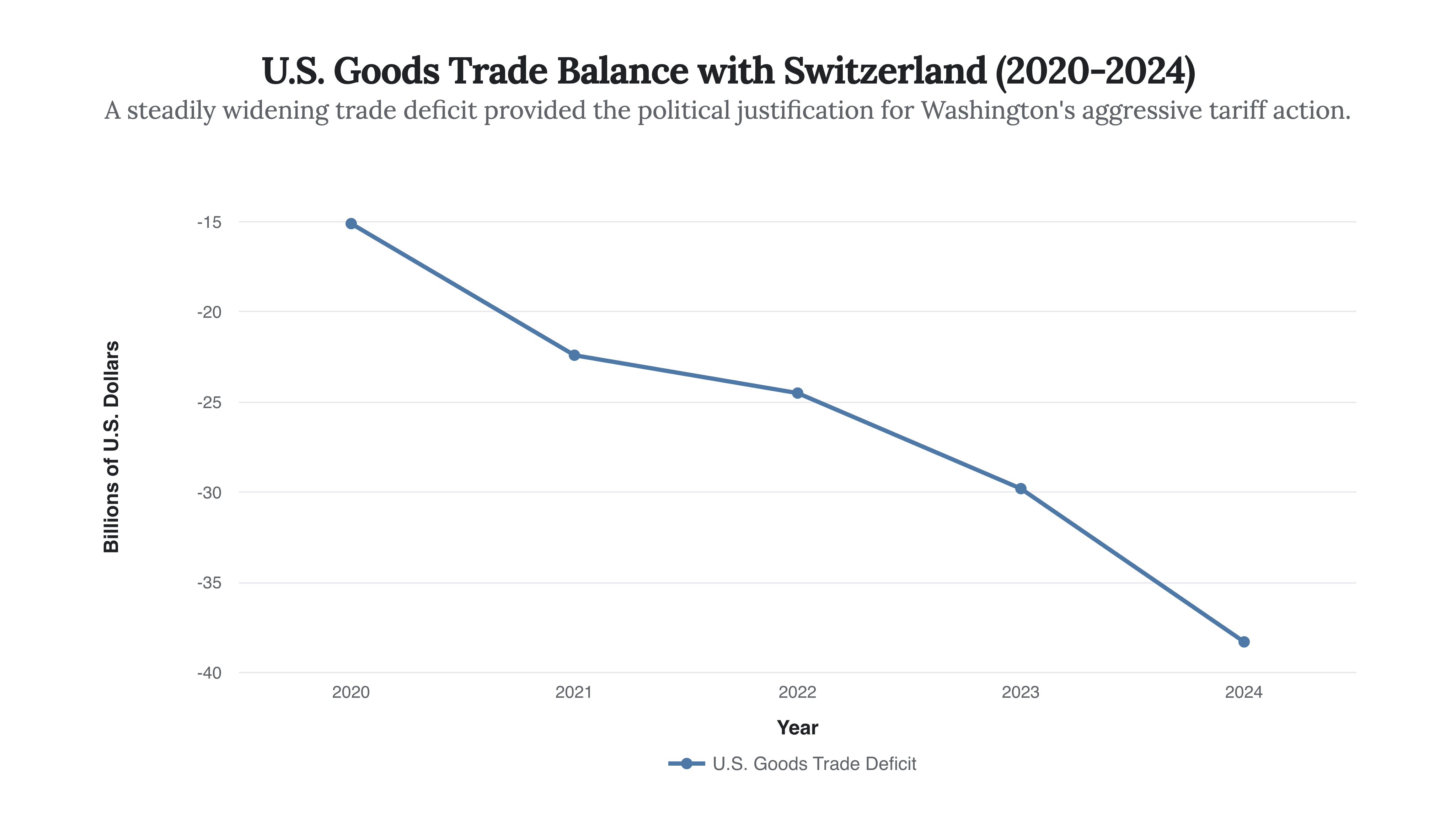
The U.S. goods trade deficit with Switzerland grew by over 150% in five years, creating the political impetus in Washington to use tariffs as a corrective measure.
Winners, Losers, and Strategic Repositioning
This landmark agreement creates a complex landscape of outcomes. While Swiss exporters are the most visible winners, the deal forces a strategic repositioning for Swiss multinationals and solidifies a major victory for U.S. industrial policy, setting a powerful precedent.
Immediate Relief and a Level Playing Field
The most immediate winners are the Swiss export industries that were staring into the abyss. Companies in the machinery, precision instruments, watchmaking, and food sectors can now compete on more equal footing with their EU counterparts. The relief was palpable among industry groups.
“This is good news for the industrial sector. For the first time in history, we are able to compete on the U.S. Market with our European counterparts.”- Nicola Tettamanti, Swissmechanic
For iconic brands like Rolex and Richemont, whose executives were reportedly involved in direct negotiations with the White House, the deal provides crucial stability in their most important market.
The Price of Market Access
The implicit losers are the shareholders of the Swiss multinational corporations now bound by the $200 billion investment pledge. While much of this may be capital that would have been invested in the U.S. anyway, the formal commitment and accelerated timeline could force companies to allocate capital based on political mandates rather than pure market optimization. This represents a significant new cost of doing business for Swiss firms, transforming market access from a given into a variable that must be continuously negotiated through strategic investment.
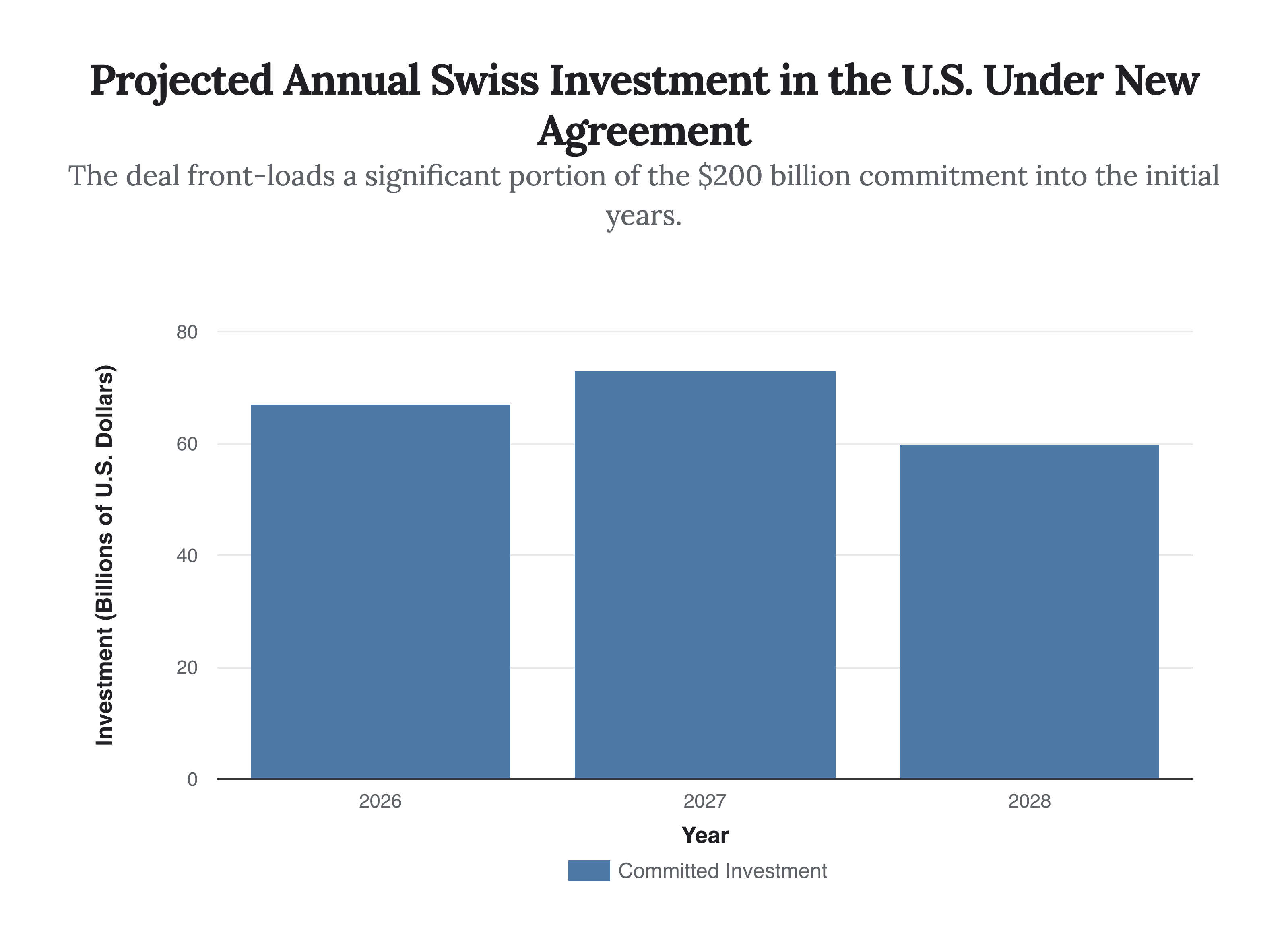
The agreement outlines a rapid deployment of capital, with the White House confirming a $67 billion investment tranche for 2026, putting immediate pressure on Swiss firms to deliver.
The Blueprint for Future Trade: A New Geoeconomic Doctrine
The strategic implications of the U.S.-Switzerland deal extend far beyond their bilateral relationship. It signals a durable shift in U.S. trade strategy, establishing a new and replicable model for its interactions with other trading partners, particularly those with significant trade surpluses.
From Free Trade to ‘Forced Investment’
The core innovation of this agreement is the codification of a ‘tariff-for-investment’ doctrine. The U.S. has demonstrated its willingness and ability to use the threat of punitive tariffs not merely as a protectionist shield, but as an offensive lever to actively coerce foreign direct investment into strategic domestic sectors. This moves beyond negotiating quotas or market access rules and directly targets the capital allocation decisions of foreign corporations. Nations with large trade surpluses but lagging U.S. investment profiles are now on notice that their trade balance is a strategic vulnerability that Washington is prepared to exploit.
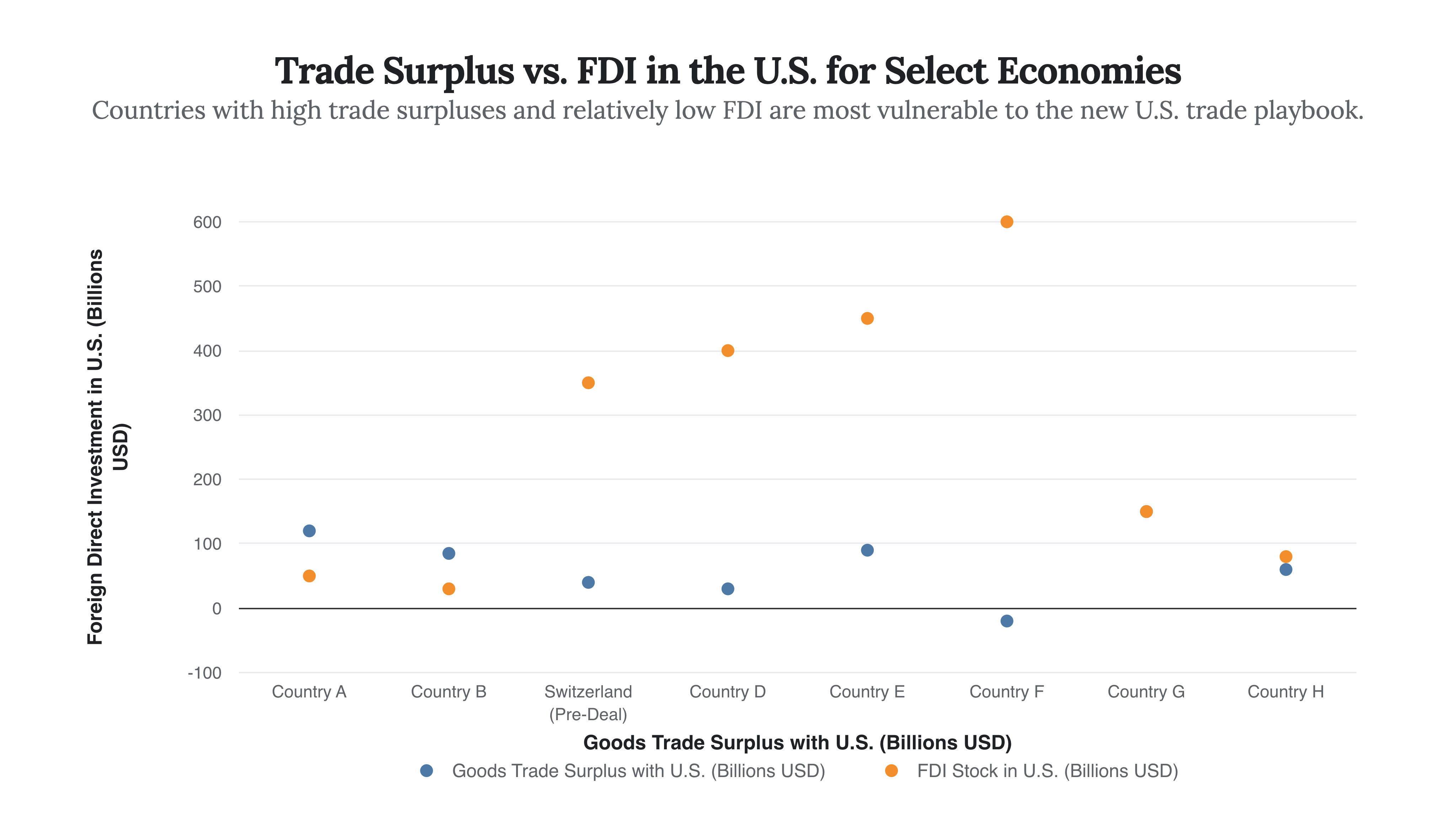
This visualization illustrates the strategic calculus: nations in the upper-left quadrant (high surplus, low FDI) are prime targets for a U.S. strategy aimed at converting trade imbalances into domestic investment.
Key Signposts to Watch
Investors and policymakers should monitor several key indicators to anticipate the future application of this doctrine. Firstly, watch the U.S. Commerce Department’s list of countries with the largest goods trade deficits; these are the primary targets. Secondly, track the rhetoric of the U.S. Trade Representative, paying close attention to language that links trade imbalances with a lack of reciprocal investment. Finally, observe upcoming trade negotiations, not for discussions of tariff percentages alone, but for the emergence of investment commitments and domestic manufacturing requirements as central negotiating points. The Swiss deal was not an anomaly; it was the precedent.
In conclusion, the resolution of the U.S.-Swiss tariff dispute marks a pivotal moment in international trade relations. What appeared to be a straightforward tariff rollback was, in fact, a masterclass in geoeconomic leverage, securing a $200 billion investment commitment that will reshape bilateral economic ties for years to come. The message from Washington is clear: in the new world order, favorable access to the American market is no longer a right, but a privilege that must be earned through tangible contributions to the U.S. industrial base. This agreement transforms the tariff from a simple trade barrier into a powerful lever for compelling foreign direct investment, fundamentally rewriting the playbook of modern economic statecraft.