


The European Central Bank (ECB) has entered a phase of deliberate strategic patience. After executing a dramatic 200-basis-point easing cycle between mid-2024 and mid-2025 to steer the Eurozone away from recessionary pressures, the Governing Council has now held its key interest rates steady for the third consecutive meeting.
The deposit facility rate remains anchored at 2.0%, a level intended to be restrictive enough to ensure inflation’s return to the medium-term 2% target, yet accommodative enough to not choke off a fragile economic recovery. This calculated pause, however, is not a declaration of victory. It is an acknowledgment of a complex and conflicting economic landscape. While headline inflation has receded to 2.1% as of October 2025—a stone’s throw from the target—stubbornly high services inflation and persistent core price pressures signal that the final mile of this disinflationary journey will be the most challenging. This briefing deconstructs the ECB’s October 2025 decision, analyzes the divergent economic indicators shaping future policy, and provides a forward-looking assessment for industry leaders and investors navigating the crosscurrents of European monetary policy.
The Anatomy of a Policy Plateau
The decision on October 30, 2025, to maintain the status quo was widely anticipated by markets and analysts. ECB President Christine Lagarde and other council members have emphasized that policy is currently in a “good place,” balancing the need to quell remaining inflation without unduly harming an economy showing tentative signs of life. The core of the ECB’s strategy has shifted from a pre-committed path to a strictly “data-dependent and meeting-by-meeting approach,” a mantra repeated in recent communications. This flexibility is crucial in an environment where the economic narrative is far from uniform.
From Aggressive Easing to a Calculated Pause
The journey to the current 2.0% deposit rate was rapid and decisive. Following a period of aggressive rate hikes to combat post-pandemic inflation, the ECB initiated a series of eight rate cuts starting in mid-2024 as the inflation threat receded and growth faltered. This pivot was essential to support the economy. Now, with inflation hovering near the target, the calculus has changed. The primary goal is to ensure price stability becomes entrenched, avoiding a premature policy relaxation that could allow inflation to reignite.
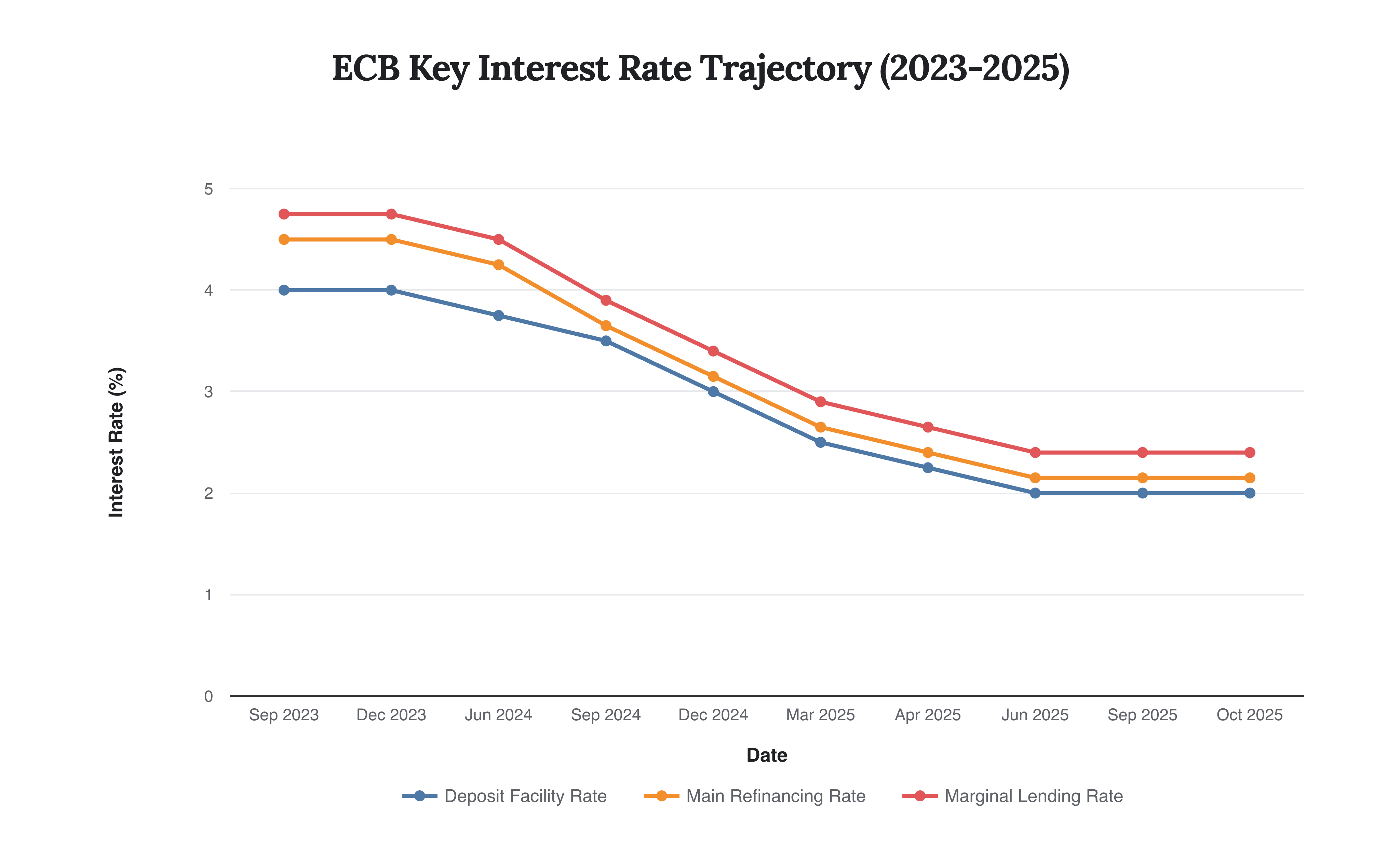
The chart illustrates the ECB’s monetary policy evolution, showing the peak in rates in late 2023, followed by a series of cuts through late 2024 and the first half of 2025, leading to the current plateau established in the summer of 2025.
“If inflation developments deviate, or if projections are modified, and if transmission is not correct, then we may change.”
- Luis de Guindos, ECB Vice-President
The Inflation Conundrum: A Two-Track Reality
While the headline inflation figure of 2.1% for October 2025 is reassuringly close to the ECB’s target, a deeper dive reveals a more complex picture. The disinflationary process is being driven almost entirely by falling energy prices, which dropped 1.0% year-on-year. Other components of the inflation basket, however, paint a stickier picture, particularly the services sector, which is heavily influenced by domestic demand and wage growth.
Services vs. Goods: The Great Divide
Inflation in the services sector rose to a robust 3.4% in October, indicating that domestic price pressures remain elevated. This is the primary reason the ECB cannot yet declare mission accomplished. In contrast, non-energy industrial goods inflation eased to just 0.6%, reflecting weakening global demand and the impact of a stronger euro on import prices. This divergence highlights the challenge facing the central bank: tightening policy enough to cool the domestic-facing services sector without further damaging the already struggling manufacturing and export-oriented parts of the economy.
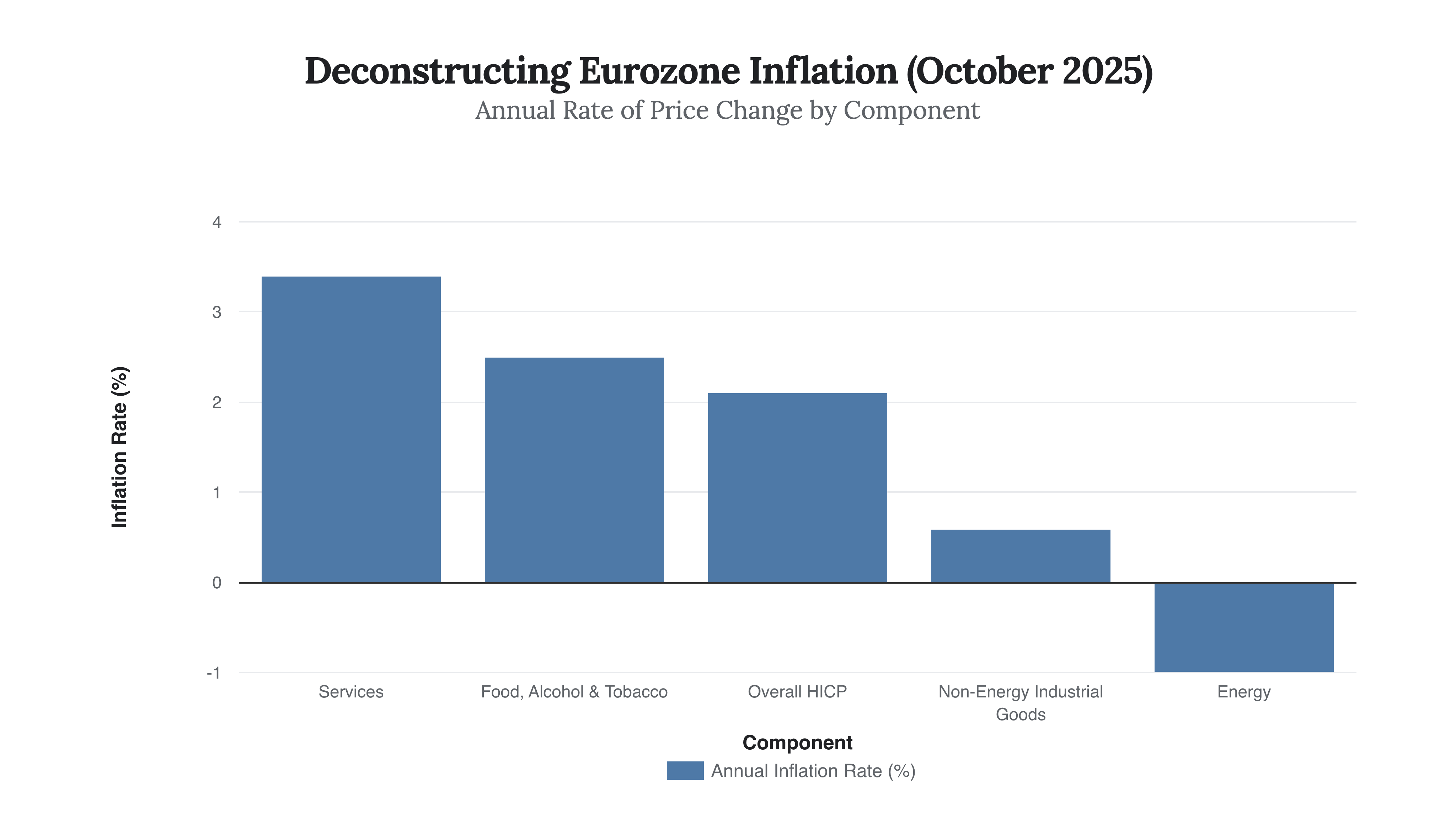
This chart breaks down the headline Harmonised Index of Consumer Prices (HICP), showing the strong upward pressure from services compared to the significant drag from energy prices in October 2025.
The North-South Divergence
The complexity is further compounded by significant inflation differentials across the 20 member states of the Eurozone. In October, annual inflation ranged from a high of 4.5% in Estonia to a low of 0.3% in Cyprus. This divergence creates a significant policy headache. A monetary policy stance appropriate for France, where inflation is just 0.9%, may be too loose for countries in the Baltics experiencing much stronger price pressures. Conversely, a policy designed to curb Estonian inflation could be crippling for economies with near-zero price growth.
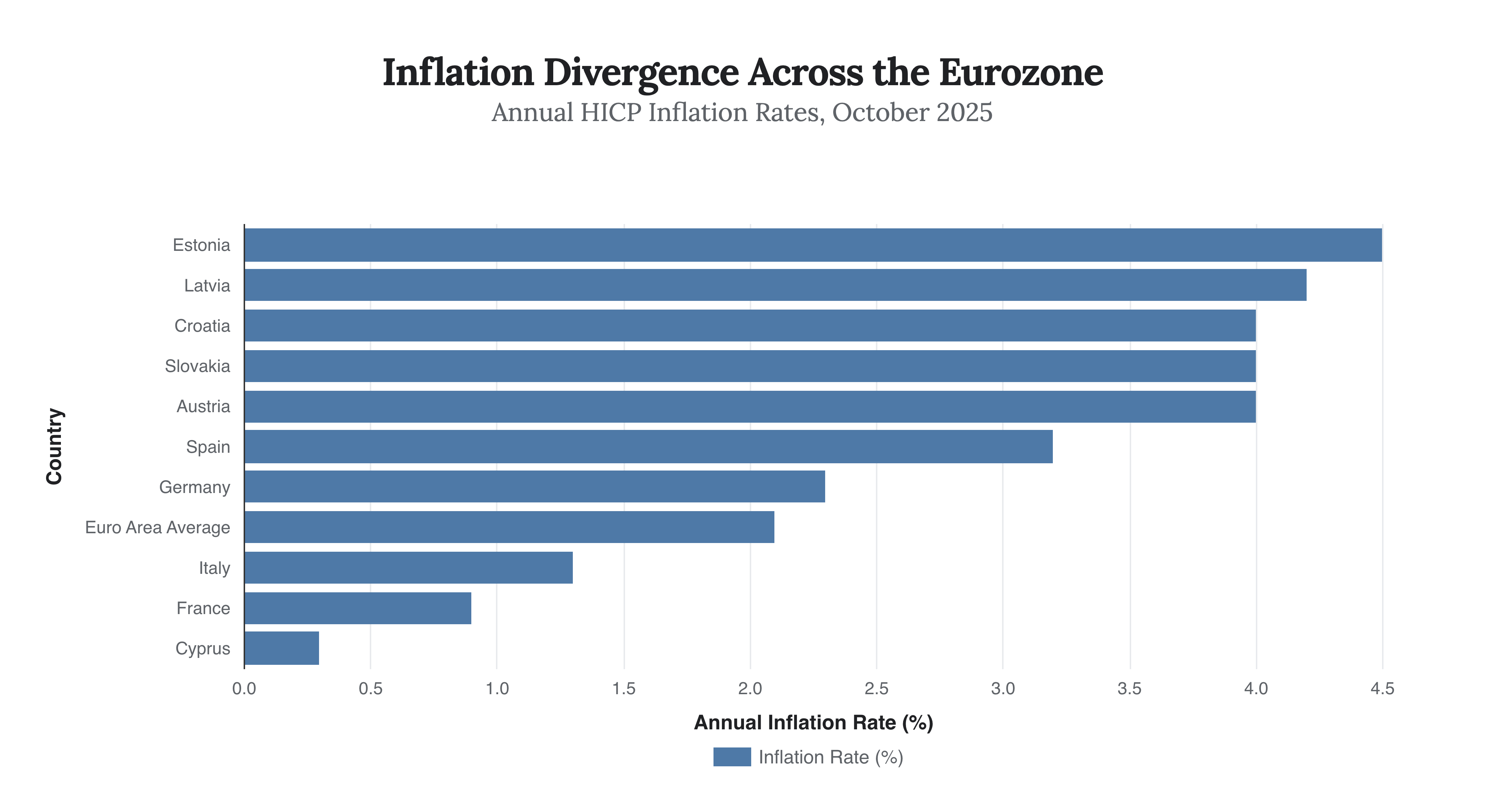
This chart highlights the wide dispersion of inflation rates across the Eurozone, underscoring the challenge for the ECB in setting a single monetary policy.
Growth and Risks: Navigating a Fragile Recovery
The Eurozone economy has proven more resilient than expected, managing a 0.2% GDP expansion in the third quarter of 2025. Robust labor markets and solid consumer balance sheets have provided a cushion. However, the outlook remains clouded by significant external risks and internal weaknesses. The ECB’s own staff projections forecast modest annual growth of 1.2% in 2025, slowing to 1.0% in 2026 before a slight recovery to 1.3% in 2027.
External Headwinds and Internal Resilience
The primary threats to the recovery are external. Ongoing global trade disputes, the imposition of U.S. tariffs, and a strong euro are weighing heavily on the manufacturing sector and exports. This is particularly acute for export-powerhouses like Germany, which has experienced economic stagnation. In contrast, the services sector, buoyed by strong tourism and consumer spending, continues to expand. This internal resilience is a key factor supporting the economy, but it is also what fuels the persistent services inflation that concerns the ECB.
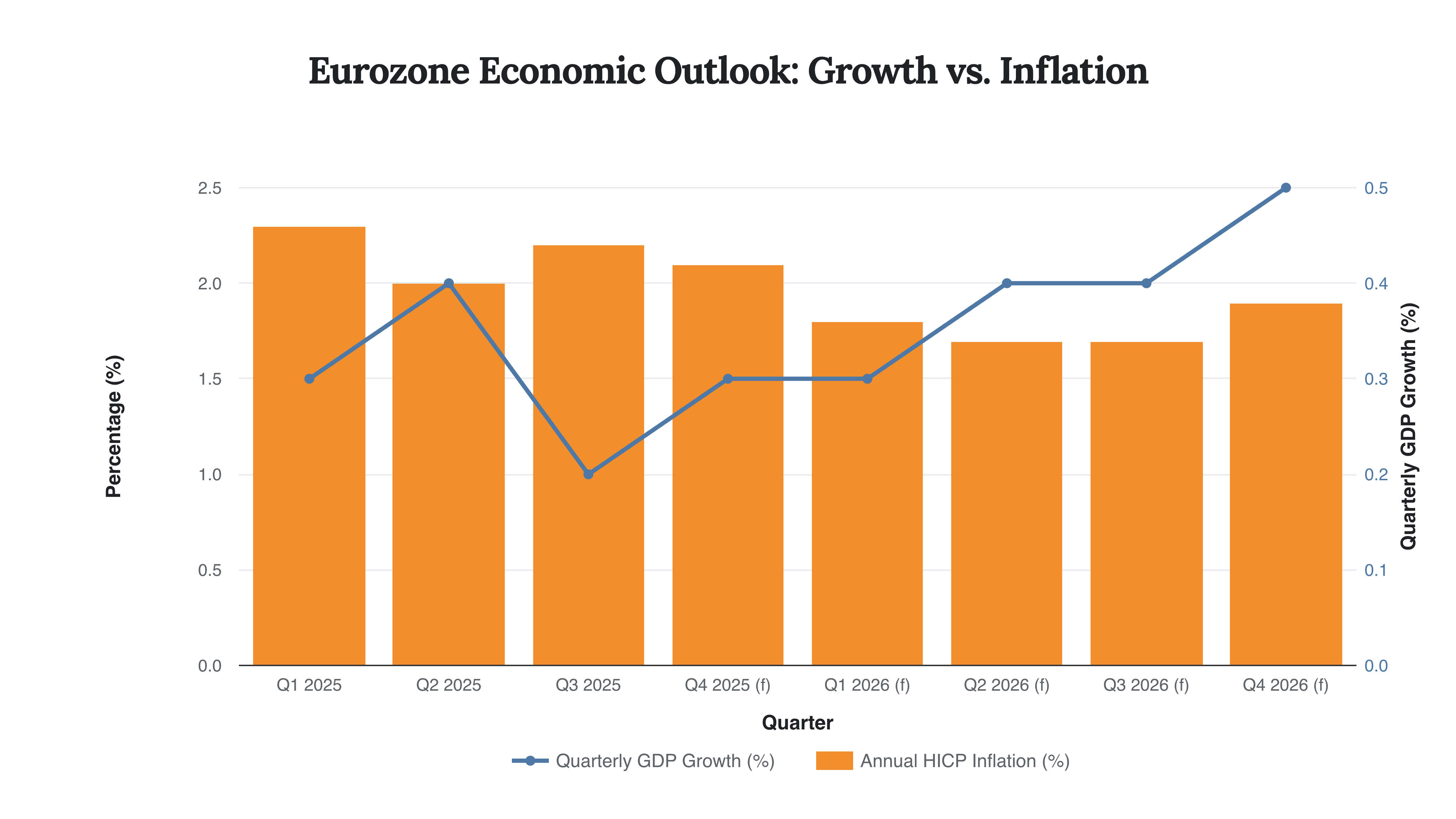
The combo chart displays the ECB’s challenge: fostering a fragile GDP recovery while ensuring inflation converges sustainably to its 2% target, with forecasts showing a slight dip below target in 2026.
“The stronger euro and the renewed tariff threats are clearly increasing disinflationary pressures for the eurozone, risking inflation undershooting and increasing the likelihood of more ECB rate cuts.”
- Carsten Brzeski, ING’s Global Head of Macro
Strategic Foresight: The Path to 2026
The ECB’s current holding pattern is unlikely to last indefinitely. The Governing Council’s future decisions will hinge on the evolving interplay between core inflation dynamics and the resilience of economic growth. Markets are currently pricing in a prolonged pause, with little chance of a rate cut before mid-2026. However, two primary scenarios could force the ECB’s hand sooner.
Scenario 1: Disinflation Stalls
If services inflation remains stubbornly high and core inflation fails to decline towards the 2% target, the ECB may be forced to adopt a more hawkish tone. While further rate hikes are a remote possibility given the fragile growth outlook, the central bank would likely signal that rates will remain at the current level for longer than markets anticipate. This would be intended to manage expectations and ensure that financing conditions remain sufficiently restrictive to cool domestic demand.
Scenario 2: Growth Falters
Conversely, a significant deterioration in the economic outlook could trigger a return to easing. An escalation of trade wars, a sharp slowdown in the global economy, or a domestic shock that undermines consumer confidence could push the Eurozone back towards recession. In this scenario, with headline inflation already near target, the ECB would have scope to cut rates to support the economy. Several analysts have penciled in the possibility of one or two rate cuts in 2026 should growth prove more sluggish than anticipated.
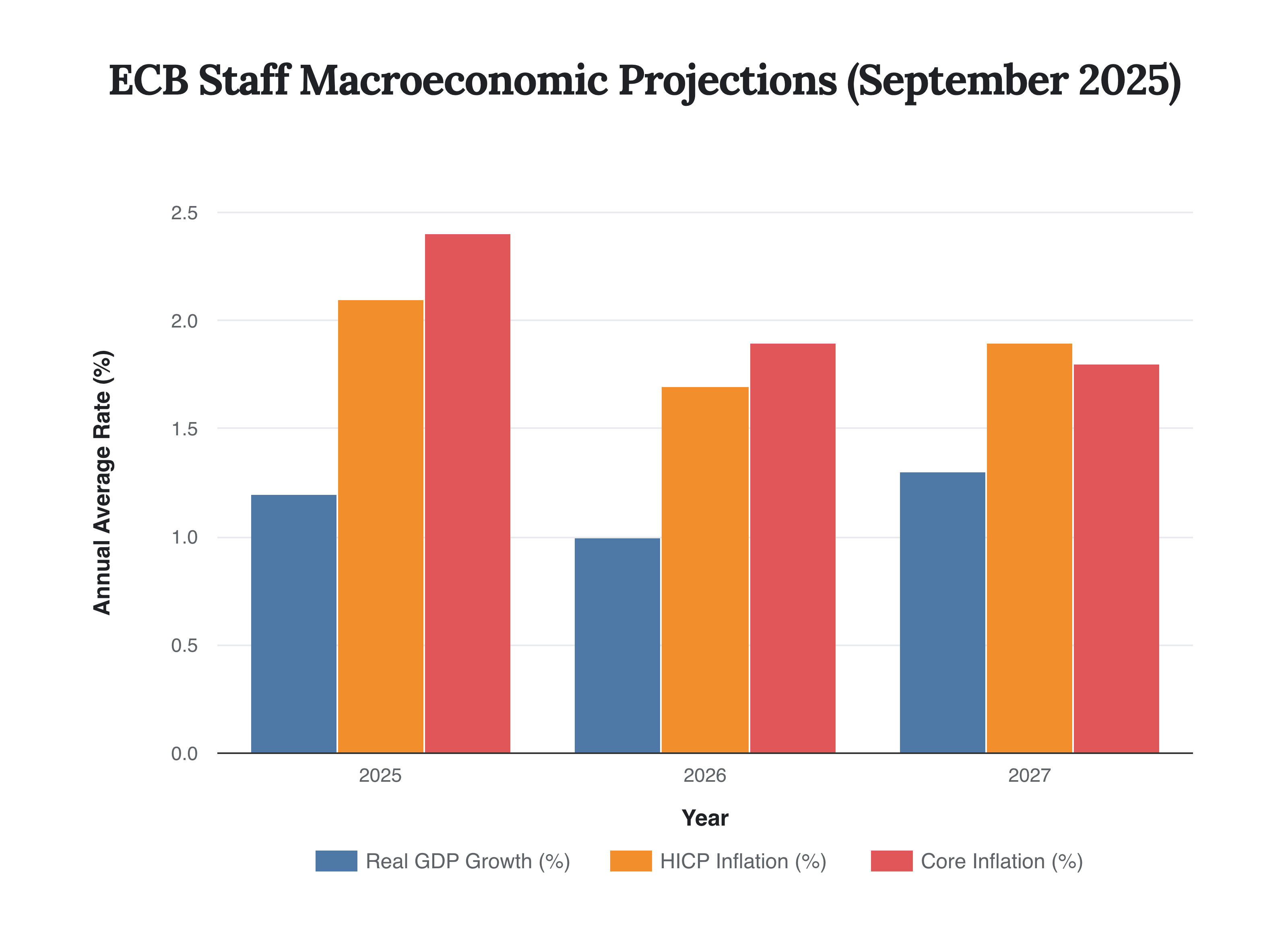
The ECB’s own projections reveal the fine line it is walking. While headline inflation is expected to dip below target in 2026, core inflation is forecast to converge more slowly, reaching 1.8% only by 2027.
The current phase of ECB policy is one of active observation. The dramatic policy pivot is complete, and the focus has shifted to fine-tuning. The Governing Council is navigating between the Scylla of resurgent inflation and the Charybdis of economic stagnation. For investors and corporate strategists, the key takeaway is that while the era of rapid rate changes is over, the direction of the next move is far from certain and will be dictated by the nuances of incoming data on core inflation and economic activity. The central bank has bought itself time, but the underlying tensions in the Eurozone economy remain unresolved.
The ECB’s greatest challenge is no longer fighting high inflation, but managing a deeply fragmented economic landscape where a single monetary policy must serve diverging national realities.
Wow, the 'final mile' thought really makes one wonder about what's next. So insightfull!