


The era of the legislative regulator is ending; the era of the actuarial regulator has begun. While Washington and Brussels debate the semantics of AI safety and climate disclosure, a quieter, more ruthless form of governance is already enforcing compliance across the global economy. It is not driven by voters or statutes, but by the binary logic of the term sheet: Covered or Exposed.
We are witnessing a fundamental inversion of the regulatory hierarchy. In 2024, the ability to operate a business is no longer solely contingent on a government license; it is contingent on insurability. From the C-suite to the server room, the “Shadow Regulatory State”—comprised of major insurers like Swiss Re, Munich Re, Chubb, and Beazley—is dictating the operational parameters of the modern corporation with a speed and precision that traditional bureaucracies cannot match.
The data is stark. In 2024, the global protection gap—the divide between economic losses and insured losses—widened to a record $1.83 trillion in premium equivalent terms. This figure represents more than just lost revenue; it represents a vast “uninsurable void” where capital is retreating, effectively regulating risky assets and behaviors out of the formal economy. If the government bans you, you can sue. If the insurer denies you, you simply vanish.
The Cyber Panopticon: Governance by Contract
The most visible frontier of this new regulatory regime is cybersecurity. Where the SEC’s disclosure rules are reactive and punitive, cyber insurance is proactive and preventative. The mechanism is simple: compliance is the condition of entry.
The “MFA Mandate” and the Ransomware Pivot
In 2023 and 2024, insurers stopped asking nicely. They began issuing “subjectivities”—binding requirements that mandated Multi-Factor Authentication (MFA), offline backups, and specific endpoint detection protocols before a policy could even be bound. The result was a massive, forced upgrade in global cyber hygiene that no government agency could have orchestrated.
The impact is visible in the divergence between attack frequency and severity. While the sheer volume of attacks has stabilized or even dipped due to better perimeter defenses forced by underwriters, the severity of successful breaches has skyrocketed as attackers target the remaining uninsurable vulnerabilities.
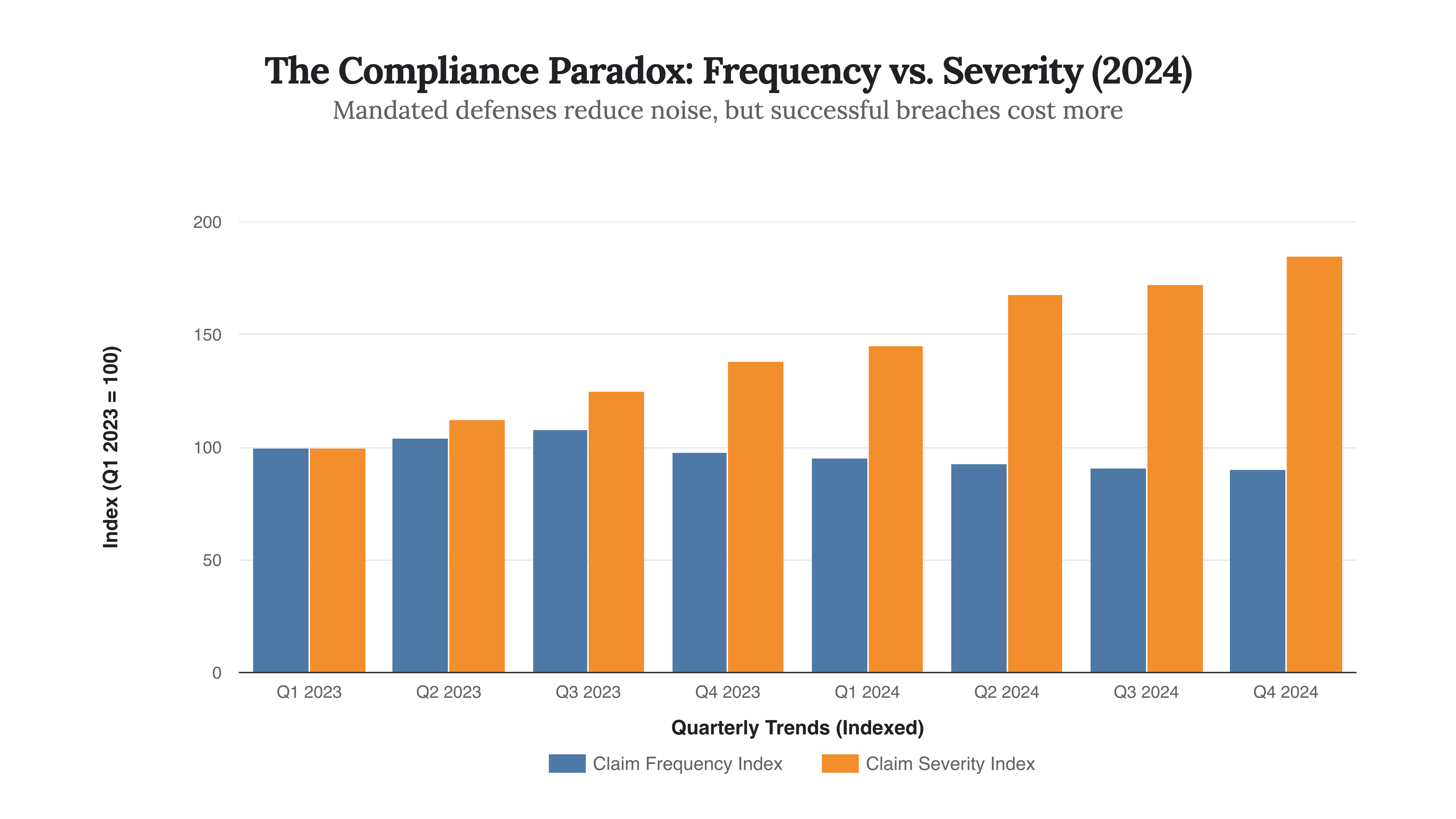
This chart reveals the strategic trade-off. Insurers have successfully “regulated” the low-hanging fruit out of the system. The 7% drop in frequency is a direct result of the “MFA Mandate.” However, the 68% spike in severity (to an average of $353,000 per incident) indicates that while the insurance-led regulatory wall is higher, the cost of breaching it has grown exponentially. We are moving toward a binary state: highly secure, insured fortresses versus uninsurable, exposed targets.
The Climate Retreat: Redlining the Planet
While cyber insurers are enforcing behavior, property insurers are enforcing geography. The withdrawal of major carriers like State Farm and Allstate from California, and the fragile state of Florida’s market, is a form of zoning by premium. It achieves rapidly what local politicians fear to do: it signals that certain areas are no longer economically viable for human habitation.
The $318 Billion Reality Check
The “Protection Gap” is the most important metric in climate economics. It measures the difference between total economic loss and insured loss. In 2024, this gap didn’t just persist; it calcified. Swiss Re reports that of $318 billion in global economic losses from natural catastrophes, only $137 billion was insured. This leaves nearly 60% of the damage on the balance sheets of governments, corporations, and individuals.
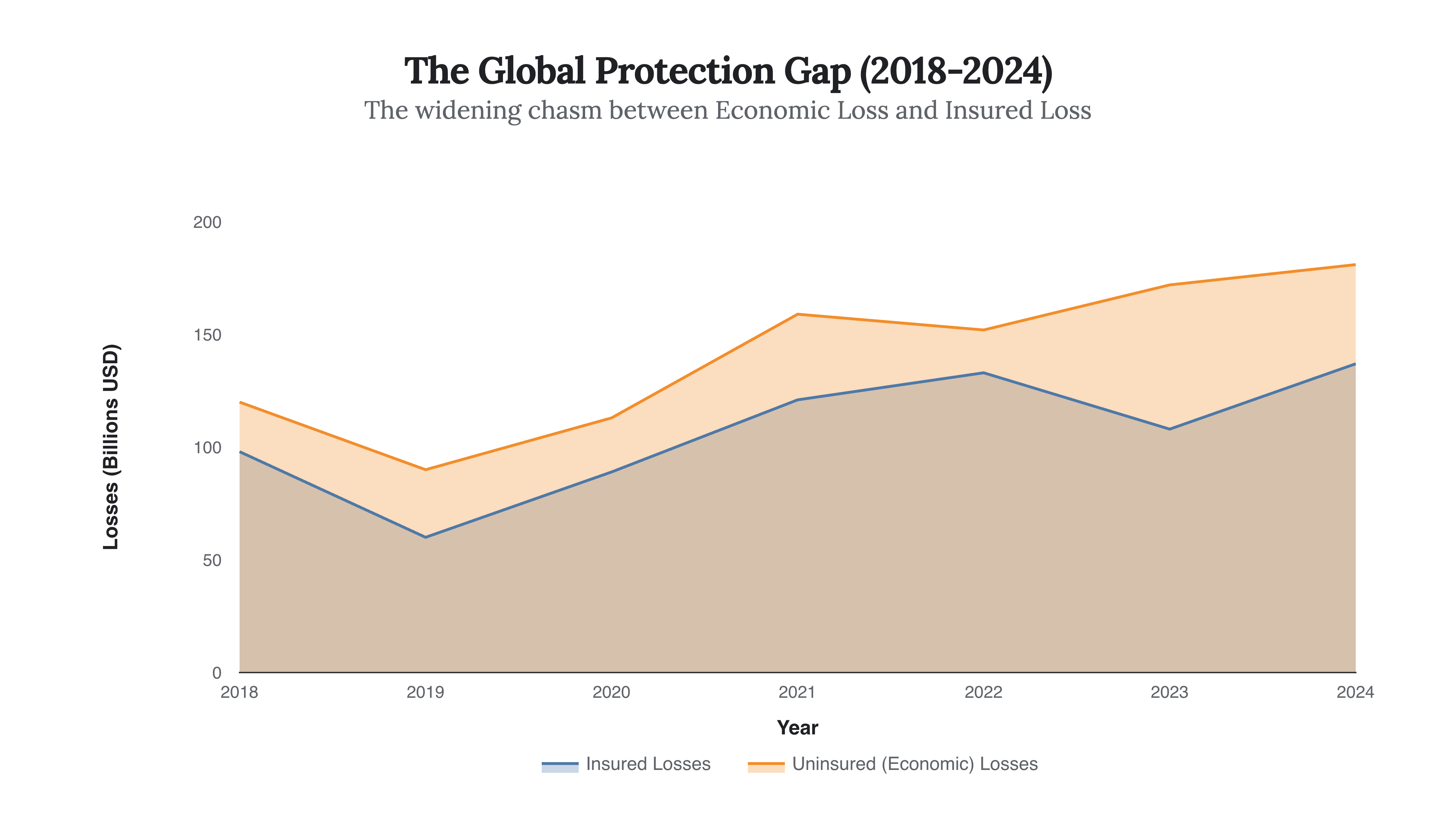
This widening gap is the mechanism of the Shadow Regulator. By refusing to cover the $181 billion “uninsured” portion, the market is effectively imposing a tax on location. In California, the FAIR Plan (the insurer of last resort) has seen its exposure explode to over $340 billion—a 20% year-over-year increase. This is the market screaming that these assets are toxic. The state is stepping in where
