



In a legal showdown with profound implications for the separation of powers, the global economy, and the American consumer, the U.S. Supreme Court is currently deliberating the legality of the Trump administration’s sweeping tariff regime. At the heart of the consolidated cases, known as Learning Resources v. Trump, lies a single, monumental question: Can a U.S. President unilaterally impose trillions of dollars in taxes on Americans under the guise of a national emergency?
The administration’s novel use of the 1977 International Emergency Economic Powers Act (IEEPA) to justify broad-based tariffs has been struck down by three lower courts, setting the stage for a definitive ruling that will either curb or dramatically expand executive authority. With the Tax Foundation projecting the contested tariffs could generate nearly $1.8 trillion in revenue over the next decade while simultaneously reducing GDP and costing hundreds of thousands of jobs, the court’s decision represents one of the most significant moments for U.S. trade policy and constitutional law in generations. This briefing deconstructs the legal arguments, analyzes the economic fallout, and provides strategic foresight into the future of presidential trade power.
The IEEPA Gambit: A New Frontier in Executive Authority
The core of the legal conflict rests on the Trump administration’s unprecedented interpretation of the International Emergency Economic Powers Act (IEEPA). Historically, presidents have used IEEPA to impose sanctions or freeze assets of foreign adversaries during national emergencies. However, the current administration has repurposed the statute, claiming that its provision allowing the president to “regulate importation” grants the authority to impose tariffs—a form of tax—on nearly all U.S. trading partners. This move has been justified by declaring national emergencies related to the trade deficit and the trafficking of fentanyl across U.S. borders.
The Constitutional Challenge: Congress’s Power to Tax
Challengers, a coalition of small businesses and twelve states, argue this interpretation is a dangerous overreach that usurps a power the Constitution explicitly grants to Congress: the power to “lay and collect Taxes, Duties, Imposts and Excises.” During oral arguments on November 5, 2025, several Supreme Court justices, including conservatives, appeared to share this concern. Chief Justice John Roberts noted that the administration was claiming “major authority” from a statute that does not even use the word “tariff” and has never before been used to justify such levies. The central argument from the challengers is that tariffs are taxes on American consumers, and such a core power cannot be delegated to the president without exceptionally clear language from Congress.
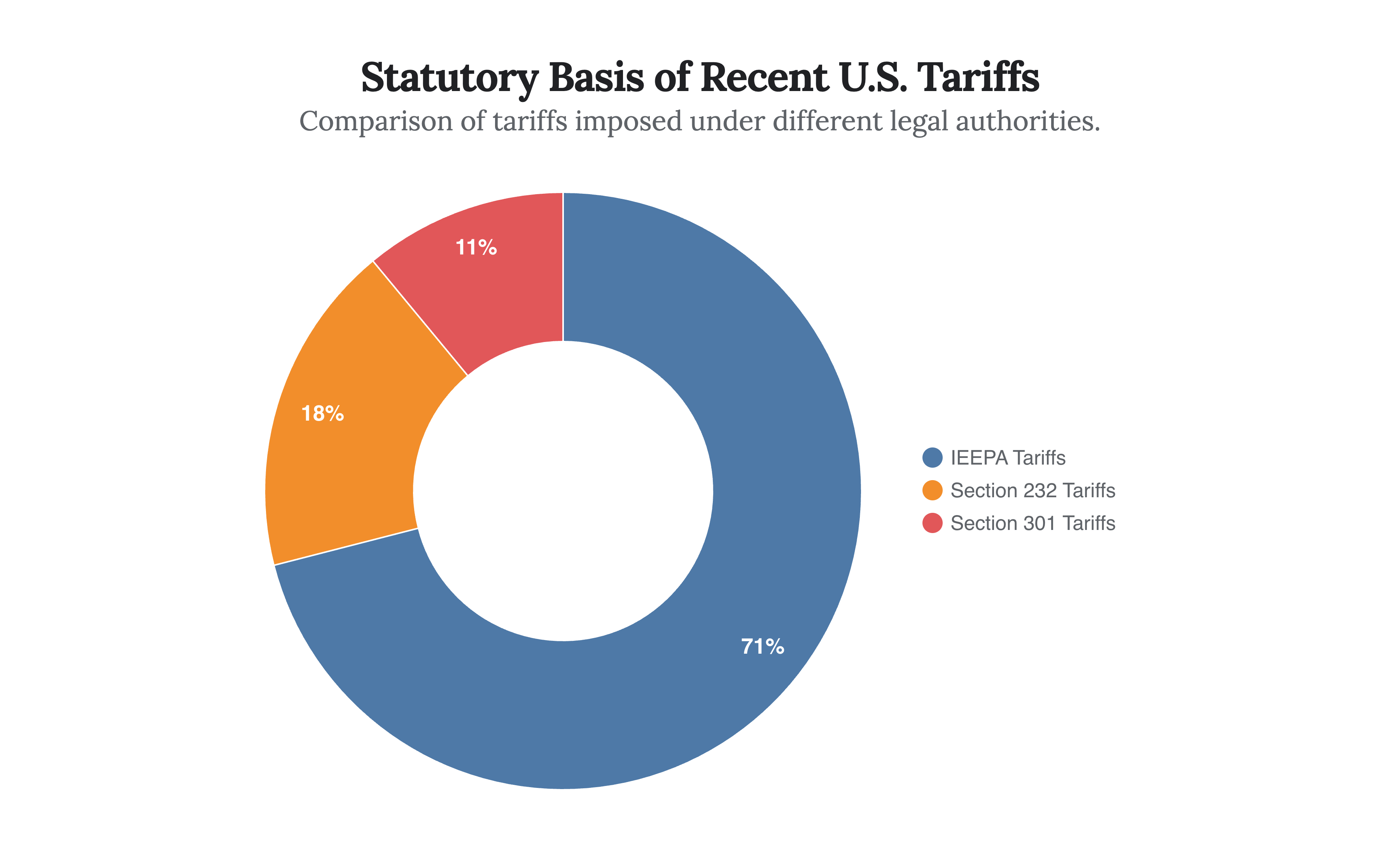
Caption: Tariffs imposed under the International Emergency Economic Powers Act (IEEPA), now being challenged at the Supreme Court, represent the vast majority of the Trump administration’s recent trade actions, highlighting the significance of the court’s impending decision.
The Administration’s Defense: National Security and Foreign Policy
In response, the administration’s lawyers have argued that the tariffs are not a tax but a regulatory tool used in the realm of foreign policy and national security, areas where the president has traditionally been afforded broad deference. The Solicitor General contended that the power to “regulate foreign commerce” includes the ability to implement what he termed “regulatory tariffs.” However, this defense was met with skepticism from the bench, with justices questioning the lack of defined limits on this purported power. Justice Neil Gorsuch raised concerns about creating a “one-way ratchet toward the gradual accretion of power” by the executive branch.
The $1.8 Trillion Price Tag: Analyzing the Economic Stakes
The legal debate is inextricably linked to the enormous economic consequences of the tariffs. The sheer scale of the IEEPA levies dwarfs previous trade actions, fundamentally altering the landscape for American businesses and households. According to the non-partisan Tax Foundation, the tariffs have already collected over $88 billion in the current fiscal year alone. This revenue comes at a significant cost to the broader economy.
Macroeconomic Headwinds
Economic analyses predict that if the tariffs remain in effect, they will act as a significant drag on the U.S. economy. Projections indicate a long-run reduction in GDP of 0.4% to 0.6% and the loss of over 428,000 full-time jobs. These negative effects stem from increased input costs for domestic manufacturers, retaliatory tariffs from trading partners that harm U.S. exporters, and a general climate of uncertainty that chills investment.
“Not only are the tariffs directly stagflationary, but they also create the additional uncertainty that is detrimental to future economic activity.” - Dr. Wayne Winegarden, Pacific Research Institute
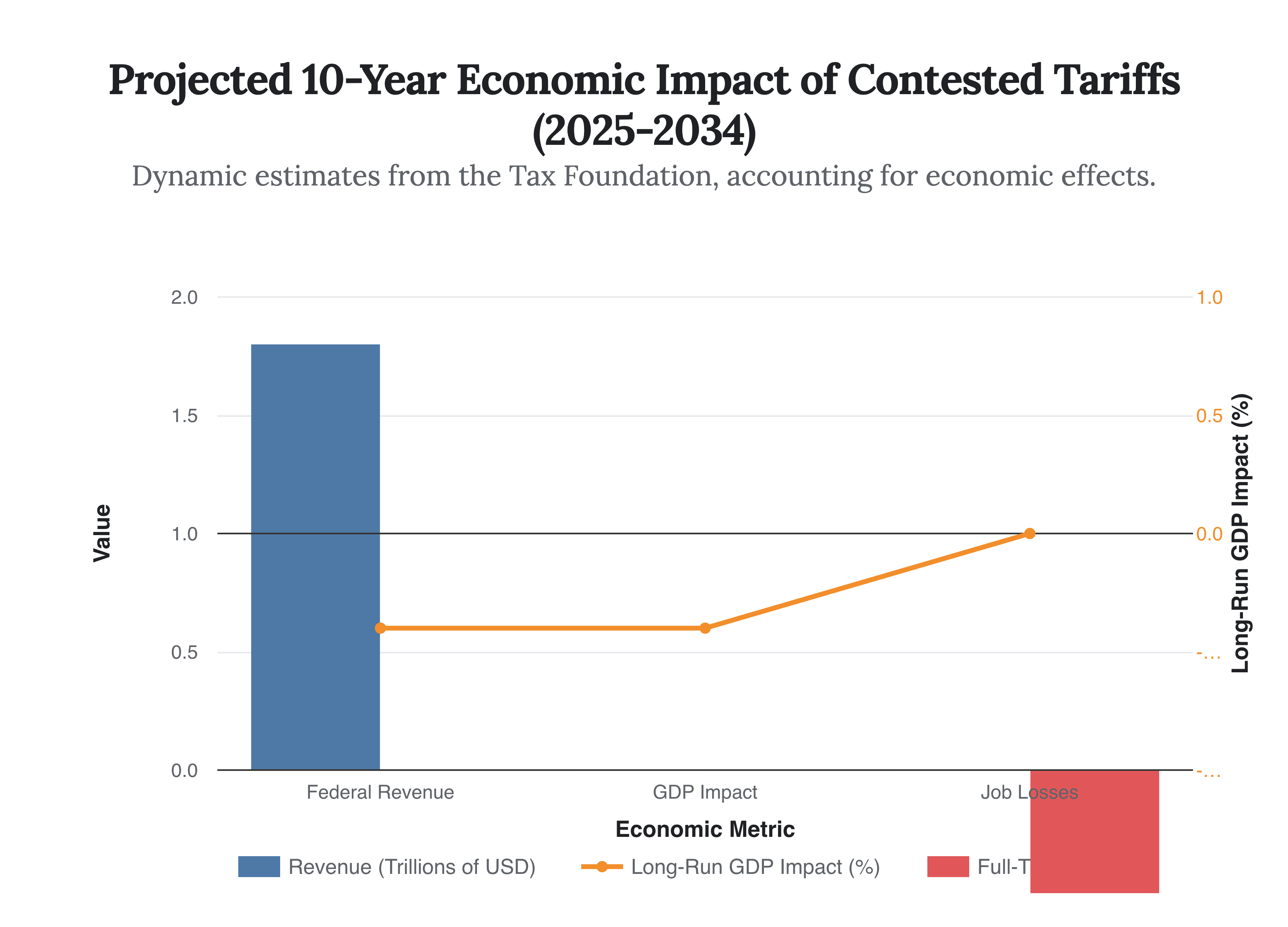
Caption: This chart illustrates the dual economic nature of the IEEPA tariffs as projected over a decade: while they generate substantial federal revenue, they are expected to have a negative impact on overall GDP and employment.
The Direct Cost to Consumers
Despite being levied on imports, the economic burden of tariffs is overwhelmingly borne by domestic consumers and businesses. Importers pass the increased costs down the supply chain, resulting in higher prices for a wide array of goods. The Tax Foundation estimates that the tariffs amount to an average tax increase of $1,000 to $1,200 per U.S. household this year. This direct impact on household budgets has contributed to inflationary pressures and has been a central argument for the coalition of small businesses challenging the executive orders.
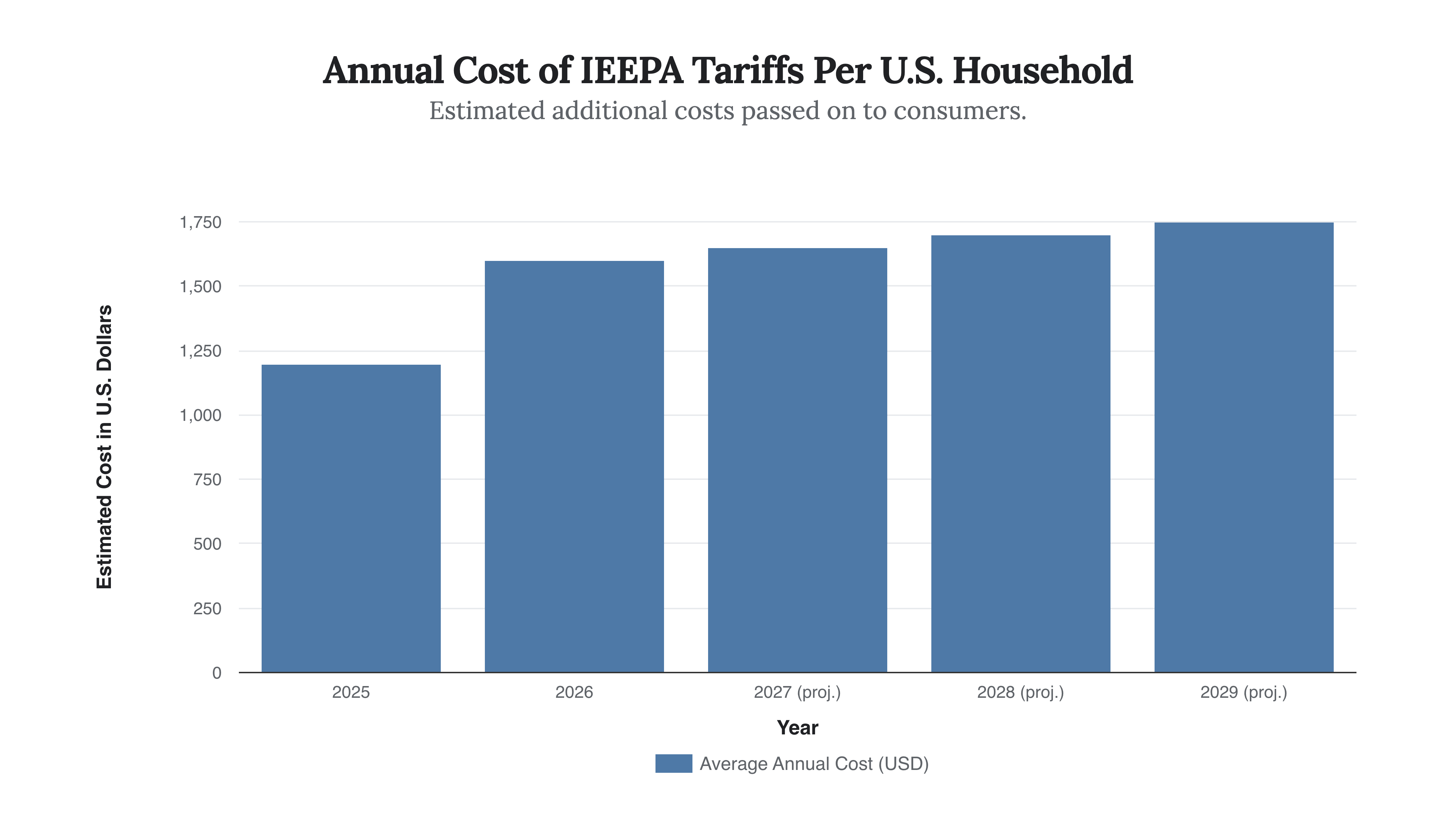
Caption: The direct financial burden on American families is projected to increase if the tariffs remain in place, making the Supreme Court’s decision a matter of kitchen-table economics.
The Specter of the ‘Major Questions Doctrine’
Looming over the case is the “major questions doctrine,” a principle of statutory interpretation increasingly utilized by the Supreme Court’s conservative majority. The doctrine asserts that in “extraordinary cases” involving issues of vast economic and political significance, an executive agency must have clear, explicit, and unambiguous authorization from Congress to act. The Court invoked this doctrine to block major Biden administration policies, including student loan forgiveness and Covid-19 vaccine mandates.
A Test of Judicial Consistency
The tariffs case presents a crucial test of whether the court will apply this doctrine consistently, regardless of the president’s party. Several justices have signaled that the administration’s attempt to derive virtually unlimited tariff power from the vague phrase “regulate importation” fits the definition of a major question. A decision to strike down the tariffs on these grounds would reaffirm the doctrine and represent a significant reassertion of congressional authority in economic policymaking.
“It does seem like that’s a major authority.” - Chief Justice John Roberts
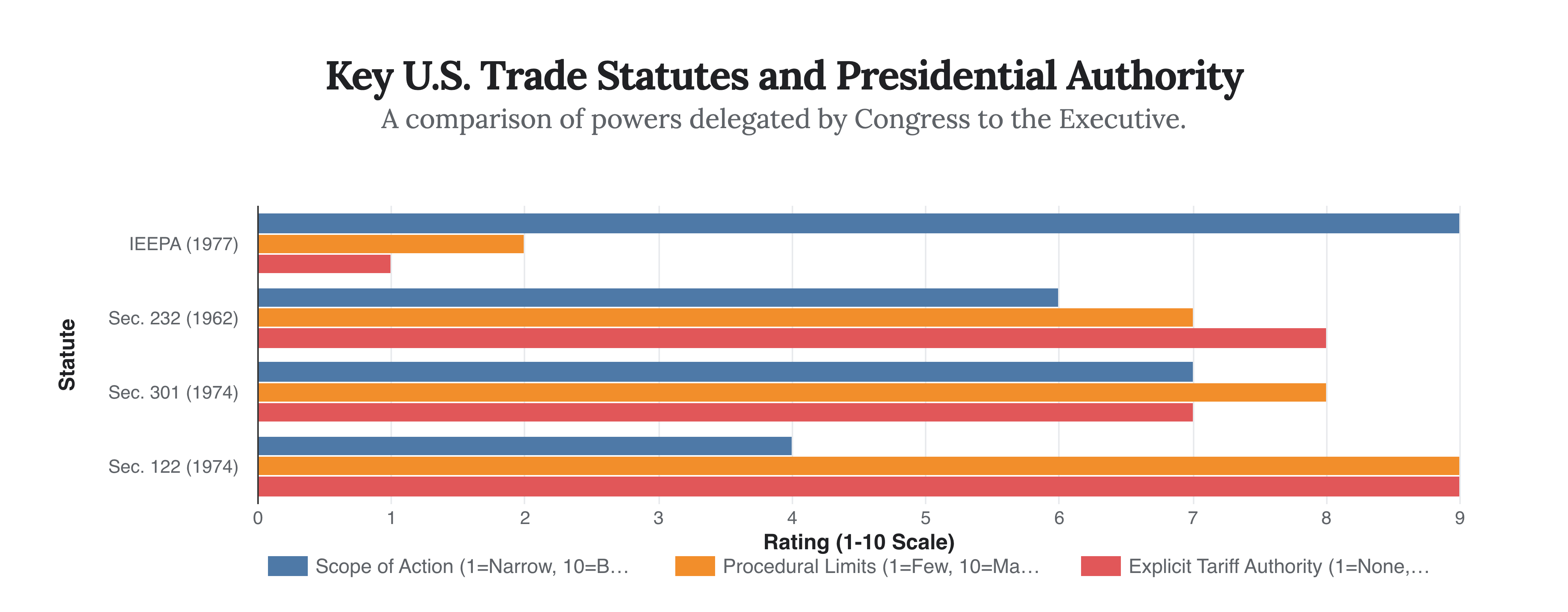
Caption: This chart visualizes the core legal dispute. IEEPA, the basis for the contested tariffs, offers broad scope with few limits but lacks the explicit tariff authority found in other trade laws, making it a candidate for scrutiny under the major questions doctrine.
Strategic Foresight: The Future of U.S. Trade Policy
Regardless of the final ruling, the Supreme Court’s decision will trigger significant strategic shifts. The outcome will redefine the toolkit available to this and future presidents in conducting trade policy and international economic negotiations. We anticipate one of three primary scenarios.
Scenario 1: Administration Loses, Tariffs Invalidated
This is the most likely scenario given the skepticism expressed by a majority of justices. A ruling against the administration would invalidate the IEEPA tariffs. A key follow-on question would be whether the Court orders the refund of the hundreds of billions of dollars already collected, a move that would have significant fiscal implications. In this outcome, the administration has signaled it has a “plan B,” likely involving attempts to reimpose similar tariffs using other statutes like Section 232 (national security) or Section 301 (unfair trade practices). However, these tools are more targeted and procedurally cumbersome, requiring investigations and consultations, thereby limiting the president’s flexibility.
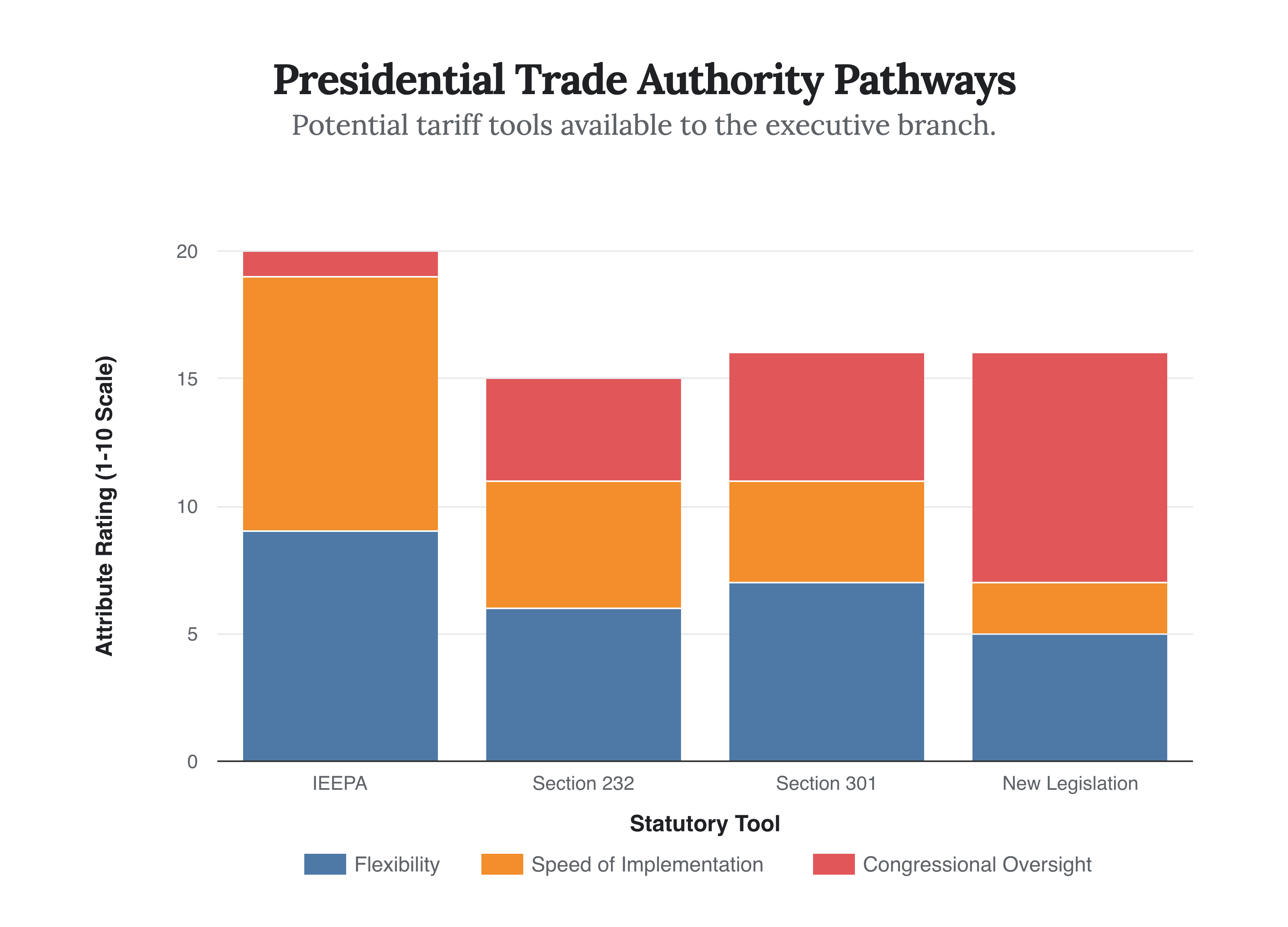
Caption: A loss for the administration on IEEPA would force a pivot to other legal authorities that offer less speed and flexibility and are subject to greater procedural checks, fundamentally changing the strategic calculus of U.S. trade policy.
Scenario 2: Administration Wins, Executive Power Expands
If the Court sides with the administration, it would legitimize the use of emergency powers to circumvent Congress in matters of trade. This would represent a dramatic expansion of executive authority, setting a powerful precedent for future presidents of both parties. A future president could declare a climate emergency and impose carbon tariffs, or a border emergency to tax remittances. For global markets and U.S. trading partners, this outcome would inject a new level of permanent uncertainty into U.S. trade policy, making long-term commitments and negotiations more fraught with risk.
Scenario 3: A Split Decision
The Court could issue a narrow or split decision, perhaps allowing for IEEPA-based tariffs only when they are very specifically and narrowly tailored to a declared emergency. For example, it could uphold the fentanyl-related tariffs on Mexico and China while striking down the broader “reciprocal tariffs” related to the trade deficit. While a legal compromise, this outcome would likely create more confusion, spawning new rounds of litigation to define the precise boundaries of this newly interpreted presidential power.
The Supreme Court’s pending decision is more than a ruling on a specific set of tariffs; it is a defining moment for the balance of power within the U.S. government. The outcome will dictate the rules of engagement for international trade, impact the financial health of millions of American households, and either rein in or unleash a potent new weapon in the arsenal of presidential power. Ultimately, the justices are not just interpreting a statute, they are drawing the line between presidential authority and congressional power for the 21st century.