


Wall Street was just handed a $135 billion bill for the future of artificial intelligence, and the market’s response was a chilling endorsement of the price tag: approximately 16,000 human jobs.
As of mid-March 2026, Meta Platforms is preparing to execute a workforce reduction of 20% or more. This is not a standard corporate restructuring born of shrinking revenues or a slowing macroeconomic environment. Instead, it is a deliberate, strategic execution designed to offset an unprecedented explosion in capital expenditure. Meta is explicitly repricing its human capital to fund its silicon infrastructure.
The Silicon Barrier to Entry
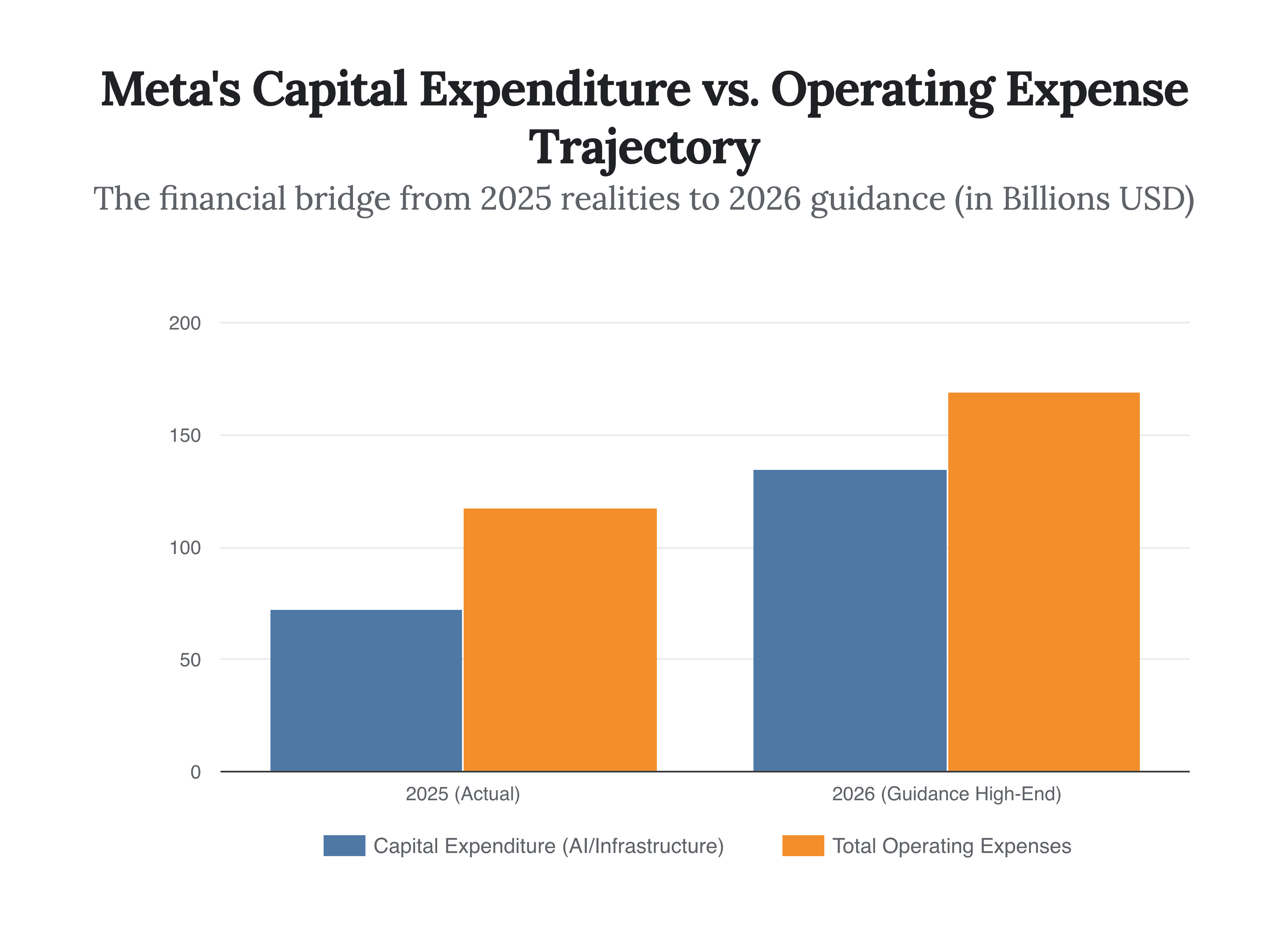
In its latest financial disclosures, Meta announced a capital expenditure (CapEx) guidance for 2026 that ranges between $115 billion and $135 billion. To contextualize this leap, Meta’s CapEx in 2025—which was already considered exorbitant by historical standards—sat at $72.2 billion. The company is effectively doubling its infrastructure footprint overnight. The lion’s share of this war chest is earmarked for the “Meta Superintelligence Labs,” funding the procurement of next-generation GPU clusters, bespoke data center cooling solutions, and proprietary silicon development.
Underneath these staggering figures lies a masterclass in strategic maneuvering: the deployment of a credible threat. By committing up to $135 billion to AI infrastructure in a single fiscal year—a figure that eclipses the gross domestic product of many sovereign nations—Chief Executive Mark Zuckerberg is attempting to build an insurmountable moat. This is an information asymmetry play at its core. Meta knows exactly how resource-intensive the next generation of multimodal AI agents will be, and they are telegraphing to the rest of the industry that they are willing to weaponize their balance sheet to dominate it.
By open-sourcing its models, Meta is actively attempting to commoditize the AI software layer. If the models themselves are free and ubiquitous, the only way to generate alpha is to own the distribution network (which Meta has through its 3.5 billion daily active users) and the underlying compute infrastructure. This strategy effectively destroys the pricing power of closed-source competitors. However, this strategy requires an unrelenting flow of capital into hardware. The servers must be fed, and in 2026, they are being fed by the salaries of the corporate workforce.
By explicitly tying a 20% workforce reduction to a $135 billion infrastructure surge, Meta has fundamentally repriced human labor as a mere funding mechanism for server architecture.
The Free Cash Flow Squeeze
Even for a behemoth operating at Meta’s scale, a $135 billion CapEx bill triggers severe systemic constraints. When capital expenditures approach nearly 49% of total projected sales, a company’s Free Cash Flow (FCF) yield inevitably plummets. In late 2025, Meta’s trailing FCF yield sat comfortably at 3.3%. Today, driven by the AI spending blitz, it has compressed to roughly 2.6%. For institutional investors who value technology giants primarily on their free cash flow rather than top-line revenue, this compression is a glaring red flag.
When the $135 billion guidance initially surfaced, investors balked. The math simply did not support the spending without a corresponding sacrifice. Then, the news of the 20% workforce reduction leaked via Reuters. The stock immediately popped 3% in premarket trading. The message from the market was unequivocal: if you want to buy the servers, you have to sell the humans.
Unlock deeper strategic alpha with a 10% discount on the annual plan.
Support the data-driven foresight required to navigate an era of radical uncertainty and join a community of institutional-grade analysts committed to the truth.
The Era of Autonomous Scaling
This 20% cut—representing over 15,000 of Meta’s nearly 79,000 employees recorded at the end of 2025—is being framed internally as the evolution of the modern corporate structure. This is distinctly different from Zuckerberg’s 2022 and 2023 “Year of Efficiency,” which eliminated 21,000 roles primarily to correct pandemic-era over-hiring. The 2026 bloodletting is about permanent, AI-driven operational automation.
The internal restructuring metrics reveal the true endgame. Meta recently established a new AI engineering organization where the manager-to-employee ratio is targeted to hit an astonishing 1:50. The traditional corporate pyramid is being violently flattened. As Zuckerberg noted to investors, projects that previously required sprawling, multi-disciplinary teams are now being executed by a single highly talented engineer augmented by an array of autonomous AI agents.

The Reality Labs Ghost and Product Pressures
To understand the absolute ruthlessness of this pivot, one must look at the ghost of Meta’s past: the Metaverse. Since 2020, Meta’s Reality Labs division has generated operating losses approaching an eye-watering $80 billion. Just this past January, Meta quietly laid off another 1,500 employees from this division. The market watched the company light tens of billions on fire for virtual reality experiences with minimal consumer traction. Wall Street was completely unwilling to let Meta repeat that history with artificial intelligence unless there were guaranteed margin protections in place.
Furthermore, this radical shift is not purely offensive; it is laced with deep defensive urgency. Meta’s scramble for compute power comes after a bruising stretch for its in-house model development. Early iterations of its open-source Llama 4 models produced highly scrutinized and often misleading benchmark results. The company was quietly forced to shelve the largest version of the Llama 4 model—internally dubbed “Behemoth”—which was initially slated for release last year.
Now, the pressure is squarely on the Meta Superintelligence Labs to deliver its next-generation models, codenamed “Avocado” and “Mango.” These models have reportedly been delayed until May 2026 after falling short of internal performance expectations. When you are spending $135 billion, internal delays are not merely technical setbacks; they are existential financial threats. To buy the time and runway needed to fix these models, Meta must trim its operating expenses—projected to hit up to $169 billion in 2026—anywhere it can. The fastest lever to pull is headcount.
A Zero-Sum Trade Between Carbon and Silicon
Meta is not alone in this brutal calculus. The entire Big Tech landscape has realized that AI infrastructure is a zero-sum game played against their own payrolls. In January 2026, Amazon eliminated 16,000 corporate roles—nearly 10% of its corporate workforce—specifically citing the rollout of generative AI and autonomous agents as the catalyst. A month later, the fintech giant Block slashed roughly 40% of its staff, with CEO Jack Dorsey directly attributing the sweeping cuts to the productivity increases enabled by AI tools.
We are witnessing a fundamental decoupling in the technology sector: the objective is no longer to scale human capital alongside revenue, but to eradicate the human bottleneck entirely.
Historically, a tech company’s growth was inextricably linked to its human capital footprint. Scaling revenues meant scaling engineering, sales, and administrative teams. Today, the curve has inverted. If Meta successfully navigates this transition, the financial upside is paradigm-shifting. The company is already seeing its AI-driven “Advantage+” ad optimization tools drastically improve targeting and engagement across Facebook and Instagram.
If they can maintain that ad revenue growth while permanently suppressing their payroll expenses via AI agents, their operating margins will expand to unprecedented levels once the infrastructure build-out tapers off. However, this is an incredibly precarious tightrope to walk. Meta is betting its entire corporate future—and the livelihoods of 16,000 employees—on the premise that its $135 billion investment will yield true superintelligence before investor patience runs dry. It is a high-stakes wager where the chips are silicon and the ante is human capital. The age of the sprawling, human-powered tech empire is over. We have officially entered the era of the autonomous hyper-scale machine.
“It is a high stakes wager where the chips are silicon and the ante is human capital.”