


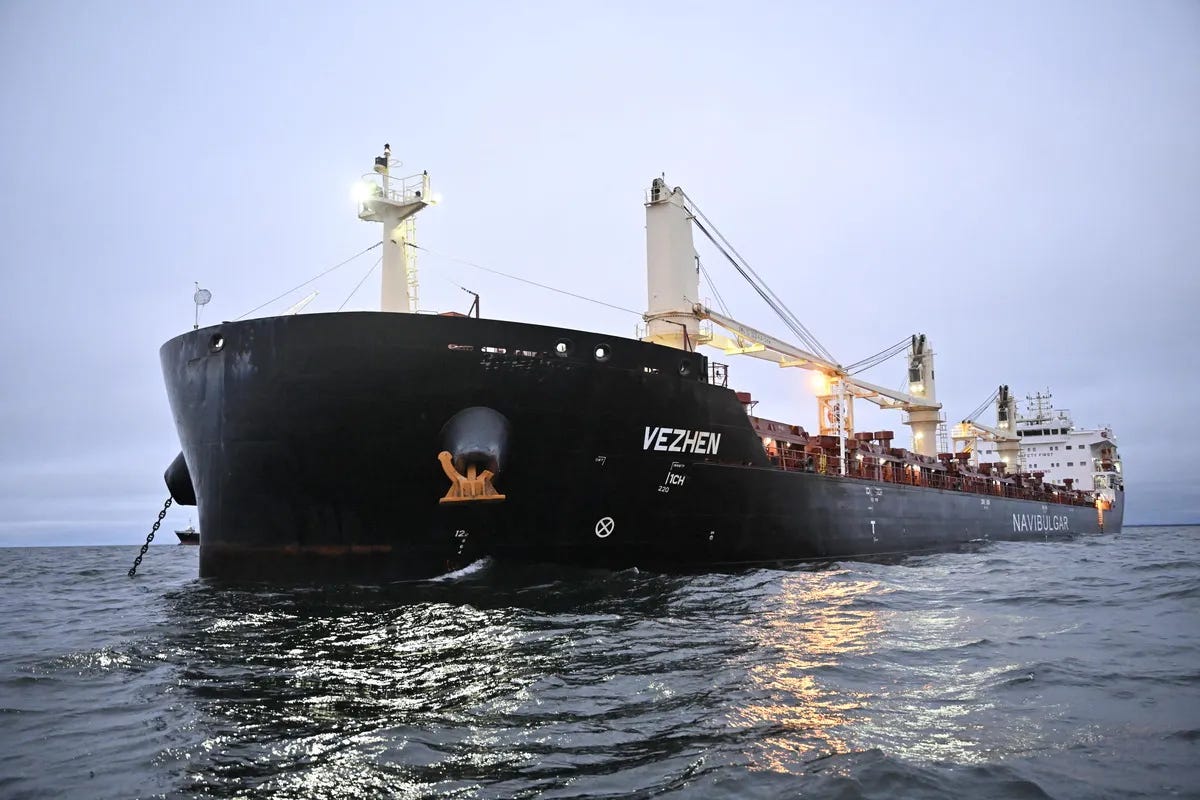
The War Has Already Started
(You Just Can’t See It)
The traditional binary of “war” and “peace” is dead. It has been replaced by a spectrum of conflict so broad and active that our current definitions fail to capture it. The most critical intelligence coming out of late 2024 and early 2025 is not about troop movements in Ukraine or missile stockpiles in the Levant; it is about the industrialization of the Grey Zone.
In the first four months of 2024 alone, aviation authorities in the Baltic region reported over 123,000 incidents of GPS jamming—a volume of interference that implies not just harassment, but a systemic, automated denial-of-service attack on NATO’s eastern flank. Simultaneously, Russia’s “Shadow Fleet” has grown to transport 4.1 million barrels of oil per day, effectively creating a parallel global economy immune to Western financial leverage.
This briefing maps these invisible frontlines. We are witnessing a transition from sporadic “hybrid” tactics to sustained, high-frequency campaigns designed to degrade Western infrastructure, economy, and resolve without ever crossing the threshold of Article 5. The strategic implication is clear: Deterrence based on the threat of kinetic war is failing because the adversary has already found a way to win without fighting.
1. The Maritime Grey Zone: The Siege of the South China Sea
While Western eyes are fixed on the Taiwan Strait, a more insidious conquest is nearing completion in the South China Sea (SCS). The data from 2024 paints a picture not of “incursions” but of permanent occupation. As shown in Figure 1, the China Coast Guard (CCG) has dramatically increased its “days on station” across key disputed features.
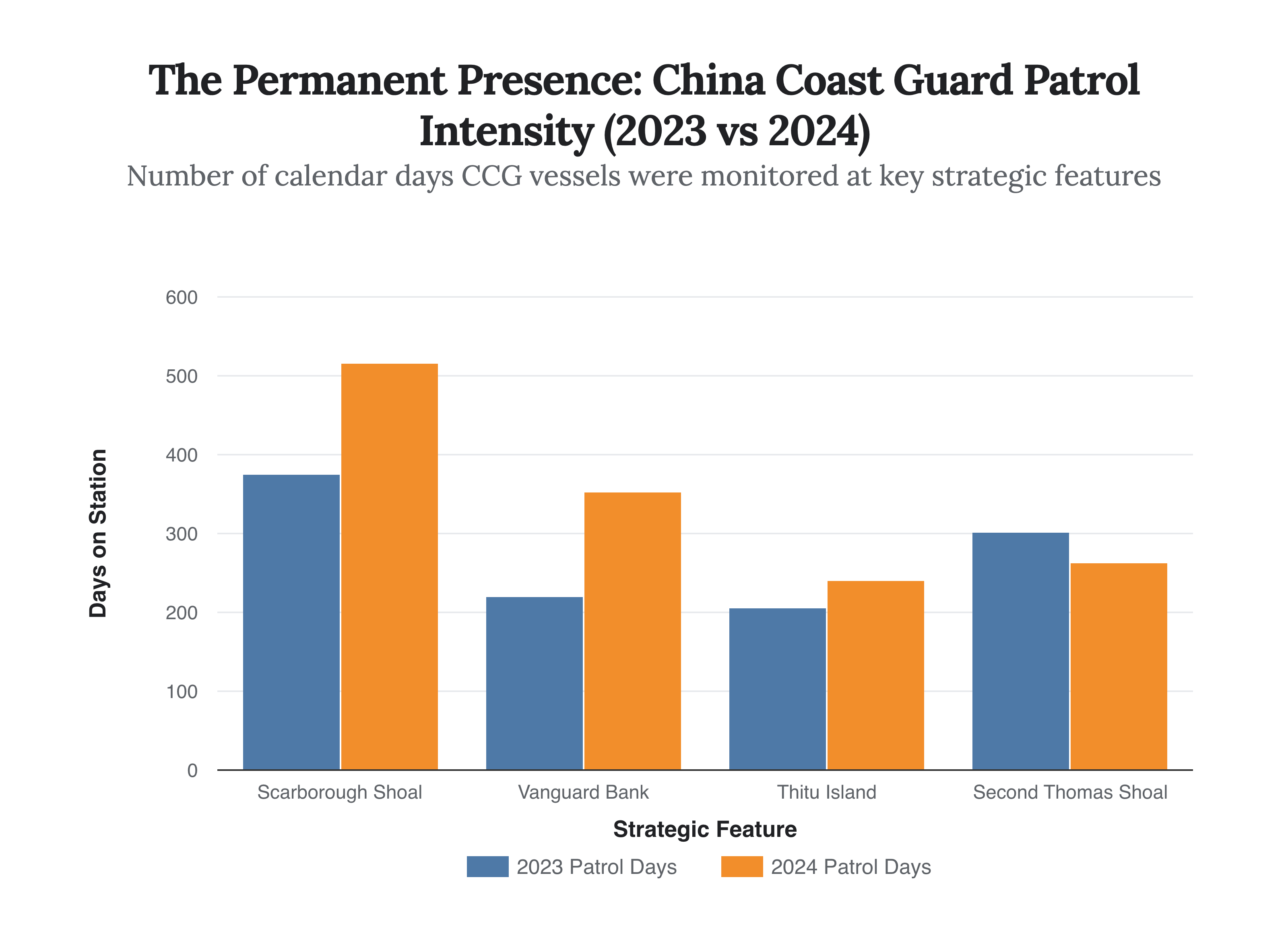
Figure 1: The Industrialization of Coercion. Data from 2024 reveals a significant escalation in the duration and persistency of China’s maritime presence. Note the 37% increase in presence at Scarborough Shoal, signaling a shift from periodic patrols to a near-permanent blockade posture. The slight decrease at Second Thomas Shoal reflects a temporary tactical pause following the July provisional arrangement, not a strategic withdrawal.
The “354-Day” Strategy
At Vanguard Bank, a critical energy-rich feature claimed by Vietnam, CCG vessels were present for 354 days in 2024—up from 221 days in 2023. This is effectively a 97% persistence rate. Beijing is no longer visiting these waters; it is living there. This “salami slicing” has evolved into “salami occupation,” where the sheer ubiquity of Chinese hulls makes resistance logistically and diplomatically impossible for smaller Southeast Asian claimants.
“China’s coast guard is as active as ever in patrolling every corner of its vast claim... signaling a continued emphasis on maritime presence that has effectively normalized coercion.” — Asia Maritime Transparency Initiative (AMTI), 2025 Analysis
Strategic Implication: The U.S. Navy’s “Freedom of Navigation Operations” (FONOPs) are becoming strategically irrelevant. A destroyer passing through once a month cannot counter a constabulary force that never leaves. The Grey Zone victory condition here is de facto sovereignty achieved through exhaustion.
2. The Economic Grey Zone: The Rise of the Phantom Fleet
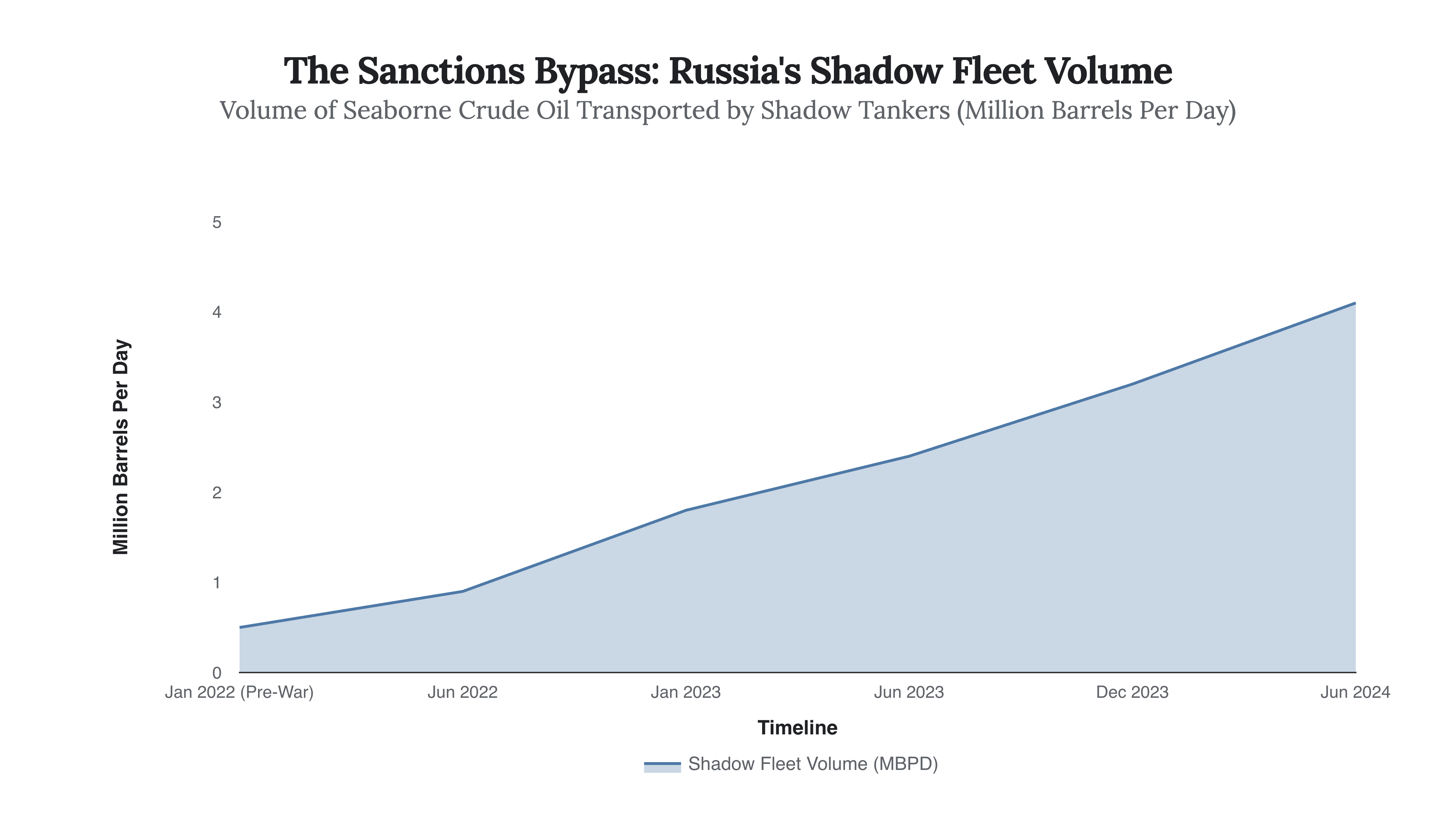
Figure 2: The Parallel Economy. Despite G7 price caps, the volume of Russian oil moved by the “Shadow Fleet” has nearly doubled in the last 18 months. By mid-2024, 70% of Russia’s seaborne oil exports were carried by these opaque vessels, effectively neutralizing the West’s primary economic weapon.
If the SCS represents territorial revisionism, the “Shadow Fleet” represents economic revisionism. Russia has spent an estimated $10 billion acquiring a fleet of aging, under-insured tankers to bypass G7 price caps. This is not a
