



In a release that caught markets by surprise, China’s National Bureau of Statistics reported that consumer prices edged back into positive territory in October 2025, rising 0.2% year-on-year after two consecutive months of decline. On the surface, this appears to be a welcome sign of stabilization for the world’s second-largest economy, which has been flirting with a deflationary spiral for the better part of a year. However, this headline figure is dangerously deceptive.
A deeper analysis reveals a stark and growing divergence between a services sector temporarily juiced by holiday spending and a goods economy mired in persistent price weakness. The real story is found in the core inflation rate which, while hitting a 20-month high of 1.2%, stands in sharp contrast to deeply negative food and goods prices. This briefing will deconstruct the anatomy of this fleeting rebound, expose the structural deflationary forces that remain firmly entrenched, analyze Beijing’s constrained policy options, and provide strategic foresight into the risks and signposts for investors and policymakers navigating this complex landscape.
The Anatomy of a Fleeting Rebound
The October 2025 data presents a paradox. While the headline Consumer Price Index (CPI) finally broke its negative streak, the Producer Price Index (PPI), which measures costs for goods at the factory gate, fell for the 37th consecutive month. This dynamic—tepid consumer inflation coupled with deep-seated industrial deflation—paints a picture of an economy struggling to generate organic demand. The apparent recovery in consumer prices is not a broad-based revival but a narrow, temporary surge driven by specific, and unsustainable, factors.
Holiday Headfake: Deconstructing the “Golden Week” Effect
The primary driver behind October’s CPI uptick was the combined National Day and Mid-Autumn Festival holiday period, which spurred a significant, albeit short-lived, burst in consumer spending on services. According to the National Bureau of Statistics, prices for hotel accommodation and air tickets jumped by 8.6% and 4.5% month-on-month, respectively. This holiday effect was potent enough to pull the headline number into the black, but its durability is highly questionable. As one economist from Goldman Sachs noted, “The broad-based price increases likely reflect seasonal demand around the Golden Week. Its durability remains to be seen.” This sentiment is echoed across the analytical community, with many viewing the bounce as a one-off event rather than the beginning of a sustainable trend.
The Divergence Doctrine: Core vs. Headline Inflation
The most strategically significant data point is the widening chasm between headline CPI and core CPI, which excludes volatile food and energy prices. While headline inflation barely crested 0.2%, core inflation accelerated to 1.2%, its highest level since early 2024. This gap signals a two-speed economy. The service sector, which dominates core inflation, is showing signs of life, propped up by policy support and pent-up holiday demand. However, the prices of physical goods that consumers buy every day continue to fall, reflecting deep-seated caution and industrial overcapacity.
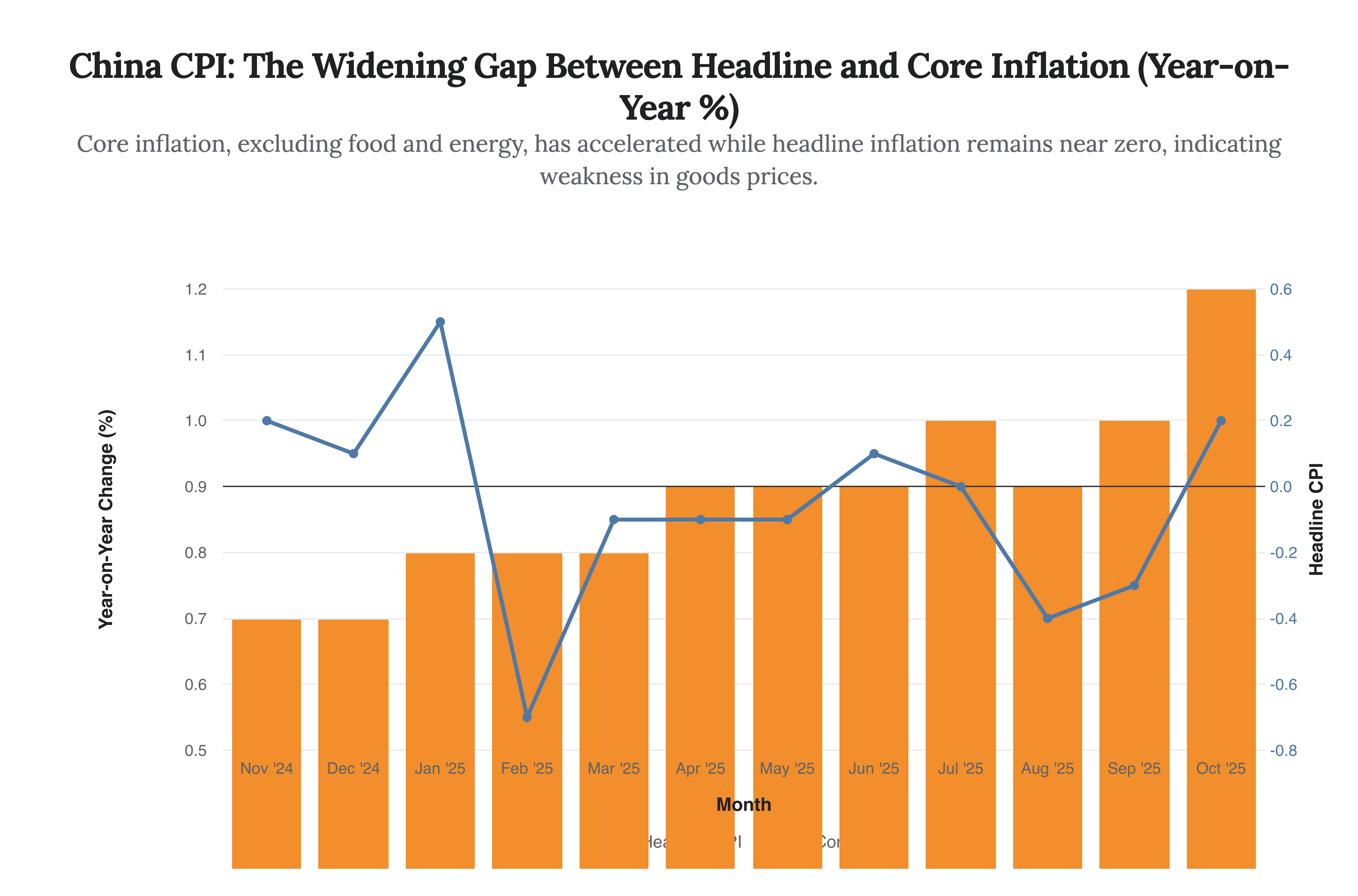
This chart clearly illustrates the growing divergence. While core inflation shows a steady, if modest, upward trend, headline CPI remains volatile and anchored near deflation, dragged down by components outside of the service sector.
The Great Wall of Deflation: Food, Pork, and Consumer Caution
The primary force pinning down China’s headline inflation is food prices, which have been in deflation for nine consecutive months. In October, food prices fell 2.9% year-on-year. While this was an improvement from September’s 4.4% drop, it still represents a significant drag on the overall index, especially given that food accounts for nearly a third of the CPI basket.
“Consumer prices swinging back to inflation reflect a holiday boost that will fade. In other words, deflationary pressures remain entrenched – and weaker growth in the fourth quarter means there’s little to change the trend.”
- Eric Zhu, Bloomberg Economics
The Pork Paradox: From Inflation Driver to Deflationary Anchor
Historically, no single commodity has influenced China’s CPI more than pork. Past outbreaks of African Swine Fever led to supply shortages and soaring prices that sent headline inflation skyrocketing. Today, the situation is reversed. An oversupply of hogs, combined with lower feed costs and subdued consumer demand, has caused pork prices to plummet, falling around 16-17% year-on-year in recent months. This has transformed pork from a primary driver of inflation into a powerful deflationary anchor. The persistent weakness in this key staple good reflects not only agricultural market dynamics but also a broader shift in consumption patterns and weaker overall demand.
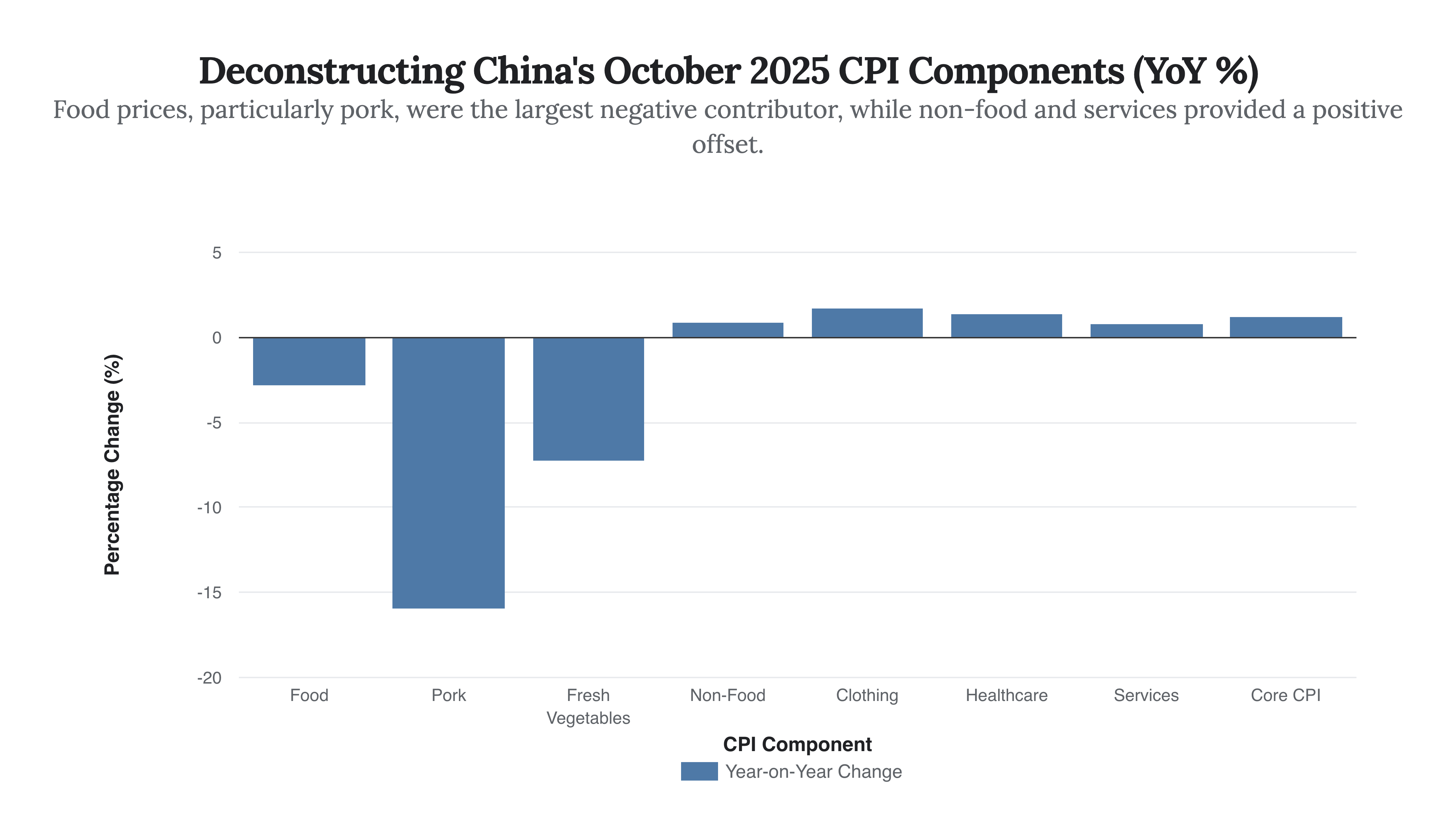
As the visualization shows, the steep decline in food and pork prices creates a formidable headwind that positive growth in other sectors struggles to overcome.
Beyond the Grocery Aisle: The Real Consumer Sentiment
The deflationary pressure is not confined to food. An analysis by Bloomberg of nearly 70 everyday products found that prices for many goods, from home appliances to cars, are falling more sharply than official data suggests. This widespread discounting is a symptom of a deeper malaise: weak consumer confidence fueled by the ongoing property market crisis, elevated youth unemployment, and anxieties about future income growth. Until households feel secure enough to start spending again, businesses will be forced to compete on price, entrenching deflationary expectations.
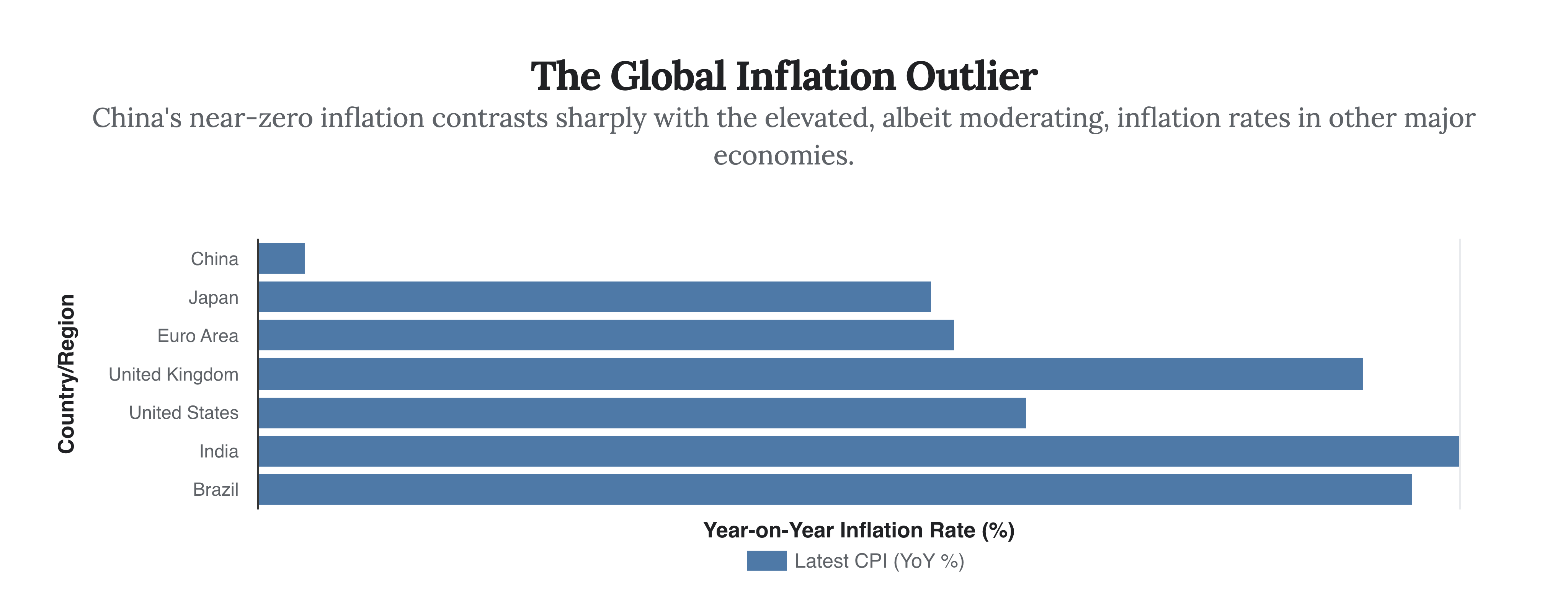
Beijing’s Tightrope: Policy Levers in a Low-Inflation Trap
Faced with this persistent deflationary threat, Beijing’s policy response has been notably restrained. Unlike Western central banks, the People’s Bank of China (PBOC) has refrained from aggressive, broad-based stimulus. This caution stems from a desire to maintain financial stability, avoid exacerbating debt levels, and prevent excessive downward pressure on the yuan. Instead, the government has opted for a suite of targeted fiscal measures and supply-side interventions.
The “Anti-Involution” Campaign and Fiscal Nudges
Recognizing that a vicious cycle of price wars is eroding corporate profitability, Beijing has launched an “anti-involution” campaign, using price guidance to discourage cut-throat competition in industries from electric vehicles to solar panels. On the demand side, policies have focused on targeted support, such as subsidies for households to trade in old cars and appliances. While these measures have provided some support to non-food inflation, they have so far failed to meaningfully shift the broader deflationary psychology gripping the nation’s consumers and businesses.
“It is too early to conclude the deflation is over. We need to wait for a few more months of data to judge if the deflation dynamic has changed fundamentally.”
- Zhiwei Zhang, Pinpoint Asset Management
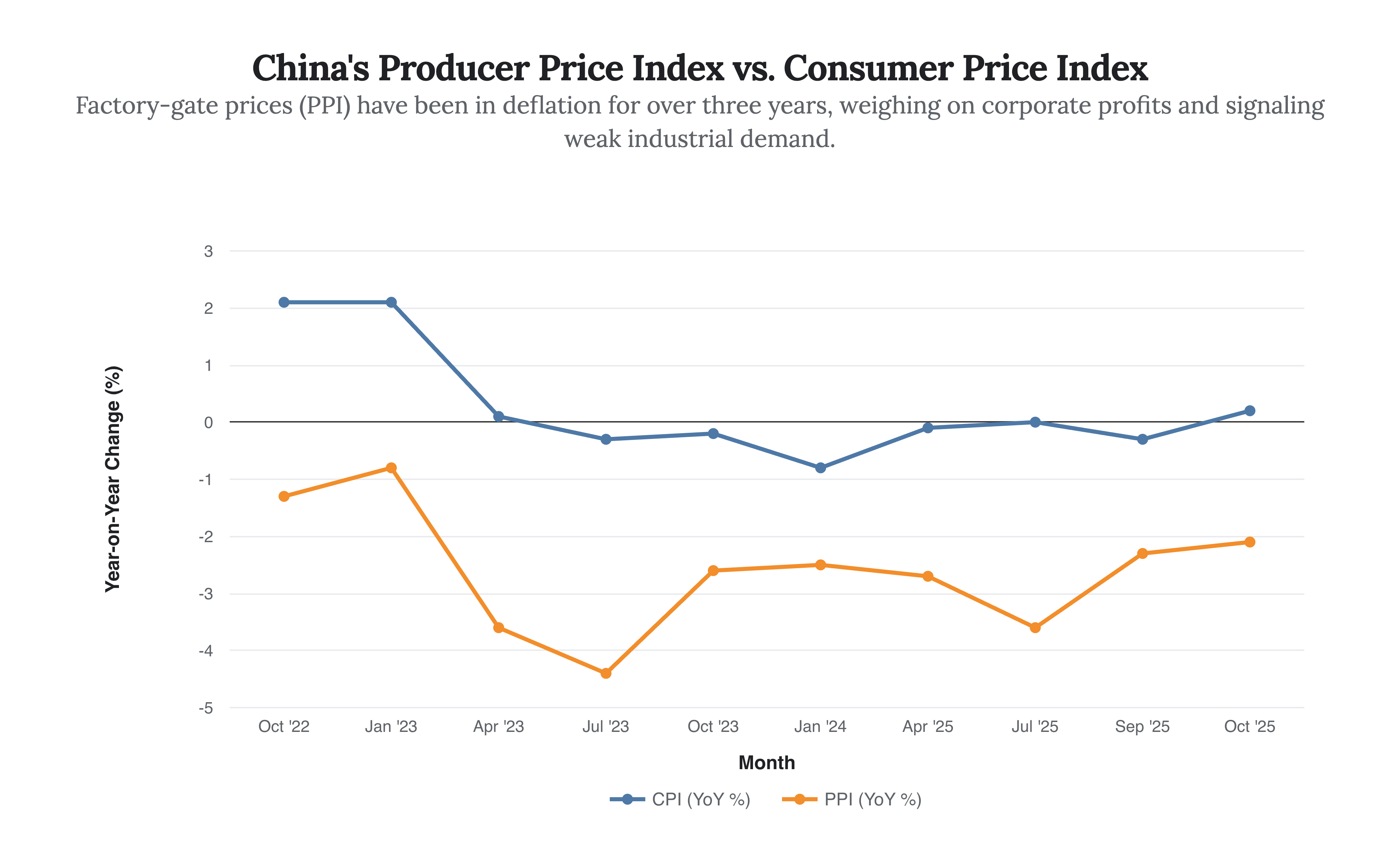
The persistent gap between a falling PPI and a flatlining CPI underscores the difficulty manufacturers have in passing on any costs, forcing them to absorb margin pressure in a weak demand environment.
Strategic Foresight: Navigating China’s Price Puzzle
Looking ahead, the trajectory of China’s consumer prices will be a critical barometer of the economy’s health. The path forward is fraught with uncertainty, balancing on the effectiveness of government policy and the potential for a genuine revival in private sector confidence.
Scenarios for 2026
Two broad scenarios present themselves. The first is a continuation of the current “muddle through” environment, where headline inflation hovers between -0.5% and 1.0%, supported by targeted stimulus but capped by the property sector overhang and weak sentiment. The second, more concerning scenario is a definitive slide into a deflationary spiral, where falling prices lead to delayed consumption, lower corporate investment, and rising real debt burdens, creating a feedback loop that is notoriously difficult to break. Forecasts remain subdued, with models from Trading Economics projecting inflation to trend around 0.5% in 2026, while others, like UBS, have warned of a potential return to deflation at -0.2% depending on external shocks.
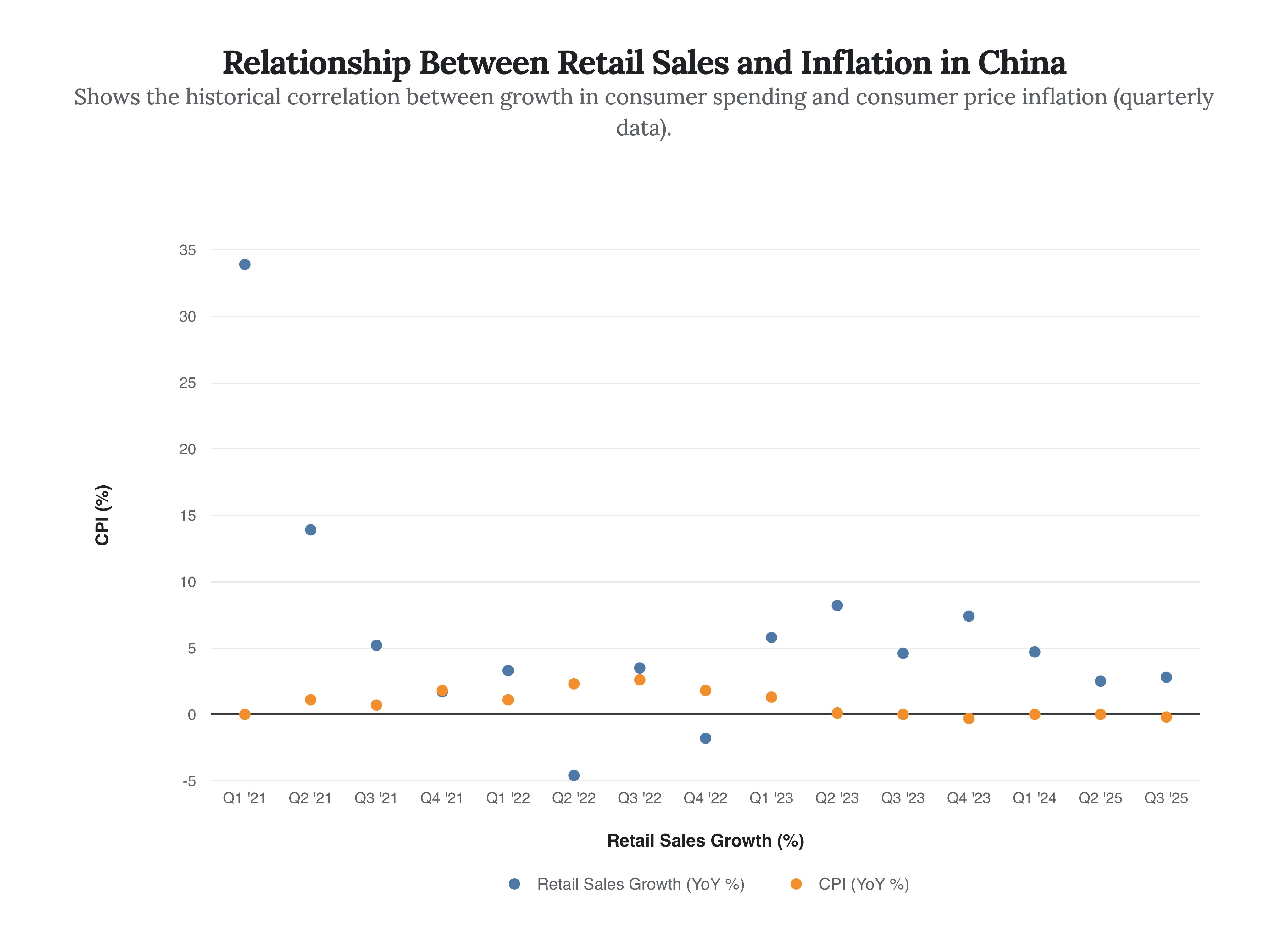
Signposts to Watch
For investors and executives, monitoring a few key indicators will be critical to assessing whether China can escape its low-inflation trap:
Producer Price Index (PPI): A sustained return to positive territory for the PPI would be the strongest signal that industrial demand is recovering and margin pressure is easing.
Credit Growth and M2 Supply: An acceleration in broad credit growth would indicate that monetary policy is gaining traction and that both firms and households are more willing to borrow for investment and consumption.
Property Market Data: A stabilization in home sales and prices is a prerequisite for the restoration of household confidence, as real estate constitutes the bulk of consumer wealth.
Retail Sales (ex-autos): Looking beyond volatile auto sales, a consistent rise in spending on discretionary goods would signal a genuine and broad-based consumer recovery.
The unexpected rise in China’s October CPI is not a sign of recovery but a data point that reveals the deep fractures within its economy. The divergence between a temporarily buoyant service sector and a structurally weak goods market highlights the immense challenge facing policymakers. While a full-blown deflationary spiral is not yet the baseline, the underlying pressures are immense and the risks are tilted firmly to the downside. The path to reflation will be slow, uneven, and contingent on Beijing’s ability to restore confidence in the property sector and, ultimately, in the country’s long-term economic trajectory.
The October inflation data is not a green shoot of recovery; it is a clear warning of the profound structural imbalances still weighing on China’s consumer economy.