


The final chapter of the Gaza hostage crisis, initiated by the October 7, 2023 attacks, is not being written with diplomatic communiqués or military victories, but through the painstaking, politically charged process of recovering the dead. As of early November 2025, with all living hostages returned, the strategic focus has shifted entirely to the remains of those who did not survive their captivity.
This is not merely a humanitarian mission for Israel; it is a complex negotiation governed by grim historical precedents and the stark reality that in this conflict, the deceased are strategic assets. Hamas is leveraging the final six sets of remains as a tool for political extraction, forcing Israel into a grim calculus where the price of national closure is measured in a new, macabre currency: a 1-to-15 exchange ratio of recovered Israeli remains for the bodies of slain Palestinian militants. This intelligence briefing deconstructs the strategic landscape of this final phase, analyzing the data behind the repatriations, the historical asymmetries that define Israel’s negotiating posture, and the forensic and political challenges that lie ahead. The central thesis is clear: the handling of these remains is a microcosm of the broader conflict, revealing enduring power dynamics and the high cost of a national ethos that demands every soldier and citizen be brought home, dead or alive.
From Abduction to Asset: The Strategic Weaponization of the Deceased
The initial chaos of the October 7 attacks saw 251 individuals abducted into Gaza. Over two years, a combination of military operations and fraught negotiations saw the return of the living. However, for 83 of the hostages, captivity ended in death. Understanding the final disposition of this group is crucial to comprehending the current strategic impasse.
The Final Accounting: A Quantitative Overview
The 251 hostages taken on October 7, 2023, have met with starkly different fates. The vast majority, 168 individuals, were eventually returned alive through a series of releases and daring rescue operations. Yet, a significant portion—nearly one-third—perished either during the initial attack, in captivity due to Israeli airstrikes, at the hands of their captors, or in tragic friendly-fire incidents. The recovery of their remains has become the final, agonizing stage of the crisis, with a small but strategically significant number still held by Hamas as leverage.
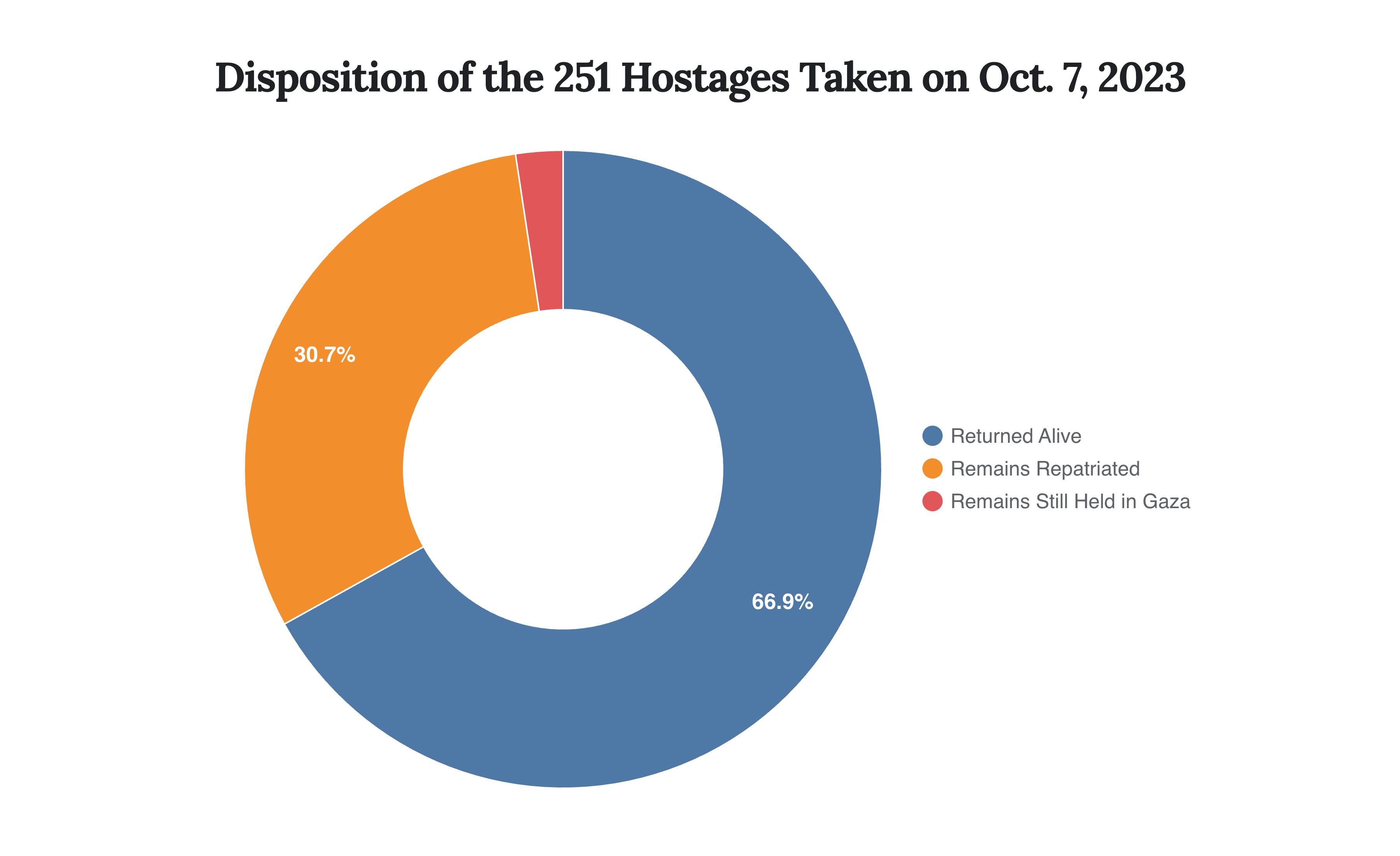
Caption: As of November 2025, of the 83 hostages confirmed deceased, the remains of 77 have been returned to Israel, leaving 6 still in Hamas’s possession.
Pathways to Repatriation
The return of the 77 deceased hostages was not a monolithic process. It was achieved through a combination of kinetic military action and complex diplomatic agreements, each carrying its own costs and implications. Military operations, while demonstrating Israeli capability, have been fraught with risk and yielded 47 recoveries. In contrast, negotiated deals, such as the January 2025 ceasefire and the final Gaza peace plan, accounted for the return of 30 sets of remains, but came at the price of significant concessions. This dual-track approach highlights the intractable dilemma facing Israeli leadership: the high-risk, high-reward nature of military rescue versus the politically costly but often more certain path of negotiation.
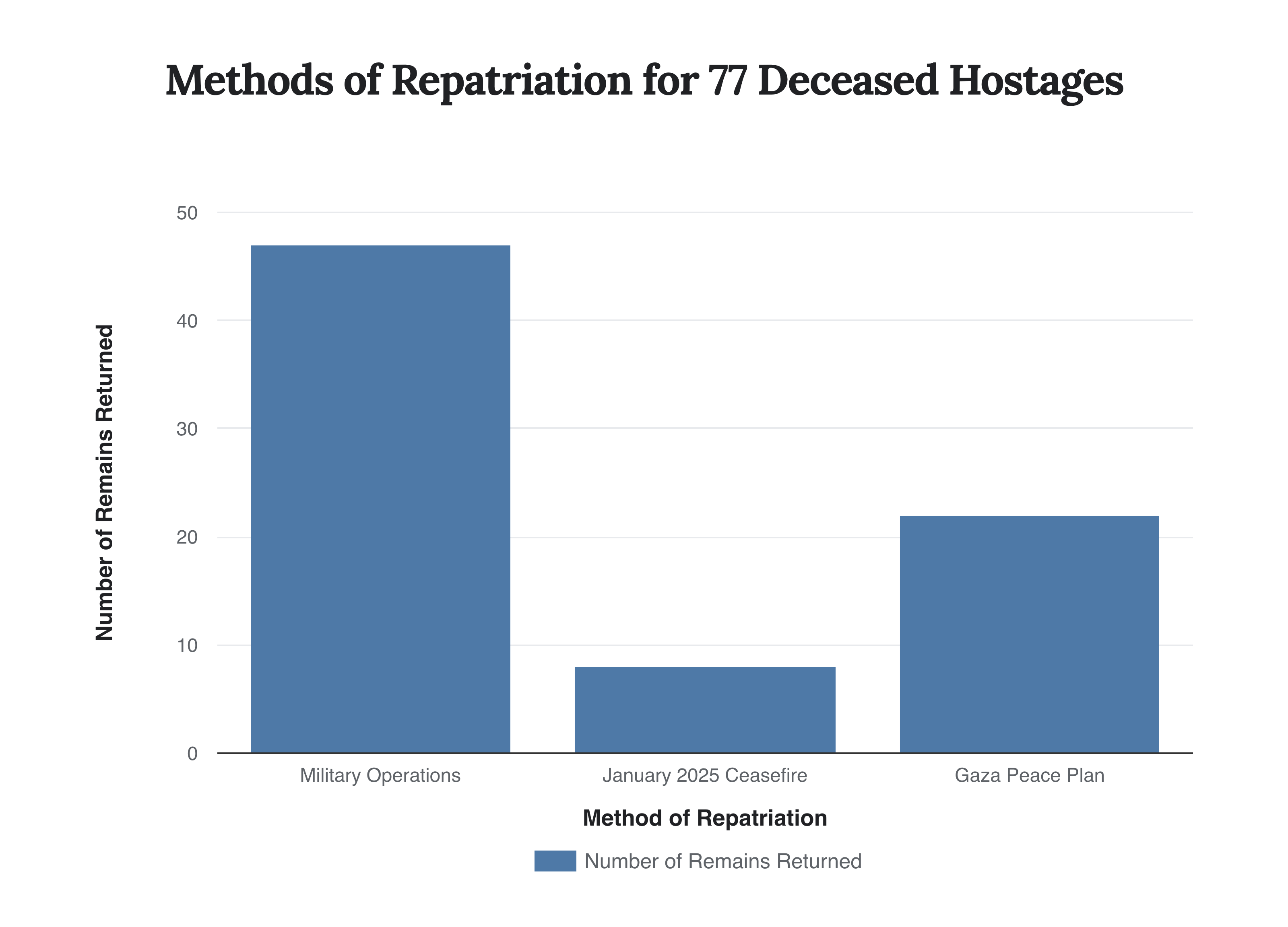
Caption: Military action has been the most frequent method for recovering remains, though recent ceasefires have relied on negotiation.
The Economics of Exchange: A History of Asymmetric Deals
To understand the current 1:15 exchange ratio for remains, one must look at Israel’s long and painful history of lopsided prisoner swaps. This history forms the bedrock of Hamas’s negotiating strategy, as they are keenly aware of the immense domestic pressure on any Israeli government to bring its people home, regardless of the cost.
The Precedent of Asymmetry
Historically, Israel has paid a disproportionately high price for the return of its citizens and soldiers, both living and deceased. The 2011 deal for soldier Gilad Shalit, which saw 1,027 Palestinian prisoners exchanged for one living soldier, is the most famous modern example. However, earlier deals were even more asymmetric. The 1983 exchange for six living soldiers held by the PLO involved the release of over 4,500 Palestinian prisoners. Even exchanges involving remains have been lopsided; a 2004 deal with Hezbollah saw 436 prisoners and 59 bodies exchanged for one living Israeli and the remains of three soldiers. This pattern has created a strategic expectation of high returns for Hamas and other militant groups, making any negotiation incredibly challenging for Israel.
“Israeli governments have long been determined to bring back captured civilians and soldiers – even at steep costs. The terms of prisoner swaps have often prompted fierce criticism domestically.”
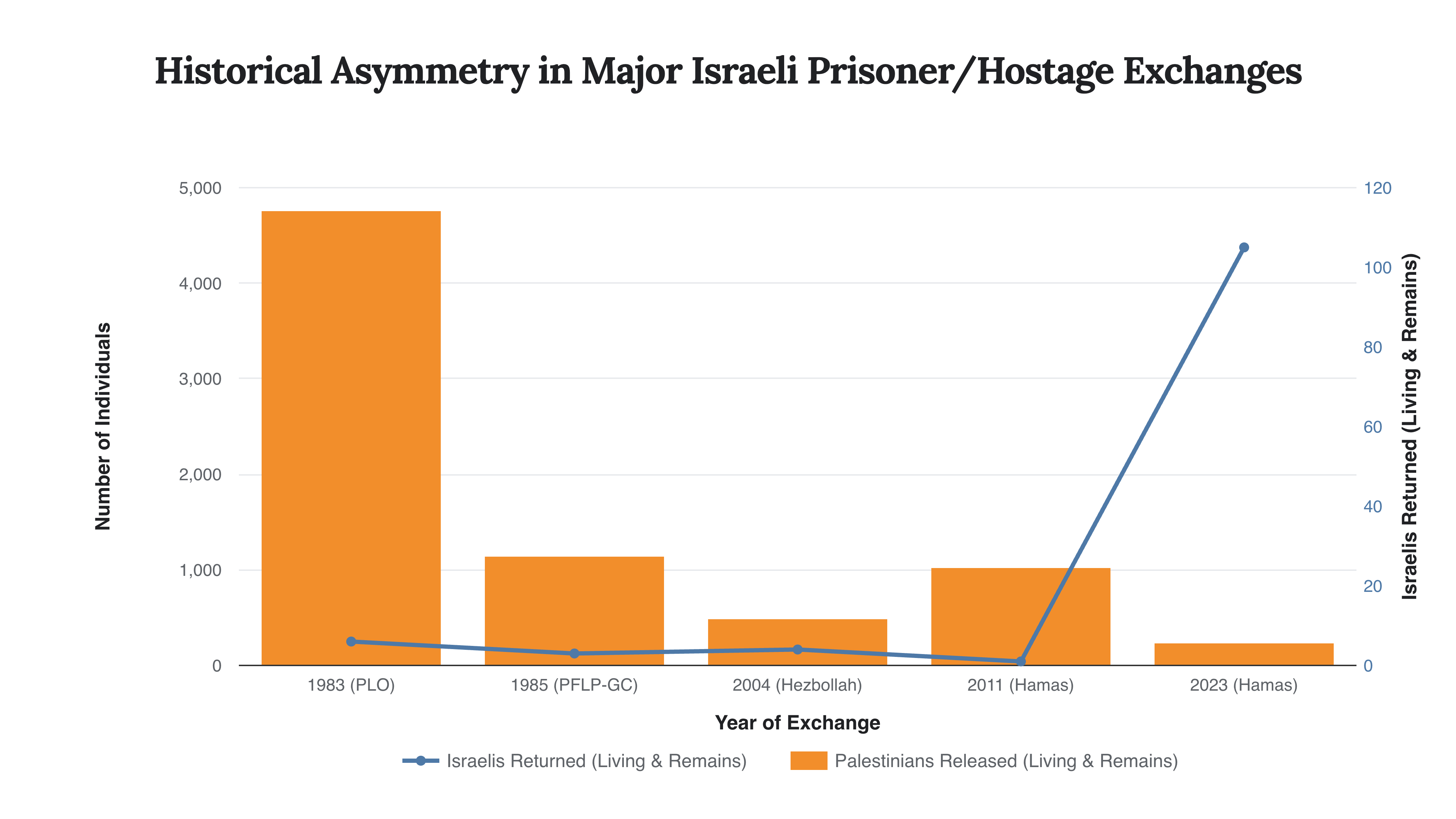
Caption: A ‘combo’ chart is used here to visualize the vast difference in scale between the number of Israelis returned and the number of Palestinian prisoners released in major historical exchanges. The disparity forms the basis of Hamas’s current negotiating leverage.
A New Currency: The 1:15 Ratio for Remains
The current ceasefire has established a new and explicit exchange rate focused solely on the deceased: 15 Palestinian bodies for the remains of each Israeli hostage. Since the truce began, this has resulted in the transfer of over 285 Palestinian bodies back to Gaza. This ratio, while still asymmetric, is a significant departure from the thousand-to-one figures seen in past deals for living hostages. It reflects a grim acknowledgment by both sides of the differing strategic value between the living and the dead. For Hamas, it remains a valuable tool to secure the return of its fallen fighters for burial. For Israel, it represents a politically painful but quantifiable cost to provide closure for the families of the victims.
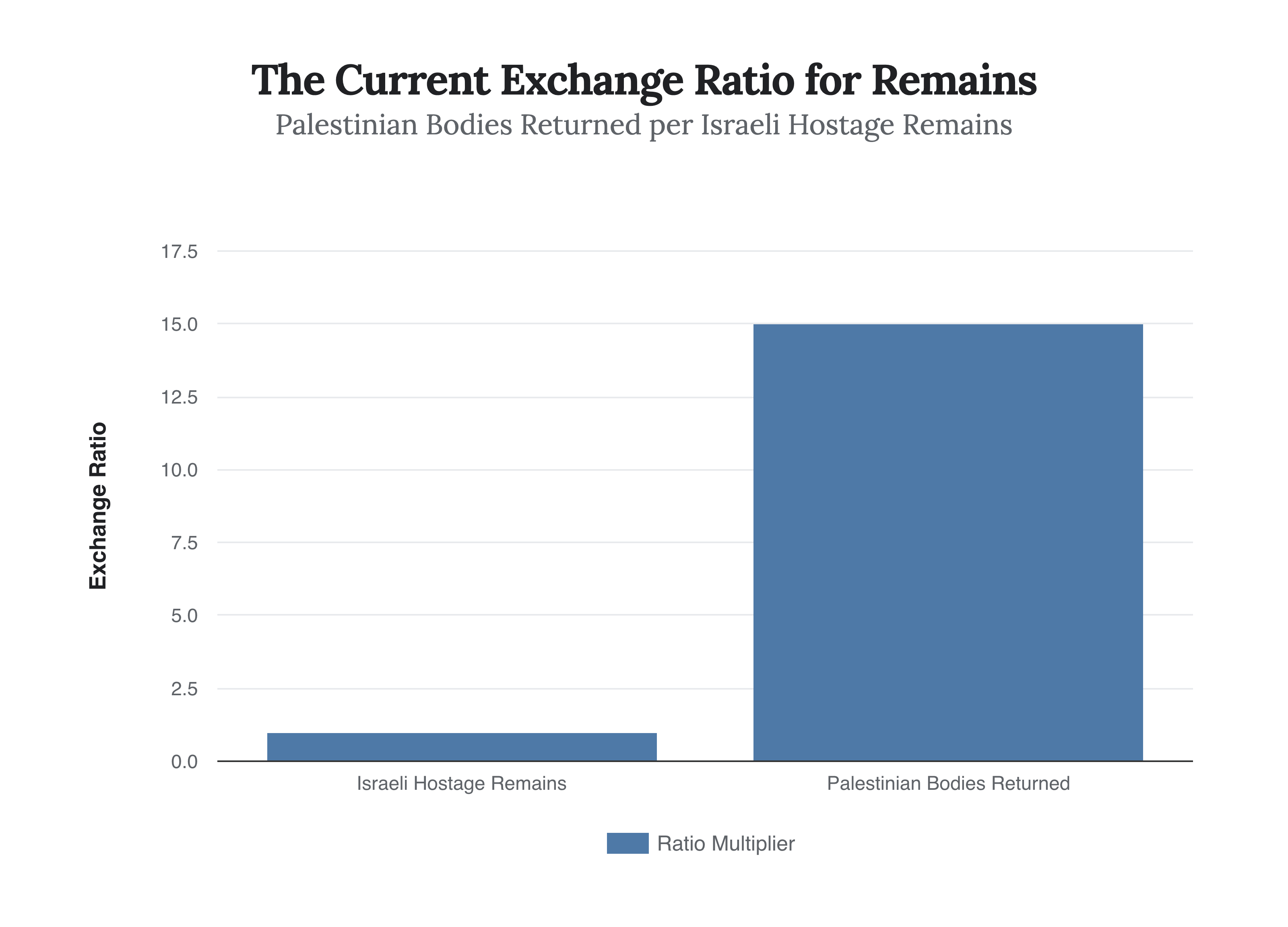
Caption: The current ceasefire agreement has codified a 1-to-15 exchange ratio for the repatriation of remains.
The Slow Pace of Return: Delay as a Bargaining Chip
When the final ceasefire took effect in October 2025, 28 hostage bodies were known to be held by Hamas. The agreement called for their swift return. However, the process has been deliberately slow, with Hamas returning bodies in small batches of one to three every few days, a tactic Israel decries as psychological warfare.
An Anatomy of the Final Six
The six individuals whose remains are still in Gaza represent a cross-section of Israeli society and highlight the indiscriminate nature of the October 7 attack. They include a career soldier whose body has been held since 2014, a police officer, and several civilians, one of whom is a Thai foreign worker. Their prolonged retention keeps the issue at the forefront of Israeli public discourse and maximizes the strategic value of each eventual return for Hamas.
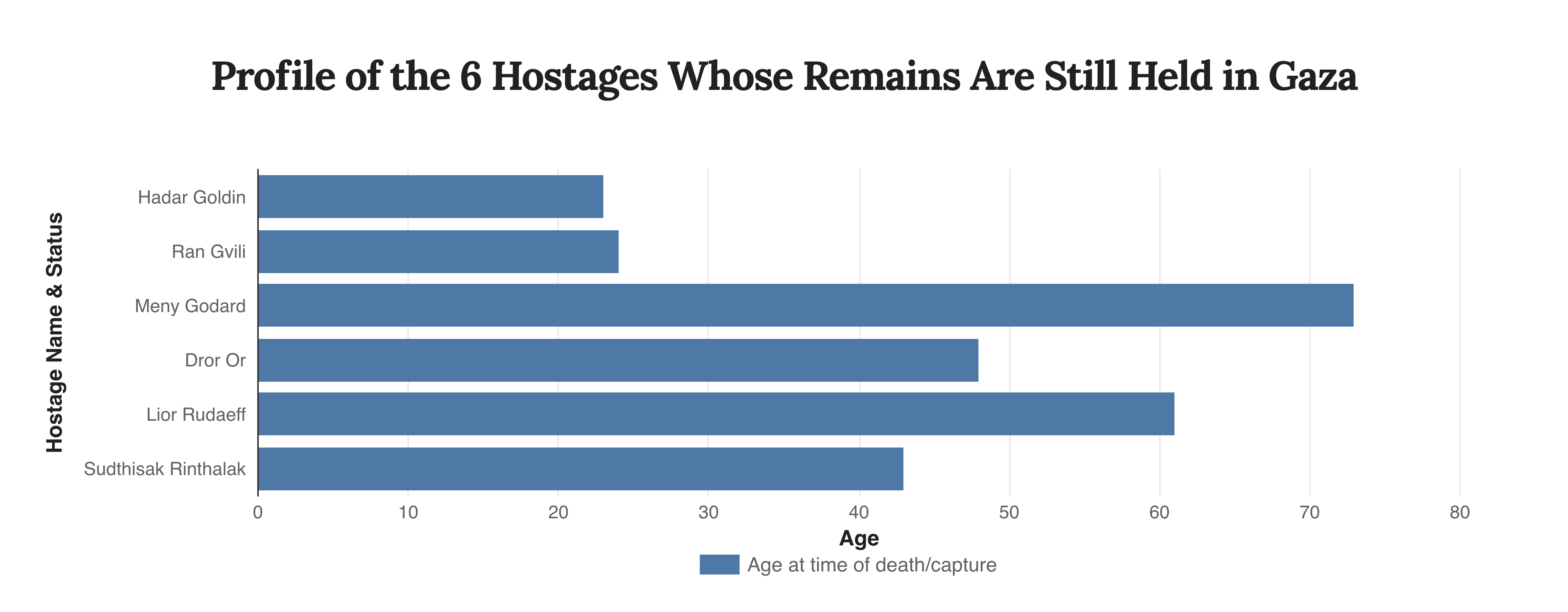
Caption: The diverse profiles of the six remaining individuals underscore the broad impact of the crisis.
Timeline of a Tense Exchange
The return of the 22 bodies since the October 2025 ceasefire began has been a slow, drawn-out process. After an initial return of four bodies, the repatriations have trickled in, prolonging the anguish for the remaining families and creating a persistent point of friction. Hamas claims the delays are due to the difficulty of locating remains under the rubble of a war-torn Gaza. Israeli officials, however, view this as a deliberate strategy to extract maximum political value and maintain leverage, accusing Hamas of dragging its feet.
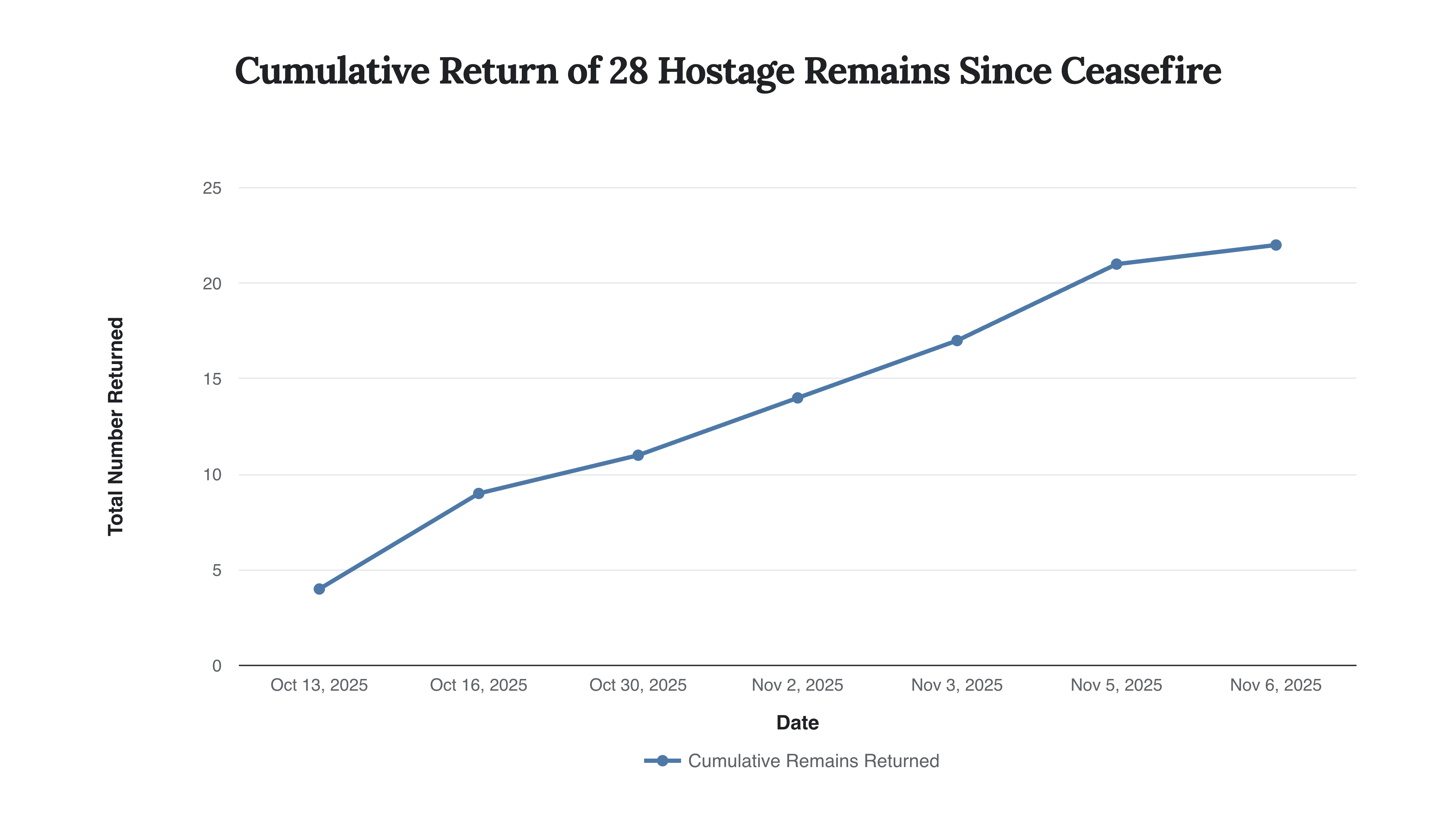
Caption: The pace of returns has been slow and incremental, a pattern Israel interprets as a deliberate stalling tactic by Hamas.
The Forensic Frontier and Future Scenarios
The final phase is also a story of science and uncertainty. Every return is followed by a complex identification process, and the potential for misidentification or deception adds another layer of tension to an already volatile situation.
The Certainty of Science, The Uncertainty of War
Each set of remains transferred from Gaza is taken to Israel’s National Center of Forensic Medicine (Abu Kabir) for a rigorous identification process. Experts use a combination of advanced CT scans, dental record comparisons, and DNA analysis to confirm identity. This process can take hours or even days, depending on the condition of the remains after more than two years in uncontrolled environments. The challenge is immense, and the process is not foolproof. There have been instances where remains handed over by Hamas were determined not to belong to any of the hostages, leading to accusations of intentional deception and psychological warfare.
“Our goal is also to learn what happened to the deceased before their death, so as to bring as much information as possible to the family and allow them a kind of closure.” - Dr. Chen Kugel, Director of the National Center of Forensic Medicine.
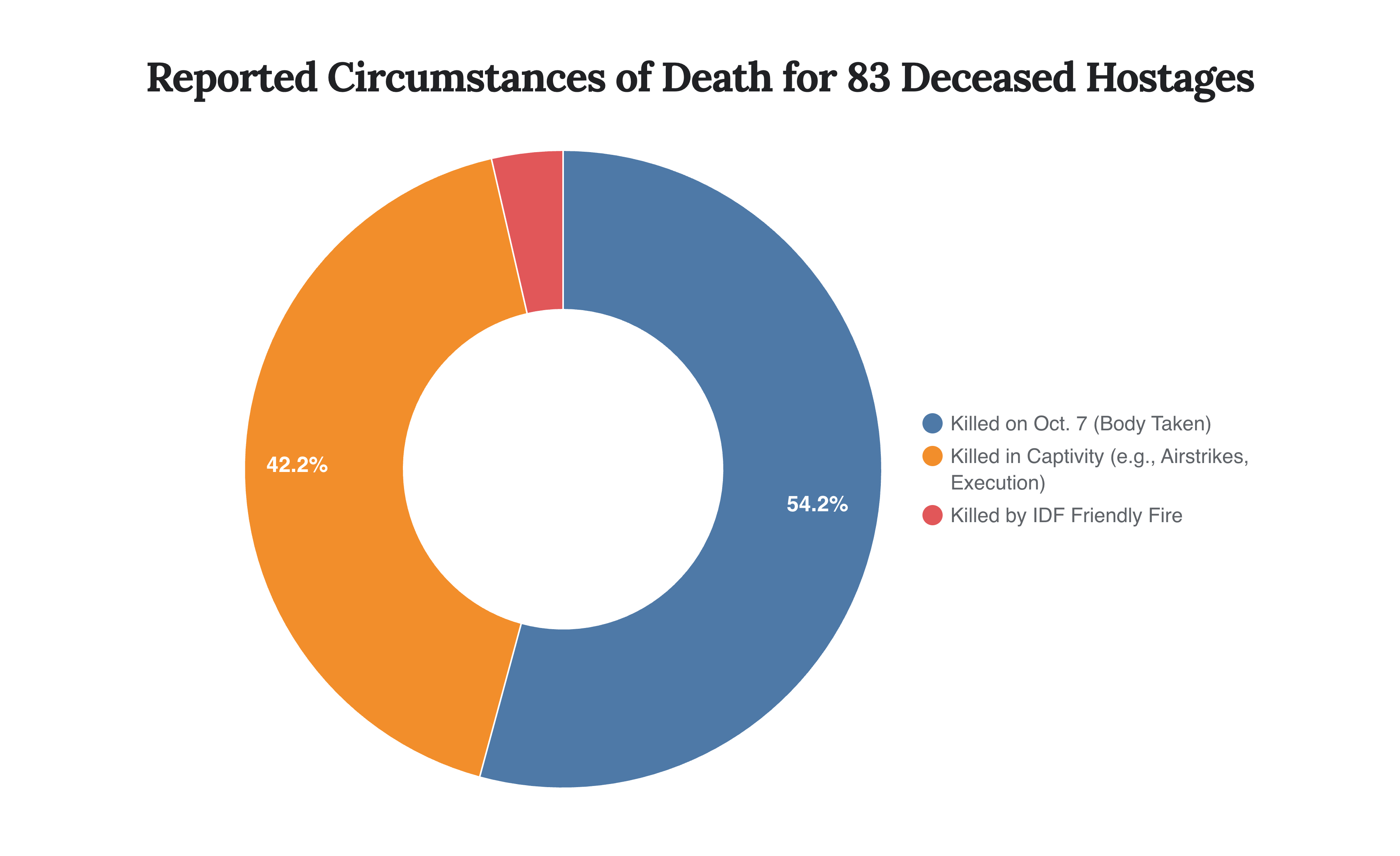
Caption: Forensic analysis attempts to determine the cause of death, a crucial but challenging task. A majority are believed to have been killed during the initial Oct. 7 attack, while a significant number died during their subsequent captivity.
Strategic Foresight: Scenarios for the Final Recoveries
As the world watches, the resolution for the final six sets of remains will likely follow one of three potential scenarios:
Full Compliance Under Pressure: Increased international pressure, potentially from the U.S. and Egypt, could compel Hamas to accelerate the return of the final six bodies in accordance with the ceasefire agreement, bringing a relatively swift, albeit painful, end to the saga.
Protracted Leverage: Hamas could continue to use the remains as a bargaining chip, attempting to link their return to additional concessions not covered by the original ceasefire, such as the release of more high-value prisoners or other political demands. This would prolong the crisis and test the limits of Israeli and international patience.
Deal Collapse and Renewed Action: If negotiations stall completely or if Hamas is perceived to be acting in bad faith, the ceasefire could collapse. Israel, under immense domestic pressure, might resort to high-risk military intelligence and special operations specifically aimed at locating and recovering the final remains, a move that would undoubtedly reignite hostilities.
The most likely path forward involves a combination of the first two scenarios—a slow, politically charged process punctuated by international mediation. The third scenario remains a constant, dangerous possibility, a testament to the fragility of the current truce. The strategic value of these last remains is simply too high for Hamas to relinquish easily, and the political imperative for Israel to recover them is too powerful to ignore. The grim negotiations will continue, shadowed by two years of war and decades of precedent.
Ultimately, the final six caskets represent the enduring strategic leverage held by Hamas, forcing Israel to negotiate not just with an enemy, but with the ghosts of its own historical precedents.