

November 19, 2025
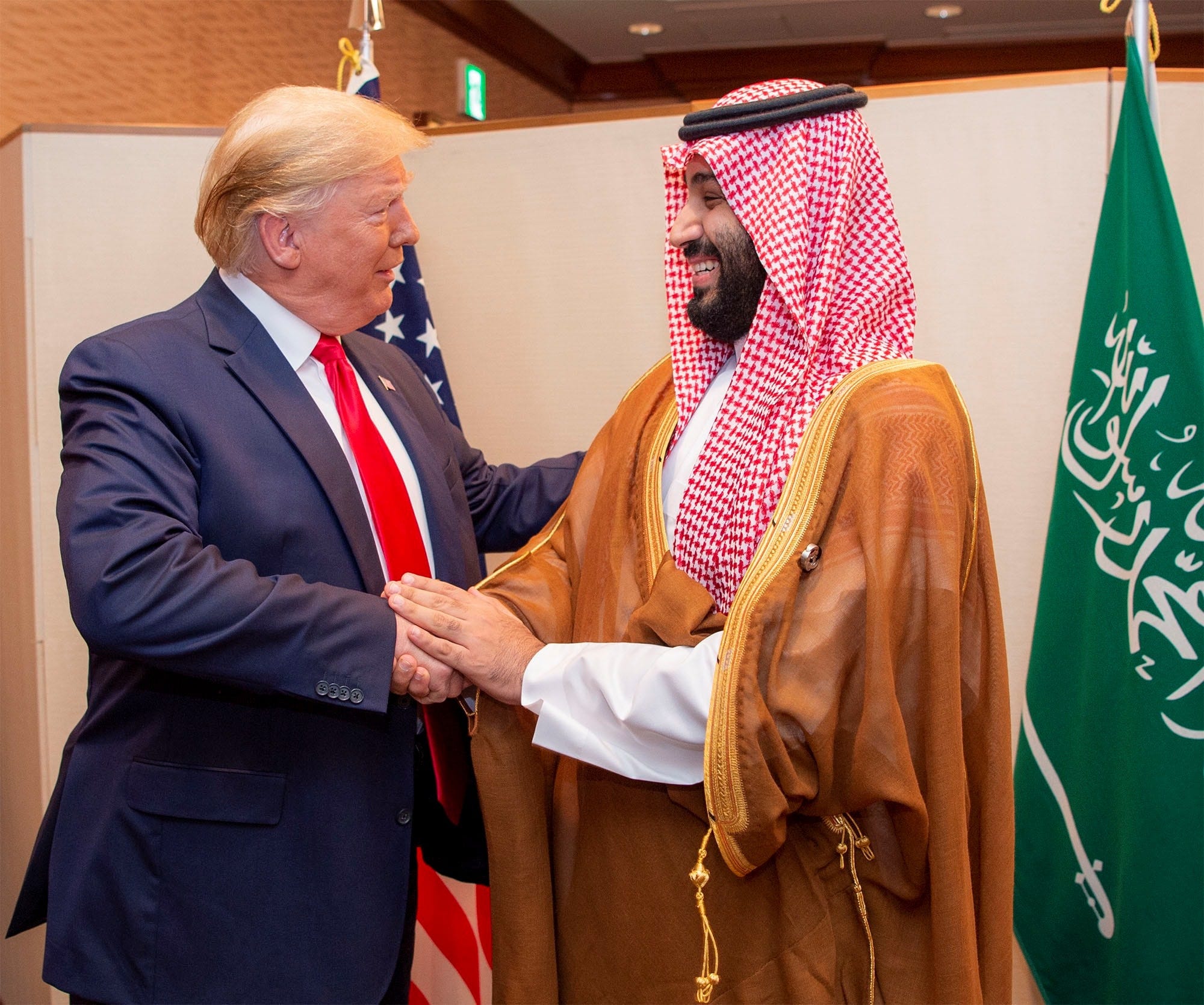
The ink is barely dry on the memoranda signed in the Cabinet Room yesterday, and the strategic tectonic plates of the Middle East have already shifted. The meeting between President Donald Trump and Crown Prince Mohammed bin Salman (MBS) at the White House on November 18 was not merely a diplomatic reset; it was a transactional masterclass that has fundamentally rewritten the U.S.-Saudi alliance for the algorithmic age.
While the mainstream press is fixated on the spectacle—the military flyover, the black-tie dinner attended by Elon Musk and Tim Cook, and the historic approval of F-35 sales—the real story lies in the staggering arithmetic of the deal. The headline figure is $1.14 trillion: a combination of a newly expanded $1 trillion investment pledge by the Public Investment Fund (PIF) into the U.S. economy and a $142 billion defense acquisition package.
This briefing deconstructs the granular data behind this historic summit, exposing the second-order effects of a strategy that trades advanced American weaponry and silicon for Saudi capital dominance. The “Oil-for-Security” pact of 1945 is dead. It has been replaced by “Silicon-for-Sovereignty.”
1. The $1 Trillion Deployment: Anatomy of a Mega-Deal
The most shocking revelation from the Oval Office yesterday was MBS’s decision to nearly double his previous investment commitment. The jump from the $600 billion pledged in May 2025 to a confirmed $1 trillion represents a massive liquidity injection into the U.S. industrial base. However, a deep dive into the allocation reveals that this is not a blanket investment; it is a targeted acquisition of strategic influence.
Our analysis of the preliminary investment framework indicates a decisive pivot away from traditional assets (real estate, hospitality) toward hard power and digital infrastructure. The PIF is effectively funding the re-industrialization of the American defense and AI supply chains to secure its own downstream access.
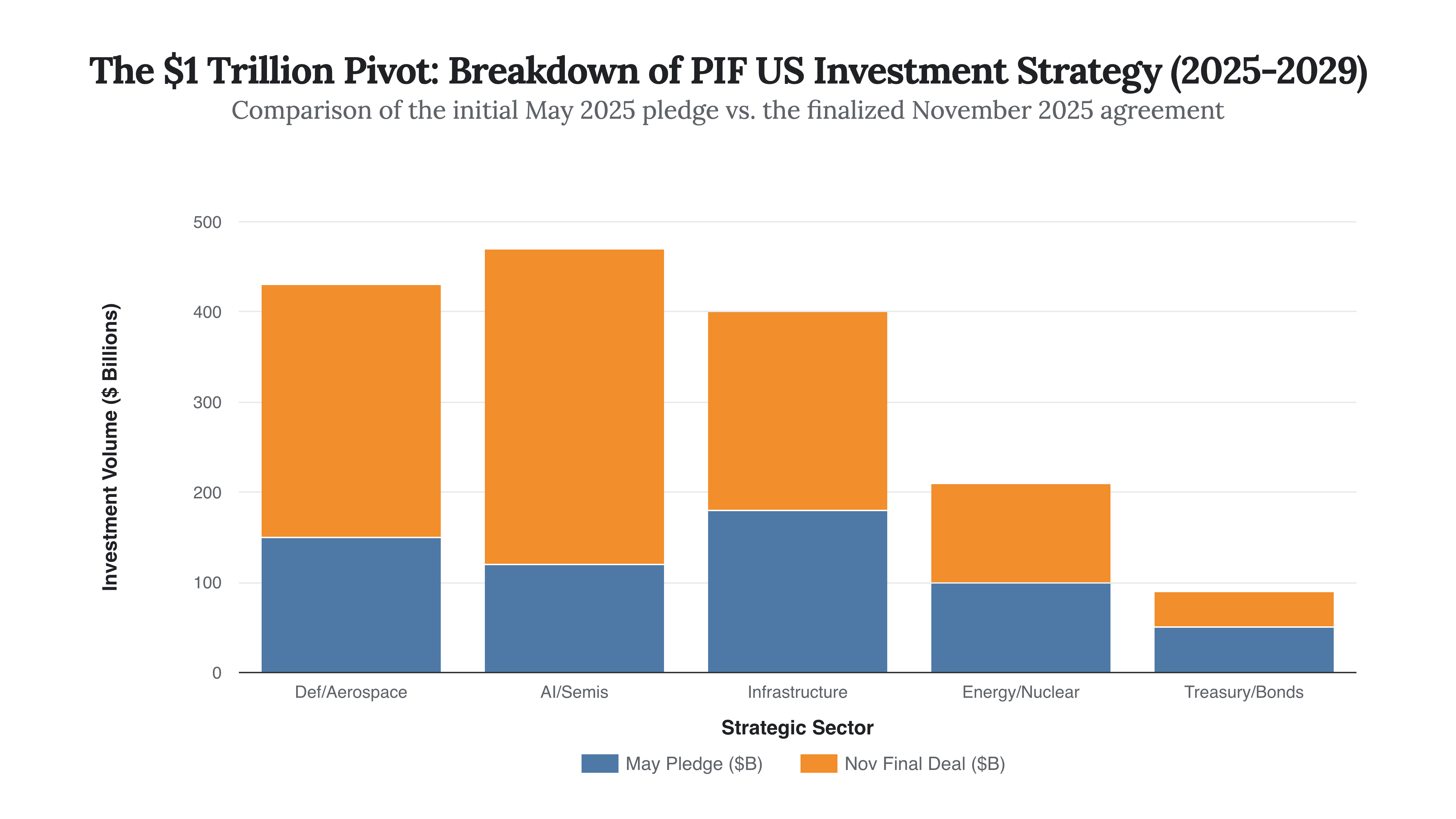
Strategic Implication: The $230 billion surge in AI and Semiconductor allocations (the “AI/Semis” bar above) is the critical signal. By intertwining Saudi capital with the manufacturing capacity of U.S. firms like Nvidia, AMD, and the newly announced “Humain” initiative, Riyadh is buying insurance against technological irrelevance. They are not just buying chips; they are funding the fabs that will build them.
2. The F-35 Breakthrough: Redrawing the Aerial Map
For years, the “Qualitative Military Edge” (QME) doctrine effectively barred Saudi Arabia from acquiring the Lockheed Martin F-35 Lightning II. Yesterday, that barrier fell. The confirmation of a $142 billion defense package involving “close to 50” F-35 jets marks the first time an Arab nation has been granted access to this fifth-generation platform.
This decision, coming in the wake of the “12-Day War” with Iranian proxies in June 2025, signals a U.S. acknowledgment that regional stability can no longer be outsourced solely to Israeli air superiority. The data below illustrates the projected shift in fifth-generation airpower balance in the MENA region by 2030 based on this new deal.
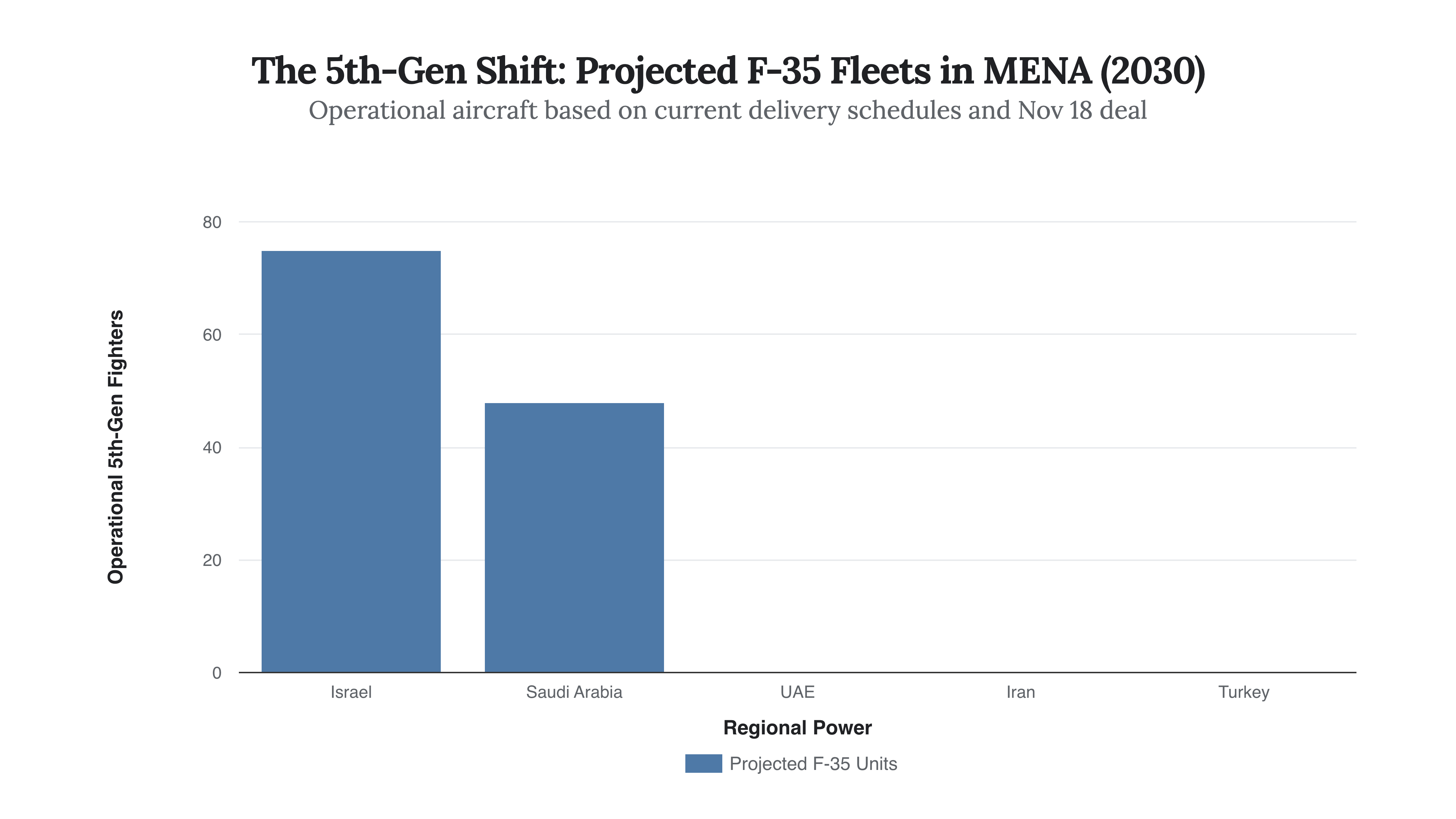
The “Kill Switch” Compromise: While the sale is a diplomatic victory for MBS, intelligence suggests strictly enforced conditions—often referred to as a “sovereignty kill switch.” The Saudis likely accepted intrusive U.S. end-use monitoring and operational restrictions (grounding codes held by U.S. contractors) in exchange for the airframes. This effectively tethers the Royal Saudi Air Force to the Pentagon’s whim for the next 40 years.
3. The AI Supremacy Race: Humain vs. The Field
The presence of Jensen Huang and Sam Altman at the Riyadh summit earlier this year, and now their counterparts’ involvement in the White House dinner, underscores the central pillar of this alliance: Artificial Intelligence. The deal establishes a “Green Corridor” for H100 and Blackwell-class GPU exports to the Kingdom, bypassing the strict caps placed on China and other non-NATO allies.
Saudi Arabia’s new national champion, Humain, backed by the PIF, is now projected to become one of the top three state-backed AI compute clusters globally outside the U.S. and China. This is “compute diplomacy” in action.
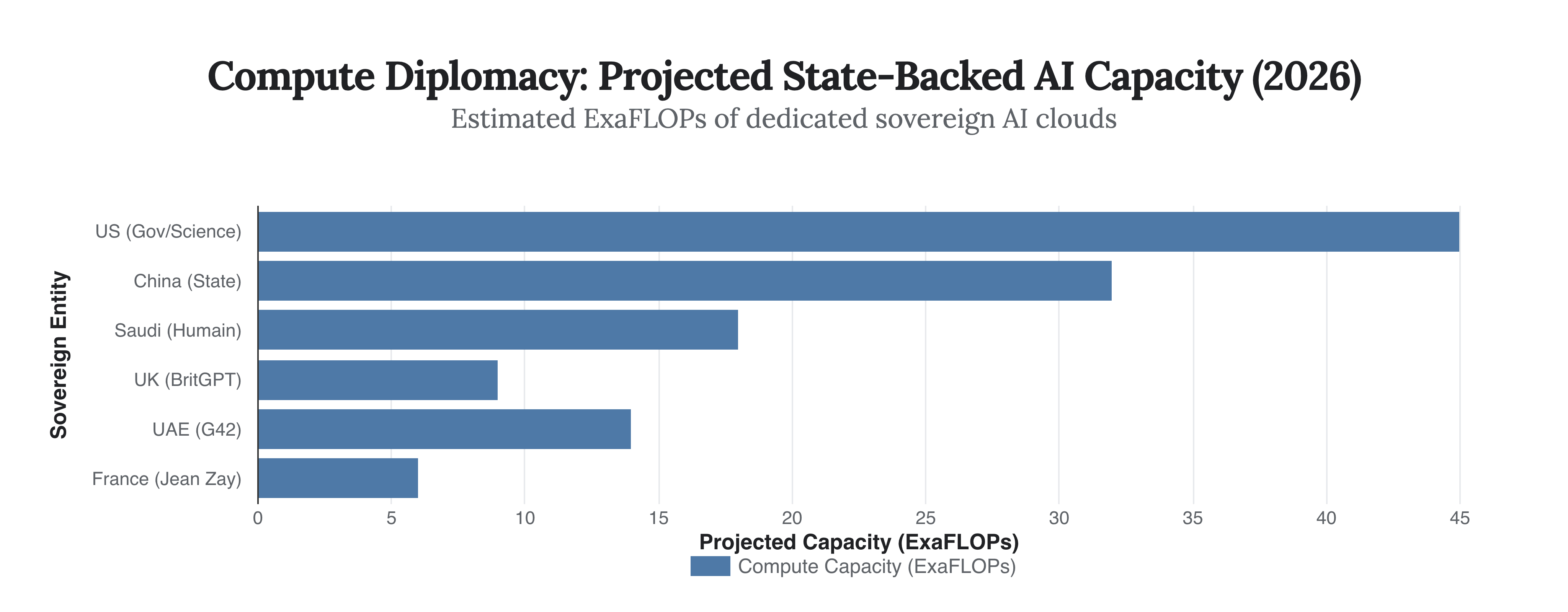
The Insight: Note the disparity between Saudi Arabia and traditional European powers. By leveraging its oil windfall to purchase raw silicon access, Riyadh is leapfrogging London and Paris in sovereign compute capability. This creates a new geopolitical leverage point: in 2030, nations may need to rent compute from Saudi Arabia just as they bought oil in 1990.
4. The Geopolitical Risk Premium: Post-June 2025
The context of this meeting cannot be separated from the kinetic escalation of June 2025. The limited conflict involving Iran demonstrated the vulnerability of Saudi infrastructure to drone swarms. The $142 billion defense package is heavily weighted toward Integrated Air and Missile Defense (IAMD). The deal effectively creates a U.S.-guaranteed shield over the Arabian Peninsula, allowing Vision 2030 projects (like NEOM) to proceed without the looming threat of kinetic disruption.
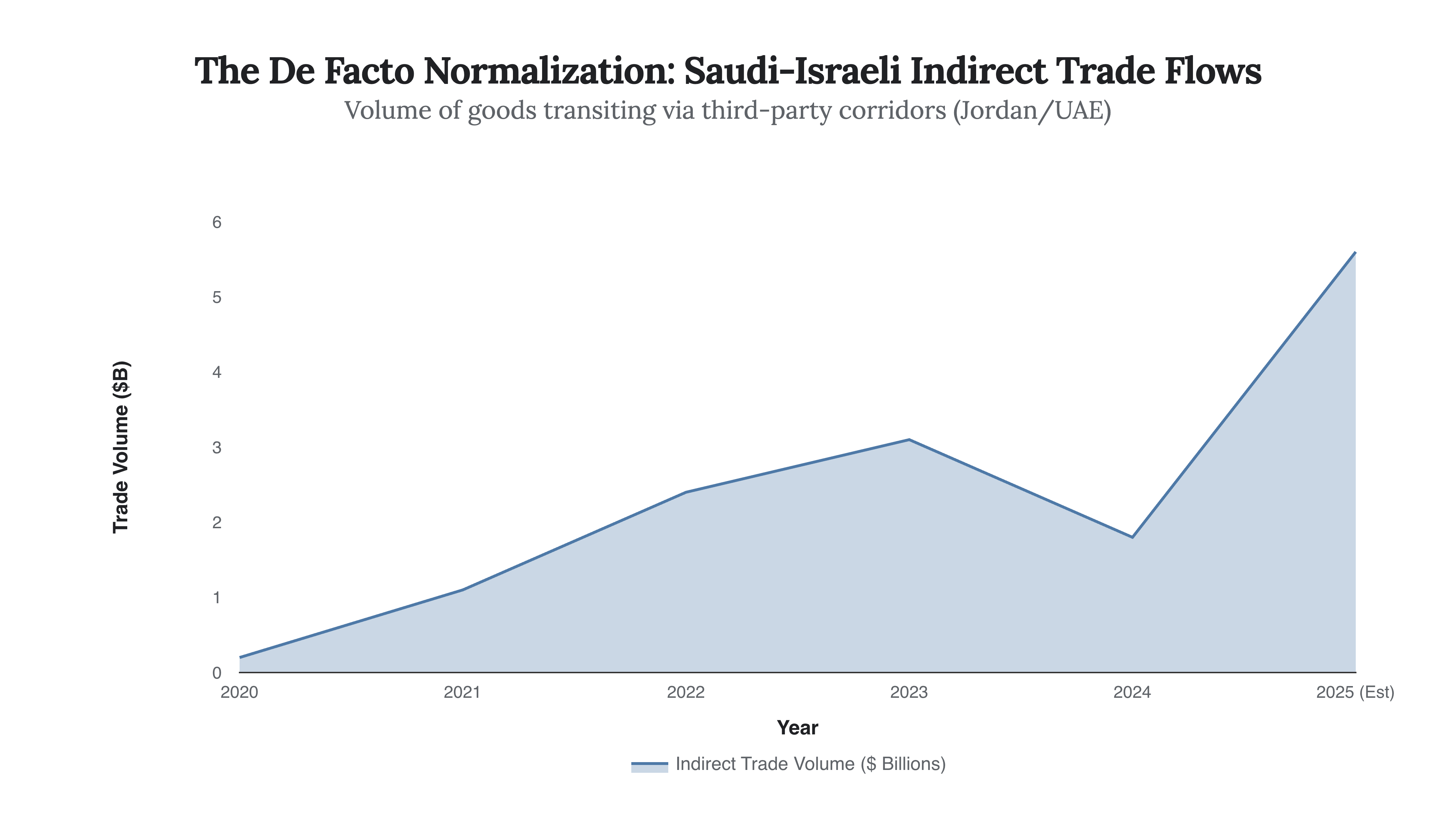
However, this security comes at a cost: the normalization timeline. While Trump pushed for immediate Saudi entry into the Abraham Accords, Riyadh held firm on the Palestinian statehood precondition. The economic data, however, suggests that trade normalization is happening de facto even if diplomatic normalization remains paused.
5. Vision 2030: The Reality Check
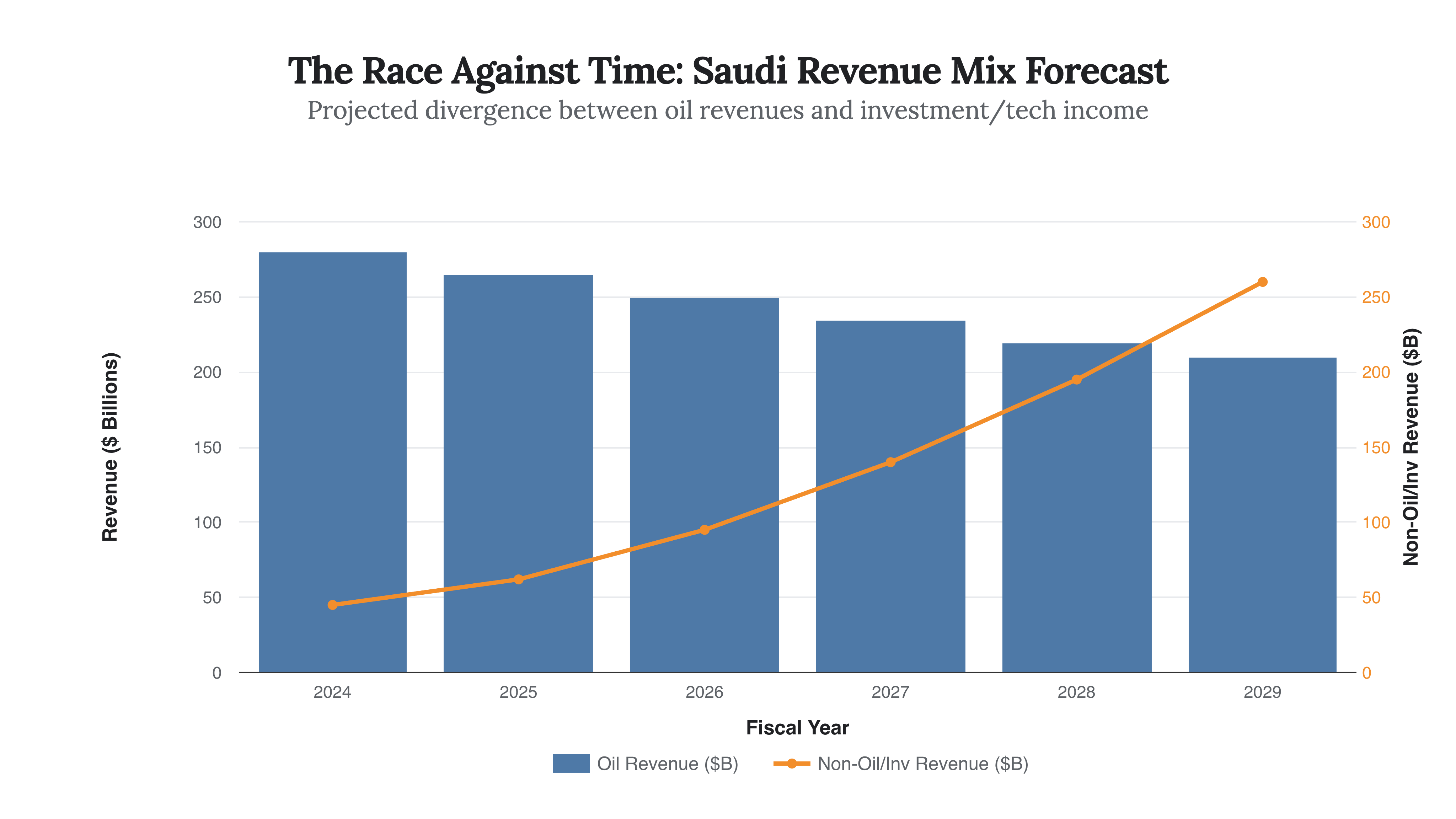
MBS needs this victory. Domestically, the Vision 2030 “giga-projects” have faced skepticism regarding their financial viability and timelines. The $1 trillion commitment to the U.S. might seem contradictory—exporting capital when it is needed at home—but it serves a dual purpose: it generates high-yield returns from U.S. tech growth to subsidize domestic projects, and it locks in the technical partners required to build NEOM.
The chart below illustrates the diverging trajectories of Saudi revenue sources, highlighting why the “Tech Pivot” formalized yesterday is an existential necessity, not a luxury.
Conclusion: The New Binary
The November 18 meeting will be remembered as the moment the Middle East’s operating system was upgraded. President Trump secured a re-industrialization war chest that dwarfs any infrastructure bill, while MBS secured the ultimate regime insurance: the U.S. military’s most advanced hardware and the U.S. tech sector’s most advanced code.
The winners are clear: U.S. defense contractors, Silicon Valley hardware firms, and the House of Saud’s long-term stability. The losers are regional adversaries relying on asymmetric drone warfare and European powers slowly being priced out of the high-end compute game.
“We are not just buying planes; we are buying the future operating system of the region.” — Senior Saudi Official (Background Briefing, Nov 18, 2025)
“This is the biggest repatriation of capital in history. They build here, we protect there. It’s a perfect deal.” — President Donald Trump (Rose Garden Press Conference)
The single most important takeaway is this: Saudi Arabia has successfully converted its diminishing oil dominance into a permanent equity stake in American technological supremacy.