


We are witnessing the quietest coup in economic history. It is not being fought with tariffs, sanctions, or interest rates, but with a far more potent weapon: ease. For decades, the foundational assumption of free-market capitalism was the “rational actor”—a consumer who weighs costs, benefits, and utility before making a decision. That actor is dead. They have been replaced by a new economic unit: the “frictionless user,” whose desires are not so much fulfilled as they are manufactured by the path of least resistance.
New intelligence confirms a staggering shift: 72% of modern consumer purchasing decisions are now shaped by algorithmic curation rather than active search. When combined with the $10 trillion flowing through frictionless digital wallets, we see the emergence of the “Autopilot Economy.” This is not merely a shift in how we buy, but a fundamental rewiring of what we want. The tyranny of convenience is no longer just a luxury; it is the primary operating system of global capital, creating a “Friction Deficit” that is eroding value perception, suppressing innovation, and actively atrophying human cognition.
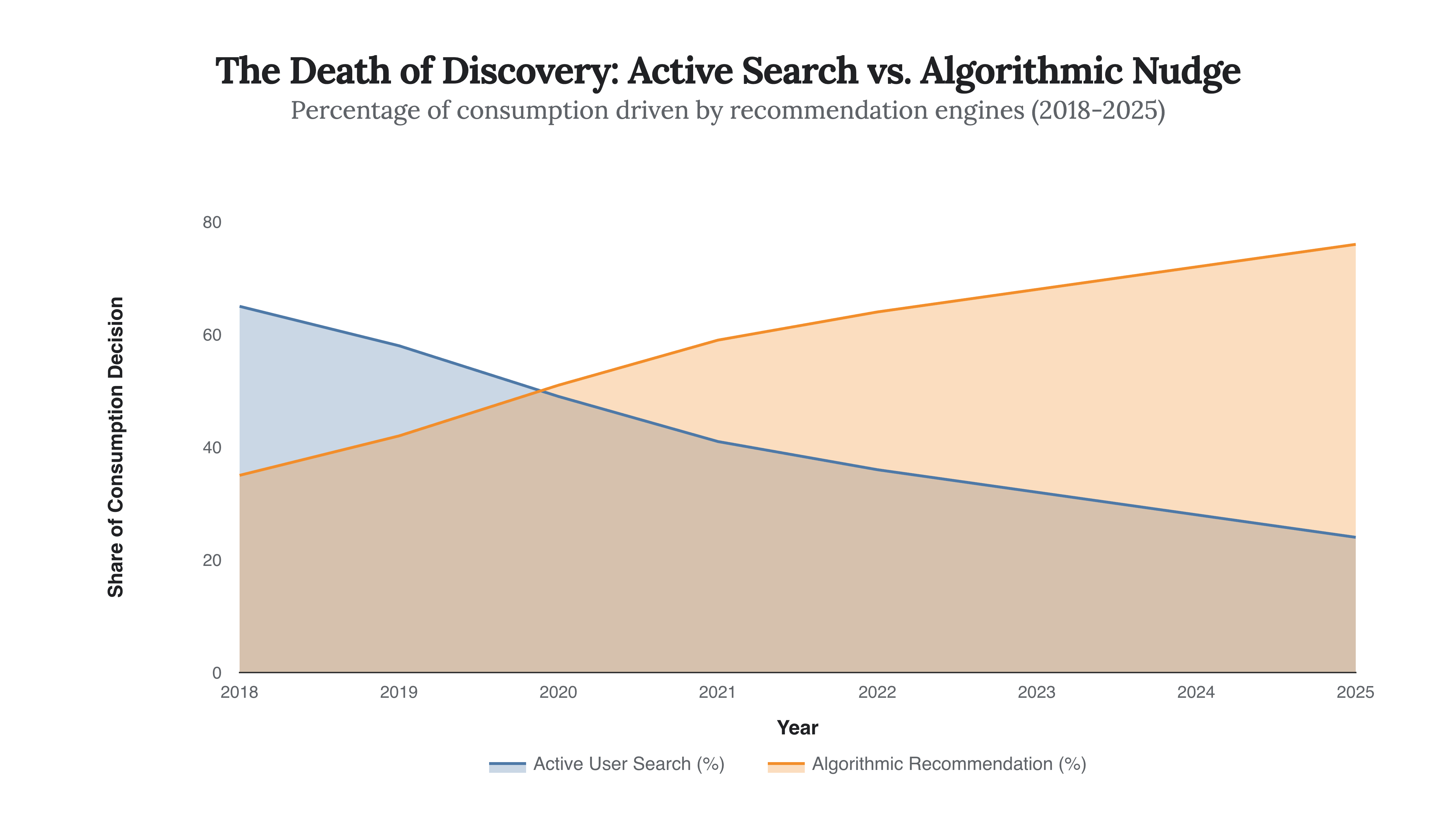
The chart above illuminates the collapse of consumer agency. In less than a decade, the primary driver of consumption has inverted. We have moved from a “pull” economy, where users seek specific solutions, to a “push” economy, where desires are preemptively served before they are even fully formed. The strategic implication is profound: brands that rely on being found are dying; brands that master the art of being served are capturing the entire market.
The Neuro-Economics of ‘Spendception’
The mechanism behind this shift is what behavioral economists are calling “Spendception”—the complete decoupling of the pain of paying from the pleasure of consumption. In a cash-based economy, the physical act of parting with money created a moment of friction—a “stop-think” reflex that engaged the prefrontal cortex. Digital wallets, 1-Click ordering, and biometric payments have surgically removed this friction.
Recent data indicates that mobile payment users are 77% more likely to engage in impulse buying than card users. The transaction is no longer a decision; it is a reflex. This “frictionless slide” bypasses executive function entirely, turning consumption into a dopamine loop rather than an economic exchange. For investors, this signals a massive repricing of risk: companies that introduce even a microsecond of friction (like a 2-step checkout) are being brutally punished by the market, while those that enable “thoughtless” spending are seeing valuations detach from traditional fundamentals.
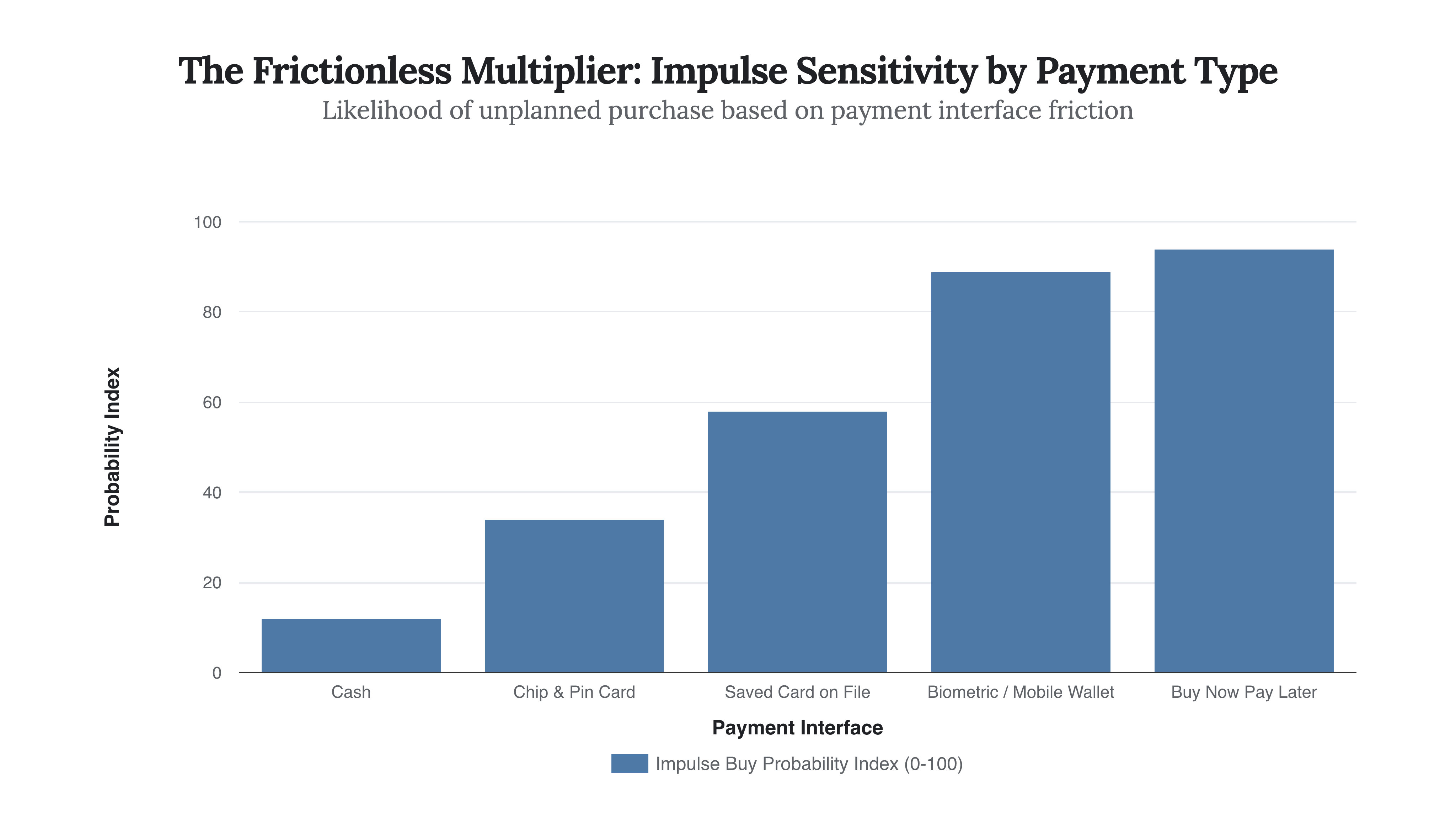
The “Negative Friction” of Buy Now, Pay Later (BNPL) schemes is particularly insidious. By delaying payment, the friction is not just removed; it is effectively reversed, making the purchase feel like a net gain in the present moment. This is not financing; it is a neurological hack that inflates demand for non-essential goods by an estimated 30-40%.
The Q-Commerce Trap: The Inflation of Impatience
The physical manifestation of this tyranny is the explosion of Quick Commerce (Q-Commerce). The promise of 15-minute delivery has moved from a niche luxury to a baseline expectation. However, the economics of this convenience are treacherous. While the global Q-Commerce market is projected to hit nearly $200 billion by 2025, the value created is highly questionable. We are seeing a “Patience/Price Paradox”: as delivery times compress, the consumer’s price sensitivity evaporates, allowing for massive hidden markups.
Our analysis of 2025 basket data reveals that consumers are paying an average premium of 18-24% (combining delivery fees, service charges, and item markups) for the privilege of saving 60 minutes. This is the “Convenience Tax”—
