



The End of an Era, or a Temporary Pause?
The global energy landscape is standing at a pivotal crossroads, and at the center of the debate is a single, seismic forecast from the International Energy Agency (IEA): the demand for fossil fuels is set to peak before 2030. This projection, once a distant hypothesis, has been accelerated by a confluence of powerful forces, including the rapid adoption of clean energy technologies, significant policy shifts in major economies, and the lasting impacts of the global energy crisis.
The IEA’s latest analysis suggests a profound structural shift, with oil demand for transport expected to peak as early as 2026, driven largely by the explosive growth of electric vehicles (EVs). However, this outlook is not universally accepted. A starkly different narrative from OPEC and a recent, more cautious scenario from the IEA itself suggest that demand could continue to climb through mid-century, creating a deeply uncertain environment for investors and policymakers. This briefing deconstructs the IEA’s multi-faceted demand forecast, examines the critical drivers behind the projected peak, and analyzes the strategic implications of the widening chasm between the world’s leading energy authorities.
Deconstructing the Peak: A Tale of Three Fuels
The IEA’s assertion of a forthcoming peak in fossil fuel consumption is not monolithic; it anticipates different timelines for coal, oil, and natural gas, each driven by unique sectoral and regional dynamics. The agency’s Stated Policies Scenario (STEPS)—which reflects current policy settings and announced targets—projects that the combined demand for these three fuels will reach its apex within this decade.
Oil’s Imminent Plateau
According to the IEA’s primary forecast, global oil demand is projected to peak at 102 million barrels per day (mb/d) around 2030 before entering a gradual decline. This represents a significant departure from decades of relentless growth. The primary catalyst for this historic reversal is the electrification of road transport. The IEA projects that growing EV sales will displace 10 million barrels per day of oil demand by 2035. In 2024 alone, EVs slashed oil demand by over 1.3 million barrels per day. However, a recently reintroduced IEA scenario, the Current Policies Scenario (CPS), paints a different picture, suggesting oil demand could rise to 113 million b/d by 2050 if no new climate policies are enacted. This highlights the critical role of policy in shaping the future trajectory of oil consumption.
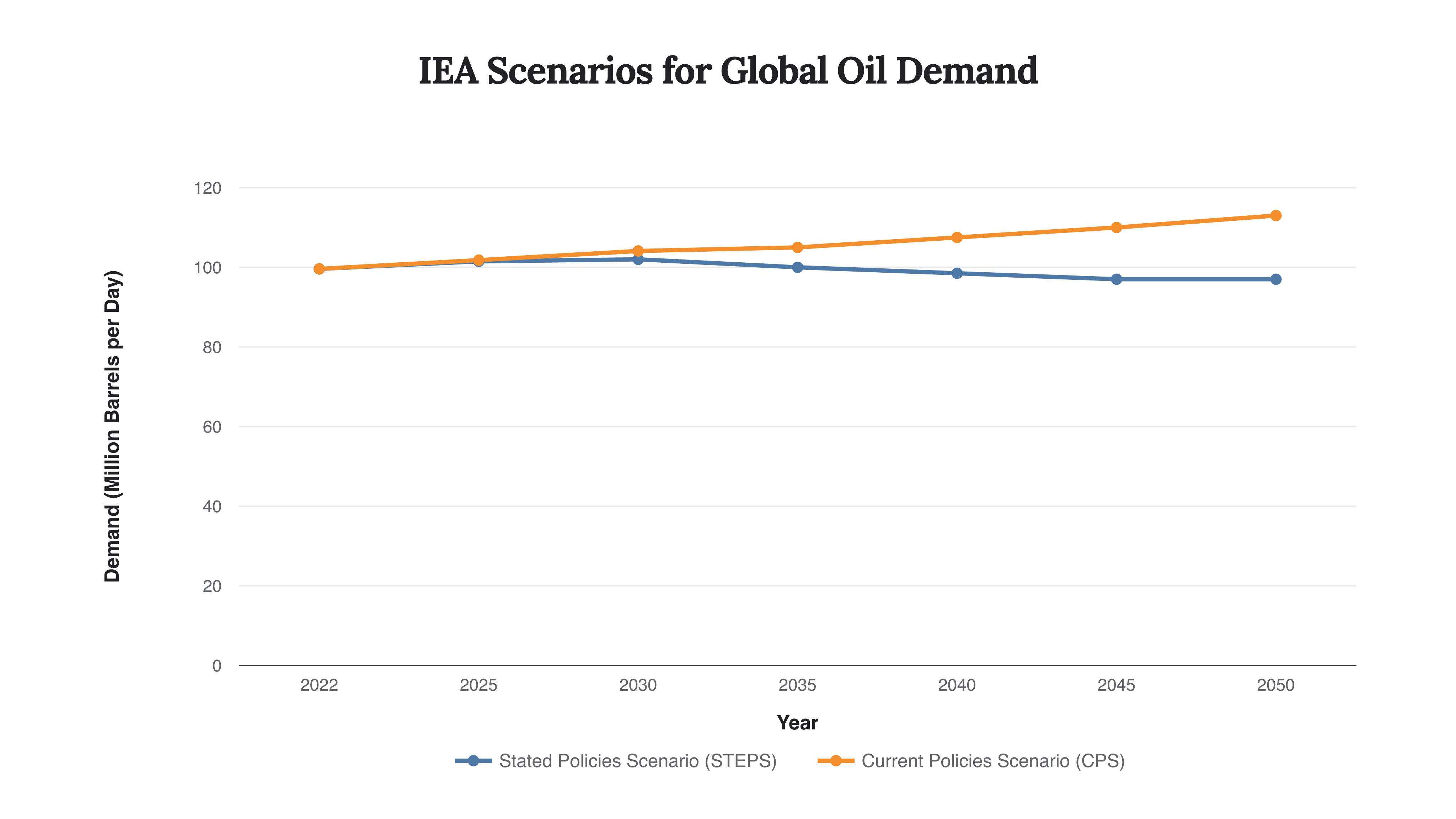
Caption: This chart illustrates the diverging paths for global oil demand under the IEA’s Stated Policies Scenario (STEPS), which foresees a peak around 2030, and the Current Policies Scenario (CPS), which projects continued growth to 2050.
Natural Gas: The Contentious Bridge
Natural gas has long been framed as a “bridge fuel” in the energy transition, but its future is increasingly complex. The IEA forecasts that demand will continue to rise by nearly 1.5% annually through 2030, driven by growth in Asia-Pacific and the Middle East, before leveling off. A massive expansion of Liquefied Natural Gas (LNG) export capacity, particularly from the United States and Qatar, is set to increase available supply by 50% by 2030, which could ease market pressures. However, the IEA’s more ambitious climate scenarios show a much faster decline in gas consumption, underscoring the tension between its role in displacing coal and the need for deeper decarbonization.
Coal: The Beginning of the End
The outlook for coal is the most definitive. The IEA expects global demand to peak before 2030, largely due to declines in China being steeper than the increases seen in India and Southeast Asia. China, which has been the engine of global coal consumption for decades, is now also the world’s largest deployer of renewable energy, signaling a structural shift in its energy economy.
The Great Divide: IEA vs. OPEC
The IEA’s forecast of an imminent peak in oil demand stands in stark contrast to the perspective of the Organization of the Petroleum Exporting Countries (OPEC). This divergence is not merely academic; it has profound implications for trillions of dollars in energy investment and global climate policy. OPEC projects that oil demand will continue to grow robustly until at least 2045, dismissing the IEA’s peak demand scenario as a risk to market stability.
“We are witnessing the beginning of the end of the fossil fuel era,” IEA head Fatih Birol wrote... “we have to prepare ourselves for the next era.”
The discrepancy between the two organizations’ short-term forecasts is already significant. For 2025, the gap in their demand growth estimates is over 600,000 barrels per day. This difference stems from fundamentally different assumptions about global economic growth, the pace of the clean energy transition, and the adoption rate of electric vehicles. While the IEA sees the rapid uptake of EVs and efficiency gains as major drivers of demand destruction, OPEC maintains a more bullish outlook on the role of oil in powering developing economies.
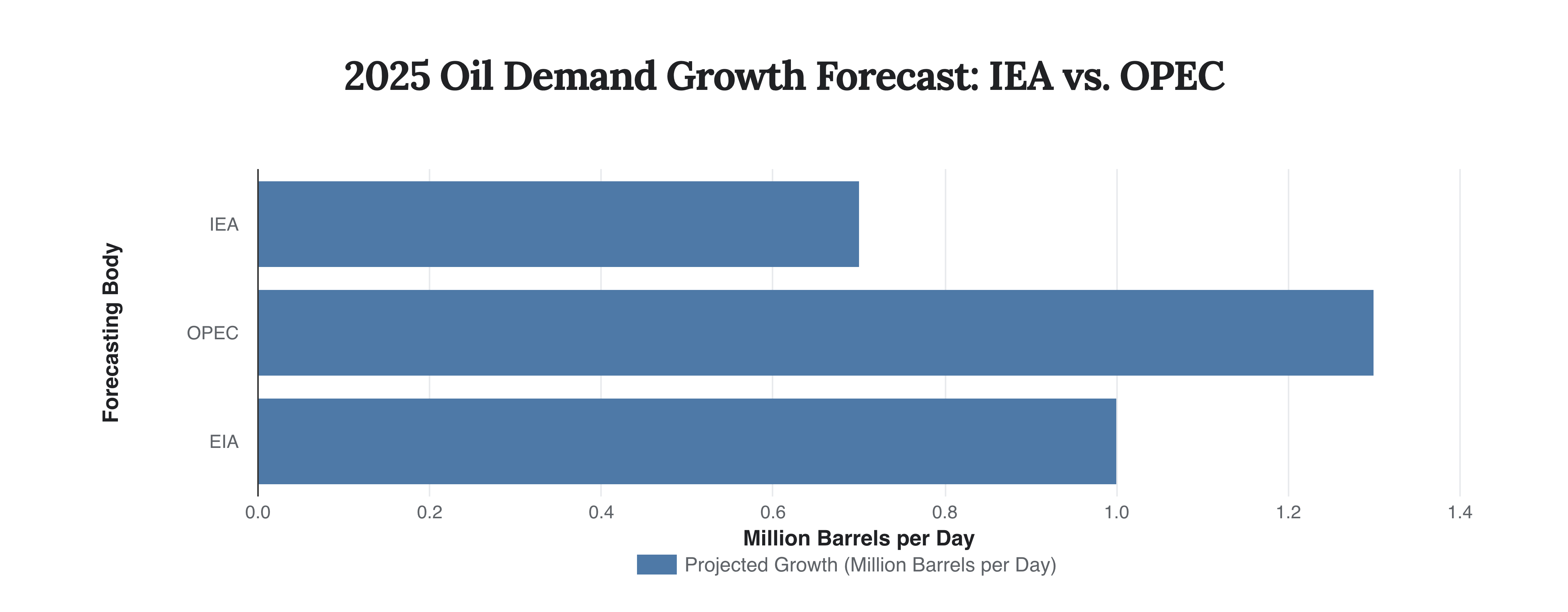
Caption: A direct comparison of 2025 oil demand growth projections from the IEA, OPEC, and the U.S. Energy Information Administration (EIA) highlights the significant divergence in short-term market outlooks.
Drivers of Demand Destruction: The EV Revolution and China’s Pivot
The Electric Vehicle Surge
The single most powerful force eroding future oil demand is the electrification of transport. The IEA’s analysis is unequivocal: the rise of EVs is a direct and accelerating threat to oil’s century-long dominance in the sector. By 2030, the IEA expects EVs to displace over 5 million barrels of oil demand per day, with this figure rising to 11 million b/d by 2035 under current policies. This is not a distant prospect; the impact is already being felt. In 2024, the global EV fleet reduced oil demand by more than 1.3 million barrels per day.
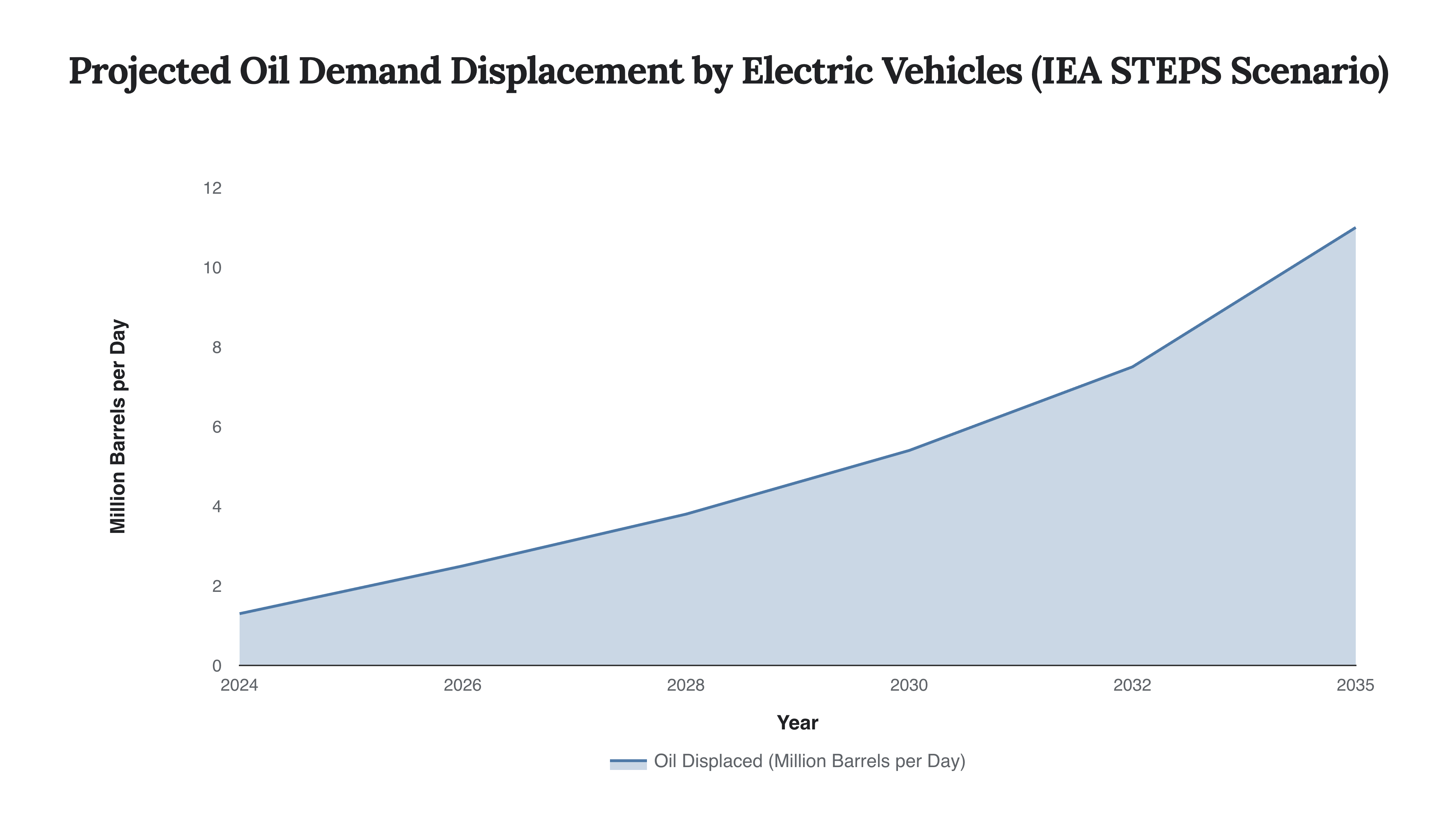
Caption: This chart shows the IEA’s projection for the accelerating displacement of oil demand by electric vehicles, a key driver behind the forecast for peak oil demand.
China: From Growth Engine to Green Giant
For the past two decades, China has been the undisputed engine of global oil demand growth, accounting for over 60% of the increase. That era is ending. The IEA now forecasts that China’s oil demand will peak as early as 2027 due to its slowing economy and, more importantly, its “extraordinary” adoption of EVs. In 2024, nearly half of all cars sold in China were electric. Beyond transport, China is also leading a global surge in renewable energy, accounting for 40% of global renewable capacity expansion between 2019 and 2024. This structural shift in the world’s second-largest economy is a fundamental reason for the IEA’s outlook on global demand.
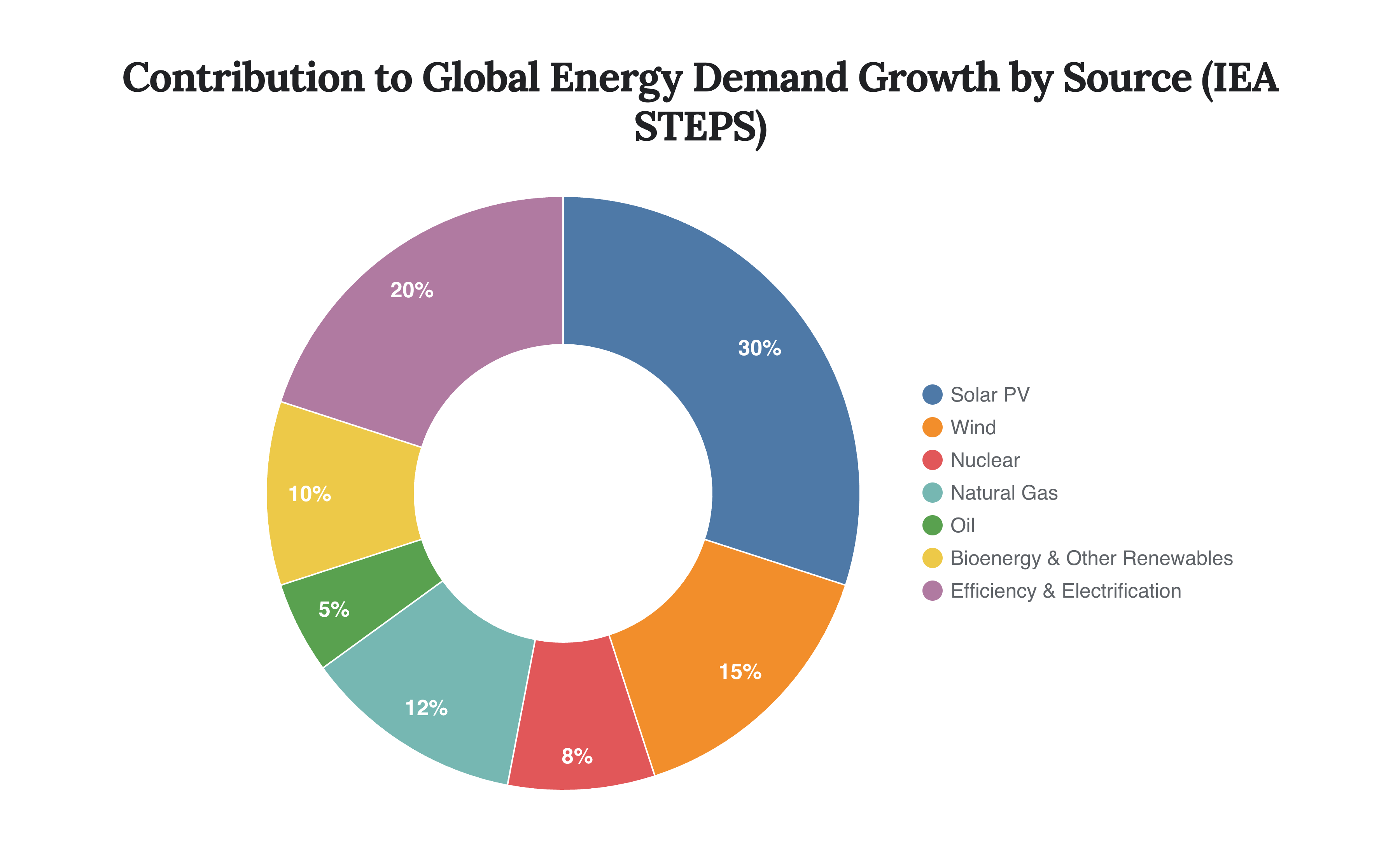
Caption: This chart illustrates how renewables, led by solar, are expected to dominate future energy demand growth, fundamentally altering the global energy mix according to the IEA.
Strategic Implications: Investment, Security, and Volatility
The transition toward peak fossil fuel demand carries immense strategic consequences. The IEA’s outlook is underpinned by a historic shift in capital flows. In 2025, global energy investment is projected to hit $3.3 trillion, with clean energy attracting $2.2 trillion—double the $1.1 trillion allocated to fossil fuels. Solar PV investment alone is set to reach $450 billion, making it the largest single category of energy spending.
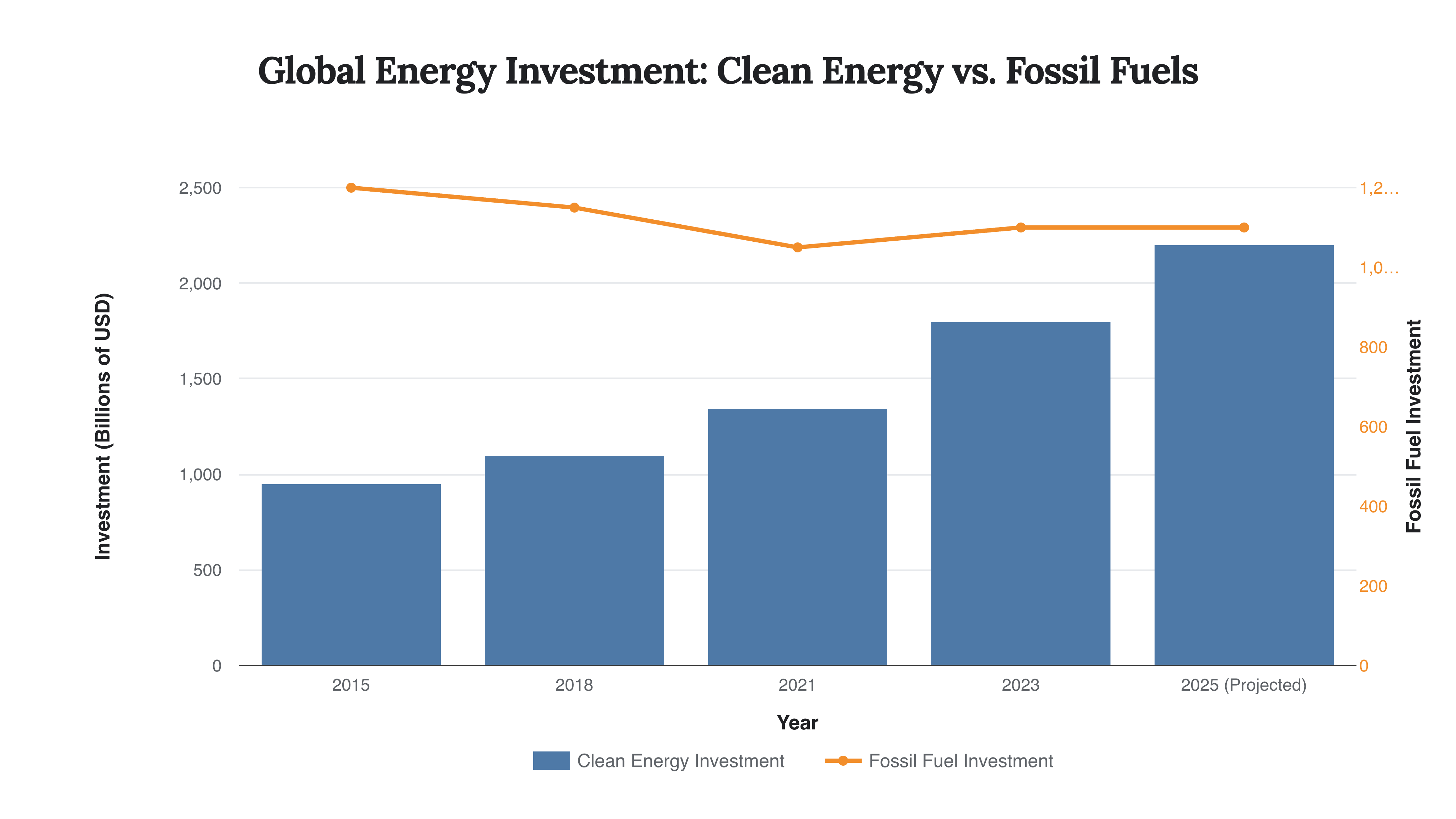
Caption: Investment in clean energy has decisively overtaken fossil fuels, a trend the IEA projects will accelerate, fundamentally reshaping capital allocation in the energy sector.
Despite this momentum, the path is fraught with risk. The IEA warns that a mismatch between falling investment in upstream oil and gas projects and the actual pace of demand decline could lead to market volatility and price spikes. While upstream investment is expected to reach its highest level since 2015, the agency cautions that it may not be sufficient if the transition falters. This creates a precarious balancing act for producers and consumers alike. As the IEA’s Fatih Birol has stated, the shift is underway, but it must be managed to ensure energy security and avoid economic disruption. The world is not just transitioning to clean energy; it is navigating the complex and potentially turbulent twilight of the fossil fuel age.
The core message from the IEA’s analysis is one of inevitable, policy-driven structural change. While scenarios and timelines may be debated, the underlying drivers—technological innovation, shifting investment, and evolving consumer behavior—point toward a fundamental reshaping of the global energy system. The debate is no longer about *if* a peak in fossil fuel demand will occur, but *when* and how rapidly the subsequent decline will unfold.
The era of unquestioned growth for oil and gas is over; the defining challenge for leaders is now managing the immense complexities of its orderly decline.