



In the world of economics, the Gini coefficient is the gold standard for measuring income inequality within a nation. A score of 0 represents perfect equality, while a 1 signifies absolute inequality where one person holds all the wealth. The United States, with its much-debated wealth gap, has a Gini coefficient of around 0.41. Now, consider the digital economy of attention and attraction on Tinder. According to a landmark analysis that treated ‘likes’ as currency, the Gini coefficient for the heterosexual market on the platform is a staggering 0.58. This figure reveals an ecosystem with more inequality than 95% of the world’s countries, placing it in the same stratum as nations with the most severe wealth disparities on Earth. This isn’t merely a curiosity of modern dating; it’s a systemic market failure with profound social, psychological, and economic consequences. The feeling of inequality on dating apps isn’t just a feeling—it’s a quantifiable reality, engineered by a combination of human nature and algorithmic architecture that has created a brutal, winner-take-all marketplace for intimacy.
The Architecture of Inequality: How Swiping Built a Hyper-Concentrated Market
The extreme inequality on platforms like Tinder wasn’t an accident; it’s an emergent property of its core design. The confluence of a gamified interface, algorithmic sorting, and an overemphasis on a narrow set of visual cues has fundamentally reshaped the dynamics of mate selection, moving from nuanced, real-world interactions to a rapid, data-driven tournament.
The Paradox of Abundance and the Gamified Interface
Traditional dating was constrained by geography, social circles, and time, creating natural friction that limited the scale of comparison. Dating apps obliterated these constraints, presenting users with a seemingly infinite catalog of potential partners. This ‘paradox of choice’ often leads to decision paralysis and heightened pickiness. The swipe mechanism—simple, addictive, and patented by Tinder—transforms this process into a high-volume, low-stakes game. Users, particularly men who make up roughly 75% of the user base, often adopt a low-cost, high-volume strategy of swiping right on a large number of profiles, creating a deluge of attention for a small subset of female users. This dynamic is the foundational layer of the attention disparity, where the perceived abundance of options incentivizes users to focus only on what they perceive as the absolute best.
Algorithmic Sorting: The Unseen Hand of the Digital Caste System
Behind the simple interface lies a complex sorting mechanism. While Tinder has moved away from its controversial ‘ELO score’ (a desirability ranking system modeled after chess rankings), its current algorithms still perform a similar function: they sort and rank users to optimize engagement. As assistant professor Apryl Williams notes, “The dating apps are only giving us what they think we want, and that’s the problem.” These systems learn from user behavior, creating feedback loops that amplify initial biases. Profiles that receive a high number of right swipes are shown more frequently, accumulating more ‘likes’ and gaining further visibility. Conversely, profiles that fall below a certain threshold of engagement are deprioritized, becoming functionally invisible. This creates a digital caste system where the ‘algorithmically desirable’ are perpetually promoted, while the majority are left in the digital shadows.
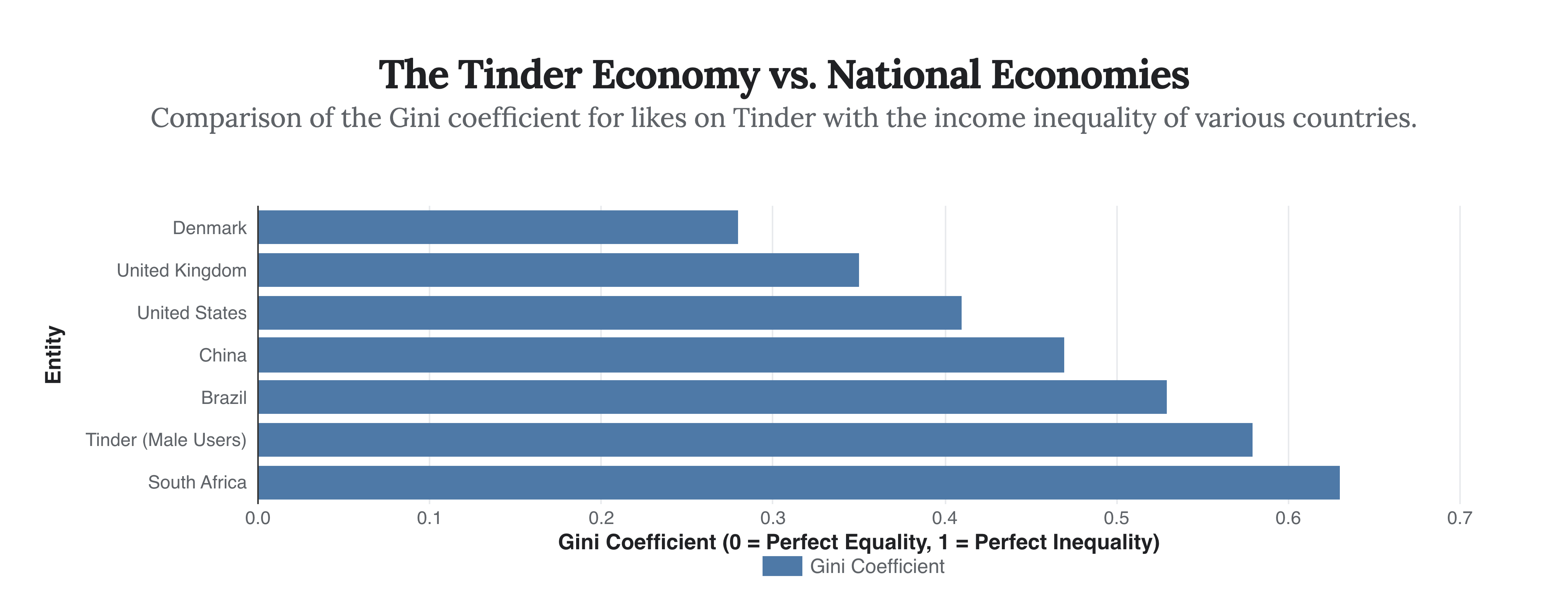
Quantifying the Great Divide: The Data Behind the Dating Experience
The macroeconomic view provided by the Gini coefficient is reflected in the vastly different microeconomic realities of its users. The data reveals two distinct, almost non-overlapping experiences on the platform, largely delineated by gender, which fuels the widespread feeling of frustration and futility.
